Heritage Kashmir · North India
Kashmiri Saffron in Uttar Pradesh
- केसरkesar · Hindi
- زعفرانzafran · Urdu
The short answer
Uttar Pradesh is India's largest saffron-consuming state by sheer population, and its two traditions pull in different directions: the Awadhi kitchen uses zafran heavily in biryani, korma and zarda, while the Braj and Kashi temple economies use kesar for prasad and tilak. Real Kashmiri Mongra costs ₹330–360 a gram direct from Pampore; Lucknow's Chowk and Aminabad, Kanpur's Naveen Market and Varanasi's Vishwanath Gali price it anywhere from ₹400 to ₹900, with quality that varies more within a single street than between cities. The state's specific problem is scale — with this much demand, adulterated stock has a very large market to disappear into.
Chowk, Naveen Market, Vishwanath Gali — and what to ask
Lucknow's Chowk is the most knowledgeable saffron market in the state, because Awadhi cooking actually depends on the spice and the shops there deal with people who can tell. If you are buying in person in UP, this is the place — but even in Chowk the default sale is loose weight from a tin, and the default origin claim is Kashmir regardless of what is in the tin. Ask the harvest year. A shop that knows will answer immediately.
Kanpur, Prayagraj, Meerut and Gorakhpur run on Delhi supply with an extra margin. Varanasi's Vishwanath Gali is pilgrim retail and behaves like Haridwar's — small packets, high prices, a lot of safflower sold as kesar to people who will not be back.
Agra's petha and dry-fruit trade around Sadar Bazaar sells saffron largely as a gifting add-on, and the Taj-adjacent shops sell it to tourists at whatever the tourist will pay. Noida and Ghaziabad price as Delhi NCR does.
Across all of it, the honest comparison is not shop-versus-shop. It is loose-and-unlabelled versus sealed-with-a-batch-code. UP has plenty of shops selling real saffron; almost none of them can tell you which field it came from.
- Chowk, Lucknow is the state's best in-person market — still ask the harvest year.
- Vishwanath Gali and Taj-adjacent Agra are tourist retail: assume the worst, test at home.
- Awadhi cooking uses saffron in grams per month, so origin pricing pays back fast.
- Zarda and biryani need aroma, not just colour — which is precisely what the cheap stock lacks.
Zafran in the Awadhi kitchen, kesar in the Kashi temple
Awadhi cooking is where Indian saffron use is most technically serious. Lucknowi biryani takes saffron steeped in warm milk, poured over the rice at the dum stage under a sealed lid — never fried, never boiled. Shahi korma, murgh musallam and the whole zafrani family carry it. Zarda, the sweet saffron-and-nut rice served at weddings and at Eid, is named for the colour and gets it from saffron in a proper kitchen and from food colour in a cheap one. Sheer khurma at Eid takes a few threads in the milk.
Varanasi has one saffron dish nowhere else does properly: malaiyo, the winter foam of milk whipped under open December dew, dusted with saffron and pistachio and sold in kulhads on Kashi's ghats between November and February. It is one of the few genuinely seasonal saffron uses in India — the dish physically cannot be made once the dew stops.
Mathura and Vrindavan use kesar in peda and in Krishna bhog through Janmashtami; Ayodhya and Kashi in prasad and tilak; and the whole state in kheer at every festival that calls for it.
- Lucknowi biryani and korma — saffron steeped in warm milk, added at dum.
- Zarda and sheer khurma at weddings and Eid.
- Banarasi malaiyo, November to February — saffron dusted over dew-whipped milk foam.
- Mathura peda and Janmashtami bhog; Kashi and Ayodhya prasad and tilak.
Delivery to Uttar Pradesh
Noida, Ghaziabad and Meerut ride the Delhi NCR lane at 3–5 business days after dispatch. Lucknow, Kanpur, Agra and Prayagraj typically arrive 4–7; Varanasi, Gorakhpur, Bareilly and the eastern districts 5–8. We dispatch within 24–48 hours of a confirmed prepaid order, sealed and batch-coded, with DTDC tracking by email.
We deliver across
- Lucknow
- Kanpur
- Varanasi
- Agra
- Prayagraj
- Noida
- Ghaziabad
- Meerut
- Gorakhpur
Every serviceable PIN code in Uttar Pradesh — not only the cities listed. DTDC Express is ?60 for 7-day delivery, and DTDC Airmax is ?120 for faster air delivery.
Saffron in Uttar Pradesh — common questions
- What is the price of 1 gram kesar in Lucknow?
- Chowk and Aminabad shops price Kashmiri-labelled Grade 1 saffron at roughly ₹450–900 per gram depending on the shop and how the sale goes. Direct from a Pampore grower family, ISO 3632 Grade I Mongra is ₹330–360 per gram, sealed, batch-coded, with the harvest year on the jar. Below ₹300 a gram anywhere, you are buying Iranian repack, Lachha weight, or dye.
- How much zafran goes into biryani for 1 kg of rice?
- A generous pinch — about 20 threads, roughly 0.2 grams — for 1 kg of raw rice. Crush the threads, steep them in three tablespoons of warm milk for fifteen minutes, and drizzle that over the top layer of rice just before you seal the pot for dum. Never fry saffron in the hot ghee with the whole spices: it scorches in seconds and turns bitter, and the aroma you paid for goes up with the steam.
- Is the saffron in Vishwanath Gali, Varanasi genuine?
- Much of it is not. Pilgrim retail around the Kashi Vishwanath corridor sells a great deal of safflower and dyed thread as kesar, at saffron prices, to visitors buying a small packet for puja. Test whatever you buy: three threads in warm water should give slow deepening gold over ten minutes with the threads staying whole and red. Instant red water, or a petal that goes limp and pale, means it is not Crocus sativus.
- Which saffron is used in Banarasi malaiyo?
- A small amount of good Kashmiri saffron, and it is dusted or steeped in a spoonful of warm milk rather than cooked — malaiyo is milk foam whipped under open dew overnight and never heated again, so the saffron is there for aroma and for the gold flecks on top. Because the dish carries so little else, poor saffron is immediately obvious in it. This is one of the few places where a cook can genuinely tell the grades apart by nose.
- Do you deliver saffron to small towns in Uttar Pradesh?
- Yes — every serviceable PIN code in the state, not only the metros. District towns and smaller centres typically add a day or two over the city lanes, so figure 5–8 business days after dispatch for eastern UP and the smaller towns against 4–7 for Lucknow, Kanpur and Agra. We ship prepaid only, sealed, with DTDC tracking emailed when the parcel leaves Pampore.
- Kesar aur zafran mein kya antar hai?
- Koi antar nahin — dono ek hi cheez hain. 'Kesar' Sanskrit se aaya hai aur Hindi mein chalta hai; 'zafran' Farsi aur Arabi se aaya hai aur Urdu aur Awadhi tehzeeb mein chalta hai. Dono ka matlab hai Crocus sativus phool ke sookhe laal reshe. Farq naam mein hai, cheez mein nahin — asli sawaal grade ka hai: ISO 3632 Category I, poora laal Mongra, aur ek origin jiska koi naam le sake.
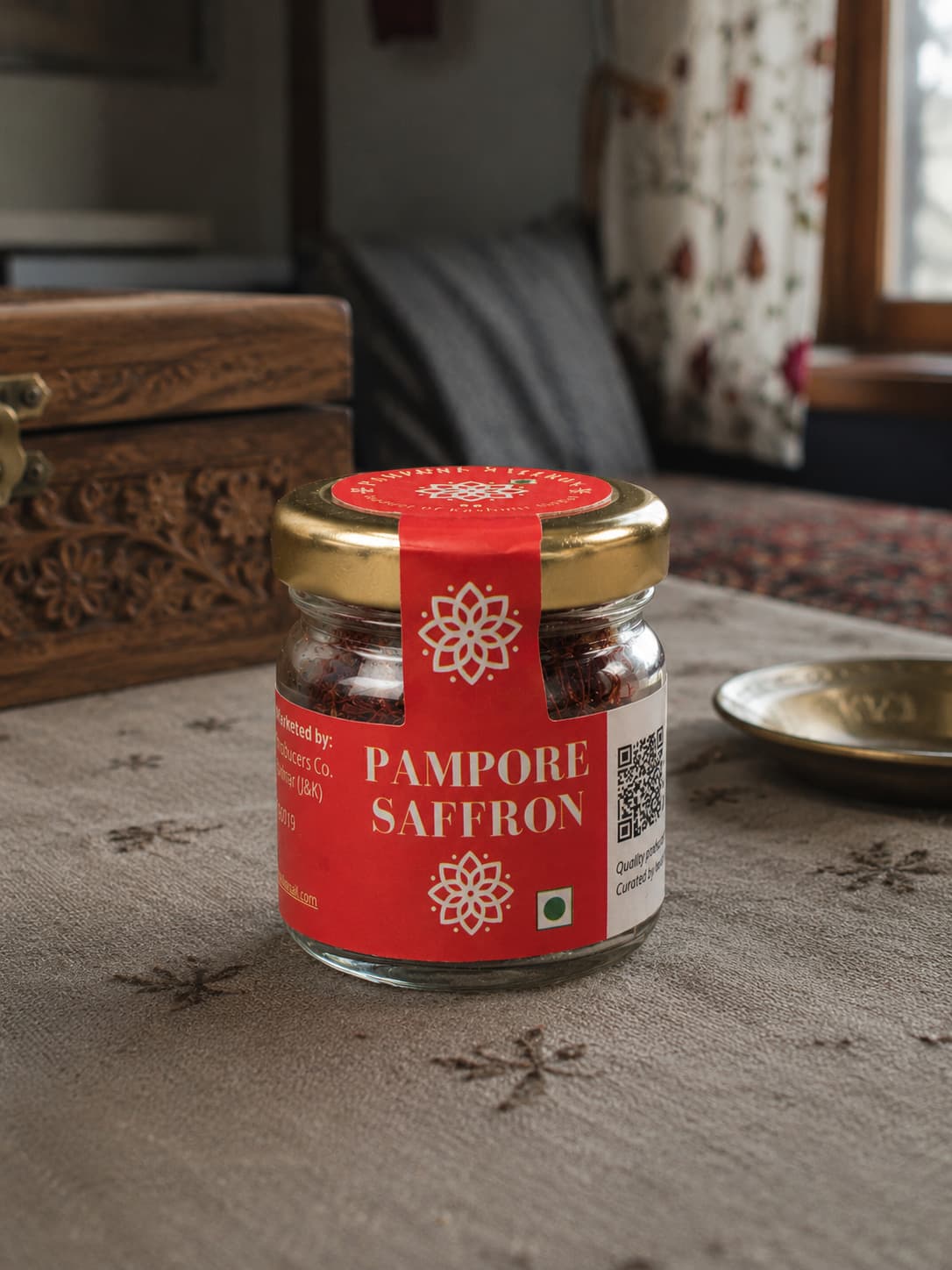
We grow and hand-sort this saffron ourselves in Pampore, seal it there in tamper-evident glass, and ship it prepaid to Uttar Pradesh. One hop, no repacking, a batch code on the jar.
Also shipping to Uttar Pradesh: Kashmiri kehwa — the winter cup.
Pampore Saffron FPO, J&K · FSSAI 11022470000019
Also in North India