Heritage Kashmir · North India
Kashmiri Saffron in Himachal Pradesh
- केसरkesar · Hindi/Pahari
The short answer
Himachal is one of the few Indian states where saffron is not purely an import: trial cultivation in Lahaul, Kinnaur and parts of Chamba has produced small Himachali crops, and the state agricultural universities have run corm programmes for years. Volumes remain tiny, so almost all saffron sold in Shimla, Dharamshala or Manali is still Kashmiri or Iranian — priced at ₹500–800 a gram in hill-station tourist shops against ₹330–360 direct from a Pampore grower. The Himachal-specific risk is the same one Kashmir has: a hill-station shop selling to holidaymakers has no repeat-custom incentive to be honest about origin.
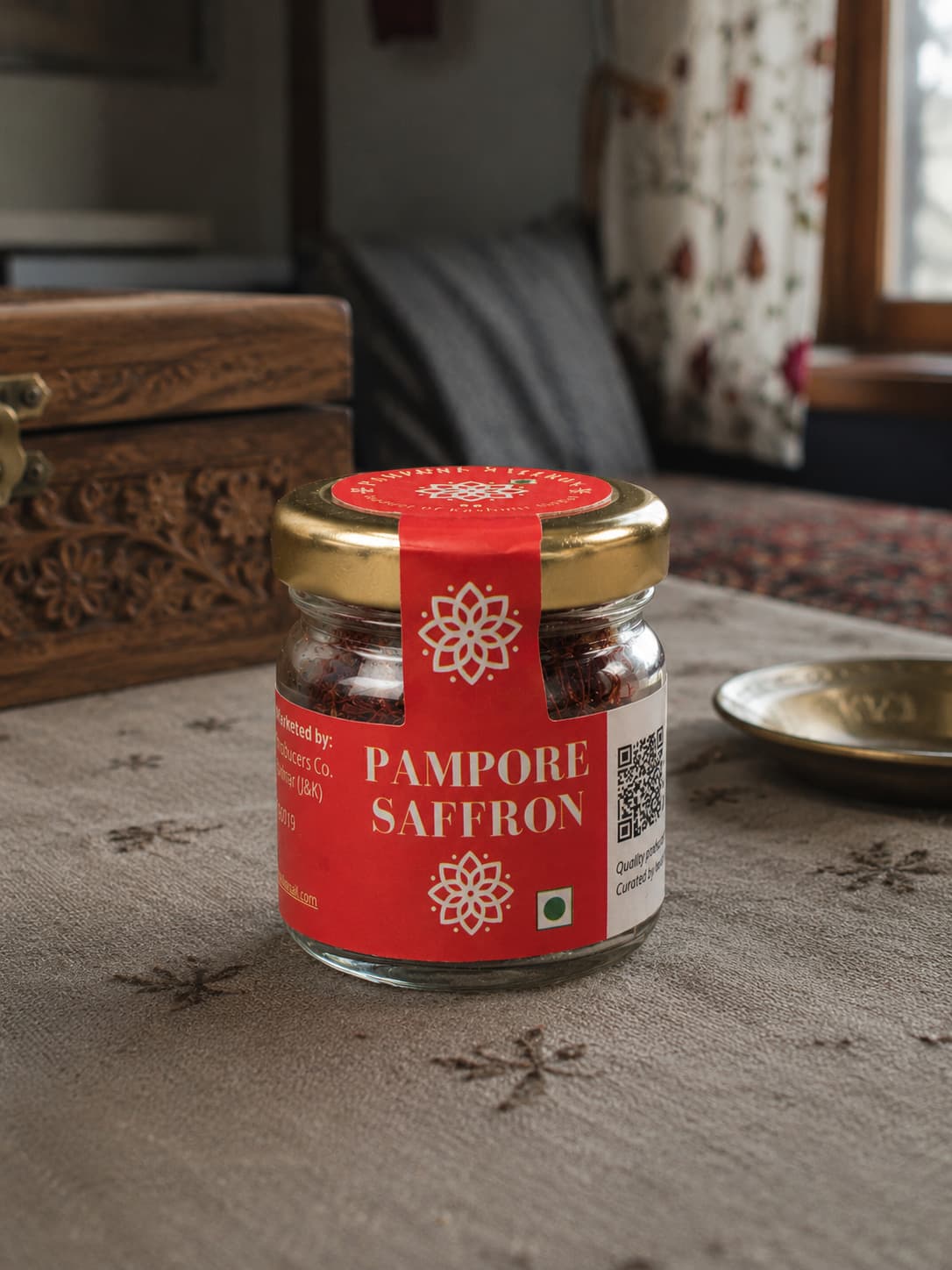
Hill-station retail and the Himachali crop
Mall Road in Shimla, McLeod Ganj in Dharamshala and the Manali market all sell saffron to people on holiday, in small quantities, at high prices, with 'Kashmiri' on the label and nothing behind it. This is not a Himachal problem specifically — it is what tourist retail does everywhere — but it is worth naming because Himachali buyers often assume the hill markets are closer to source than the plains. They are not. Chandigarh and Delhi wholesalers supply them.
The Himachali crop is a real and genuinely interesting thing, and we would rather point at it honestly than pretend it does not exist. Saffron has been grown experimentally in Lahaul-Spiti, Kinnaur and Chamba, and the agro-climatic case is sound: high altitude, dry autumn, cold winter. Yields so far are small and mostly absorbed locally or by research programmes. If you can buy a documented Himachali crop from the grower, that is a good purchase. What you should not accept is a Shimla shop implying that its Iranian stock is local because the shop happens to be in the hills.
For Kangra, Una, Bilaspur and the lower belt, availability of any credible Grade 1 is thin and the practical answer is to order sealed from source. Hill delivery takes a little longer and is entirely reliable to the district towns.
- Mall Road and McLeod Ganj saffron is plains stock at holiday prices.
- Himachali saffron from Lahaul, Kinnaur or Chamba exists but is small-volume — ask for documentation, not a story.
- Kashmiri Mongra is all-red, short and thick with a flared tip; Iranian threads are longer and thinner.
- The upper valleys close in winter — order gifts well before the snow.
Saffron in Himachali food and ritual
The dish to know is mittha — the sweet saffron rice served as part of the Himachali dham, the formal community meal cooked by botis in a temple courtyard or a village yard. Mittha is rice, sugar, ghee, raisins and saffron, and it is served near the end of the dham on a leaf plate. A dham for two hundred people is one of the few places in India where saffron is used communally rather than by the pinch.
Beyond the dham, Himachal's saffron use is temple-led. Kesar tilak at the shakti-peeth temples — Jwalamukhi, Chintpurni, Naina Devi, Baijnath — and saffron in the prasad at the larger shrines. The Tibetan Buddhist community around Dharamshala uses saffron water in ritual washing and in offerings, which is a distinct tradition with its own supply chain.
In the home, kesar doodh does the winter work here as it does everywhere north of the Vindhyas, and Himachal has more winter to get through than most.
- Mittha at a dham — saffron rice, cooked at community scale.
- Kesar tilak and prasad at the Himachali shakti-peeths.
- Tibetan Buddhist ritual use around Dharamshala and Bir.
- Kesar doodh across a long hill winter — 3–4 threads a glass.
Delivery to Himachal Pradesh
Himachal is a hill lane and honest about it: Shimla, Solan, Una, Bilaspur, Mandi and Dharamshala typically arrive 5–8 business days after dispatch, and Kullu, Manali, Chamba and the upper valleys can take longer in winter when passes and roads are affected. We dispatch within 24–48 hours of a confirmed prepaid order and email you DTDC tracking; if you are ordering for a specific date, order early.
We deliver across
- Shimla
- Dharamshala
- Mandi
- Solan
- Kullu
- Manali
- Una
- Bilaspur
Every serviceable PIN code in Himachal Pradesh — not only the cities listed. DTDC Express is ?60 for 7-day delivery, and DTDC Airmax is ?120 for faster air delivery.
Saffron in Himachal Pradesh — common questions
- Is saffron grown in Himachal Pradesh?
- In small quantities, yes. Trial and small-scale cultivation has been carried out in Lahaul-Spiti, Kinnaur and parts of Chamba, supported by state agricultural universities and corm-distribution programmes, and the high-altitude dry-autumn climate genuinely suits Crocus sativus. But the volumes are nowhere near commercial supply, so the saffron actually on sale in Shimla, Manali or Dharamshala is overwhelmingly Kashmiri or Iranian. Treat 'local Himachali saffron' as a claim that needs documentation.
- How much does saffron cost in Shimla or Manali?
- Hill-station shops price Kashmiri-labelled saffron at roughly ₹500–800 a gram, and Mall Road and Manali market rates run at the top of that because they are selling to holidaymakers. The same ISO 3632 Grade I Mongra is ₹330–360 a gram direct from a Pampore grower family, delivered sealed to a Himachal address. You are paying tourist retail for the convenience of carrying it home in your bag.
- How much saffron goes into mittha for a dham?
- For a dham-scale mittha feeding around 100 people — roughly 8–10 kg of rice — about 2 to 3 grams of saffron is generous and plenty. Steep it crushed in half a cup of warm milk or warm water for twenty minutes and fold that in when the rice is nearly done, off the direct heat. Adding dry threads into hot ghee at the start, which is the shortcut, burns them.
- Do you deliver to Kullu, Manali and Lahaul?
- Yes, to every serviceable PIN code, but be realistic about the timing. Kullu and Manali typically run 6–9 business days after dispatch, and Lahaul-Spiti, Kinnaur and Pangi are seasonal — winter road closures can extend that substantially or make delivery impossible until the passes reopen. For a gift with a date attached, order two to three weeks ahead.
- How can I tell Kashmiri saffron from Iranian saffron?
- Look at the thread. Kashmiri Mongra is short, thick, uniformly dark red, and flares into a small trumpet at the tip. Iranian saffron — genuine, good saffron — runs longer and thinner and often carries a paler shade. Kashmiri also has a heavier, more honeyed aroma against Iran's sharper, more medicinal note. In water, both bleed gold slowly; dyed imitation bleeds red immediately. The difference is origin and price, not real versus fake — the fraud is only ever in the labelling.
- Does saffron spoil in a cold, damp hill climate?
- Damp is the real enemy, not cold. Saffron is hygroscopic — it pulls moisture out of the air, gains weight, clumps, and eventually loses aroma. In Shimla, Dharamshala or Manali, where monsoon humidity is high and homes are cold, keep the jar tightly closed in a dark cupboard, never in the fridge, and never open it in a steamy kitchen. Take out what you need quickly and shut it again. Kept dry and dark, it holds two to three years.
We grow and hand-sort this saffron ourselves in Pampore, seal it there in tamper-evident glass, and ship it prepaid to Himachal Pradesh. One hop, no repacking, a batch code on the jar.
Also shipping to Himachal Pradesh: Kashmiri kehwa — the winter cup.
Pampore Saffron FPO, J&K · FSSAI 11022470000019
Also in North India