Heritage Kashmir · North India
Kashmiri Saffron in Delhi
- केसरkesar · Hindi
- زعفرانzafran · Urdu
The short answer
In Delhi, real Kashmiri Mongra saffron sells for roughly ₹330–360 a gram bought direct from a Pampore grower family, against ₹500–900 a gram at a Karol Bagh or South Delhi dry-fruit counter for the same grade. The kesar sold loose by weight in Khari Baoli at ₹150–250 a gram is almost never Kashmiri Grade 1 — at that price it is Iranian bulk stock repacked, Lachha (threads with the yellow style still attached, so you pay for weight that carries no colour), or dyed corn silk. Delhi has no saffron of its own; every gram in the city arrived from somewhere else, so the only question worth asking a seller is which harvest and which village, and whether they can name it.
What Delhi actually buys, and where it goes wrong
Khari Baoli, behind Fatehpuri Masjid, is Asia's largest wholesale spice market and it is where most saffron sold anywhere in Delhi enters the city. That is exactly why it is a difficult place to buy a gram. The market runs on volume and on trust between traders who have dealt with each other for decades; a walk-in retail customer buying two grams is at the very end of that chain, and the tin the shopkeeper scoops from has changed hands three or four times since it left a farm.
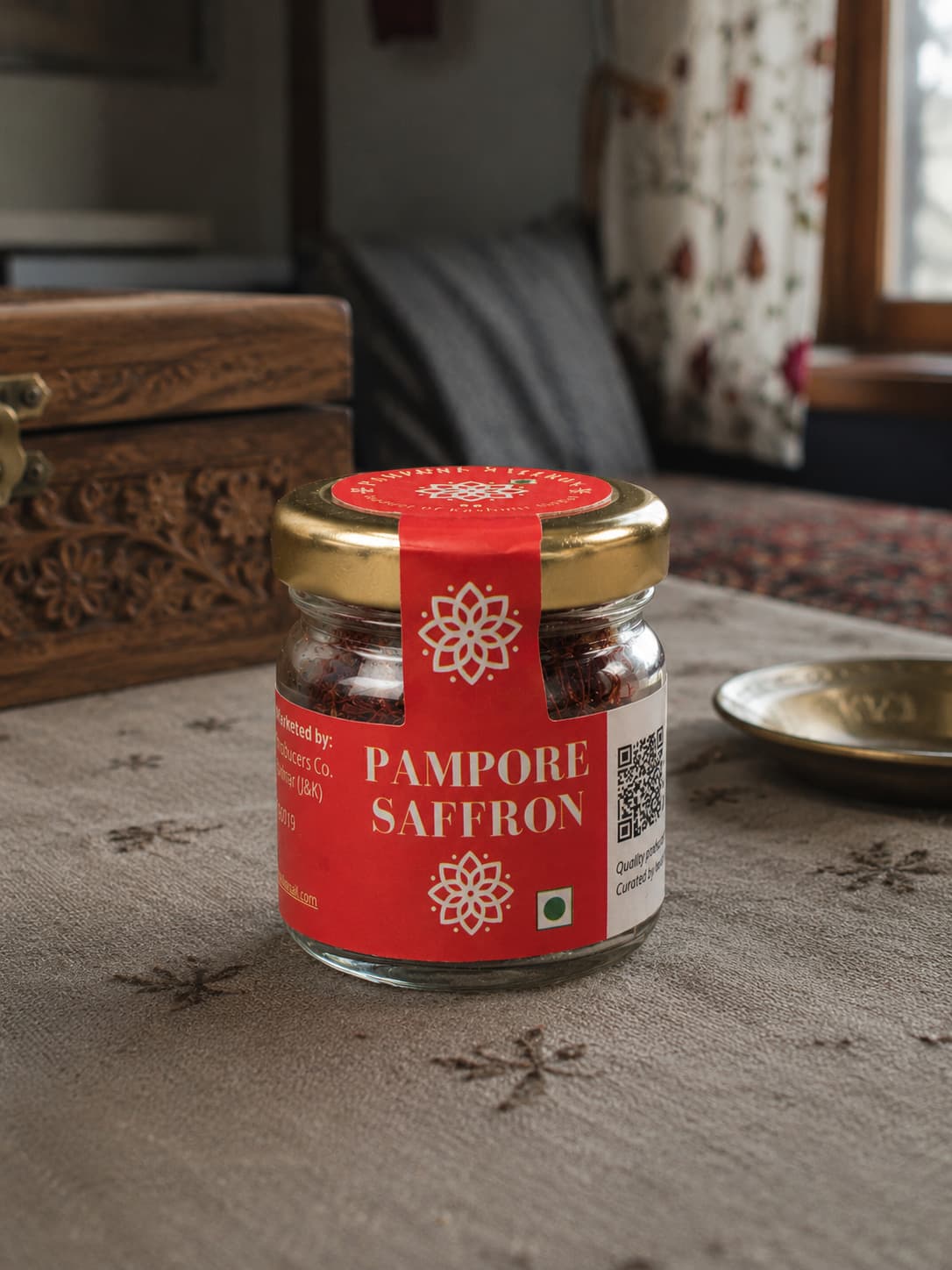
The specific Delhi failure is the loose-weight sale. Saffron scooped from an open tin into a paper twist has no batch code, no seal, no grade card and no way back to a field. It also picks up moisture from the shop, which matters more than people think: damp saffron weighs more, and you are buying by weight. A sealed jar filled at source solves both problems at once — you can see the threads before you break the seal, and the weight on the label is the weight of dry saffron.
The second Delhi pattern is the gifting box. Every Diwali, dry-fruit shops in Karol Bagh, Lajpat Nagar and the Khan Market end of town sell handsome boxes with a one-gram saffron vial tucked into a corner. That vial is the cheapest thing in the box by cost and the most expensive-sounding thing on the label. If the box does not say Kashmir, ISO 3632 and a grade on the vial itself, assume it is filler.
- Ask for the harvest year. Kashmir's crocus flowers late October to early November — a 2025 harvest sold in mid-2026 is normal and honest; a seller who cannot name a year is not selling from a farm.
- Refuse loose weight. Sealed, batch-coded, tamper-evident, or walk.
- Check the thread. Kashmiri Mongra is all dark red, short and thick, with a trumpet-flared tip. Long threads with yellow-orange tails are Lachha or Iranian.
- Do the water test in the shop if they will let you: real saffron releases gold slowly over ten minutes and the thread stays intact. Dyed material stains the water red instantly and the thread goes pale.
What Delhi cooks with kesar
Delhi's saffron habit is Mughlai by inheritance and Punjabi by household. The Old Delhi kitchens around Jama Masjid put it in biryani and in shahi tukda — fried bread in saffron-scented rabri, which is the dish most Delhi families will point at first. Sohan halwa and the winter run of gajar ka halwa both take a saffron finish in the households that can afford it.
The everyday use, though, is kesar doodh through Delhi's punishing December and January — the same three-strand glass of warm milk that Punjab and Haryana drink, carried into the city by Partition-era families and never put down. Karva Chauth sargi trays in West Delhi almost always include a saffron sweet or a small vial.
One correction worth making, because Delhi buyers get it wrong more than most: saffron should never go into hot ghee or hot oil at the start of a biryani. It burns and turns bitter. Steep it in two tablespoons of warm milk for fifteen minutes and pour that over the rice at the dum stage.
- Shahi tukda and Old Delhi biryani — saffron steeped in warm milk, added at the end, never fried.
- Kesar doodh through Delhi winter — 3–4 threads a glass, no more.
- Diwali and Karva Chauth gifting — a sealed 2 g jar reads better than a 1 g vial in a box.
- Gajar ka halwa in January — a pinch of steeped saffron with the khoya.
Delivery to Delhi
Delhi NCR is our fastest lane. Orders confirmed before evening are packed and dispatched from Pampore within 24–48 hours, and DTDC typically lands them in New Delhi, Noida, Gurugram, Faridabad and Ghaziabad inside 3–5 business days of dispatch. We ship prepaid only, tamper-sealed, with the AWB emailed to you the moment the parcel leaves.
We deliver across
- New Delhi
- Chandni Chowk
- Karol Bagh
- Dwarka
- Rohini
- Saket
- Noida
- Gurugram
Every serviceable PIN code in Delhi — not only the cities listed. DTDC Express is ?60 for 7-day delivery, and DTDC Airmax is ?120 for faster air delivery.
Saffron in Delhi — common questions
- What is the price of 1 gram Kashmiri kesar in Delhi?
- Genuine ISO 3632 Grade I Kashmiri Mongra costs ₹330–360 per gram direct from a Pampore grower family, and ₹500–900 per gram across a Delhi retail counter for the same grade. Anything offered in Delhi at ₹150–250 a gram is Iranian repack, Lachha weight, or adulterated — a kilogram of Kashmiri saffron needs roughly 160,000 hand-picked flowers, and that floor does not move because a shop is having a sale.
- Is the saffron sold in Khari Baoli real?
- Some of it is real saffron and very little of it is Kashmiri Grade 1. Khari Baoli is a wholesale market: it moves large volumes of mostly Iranian saffron, which is genuine saffron but not Kashmiri Mongra, plus Lachha grades where the yellow style is left attached to inflate weight. The market's own traders are not hiding this — the confusion happens when a retail buyer assumes 'spice market' means 'origin'. Buy sealed with a stated origin and harvest year, or accept that you do not know what you have.
- Where can I buy original Kashmiri saffron in Delhi?
- You have three real options. Buy direct online from a Kashmiri grower family who will name the village and the harvest, which is what we do from Pampore — sealed jar, batch code, delivered to Delhi in 3–5 business days. Buy from the J&K government emporium, which stocks verified stock at fixed rates. Or buy from a named national brand at a modern-trade store and accept the retail markup. What we would not do is buy loose by weight from an open tin, in Delhi or anywhere.
- How long does saffron delivery to Delhi take?
- 3–5 business days after dispatch, and we dispatch within 24–48 hours of a confirmed prepaid order. So Delhi, Noida and Gurugram addresses usually see the parcel inside a week of ordering. You get a DTDC tracking number by email when it ships.
- Do you deliver saffron to Noida and Gurugram?
- Yes — the whole of Delhi NCR including Noida, Greater Noida, Gurugram, Faridabad, Ghaziabad and Sonipat is on the same 3–5 business day lane as central Delhi. We ship prepaid across every serviceable PIN code in India, and shipping is free on every order with no minimum.
- How much kesar should I put in one glass of milk?
- Three to four threads, about 30 mg, per glass. Crush them between your fingers, steep in two tablespoons of warm — not boiling — milk for ten to fifteen minutes until the liquid is deep gold, then stir that into the rest of the glass. More than that is wasted money and, above roughly 1.5 grams in a day, genuinely inadvisable. One gram of good saffron is around 250 glasses of kesar doodh, which is why the price per gram matters far less than people assume.
We grow and hand-sort this saffron ourselves in Pampore, seal it there in tamper-evident glass, and ship it prepaid to Delhi. One hop, no repacking, a batch code on the jar.
Also shipping to Delhi: Kashmiri kehwa — the winter cup.
Pampore Saffron FPO, J&K · FSSAI 11022470000019
Also in North India