Heritage Kashmir · North India
Kashmiri Saffron in Jammu & Kashmir
- کونگkong · Kashmiri
- زعفرانzafran · Urdu
- केसरkesar · Dogri/Hindi
The short answer
This is where the saffron comes from. Kashmiri saffron is grown almost entirely on the karewa plateaus around Pampore in Pulwama district — our own fields included — harvested by hand over about three weeks from late October, and protected by a Geographical Indication granted by the Government of India in 2020, which restricts the name 'Kashmir Saffron' to saffron actually grown in the valley. Being in J&K does not by itself get you real kesar: the Srinagar–Pampore highway and the Pahalgam and Gulmarg tourist markets are among the most heavily adulterated saffron retail in India, precisely because they sell to visitors who will never return. The price at a grower's door is ₹330–360 a gram, and any Kashmir shop quoting you far less is not selling you Kashmiri Grade 1.
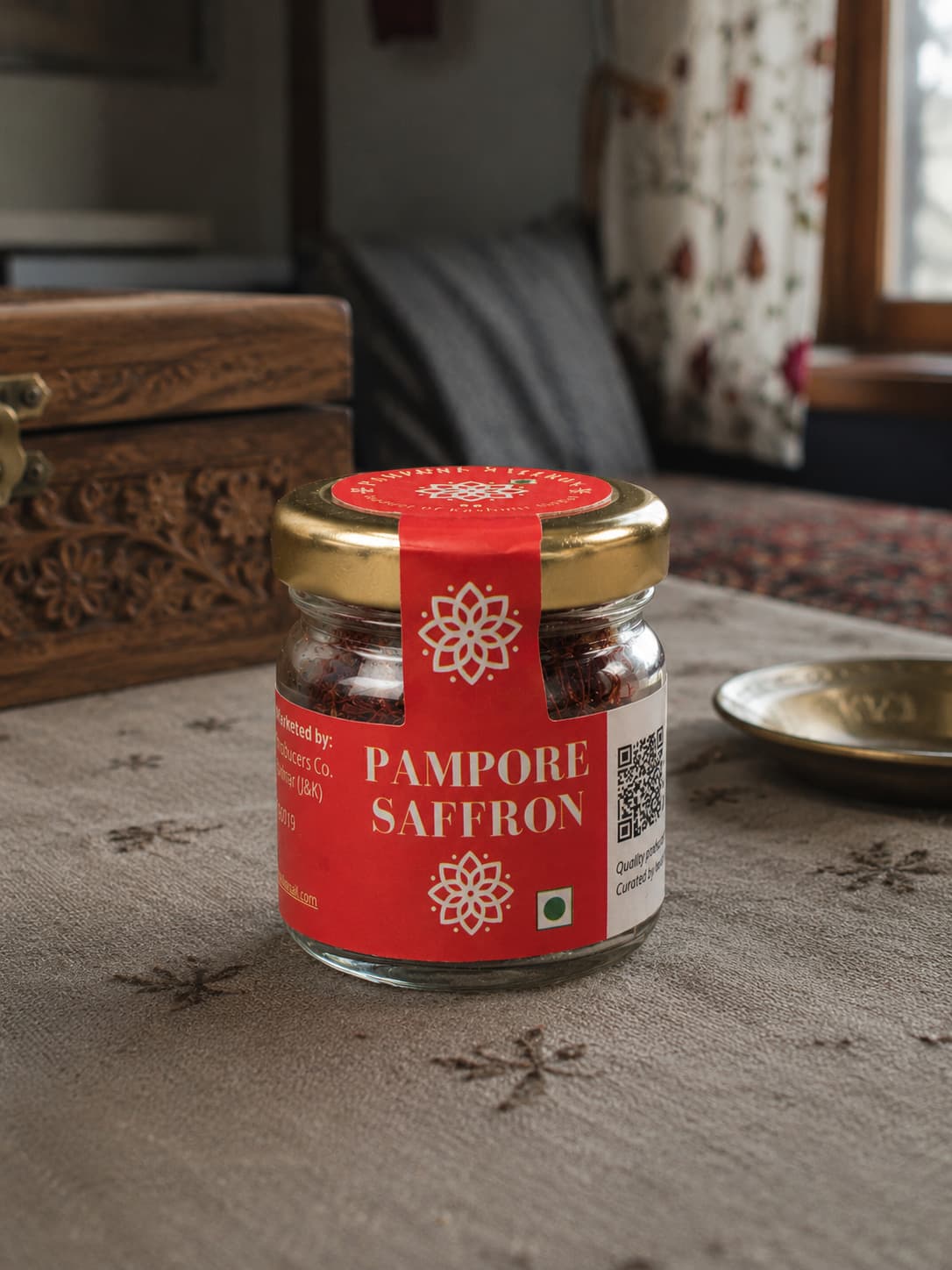
Buying saffron in Kashmir, from someone who lives here
We will say the uncomfortable thing plainly, because we live with the consequences of it. The single worst place in India to buy Kashmiri saffron is a roadside stall on the Kashmir highway. Tourist-facing saffron retail in the valley runs on one-time transactions, and one-time transactions with no way to complain are exactly the conditions under which dyed maize silk, safflower, and cheap Iranian stock get sold as Mongra at ₹1,500 a gram to a family driving back to Jammu. This damages every honest grower in Pampore and it has done so for decades.
The GI tag, granted in 2020, was meant to fix this and partly has. It gives 'Kashmir Saffron' legal protection as a name, defines the growing area, and sits alongside the ISO 3632 grading standard that measures crocin, picrocrocin and safranal in a lab. What it cannot do is police a stall. So the practical test in the valley is the same as everywhere else, plus one local advantage: here you can actually go to the field. A real grower can show you a karewa, name the harvest, and hand you a sealed jar with a batch code.
Jammu division is a separate market. The J&K government emporium near the Raghunath temple in Jammu sells verified stock at fixed rates and is a genuinely safe place for a walk-in buyer — the strongest recommendation we will make for anywhere we do not own.
- Highway and tourist-market saffron in the valley is the highest-risk saffron purchase in India.
- GI 'Kashmir Saffron' since 2020 protects the name; it does not police a roadside stall.
- The J&K government emporium in Jammu is a reliable walk-in option at fixed rates.
- Harvest runs roughly late October to mid-November — fresh crop reaches jars from late November.
How Kashmir actually uses its own saffron
Less lavishly than outsiders assume, and more precisely. Kahwa is the everyday use — green tea with cardamom, cinnamon, crushed almonds and a few threads of saffron, drunk through the day and through the winter, and the single largest domestic saffron use in the valley. A Kashmiri household making kahwa for four uses perhaps four threads.
Wazwan, the formal multi-course feast, is where saffron becomes structural. Rogan josh takes its colour from Kashmiri chilli and ratan jot rather than saffron, but the rista, the gushtaba and above all the zafrani pulao and the phirin served at the end carry real saffron. A wazwan for a wedding will use grams.
Then there is the non-culinary use that most of India has forgotten: saffron in kahwa served to guests as a mark of respect, saffron water at shrines, and kong posh — the crocus flower itself — which is a fixture of Kashmiri poetry and of the fortnight in autumn when the karewas turn purple and the entire district stops other work to pick.
- Kahwa — 3–4 threads for a pot of four, added with the cardamom at the end of the steep.
- Wazwan zafrani pulao and phirin — gram-scale for a wedding.
- Shrine and hospitality use — saffron water, saffron in the guest's cup.
- Kong posh season, late October — the three weeks the valley picks by hand.
Delivery to Jammu & Kashmir
We pack in Pampore, so J&K is a local lane. Srinagar, Pampore, Anantnag, Pulwama and Budgam typically arrive 2–4 business days after dispatch; Jammu, Udhampur and Kathua 3–5; and Kupwara, Gurez, Bandipora and remote addresses longer, with winter road conditions occasionally extending everything. Local buyers are also welcome to collect from Lethpora, Pampore, or order on WhatsApp.
We deliver across
- Srinagar
- Pampore
- Jammu
- Anantnag
- Baramulla
- Udhampur
- Kathua
Every serviceable PIN code in Jammu & Kashmir — not only the cities listed. DTDC Express is ?60 for 7-day delivery, and DTDC Airmax is ?120 for faster air delivery.
Saffron in Jammu & Kashmir — common questions
- Where exactly is Kashmiri saffron grown?
- Almost entirely on the karewas — the elevated alluvial plateaus — around Pampore in Pulwama district, with smaller areas in Budgam, Srinagar and Kishtwar. Pampore accounts for the overwhelming majority. The karewa soil drains hard and the valley's autumn is dry and cold, which is what Crocus sativus needs; that combination is why saffron grows there and not thirty kilometres away. The Government of India's 2020 GI registration formally ties the name 'Kashmir Saffron' to this growing area.
- When is Kashmiri saffron harvested?
- Late October to mid-November, over roughly three weeks. The flowers open at dawn and have to be picked the same morning before the sun degrades them, then the three red stigmas are separated from each flower by hand the same day and dried. It is the most labour-intensive fortnight in Kashmiri agriculture — entire families work it — and it is the whole reason the spice costs what it does. Fresh-harvest jars reach buyers from late November onward.
- Why is saffron sold cheap on the Srinagar highway?
- Because it is not Kashmiri Grade 1. Highway and tourist-market stalls sell dyed maize silk, safflower, and Iranian bulk stock relabelled as Kashmiri, to buyers who are passing through once and cannot come back. Genuine Kashmiri Mongra cannot be cheap: about 160 flowers make one gram, all picked and sorted by hand, so ₹330–360 a gram at a grower's door is close to the floor. If a stall on the Pampore road offers you Mongra at ₹150 a gram, the arithmetic alone tells you what it is.
- What does the GI tag on Kashmir saffron actually guarantee?
- It guarantees origin, not grade. The Geographical Indication registered in 2020 makes 'Kashmir Saffron' a protected name that can legally only be used for saffron grown in the designated area of the valley — it is a legal restriction on the word, enforceable against misuse. It does not measure quality. Quality is ISO 3632, which lab-tests crocin (colour), picrocrocin (taste) and safranal (aroma); Category I is the top band. A jar worth buying carries both: GI origin and Category I grading.
- Can I visit and buy directly from a saffron farm in Pampore?
- Yes. We are at Lethpora, Pampore, in Pulwama district, and buyers are welcome to collect in person or arrange it on WhatsApp at +91 95966 08297. If you are in the valley in the last week of October or the first half of November you can see the harvest itself, which is worth the trip regardless of whether you buy. Outside that window you can still see the sorting and the sealing, which is the part that decides what ends up in the jar.
- What is kong, and is it the same as kesar?
- Kong is the Kashmiri word for saffron, and kong posh is the crocus flower. Same spice as kesar in Hindi and zafran in Urdu — Crocus sativus, the three dried red stigmas of the autumn crocus. Kashmiri has its own word for it because Kashmir has grown it for something like two thousand years and needed one; the flower appears in Kashmiri poetry and place names long before it was a commodity anyone shipped.
We grow and hand-sort this saffron ourselves in Pampore, seal it there in tamper-evident glass, and ship it prepaid to Jammu & Kashmir. One hop, no repacking, a batch code on the jar.
Also shipping to Jammu & Kashmir: Kashmiri kehwa — the winter cup.
Pampore Saffron FPO, J&K · FSSAI 11022470000019
Also in North India