Proof, not promises
Lab reports and certificates
Our saffron is tested by the Quality Evaluation Laboratory of the India International Kashmir Saffron Trading Centre (IIKSTC) in Pampore — the Government of Jammu & Kashmir’s own saffron laboratory, accredited to ISO/IEC 17025. The full report is below, every value typed out, with the details you need to check it yourself.
Saffron: ISO 3632 Grade I, tested by IIKSTC
Result: Grade I under ISO 3632-1:2011
- Laboratory
- IIKSTC Quality Evaluation Laboratory, Dussu, Pampore, J&K 192121
- Accreditation
- ISO/IEC 17025:2017 accredited · NABL certificate TC-11843
- Report number (ULR)
- TC118432400000069F
- Issued
- 1 July 2024
- Product type
- GI-Saffron · Cut – Filamentous
- Lot
- L20020645 (4,468 g)
- Sample
- SPSC-SS/IIKSTC/2023/0014 · 7 g
- Tested
- 24–27 June 2024
| What was measured | Grade I limit | Our result |
|---|---|---|
| Colouring strength (crocin), A¹%₁cm at 440 nm, dry matter | min. 200 | 213.59 |
| Flavour strength (picrocrocin), A¹%₁cm at 257 nm, dry matter | min. 70 | 80.96 |
| Aroma strength (safranal), A¹%₁cm at 330 nm, dry matter | 20–50 | 37.92 |
| Moisture and volatile matter, % mass | max. 12 | 11.72 |
| Total ash, % on dry matter | max. 8 | 4.75 |
| Extraneous matter (floral and plant waste), % mass | max. 0.5 | 0.09 |
| Foreign matter (from other plants), % mass | max. 0.1 | 0.04 |
Crocin, picrocrocin and safranal are absorbance readings (A¹%₁cm) on dry matter, as the standard specifies — not percentages. Higher crocin means more colouring strength; Grade I needs at least 200.
What the laboratory itself says this report covers
- The analysed sample conforms to Grade I as per ISO 3632-1:2011.
- The result is limited to the lot named on the report.
- Adulterants were not checked.
This is the most recent IIKSTC report we hold, for the lot named above. We add each new report here as it is issued. Ask on WhatsApp which lot your jar comes from.
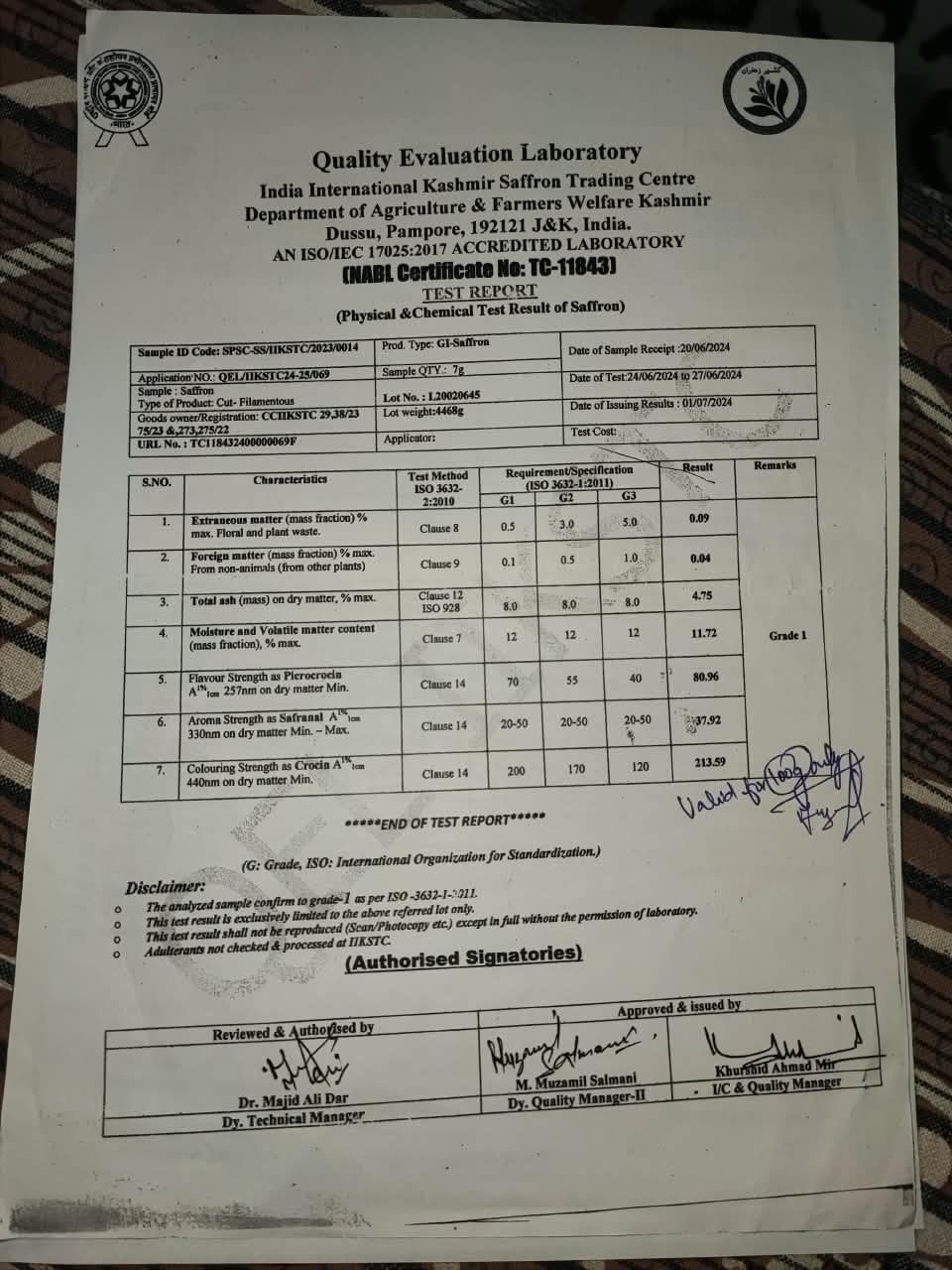
How to check this report yourself
- The report number TC118432400000069F is a NABL Unique Lab Report number. It starts with the lab’s NABL certificate number, TC-11843, which you can look up on the NABL website.
- The laboratory is the IIKSTC Quality Evaluation Laboratory, run by the Department of Agriculture & Farmers Welfare, Kashmir, at Dussu, Pampore, J&K 192121. Quote the report number and lot L20020645 and they can confirm it.
- Signed by Dr. Majid Ali Dar, Dy. Technical Manager; M. Muzamil Salmani, Dy. Quality Manager-II; Khurshid Ahmad Mir, I/C & Quality Manager.
Two different things: the cut and the grade
Mongra describes the cut: the all-red stigma, with the yellow style removed by hand. That is sorting, done by our family. ISO 3632 Grade I is a laboratory result: colour, flavour and aroma strength, moisture and impurities, measured against the international standard. The first is our work; the second is IIKSTC’s measurement, shown above.
Home checks such as the warm-water test tell you whether threads behave like real saffron — slow golden colour, threads that stay whole. They cannot tell you the grade, the origin or whether every adulterant is absent. That is what a laboratory report is for.
Shilajit
Each batch of our Himalayan shilajit is tested for fulvic acid and for lead, arsenic, mercury and cadmium. The certificate of analysis for your batch is sent on request.
Who you are buying from
The Heritage Kashmir is the brand of Pampore Saffron Farmers Producer Company Limited, a farmer producer company in Pampore, Pulwama, Jammu & Kashmir. Every number below is public and can be checked on the government portal linked beside it.
Company (Ministry of Corporate Affairs)
Pampore Saffron Farmers Producer Company Limited, incorporated 19 July 2021
FSSAI food business licence
State licence, Jammu & Kashmir — saffron, dry fruits, almonds, walnut kernels, almond oil
GST registration
Regular registration since 18 March 2022
Importer-Exporter Code (DGFT)
Issued 8 September 2023, Srinagar
Udyam (MSME) registration
Micro enterprise, manufacturing