Heritage Kashmir · Kashmir valley · Raw, never heated
Kashmiri Honey: Raw Saffron Honey from Pampore
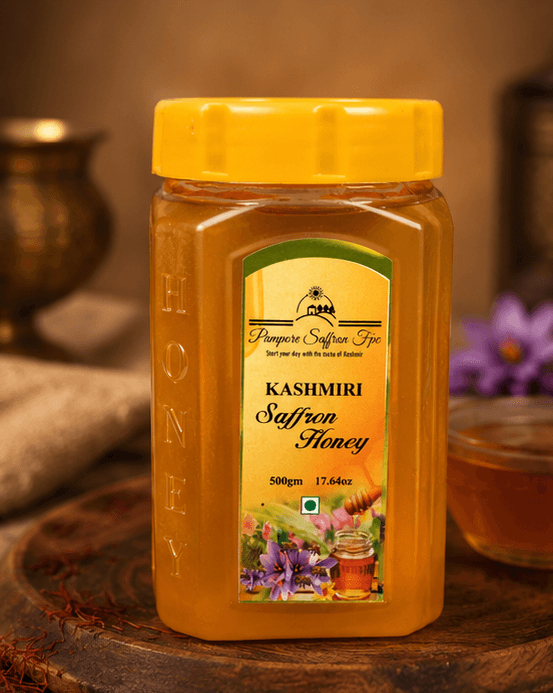
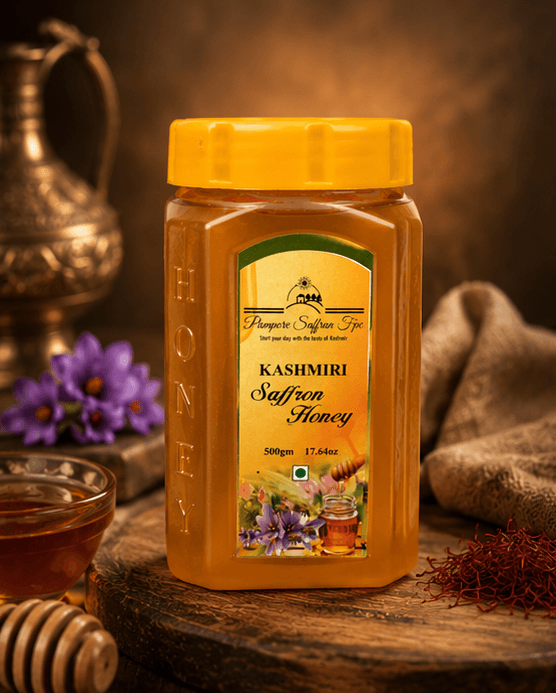
Our Kashmiri honey is raw acacia honey from the Acacia and Kikar forests of the Kashmir valley, never heated, infused with Mongra saffron from our own fields in Pampore — the threads stay in the jar. ₹649 for 500 g, ₹1,249 a kilo.
Prepaid or cash on delivery · Ships pan-India via DTDC · Order line +91 95966 08297
One valley, one bloom
Acacia and Kikar honey from traditional beekeepers in Kashmir — a named floral source, not pooled stock.
Raw, never heated
Coarse-sieved only, so it keeps its aroma and will granulate in time, as raw honey does.
Saffron from our own fields
Steeped with Mongra threads from our family's fields in Pampore, left whole in the jar.
Our Kashmiri saffron honey
| Ingredients | Raw acacia honey and Mongra saffron threads from our own fields in Pampore — nothing else |
|---|---|
| Floral source | Acacia and Kikar bloom, Kashmir valley |
| Heated? | Never — raw, coarsely sieved |
| Colour | Deep gold, with the threads visible in the jar |
| Taste | Light floral sweetness with a warm, earthy saffron note |
| Crystallises? | Slowly — acacia honey is high in fructose |
| Best for | Warm milk, kahwa, kheer, gifting |
| 500 g jar | ₹649 |
| 1 kg jar | ₹1,249 |
Which honey is best in India?
The best honey is raw, names its bloom, and suits what you will use it for — the brand on the label matters less than any of those. Heating honey keeps it liquid on a filling line and also drives off the enzymes and aromatics you are paying for, so raw comes first. A named floral source, region and harvest come second, because they are the only details on a label you can hold a seller to. Then the bloom: acacia is the lightest and cleanest, slow to set, and right wherever the honey should not dominate; darker multifloral and forest honeys carry more flavour and more pollen; and a saffron honey like ours is for warm milk, kahwa and gifting.
How to check if honey is original
No home test proves honey is original; a laboratory test on the batch does. The popular kitchen tests — the water test, the thumb test, the flame test — fail on some genuine honeys and pass on some syrups, because modern adulterants are made to behave like honey. What a buyer can actually check:
- The ingredient line. Honey should list honey and nothing else; an infused honey should name what is infused, as ours names saffron.
- A named bloom, region and harvest. A real beekeeping operation knows where the boxes stood and when they came off. “Natural” and “pure” on a label are unregulated words.
- Whether it granulates. Raw honey sets in time; honey that stays glassy for years has usually been heated or cut with syrup. Acacia is the one common exception — it is high in fructose and sets slowly.
- For a saffron honey, the threads. Imitations get their gold from colour and their taste from flavouring; a real infusion leaves whole threads in the jar.
- A test report for the batch. India’s standard test catches C4 syrups from cane and maize; C3 syrups from rice and beetroot need NMR to be caught. In 2020 the Centre for Science and Environment found 77% of 22 honey samples from 13 brands adulterated — the full story is in our saffron honey guide.
In the same spirit: we have not commissioned an NMR test on our honey. If we do, the report and its reference number will go on the product page. Until then we offer a named bloom, a named valley, an FSSAI licence (11022470000019) you can look up, and honey that behaves like raw honey in your cupboard.
Kashmiri honey price per kg
| Pack | Price | Per kg |
|---|---|---|
| Kashmiri Saffron Honey, 500 g | ₹649 | ₹1,298 |
| Kashmiri Saffron Honey, 1 kg | ₹1,249 | ₹1,249 |
Raw, single-origin honey costs more than blended table honey because it comes from one bloom in one season rather than being pooled from many sources and standardised. A saffron honey costs more again because of the saffron — Kashmiri Mongra sells at roughly ₹330–360 a gram. The kilo jar is the cheaper rate per gram.
Further reading
- Saffron honey in India: how the infusion works, and the sugar-syrup problem
- Kashmiri honey: acacia, kikar and what “white honey” means
- Kashmiri kahwa — where a spoon of saffron honey goes
Ready to order Kashmiri saffron honey?
Kashmiri honey — frequently asked questions
What is Kashmiri honey?
Honey from the bloom of the Kashmir valley. The best known is acacia — called kikar locally, and often sold as Kashmiri white honey because it is so pale — alongside darker multifloral and forest honeys. Ours is raw acacia honey from the valley's Acacia and Kikar forests, collected by traditional beekeepers and never heated, infused with Mongra saffron from our own fields in Pampore.
Which honey is best in India?
Floral source and processing matter more than brand. Choose raw over pasteurised, because heating honey to keep it liquid also drives off its enzymes and aromatics. Choose a jar that names its bloom, region and harvest, because a seller who cannot name a bloom usually does not have one. Then choose the bloom for the use: acacia is the lightest and cleanest, darker forest honeys carry more flavour, and a saffron honey is for warm milk, kahwa and gifting.
How can I check if honey is original at home?
You cannot settle it at home. The water, thumb and flame tests fail on some genuine honeys and pass on some syrups, because modern adulterants are made to behave like honey. What does tell you something: an ingredient line that names honey and nothing else (or honey and the named infusion); a named floral source, region and harvest; and honey that eventually granulates, since honey that stays glassy for years has usually been heated or cut with syrup (acacia, which sets slowly, is the exception). For a definitive answer only a laboratory test on the batch — C4 sugar screening, or NMR — will do.
What honey is your saffron honey made from?
Raw acacia honey — called kikar locally, and often sold as Kashmiri white honey because it is so pale — from the Acacia and Kikar forests of the Kashmir valley, collected by traditional beekeepers and never heated. Acacia is the lightest and mildest of the valley's honeys and slow to crystallise, which is why it carries the saffron well. We do not currently sell it plain; our only honey is this one, with Mongra saffron from our own fields in Pampore steeped in it.
What is the price of Kashmiri honey per kg?
Our saffron honey is ₹1,249 a kilogram, or ₹649 for a 500 g jar. Raw, single-origin honey costs more than blended table honey because it comes from one bloom in one season rather than being pooled and standardised, and a saffron honey costs more again because of the saffron. A raw, single-origin claim at commodity-blend prices is a reason to ask which bloom and which batch.
Does pure honey crystallise or freeze in winter?
It often crystallises, and cold speeds that up — raw honey sets fastest at cool room temperatures, which is why it is best kept out of the fridge. It does not freeze solid in an Indian winter; it thickens. Crystallised honey is not spoiled: stand the sealed jar in warm, not boiling, water for fifteen to twenty minutes to make it pourable again, and never microwave it. Acacia honey, being high in fructose, is among the slowest honeys to set.