“White honey” is not a grade. It is almost always acacia honey — from the bloom of the tree North India calls kikar — which is very pale and, because it is fructose-dominant, stays liquid long after most raw honey has set solid. That single fact matters more than it sounds, because the most repeated rule about buying honey — real honey crystallises — has exactly one important exception, and this is it.
Floral source is the only useful label on a honey jar
Almost everything a shopper reads on Indian honey packaging is decoration. “Natural”, “pure”, “organic” and “raw” range from loosely defined to entirely unregulated in practice. What actually tells you something is which flowers the bees worked.
Floral source determines colour, aroma, taste and — critically — whether the honey sets. It is also the claim that is hardest to fake convincingly, because it commits the seller to a place and a season. A jar that says acacia is telling you the hives were near acacia in bloom. A jar that says “natural honey” is telling you nothing at all, and a great many jars say exactly that.
When we inspected competitor saffron-honey pages in September 2026, the pattern was consistent: several ran to about 150 words and none named a floral source. That is the gap this page exists to close.
Acacia, kikar, babul — one tree, several names
Kikar is the common North Indian name for acacia; babul appears too. It flowers in the warmer months with pale, nectar-heavy blossom, and the bloom is short — typically a few weeks. During it, nectar flow can be strong enough that bees fill comb unusually fast, which is part of why single-floral acacia honey is possible to collect at all. Miss the window and the hives are working something else.
The resulting honey is pale — anywhere from nearly water-white to a light amber — with a mild, clean floral taste and none of the treacly heaviness of darker forest honeys. That paleness is where “white honey” comes from. It is a description of appearance, not a certification, and no standards body issues it.
Why acacia stays liquid: the fructose ratio
Honey is mostly two sugars, glucose and fructose, and crystallisation is glucose coming out of solution. So the behaviour of a honey in your cupboard is decided largely by which of the two dominates.
| Honey type | Sugar balance | Typical behaviour |
|---|---|---|
| Acacia / kikar | Fructose-dominant | Stays liquid for a long time — often a year or more |
| Mustard / sarson | Glucose-rich | Sets quickly, sometimes within weeks |
| Multifloral / wild | Varies with the bloom | Unpredictable — depends what the bees found |
So the familiar advice — if it never crystallises, be suspicious — is good general guidance and wrong for acacia. With a fructose-dominant honey, staying pourable is simply what it does.
The reverse is more informative. Honey that has been heated hard and ultra-filtered is delayed from crystallising, because the seed crystals and pollen that nucleate the process have been stripped out. That is why crystallisation is decent evidence a honey has not been aggressively processed — and why the right response to a set jar is warm water, never a microwave, as the saffron honey piece explains.
What honey does not do
Worth stating plainly, because this category attracts more nonsense than most. Honey is roughly 80% sugar and about 60 calories a tablespoon, whatever flower it came from. Raw honey retains trace enzymes, pollen and antioxidant compounds that processing destroys, and that is a real difference in quality — it is not a difference that converts a sweetener into a treatment.
- It is not a weight-loss food. Swapping refined sugar for honey swaps one sugar for another with better flavour.
- It does not “boost immunity”. Warm honey in water is soothing on a sore throat, which is a genuine and modest comfort.
- It must never be given to infants under twelve months. This one is not a nuance — infant botulism is a real and serious risk, and it applies to raw honey specifically.
- If you are managing diabetes, honey counts as sugar. Its floral source does not change that.
What to ask before buying a jar
- Which flower? If the seller cannot name a floral source, they are selling blended stock and everything else on the label is decoration.
- Which season, and where? A short bloom means a datable harvest. Vagueness here is the tell.
- Raw or heated? Heating for filtration and pourability is common and rarely disclosed.
- Has it been NMR tested? India’s standard test catches C4 sugar syrups; C3 syrups from rice and beetroot slip through. NMR catches both, and it is mandatory for Indian honey exported to the United States but not for honey sold within India. The full story of that gap — including the 2020 investigation that found 77% of sampled Indian honey adulterated — is worth reading before you spend.
What we sell, stated exactly
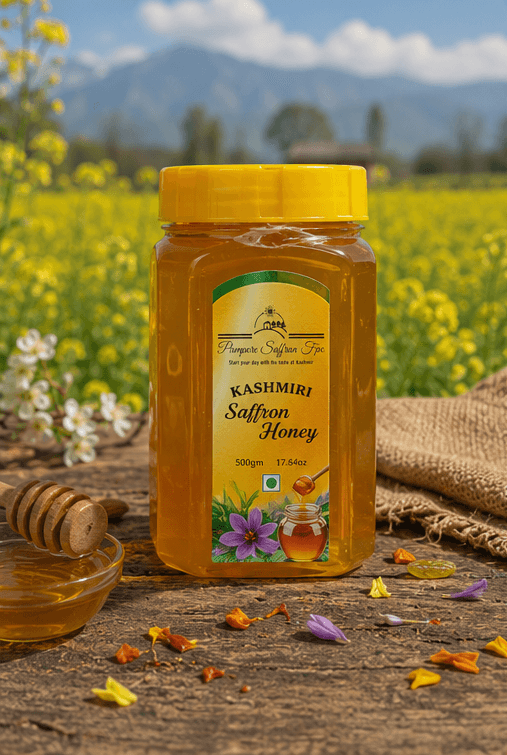
Our saffron-infused wild honey is raw honey collected from the acacia and kikar forests of Kashmir, with our own Grade I Mongra saffron threads steeped into it — which is why you can see threads in the jar rather than a uniform colour with nothing to show for itself. It is sold as a liquid honey in 500 g and 1 kg jars.
Two honest qualifications. It is wild-collected, so it is acacia-led rather than a laboratory-certified monofloral — bees do not read maps, and nearby blooms contribute. And we have not put it through NMR testing. Given how much of this page rests on that test being the meaningful one, it would be incoherent not to say so. If and when we do, the report and its reference number will be published here rather than summarised.
If you want to know how the saffron infusion itself works — and why a jar with no visible threads is a flavouring rather than an infusion — that is covered here. For which harvest is currently in stock, ask on WhatsApp at +91 95966 08297.