The difference is not altitude and it is not soil. It is that California grows a small number of grafted, irrigated cultivars bred for uniformity, and Kashmir still grows mostly seedling trees classified by how thick their shells are. Everything people notice downstream — size variation, colour spread, how strongly the kernel tastes, what it costs — follows from that one fact. Most of the rest of what gets said about this comparison is marketing on one side or nostalgia on the other.
The variety difference, which is the whole story
A Californian walnut orchard is a planted thing. Trees are grafted, so every tree in a block is genetically the same tree, chosen for pale kernel colour, a shell that cracks predictably, and nuts that ripen together. One cultivar, Chandler, dominates modern plantings to an extent that would be unusual in almost any other crop. Orchards are irrigated, floors are swept, trees are shaken mechanically, and the crop goes into forced-air dehydrators within hours of coming off the tree.
Kashmir’s walnut trees were mostly not planted from a catalogue. A great many are seedlings — grown from a nut, not grafted — which means each tree is genetically its own thing. They are frequently rainfed rather than irrigated, often standing along field edges and hill slopes rather than in blocks. Jammu & Kashmir accounts for effectively all of India’s commercial walnut production.
Because there are no cultivar names to sort by, Kashmir classifies walnuts by shell thickness instead. The local terms are worth knowing, because they are what a trader is actually talking about:
- Kagzi — “paper”. The thinnest shell, crackable in the hand, highest kernel-to-shell ratio, most prized and most expensive.
- Khanak — medium shell, the common commercial middle.
- Burzul — thick shell, lower kernel yield.
- Wonth — the hardest shell of the four. Historically valued as much for the shell as the kernel.
None of that is a quality standard in the ISO sense. It describes the nut in front of you, not a graded specification — which is exactly why in-shell and kernel prices need care when comparing sellers.
Side by side
| Kashmiri | California | |
|---|---|---|
| Tree | Largely seedling-grown; each tree genetically distinct | Grafted cultivars, Chandler dominant |
| Water | Frequently rainfed | Irrigated orchards |
| Sorting system | By shell thickness — Kagzi, Khanak, Burzul, Wonth | By cultivar, then size and kernel colour grade |
| Harvest & drying | Largely hand-knocked, sun-dried | Mechanically shaken, forced-air dehydrated |
| Shelling | Largely hand-cracked; more intact halves | Machine-shelled at volume |
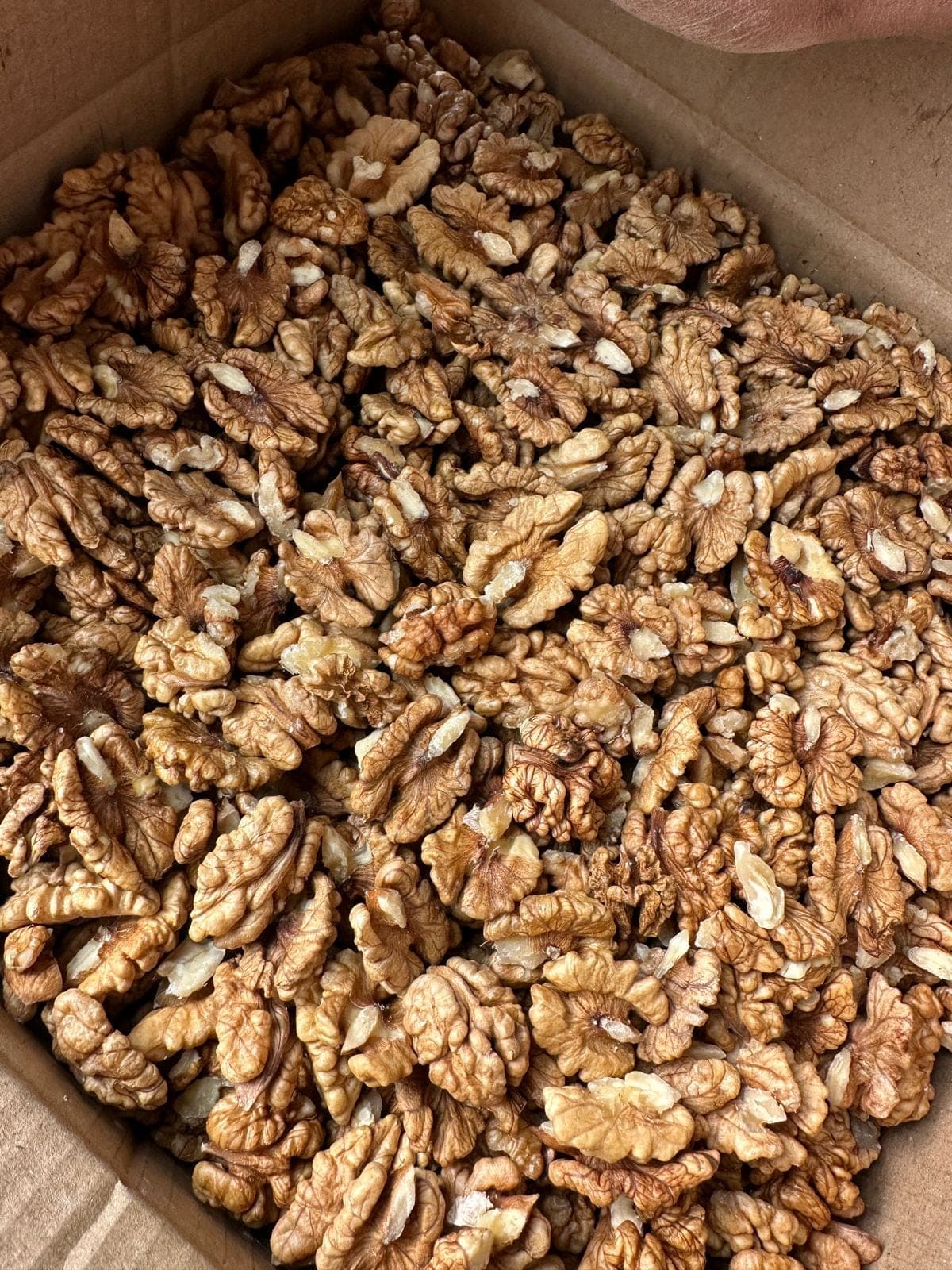
| Kernel appearance | Variable size and colour within a batch | Highly uniform, typically paler |
| Flavour | More aromatic, more bitterness at the skin | Milder, more consistent |
| Nutrition | No meaningful difference. Both are roughly 65% fat, both are the richest common nut source of ALA. | |
The nutrition number, and the caveat that belongs beside it
Walnut kernels run around 9 g of alpha-linolenic acid per 100 g — roughly 2.7 g in a 30 g handful, which on its own clears most daily reference intakes for ALA. No other common nut is close. That is the genuinely remarkable thing about walnuts and it is true of Kashmiri and Californian kernels alike.
Here is the part that usually gets left out. ALA is not EPA or DHA. It is the plant-form omega-3, and the human body converts only a small share of it into EPA and very little into DHA — the forms most of the cardiovascular and neurological research actually studied. Walnuts are an excellent food and a sensible daily habit. They are not a replacement for oily fish, and a seller who implies otherwise is counting on you not knowing the difference. The same discipline applies to cold-pressed walnut oil, where the claim gets stretched furthest.
Kernel colour: graded, but not what you think
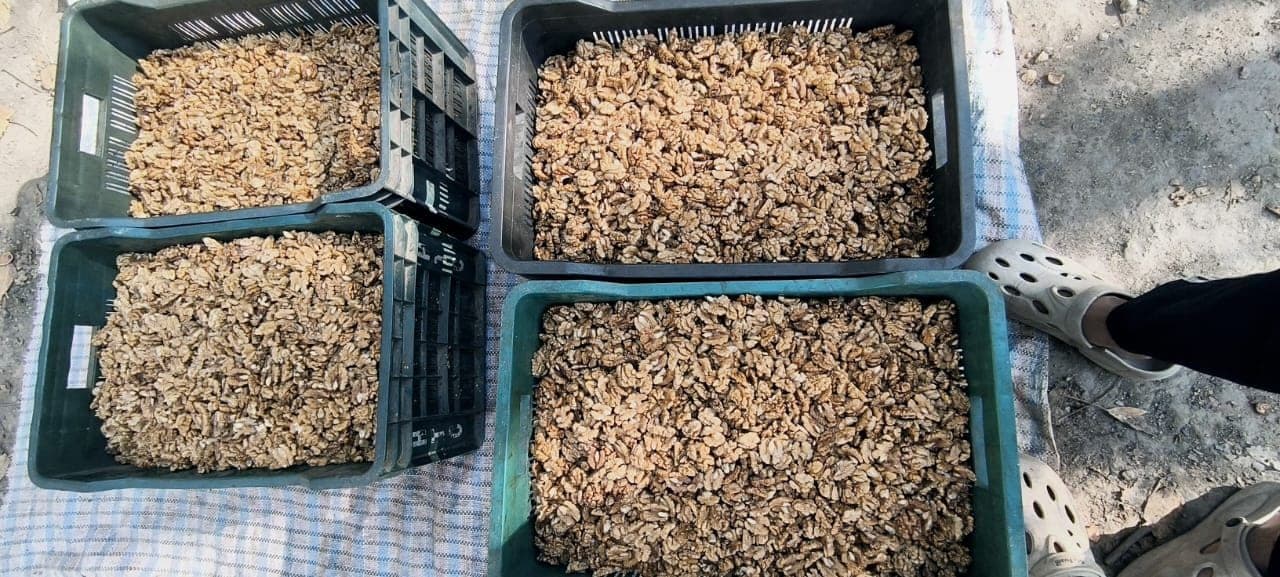
Commercial walnut grading leans heavily on kernel colour — pale “extra light” halves fetch more than amber ones. It is worth knowing what that scale does and does not measure.
Colour tracks handling and age more than it tracks nutrition. Kernels darken with oxidation, heat and time, so pale usually means fresh and carefully dried — a real signal. But a darker Kashmiri kernel from this autumn is a better nut than a pale one that has spent a year in a warehouse, and the colour scale cannot tell you which you are holding. Uniform pallor across an entire batch tells you the lot was graded, which is a statement about sorting, not about origin.
Freshness is the axis that actually decides quality
If you take one practical thing from this: with walnuts, freshness beats provenance. About 65% of a walnut is fat, and most of that is polyunsaturated — the fat that oxidises fastest. Rancidity is the default state of an old walnut, and it arrives sooner than people expect.
Rancid walnuts taste sharp, bitter and faintly of paint or old crayon. An enormous number of people who say they dislike walnuts have simply never eaten a fresh one. If a kernel makes you wince at the back of the throat, that is not the walnut’s character — it is oxidation, and no origin story fixes it.
Which means the questions worth asking a seller are unglamorous: which harvest, and how has it been stored since? Walnuts come off the tree in Kashmir around September and October. Buying close to that window, and keeping the kernels sealed, cool and out of the light, will do more for what is in your bowl than any argument about cultivars.
When a California walnut is the better buy
We sell Kashmiri kernels, so take this in the spirit it is offered: there are cases where the Californian nut is straightforwardly the right choice, and pretending otherwise would be silly.
- When you need matched halves. Decorating a cake, plating a dessert, anything where the nut is seen. Grafted trees and machine grading exist precisely to deliver that, and hand-cracked seedling stock will not match it.
- When you want mildness. Some people dislike the bitter edge in the skin. Californian kernels are gentler.
- When budget is the binding constraint. Scale is real. A hand-cracked kernel cannot be priced like a machine-shelled one, and a cheaper walnut eaten daily beats an expensive one bought twice a year.
What a Californian walnut cannot offer is a named valley, a named harvest and a grower who will answer the question. That is the trade, stated plainly.
What we sell, and what it costs
Our Kashmiri walnut kernels are sold shelled — akhrot giri — at ₹1,550 a kilogram, in 250 g, 500 g and 1 kg packs. Shelled, because the conversion trips people up constantly: a kilogram of in-shell walnuts yields only roughly 400–450 g of kernel, so an in-shell price that looks lower usually is not.
We are a farmer producer company in Pampore, so the walnuts come through fewer hands than the retail chain would normally involve. What we do not yet publish on the product page — and should — is the harvest year and the lot code. That is being fixed, and until it is there, ask us on WhatsApp at +91 95966 08297 and we will tell you which harvest is in the jar.
If you are working out how much to actually eat, the daily dry-fruit amounts piece has the per-item chart, and what Kashmiri walnuts actually do covers the health side without the usual overreach. If the words on the packet are the confusing part — akhrot, giri, kernels, in-shell — that vocabulary is untangled here.