There is no single Kashmiri walnut price. Through 2026, kernel listings have run from wholesale halves around ₹850 a kilogram and lighter grades around ₹1,150, through retail at ₹900–₹1,500, to premium retail near ₹1,900 — and in-shell offers advertised far below all of them. The spread is not mostly about origin. It is about whether you are buying shell, how intact the kernels are, and how old the crop is. This page does the conversions so you can compare two listings and know which is actually cheaper.
The ladder, honestly laid out
These are ranges observed across Indian wholesale directories and retail listings during 2026. Treat them as a map of the market rather than today’s quote — walnut prices move with the crop, the season and the seller.
| Band | Typical form | What it usually means |
|---|---|---|
| ₹350–600 / kg | Usually in-shell, bulk | Thick shell or old crop. Convert to kernel before believing it. |
| ~₹850 / kg | Kernel halves, wholesale | Mandi-level for standard halves. Not a retail price. |
| ~₹1,150 / kg | Light kernel, wholesale | Paler colour grade, which is graded and priced higher. |
| ₹900–1,500 / kg | Kernel, retail | The band most households actually buy in. |
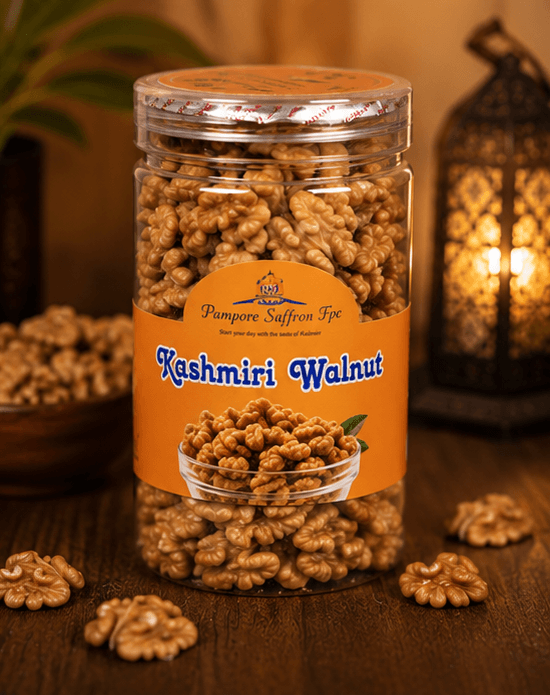
| ₹1,550 / kg | Kernel, our packs | Hand-cracked halves, current crop, sold direct. |
| ~₹1,900 / kg | Premium retail | Branded packaging and gifting presentation. |
We sit near the top of the retail band and below premium retail. That is a position, not a boast, and the rest of this page is the argument for and against it.
The conversion that decides everything
Before comparing any two walnut prices, settle whether each is for in-shell nuts or kernels. One kilogram of in-shell walnuts yields roughly 400–450 g of kernel from thin-shelled stock, and meaningfully less from thick shells.
| In-shell price | Yield assumed | True cost per kg of kernel |
|---|---|---|
| ₹400 / kg | 45% | ₹889 |
| ₹600 / kg | 45% | ₹1,333 |
| ₹600 / kg | 35% (thick shell) | ₹1,714 |
| ₹800 / kg | 45% | ₹1,778 |
Read rows two and three together: identical money, wildly different value, decided by a variable the listing did not mention. This is why Kashmir grades walnuts by shell thickness in the first place — Kagzi, Khanak, Burzul, Wonth — as the comparison with California walnuts sets out. The vocabulary is unpacked in walnut vs walnut kernels.
What you are paying for, ranked by how much it moves the price
- Shell or no shell. The largest single factor, and the one most often left ambiguous.
- Halves versus pieces. Intact halves take skilled hand-cracking. You are buying appearance — there is no nutritional or flavour difference in a broken kernel from the same lot.
- Kernel colour grade. Pale “light” kernels command a premium. Colour tracks handling and age more than quality, so it is a useful signal and a poor guarantee.
- Crop year. Rarely stated, and it matters more than anything above it. Walnut fat oxidises; a cheap kernel from last year is worse value than a dearer one from this autumn.
- Packaging and channel. A gifting box costs more than a poly pack containing the same nuts.
Where the money goes at ₹1,550
We are a farmer producer company, so the chain is short — but short is not the same as free. Hand-cracking is the expensive part. A person cracking nut by nut produces far fewer kilograms per day than a machine, and it is also why more of what you get arrives as whole halves. Sun-drying takes space and time. Sorting is done by hand.
What you are not paying for is a chain of intermediaries, and that is the honest reason a grower-direct price can sit below premium retail while the kernels are fresher.
What we do not yet print on the pack, and should, is the harvest year and lot code. Given that crop year moves quality more than any grade on this page, that is the most useful thing a walnut seller can publish and almost nobody does. It is being fixed. Until it is on the page, ask us on WhatsApp at +91 95966 08297 and we will tell you which harvest is in the pack.
When you should not buy from us
If price per kilogram is your binding constraint, buy in-shell from a local seller in autumn and crack them yourself. You will eat better walnuts than most retail kernels, for less money, and the shell will keep them fresh while you work through them. The cost is your time, and for many households that trade is clearly worth it.
If you need matched halves for presentation, graded commercial stock will out-perform hand-cracked seedling walnuts on uniformity. If you are baking or grinding, buy pieces and save the difference — nobody has ever tasted the shape of a walnut.
Our walnut kernels come in 250 g at ₹390, 500 g at ₹775 and 1 kg at ₹1,550 — the per-kilo rate is effectively flat, so buy the size you will finish rather than the size that looks efficient. For how much to eat in a day, the 30-gram rule has the per-item chart, and the benefits piece covers the nutrition without the usual overreach.