
Kashmiri Walnut Kernels (Akhrot Giri)
Akhrot giri from high-altitude Kashmiri orchards — plump, pale, low-bitterness kernels, hand-sorted and cold-stored.
Choose weight
₹775
500 g · GST-inclusive
1
- Akhrot giri — shelled kernels, no shell weight paid for
- Kashmir high-altitude orchards, paper-shell variety
- Hand-sorted light halves, low bitterness
- Cold-stored for freshness — no added oil, salt or preservative
- FSSAI licensed
- FPO-backed
- Single-origin Kashmir
- Ships pan-India · COD available
FSSAI licence 11022470000019. The Heritage Kashmir — a brand of the Pampore Saffron Farmers Producers Organization, J&K.
What each size costs, per kg
The same Walnut Kernels (Akhrot Giri) in every pack — only the quantity changes. The per-kg column is the honest comparison, and it is the one worth making against any other seller.
| Pack | Price | Per kg |
|---|---|---|
| 250 g | ₹390 | ₹1,560/kg |
| 500 g | ₹775 | ₹1,550/kgbest value |
| 1 kg | ₹1,550 | ₹1,550/kgbest value |
Prices as of 14 October 2026, GST included.
About this product
Akhrot giri simply means shelled walnut: akhrot is the walnut, giri is the kernel inside the shell. What you get here is the kernel — whole light halves, no shell to crack and no weight paid for shell.
These come from Kashmiri high-altitude orchards in Shar Shali (Sharshali) village, Khrew, near Pampore in Pulwama district, about 1,600 metres above sea level. Kashmiri walnuts grow slowly at altitude, which is why the kernels are plumper, paler and less bitter than plains-grown varieties, and why the paper-thin shell releases them whole. They are cracked by hand in Kashmir, sorted by hand, and we cold-store every batch so the natural oils never turn.
On price, so it can be compared honestly: ₹1,550 a kilogram — ₹1,550 for the kilo pack, ₹775 for 500 g, and ₹390 for 250 g, which rounds up ten rupees a kilo rather than printing half a rupee on a price tag. Kernel prices and in-shell prices are not comparable either way: a kilogram of in-shell walnuts yields only 400–500 g of kernel, so in-shell stock that looks half the price usually is not. Weigh what you are actually eating.
How to use: soak 3–4 halves overnight for breakfast, fold into halwa and brownies, or serve on a winter dry-fruit platter. Store airtight, refrigerated in summer, and they stay fresh for months.
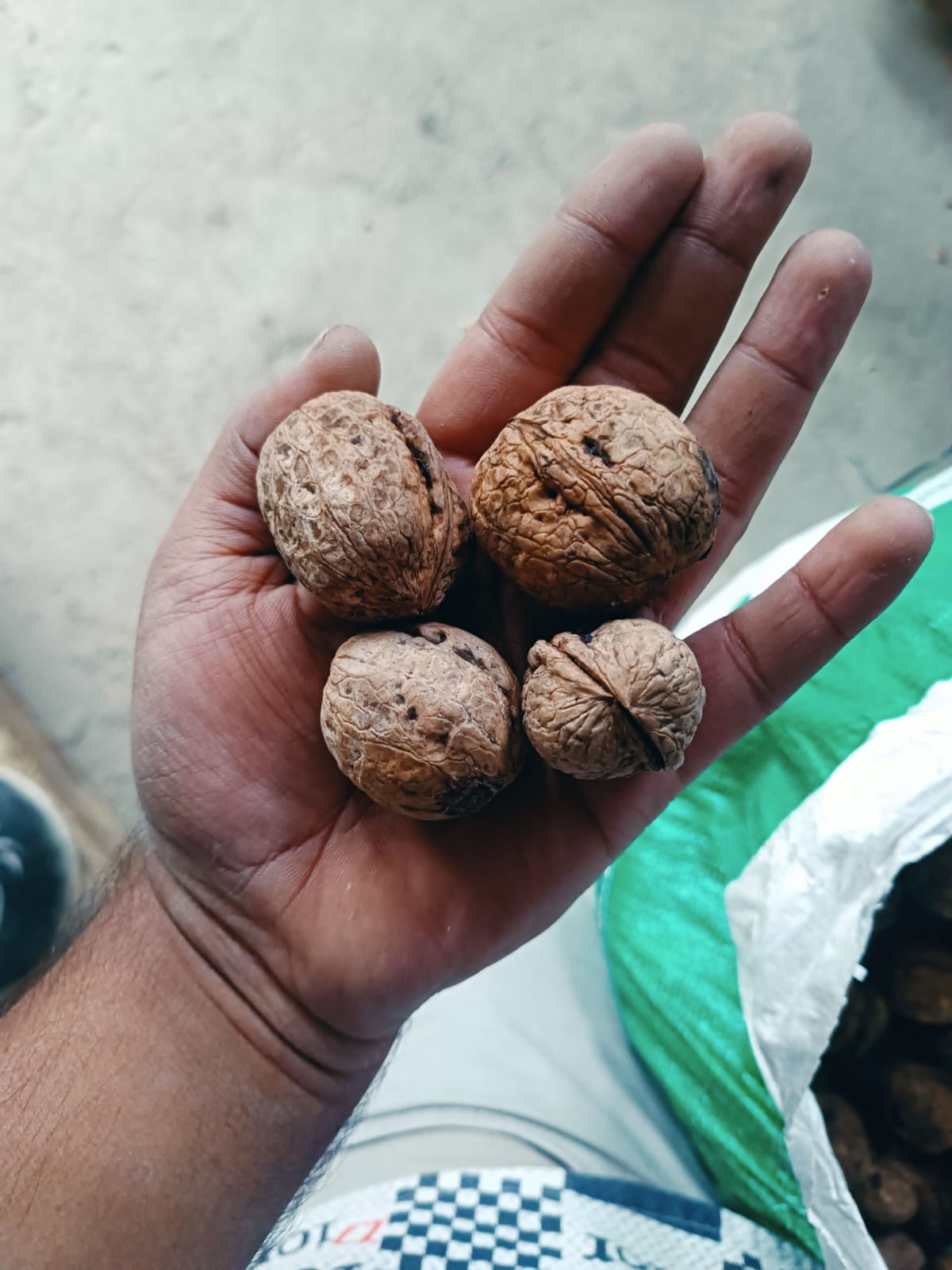
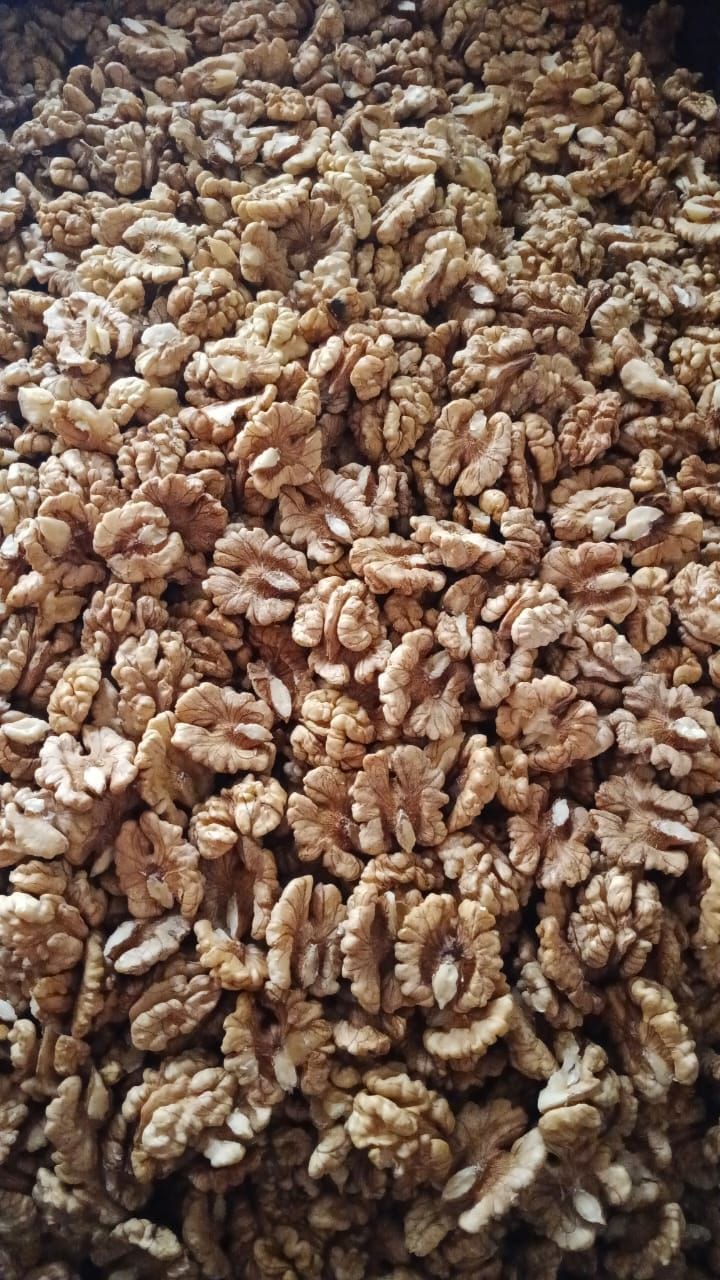
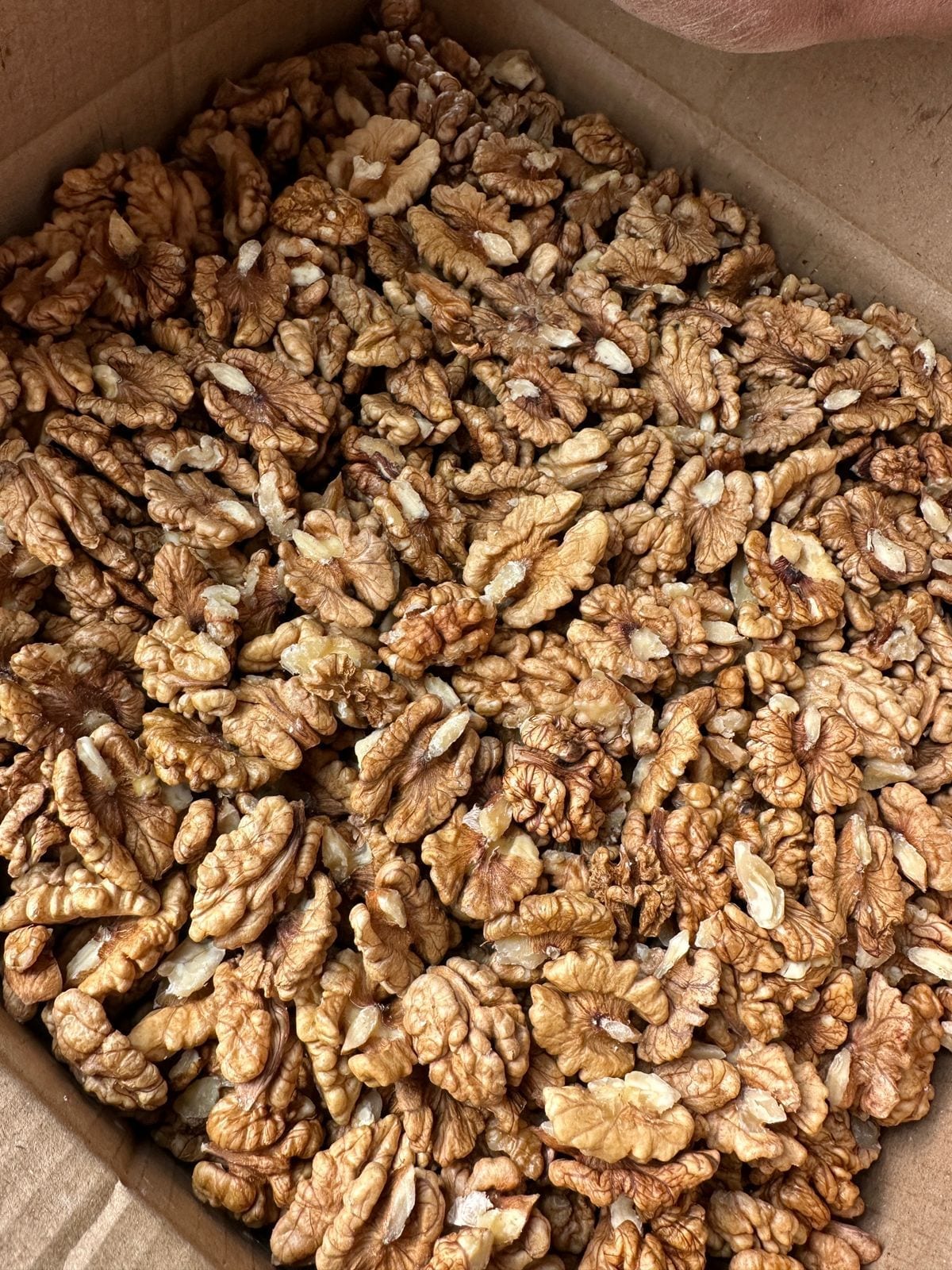
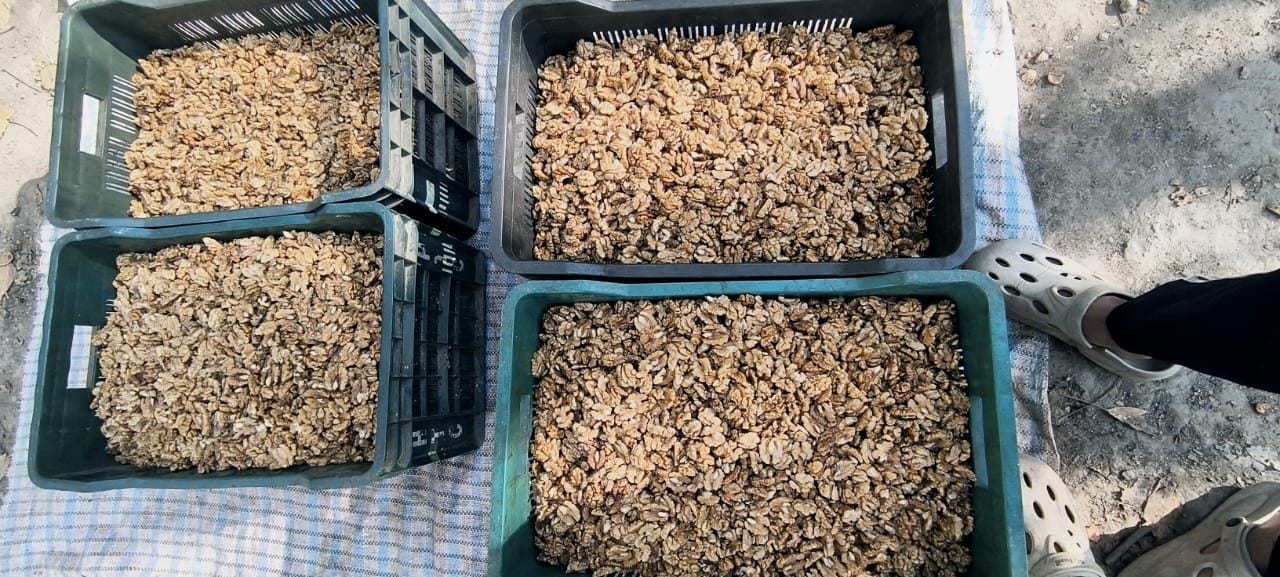
From our orchards
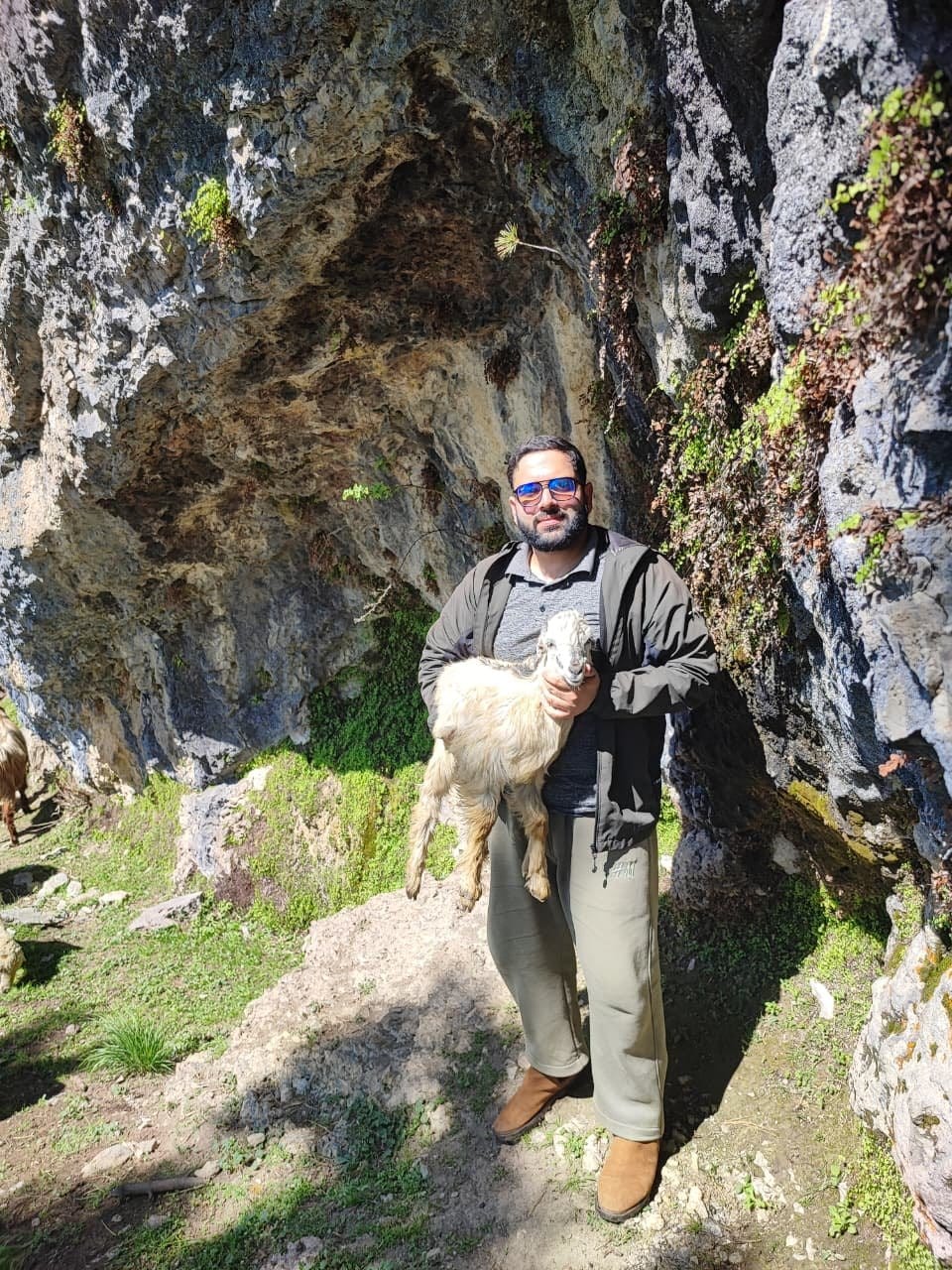
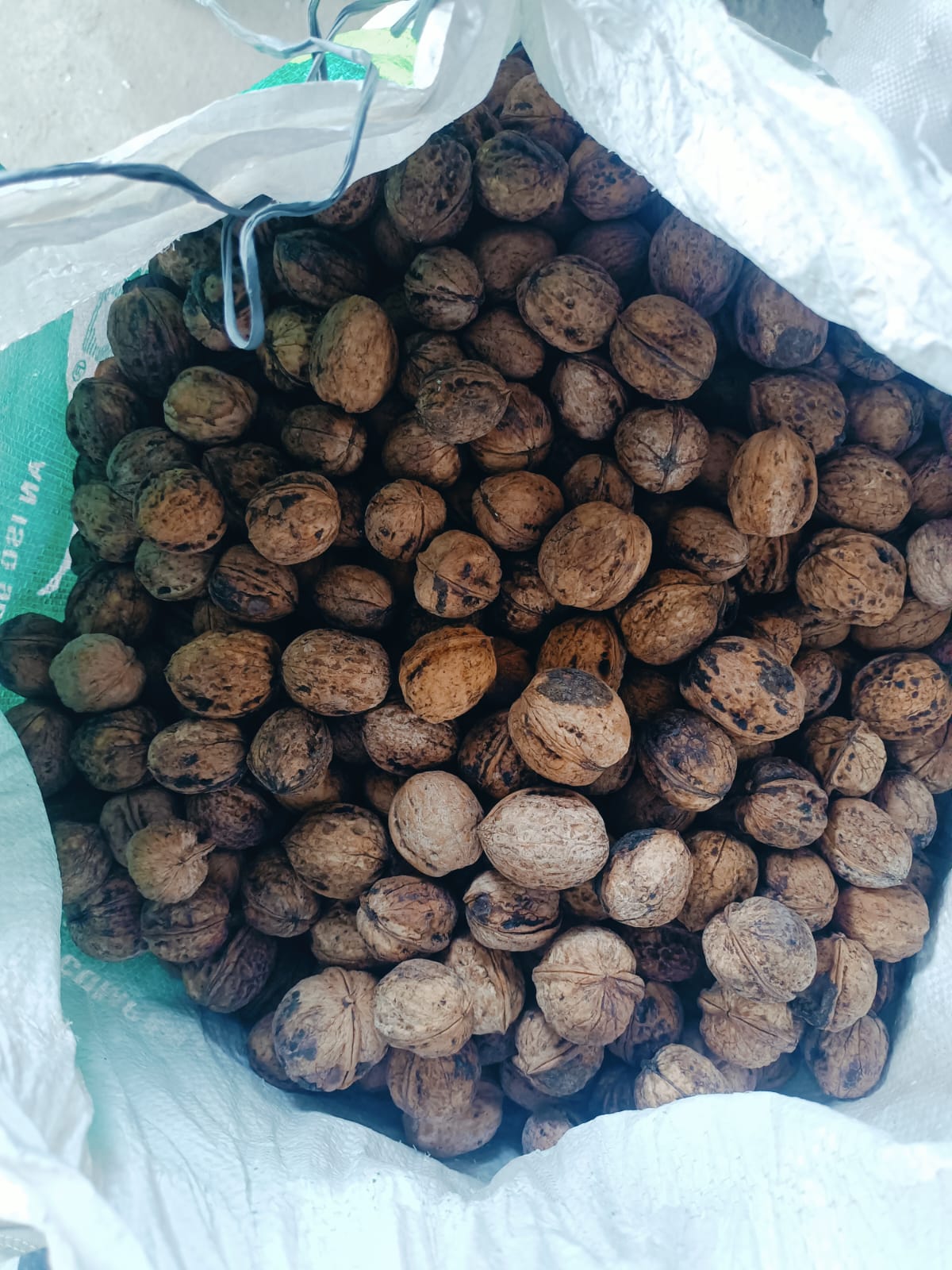
Kashmiri walnuts, before they reach the pouch
Real photographs of our own kernels — cracked, sorted and graded by colour before the palest go into your pouch.
The walnut guide
Kashmiri walnut kernels (akhrot giri): the complete guide
Kashmiri walnut kernels are the shelled halves of walnuts (Juglans regia) grown in high-altitude orchards in the Kashmir Valley — the akhrot dry fruit, sold out of its shell as akhrot giri. This pack holds the kernel only: light halves, sorted by hand and cold-stored, with nothing added. The price is ₹1,550 a kilogram at every size — ₹390 for 250 g, ₹775 for 500 g and ₹1,550 for 1 kg — delivered across India.
Kashmiri walnut kernels at a glance
- Product: shelled walnut kernels (akhrot giri), sold by kernel weight — no shell in the pack.
- Species: Juglans regia, the walnut traded as the English or Persian walnut.
- Names: walnut in English, akhrot in Hindi and Urdu, doon in Kashmiri. Giri means kernel.
- Origin: high-altitude orchards in Shar Shali village, Khrew, Pampore (Pulwama district, Kashmir), about 1,600 m above sea level; paper-shell walnuts.
- Cracking: by hand, in Kashmir.
- Sort: light halves, sorted by hand, then cold-stored so the natural oils stay fresh.
- Price: ₹1,550 per kg — 250 g ₹390, 500 g ₹775, 1 kg ₹1,550.
- Shell to kernel: 1 kg of walnuts in the shell gives 400–500 g of kernel.
- Season: the Kashmir walnut harvest runs from September into October.
- GI status: Kashmiri walnuts have no GI tag yet; an application filed in June 2024 is pending.
Walnut kernels meaning in Hindi, and akhrot in English
Walnut kernels means akhrot giri, or akhrot ki giri (अखरोट की गिरी): the part of the walnut you eat, out of its shell. Akhrot is the walnut and giri is the kernel — so akhrot in English is walnut, and akhrot giri is walnut kernels. Walnut giri, shelled walnut kernels and walnuts without shell all name what is in this pack. In Kashmiri, the walnut is doon.
The difference matters when you shop. Plain “akhrot” on a price list usually means walnuts still in the shell, so an akhrot 1 kg price and an akhrot giri 1 kg price describe different amounts of food. Our guide to walnuts and walnut kernels does the conversion, and the same page is there in Hindi and Hinglish.
Where Kashmiri walnuts come from
Jammu and Kashmir grows most of India’s walnuts — over 85 per cent of national output by ICAR’s figure, and more than 90 per cent in figures attributed to APEDA. India produced about 3.2 lakh tonnes of walnuts from roughly 97,000 hectares in 2024-25. Kashmiri akhrot comes mainly from Anantnag, Kupwara and Pulwama, with Shopian, Baramulla, Budgam, Srinagar and Ganderbal close behind.
Most of those trees were raised from seed rather than grafted from a named cultivar. That is why Kashmiri walnuts vary from tree to tree in size, shell and kernel colour — and why every lot has to be sorted. Ours come from orchards in Shar Shali (Sharshali) village in Khrew, near Pampore in Pulwama district — one of the valley’s main walnut districts. Khrew sits at about 1,600 metres above sea level, and our trees stand 20 to 30 feet tall. They are high-altitude orchards where the trees grow slowly, and that slow growth is why the kernels come out plump, pale and low in bitterness.
Kashmiri walnut varieties: kagzi, burzul and wonth
Kashmiri growers sort their walnuts into three types by the shell, not by cultivar:
- Kagzi (kaghazi, from kagaz, paper): a thin, paper shell that cracks in the hand. It sells for the most.
- Burzul (barzul): a medium shell, between the other two.
- Wonth (wounth): the hardest shell and the cheapest nut.
Research stations have released named varieties too — SKUAST-Kashmir’s Hamdan and Sulaiman among them — but most of the crop still comes from seedling trees classed by their shell. Ours are paper-shell walnuts.
Why the shell decides the kernel
A paper shell lets the kernel come out as whole walnut halves; a hard shell has to be hammered, and the kernel breaks into pieces on the way out. The shell also decides how much you actually eat: a kilogram in the shell gives 400–500 g of kernel, and ICAR’s Srinagar institute measured kernel recovery of 38 to 66 per cent across eleven selected Kashmiri trees. A kagzi akhrot in the shell is the same nut as this giri, with the cracking still to do.
Walnut season in Kashmir: from tree to pack
The harvest starts in September and runs into October. Climbers knock the nuts down with long willow or cedar poles, families gather them from the grass, and the green husks come off. The nuts are washed, dried in the sun and shelled by hand. Ours are cracked by hand in Kashmir, one nut at a time — the way whole halves survive the shell.
Speed is what keeps a kernel pale. University of California walnut research found that most quality loss happens in the first nine hours after harvest, and that kernels darken faster the hotter it is — so picking, hulling and drying cannot wait. Our kernels are then sorted by hand into light halves and cold-stored, so the oil stays fresh until packing. Searches for walnut prices in India climb through November and December, their busiest weeks of the year.
How walnut kernels are graded: extra light, light, amber
FSSAI’s food standard for walnut kernels has applied since February 2022. The colour words on walnut packs, from extra light to amber, are the four shades of the walnut colour chart in the United States grade standard, which also sorts lots by size:
| Term | What it means | What it tells you |
|---|---|---|
| Extra light | Palest shade on the walnut colour chart | A quickly handled lot; the highest-priced colour |
| Light | The next shade, still pale | Priced just below extra light — what we sort for |
| Light amber | Light brown skin | More heat, delay or storage time in its history; priced lower |
| Amber | Darkest shade in the US commercial grade | Priced lowest; anything darker is “off colour” |
| Halves | At least 85% half kernels by weight | Platters, soaking, gifting |
| Pieces and halves | At least 20% halves, the rest large pieces | Cooking and baking |
| Pieces | Broken kernels | Halwa, brownies, chutney |
Indian listings also use trade names such as “extra light halves”, “light broken”, “snow white” and “brown halves”; treat them as labels until the seller tells you what they mean. Colour is not a freshness test on its own either — a pale kernel stored warm can still taste stale — so smell and taste it too. Our Kashmiri vs California walnuts comparison goes further into kernel colour.
How to choose good walnut kernels
If you are looking for the best walnuts in India, there is no single answer — there is a fresh, well-handled lot, sold honestly. Six checks, in order:
- Kernel or shell? Compare kernel prices with kernel prices.
- Smell. Fresh kernels smell faintly sweet and nutty; a smell like paint thinner means the oil has turned rancid.
- Snap. A good half breaks cleanly. Soft or rubbery kernels have taken on moisture or age.
- Taste. Mild, with a light tannic edge from the skin. A sharp, bitter burn at the back of the throat is stale oil.
- Look. Even colour, no mould, no webbing or insect damage, no bits of shell.
- Label. A packing date, an origin, and a seller who answers questions.
Buying walnut kernels online: 250 g, 500 g or 1 kg
When you buy walnuts online here, all three packs hold the same hand-sorted light halves at the same rate, ₹1,550 a kilogram, so the larger pack buys convenience rather than a discount. Choose by how fast you eat them:
- 250 g (₹390): to try them, or for one person’s daily handful.
- 500 g (₹775): a household jar for breakfasts, baking and guests.
- 1 kg (₹1,550): walnut kernels 1 kg for halwa, brownies, a winter dry-fruit platter, or splitting between two homes. Freeze what you will not open within a few weeks.
That makes our Kashmiri walnut price for 1 kg of kernels ₹1,550. If you are weighing it against a walnuts 1 kg price for nuts in the shell, a kilogram of kernels equals 2 to 2.5 kg of in-shell walnuts. Our Kashmiri walnut price per kg guide sets out the market bands.
Storage and shelf life
Walnuts are about two-thirds fat, and most of it is polyunsaturated — the kind that oxidises fastest. Heat, light and air turn it rancid; cold slows that down. Keep kernels airtight, in the dark, and in the fridge once the weather warms. University of California guidance gives dried walnuts up to a year in the refrigerator and up to two years frozen at −18 °C; Michigan State University Extension is more cautious, at three months in the fridge and a year in the freezer. Ours are cold-stored before packing, and the best-before date on the pack is the one to follow.
Walnut nutrition per 100 g
Typical values for walnuts from USDA FoodData Central (record 170187), not a laboratory test of our batch:
- Energy: 654 kcal
- Protein: 15.2 g
- Fat: 65.2 g, of which polyunsaturated 47.2 g — including 9.1 g of alpha-linolenic acid (ALA), the plant omega-3
- Carbohydrate: 13.7 g, including 6.7 g of fibre
- Magnesium: 158 mg
A 28 g handful — about 14 halves — carries roughly 185 kcal, 4.3 g of protein and 2.6 g of ALA. For daily amounts and what the research says, read Kashmiri walnut benefits.
Sources
- ICAR, Indian Farming 75(6), 2025
- APEDA — walnuts
- Kashmir Life — the 2025 walnut harvest
- GI Registry — application 1294
- ICAR-CITH kernel study, Indian J. Agric. Sci. 90(3)
- Khrew — elevation 1,607 m (Wikipedia)
- USDA standards for shelled walnuts
- University of California ANR — walnut harvest quality
- UC ANR — storing nuts from the home orchard
- Michigan State University Extension — preserving walnuts
- USDA FoodData Central 170187 — walnuts
Why buy from us
Compare on facts, not marketing.
| The Heritage Kashmir | Typical online sellers | |
|---|---|---|
| Where it comes from | Bought directly from growers in the Kashmir valley — never from a mandi | Outsourced from mandis, importers or re-packers. Most brands, however big, do not own a farm. |
| Proof of what you get | FSSAI-licensed, with origin details on every order | No verifiable proof — just a label |
| Freshness | Cold-stored and hand-sorted, packed to order | Unknown stock age, often months old |
| Purity | Single-origin — never blended | Often blended, diluted, or of mixed origin |
| Price | Best rate when you book direct on WhatsApp | Marked up by middlemen & marketplace fees |
Booking a larger order? Message us on WhatsApp for the best direct-from-farm rate.
Order on WhatsAppBuying walnut kernels (akhrot giri)
Akhrot giri is the edible walnut kernel, sold without its shell. This is a kernel listing. A kilogram of in-shell walnuts is not the same quantity of food as a kilogram of kernels.
Compare before you choose
Compare kernel weight, halves versus pieces, the packing date and delivered price. Whole halves suit presentation; pieces can be useful when chopping for cooking. Check the actual pack description rather than assuming a grade from colour alone.
Check the pack
Ask for current pack photographs if the proportion of halves matters to your recipe. Check the seal and the storage instructions when the order arrives.
Delivery, payment and returns
- Dispatch
- Packed and dispatched from Pampore within 24–48 hours of a confirmed order, tamper-sealed.
- Delivery
- Prepaid delivery is ₹60 on every order, with priority dispatch: DTDC Express, 7–8 days, or DTDC Airmax, 3–5 days. A tracking number is emailed after dispatch. The store minimum is ₹600 per order.
- Payment
- Pay online through Razorpay (UPI, card, netbanking or wallet), or choose cash on delivery for a ₹99 delivery fee where DTDC offers it for your PIN code. COD goes by DTDC Express (7–8 days) and is packed once you confirm the order on WhatsApp.
- Returns
- Arrives damaged, leaking, wrong or not as described? Send a photo on WhatsApp within 48 hours of delivery and we refund or replace in full — your choice, nothing to post back. Opened food cannot otherwise be returned. Full policy.
Frequently asked questions
What is akhrot giri?
Akhrot is the Hindi and Urdu word for walnut; giri means the kernel — the part inside the shell. So akhrot giri is shelled walnut kernels, which is exactly what this pack contains. It matters when comparing prices: a kilogram of in-shell walnuts yields only about 400–500 g of kernel, so in-shell stock advertised at half the price of kernels is usually the same price or dearer once you weigh what you can actually eat.
What is the akhrot giri rate per kg?
Ours is ₹1,550 a kilogram — ₹1,550 for the 1 kg pack, ₹775 for 500 g, and ₹390 for 250 g (which rounds up by ten rupees a kilo rather than printing half a rupee on a price tag). That is the kernel rate, not an in-shell rate, and it is the same graded stock at every size. Prices across the market vary with grade, kernel colour and whether the seller is quoting in-shell or shelled weight — always check which.
Why are Kashmiri walnuts better than regular walnuts?
Kashmiri walnuts grow slowly in high-altitude orchards — ours at about 1,600 metres in Khrew, Pampore — producing plumper, paler kernels with less bitterness. Many Kashmiri trees bear paper-thin (kagzi) shells, so the kernels come out whole and have a delicate, buttery flavour. We cold-store every batch so the natural oils stay fresh.
How should I store walnut kernels?
Walnuts have high oil content and can go rancid if stored poorly. Keep them in an airtight container in a cool, dry place. In summer or humid climates, refrigerate them — they will stay fresh for 6+ months. For long-term storage, freeze them. Never store walnuts near onions, garlic, or strong spices — they absorb odours easily.
What does walnut kernels mean in Hindi?
Walnut kernels means akhrot giri, or akhrot ki giri (अखरोट की गिरी) — walnuts taken out of their shell. Akhrot is walnut and giri is kernel. A pack labelled walnut kernels, walnut giri or akhrot giri holds the shelled nut with no shell weight in it, which is what this pack contains.
What is akhrot called in English?
Walnut. Akhrot is the Hindi and Urdu word for walnut, and akhrot giri is walnut kernels in English. The species is Juglans regia, traded as the English or Persian walnut. In Kashmiri it is called doon.
Are Kashmiri walnuts GI-tagged?
Not yet. An application for "Jammu Kashmir Walnut" (GI application no. 1294) was filed on 26 June 2024, and the Geographical Indications Registry showed it at pre-examination when we checked in October 2026. Until a tag is granted, no seller can honestly call Kashmiri walnuts GI-tagged.
When is walnut season in Kashmir?
The harvest runs from September into October. The nuts are knocked from the trees with long poles, then de-husked, washed, dried in the sun and shelled by hand before sorting. We cold-store our kernels so they stay fresh between harvests.
What are kagzi walnuts (kagzi akhrot)?
Kagzi, from kagaz (paper), is the Kashmiri name for thin, paper-shell walnuts that crack in the hand. Growers class walnuts by shell: kagzi is the thinnest and sells for the most, burzul is medium, and wonth is the hardest and cheapest. A paper shell lets the kernel out in whole halves; our kernels come from paper-shell walnuts.
What do light, light amber and amber mean on walnut kernels?
They are colour grades from the walnut colour chart in the United States grade standard — extra light, light, light amber and amber, from palest to darkest. Lighter kernels fetch more, because kernels darken with heat and delay at harvest and with time in storage. Ours are sorted by hand for light halves. Colour alone does not prove freshness, so smell and taste matter too.
Are your walnut kernels whole halves or broken pieces?
The pack is sorted by hand for light halves. Walnut halves are fragile, though, so if whole halves matter for a recipe or a gift platter, message us on WhatsApp before you order and we will send a photograph of current stock.
How can I tell if walnut kernels have gone rancid?
Smell them first: fresh kernels smell faintly sweet and nutty, rancid ones smell like paint thinner. Then taste one — stale oil leaves a sharp, bitter burn at the back of the throat. A rubbery texture, mould or insect webbing are further reasons to throw them out.
How long do walnut kernels last?
Months, if they are kept cold and airtight; much less at warm room temperature. University of California guidance gives dried walnuts up to a year in the refrigerator and up to two years in a freezer at −18 °C; Michigan State University Extension gives a more cautious three months and one year. Follow the best-before date on our pack, and refrigerate once the weather warms.
Where do your walnuts come from?
From orchards in Shar Shali (Sharshali) village in Khrew, near Pampore in Pulwama district, Kashmir, about 1,600 metres above sea level, where our trees stand 20 to 30 feet tall. Pulwama is one of the valley's main walnut districts, alongside Anantnag and Kupwara. The walnuts are paper-shell (kagzi) nuts; the kernels are sorted by hand into light halves and cold-stored before packing.
Are your walnuts cracked by hand?
Yes. Our walnuts are cracked by hand in Kashmir, one nut at a time, and the kernels are then sorted by hand into light halves. Hand-cracking paper-shell (kagzi) walnuts is how whole halves come out of the shell rather than crushed pieces.
Where are walnuts grown in India?
Mostly in Jammu and Kashmir, which grows over 85 per cent of India's walnuts by ICAR's figure (over 90 per cent in figures attributed to APEDA). Uttarakhand, Himachal Pradesh and Arunachal Pradesh grow most of the rest. In Kashmir the main walnut districts are Anantnag, Kupwara and Pulwama.
How much protein and omega-3 is in walnut kernels?
Per 100 g, USDA FoodData Central lists 654 kcal, 15.2 g of protein, 65.2 g of fat and 9.1 g of alpha-linolenic acid (ALA), the plant form of omega-3. A 28 g handful of about 14 halves gives roughly 4.3 g of protein and 2.6 g of ALA. These are typical values for walnuts, not a test of our batch.
Should I compare akhrot giri prices with whole walnuts?
Compare like with like: kernel prices with kernel prices. Whole walnuts include shell weight, so their per-kilogram price is not a direct comparison.
What pack sizes and prices are available for Walnut Kernels (Akhrot Giri)?
250 g: ₹390; 500 g: ₹775; 1 kg: ₹1,550. Prices include GST. Select a pack to check availability. The store minimum is ₹600 per order. Prepaid delivery is ₹60 on every order, with priority dispatch: DTDC Express, 7–8 days, or DTDC Airmax, 3–5 days.
What customers say
5.0from 11 verified buyers of Walnut Kernels (Akhrot Giri)5.0on Google from 63 reviews of The Heritage Kashmir
Reviews from buyers on this website come first, then reviews of the shop on Google.
- Verified buyerBought from us · October 2026Walnut Kernels (Akhrot Giri)
One tree walnuts and very good quality
Texture is great
- Verified buyerBought from us · October 2026Walnut Kernels (Akhrot Giri)
Oil content buhat zyda hai .... Apka product buhat acha laga . Thank you
- Verified buyerBought from us · October 2026Walnut Kernels (Akhrot Giri)
Walnut were top quality
Pure , white and tasty, worth it
- Verified buyerBought from us · October 2026Walnut Kernels (Akhrot Giri)
Amazing akhrot giri
Very good quality
- Verified buyerBought from us · October 2026Walnut Kernels (Akhrot Giri)
One tree walnuts were very good
- Verified buyerBought from us · October 2026Walnut Kernels (Akhrot Giri)
Absolutely top notch
- Verified buyerBought from us · October 2026Walnut Kernels (Akhrot Giri)
Very good snow white Almonds
- Verified buyerBought from us · October 2026Walnut Kernels (Akhrot Giri)
Rated 5 out of 5 after buying.
- Verified buyerBought from us · October 2026Walnut Kernels (Akhrot Giri)
Rated 5 out of 5 after buying.
- Verified buyerBought from us · October 2026Walnut Kernels (Akhrot Giri)
Rated 5 out of 5 after buying.
- Verified buyerBought from us · September 2026Walnut Kernels (Akhrot Giri)
Rated 5 out of 5 after buying.
 FaizanGoogle review · October 2026
An exceptional experience! The quality of their Kashmiri dry fruits and authentic saffron is unmatched. Everything is incredibly fresh, packed beautifully, and tastes amazing. If you are looking for premium, genuine Kashmiri produce, this is the perfect place. Highly recommended!
 Arsalan ShahGoogle review · October 2026
Fresh dry fruits, good quality, and reasonable prices. Highly recommended!
 Sheikh TawqeerGoogle review · October 2026
Really good quality dry fruits and saffron. Everything felt fresh and authentic, and the service was warm and friendly. Definitely worth visiting if you’re looking for genuine Kashmiri products!
 Rahul MauryaGoogle review · October 2026
Bought from here a few times now. Always got 10/10 quality saffron & dry fruits. Easily one of the best in Kashmir
 Pranav MishraGoogle review · October 2026
Really good stuff icl, greatest saffron and dryfruits seller in the multiverse
 Faisal QayoomGoogle review · October 2026
Excellent quality and freshness! The dry fruits were fresh, tasty, and well-packed. Great quality at a reasonable price. Highly recommended! ⭐⭐⭐⭐⭐
 Ahmad basha SyedGoogle review · October 2026
Excellent quality saffron! The strands look fresh and premium, with a beautiful natural aroma and colour. The quality is genuinely impressive, and the packaging was neat and secure. Very happy with my purchase. Definitely worth buying! ❤️
 Danish HameedGoogle review · October 2026
Very goof quality
 Sheikh Tahfeez AhmadGoogle review · October 2026
Quality is superb
 THE KNOWN 1Google review · October 2026
Premium quality stuff 🤌🏻
 Bhat EhsanGoogle review · October 2026
Excellent
 Kaaabir KhanGoogle review · October 2026
Superb Quality! And best price you will ever get Worthy Experience ❤️
 AyaN AmeenGoogle review · October 2026
beyond expectation... quanlity is really superb
 Majid RatherGoogle review · October 2026
Supr quality
 zaid khanGoogle review · October 2026
one of the best experiences.
 Rakib ZahoorGoogle review · October 2026
It's a great place. Quality is superb
 magray shakirGoogle review · October 2026
quality to b trusted
 Sheikh SaadGoogle review · October 2026
Very good quality
 suhaib QurashiGoogle review · October 2026
Superb quality 👌
 Kifayat FarooqGoogle review · October 2026
Great quality and awesome hospitality
 rahilGoogle review · October 2026
Quality is amazing, loved it
 Zamin BashirGoogle review · October 2026
super quality
 Magandeep SinghGoogle review · October 2026
Quality is top notch and really fabulous! Authentic and amazing! Would recommend to everyone! 😍
 Naveed Mohammad pareyGoogle review · October 2026
“The saffron quality is genuinely impressive. Great aroma, vibrant colour, and a rich flavour. A wonderful product from Heritage Kashmir.”
 Bhat RakibGoogle review · October 2026
This product is just 🔥 Looks aesthetic, feels premium, and works perfectly. Instantly became my favourite. Quality 10/10.
 Kashif ShabirGoogle review · October 2026
Best quality ❤❤
 Yasir HamidGoogle review · October 2026
Outstanding
 moomin magrayGoogle review · October 2026
The overall experience was too good
 Masroor RiyazGoogle review · October 2026
Exceptional quality saffron with deep-red threads, an intense aroma, and rich, natural color in just a few strands
 Hammaad SuhailGoogle review · October 2026
Very good quality and completely pure.The quality is consistently excellent. Definitely one of the best places for genuine, high-quality products. Highly recommended!
 Sheikh AhsanGoogle review · October 2026
Great quality
 Khass NafarGoogle review · October 2026
Good quality
 XeropXGoogle review · October 2026
Best experience
 Rujhan RatherGoogle review · October 2026
excellent quality
 Mozin GaniGoogle review · October 2026
Pure saffron quality with genuine prize.
 Moien ShabanGoogle review · October 2026
Really impressed with the quality of the saffron from The Heritage Kashmir. The saffron has a beautiful natural aroma, rich colour, and the quality feels genuinely premium. The packaging was also neat and secure. Overall, a very good experience and I’m definitely satisfied with my purchase. Highly recommended! ❤️
 MOHAMMAD ALEEMGoogle review · October 2026
Good-quality natural products with neat packaging. The saffron has a lovely aroma,Smooth delivery and a great overall experience. Would definitely recommend!
 Shahid NisarGoogle review · October 2026
Good quality stuff
 Shaiq NabiGoogle review · October 2026
Good-quality natural products with neat packaging. The saffron has a lovely aroma, and the shilajit feels authentic and well-presented. Smooth delivery and a great overall experience. Would definitely recommend!
 PEACE FOUNDATIONGoogle review · October 2026
I purchased saffron from your website.... It was really nice ,authentic.. delivery was on time...... Quality, it was super awesome.......
 wani musavirGoogle review · October 2026
Trustworthy service and quality products.
 Naveen SonyGoogle review · October 2026
i bought saffron powder and it was extremely good. the quality was excellent and i was really happy with the product. delivery was also smooth and everything was well packed. really satisfied with my purchase and would definitely recommend them.
 Imad WaniGoogle review · October 2026
They sell iso grade 1 Saffron and that is unheard from other sellers. Wishing you lots of success with this amazing journey.
 Sadaa SadaariyazGoogle review · October 2026
Wishing Kashmir Heritage huge success and hoping it reaches people all across the country. Keep going and keep making Kashmir proud! 🤝✨
 AFTAB WANIGoogle review · October 2026
Proud to see kashmir heritage promoting The saffron, looks authentic, has a beautiful aroma, and gives a lovely natural colour and flavour. The packaging was also good. Highly recommended for anyone looking for quality Kashmiri saffron. 🌸❤️
 Suhaib MirGoogle review · October 2026
Mudasir is a great businessman, I have known him for long and he cares about his customers
 faizan bashirGoogle review · October 2026
Very nice and 100% authentic products💕
 Maaid Farooq WaniGoogle review · October 2026
Exceptional. Quality is fantastic. I compared your product with top bands out in market and I found your product best. Quality is superb
 Daily Quran_360Google review · October 2026
Original story.
 Kashish KhanGoogle review · October 2026
Thank you
 Ayushi TiwariGoogle review · October 2026
Thank you
 Bhatt YawerGoogle review · October 2026
🔥💝
 lone hashimGoogle review · October 2026
Thank you
 Fahadsajad BhatGoogle review · October 2026
Rated five stars on Google.
 Tawqeer NazirGoogle review · October 2026
Rated five stars on Google.
 Mohsin BhatGoogle review · October 2026
Rated five stars on Google.
 Saqib AltafGoogle review · October 2026
Rated five stars on Google.
 TerminatorGoogle review · October 2026
Rated five stars on Google.
 Shamiq ShafiGoogle review · October 2026
Rated five stars on Google.
 Suhail ShafiGoogle review · October 2026
Rated five stars on Google.
 Jitendra Kumar PradhanGoogle review · October 2026
Rated five stars on Google.
 TawseefGoogle review · October 2026
Rated five stars on Google.
 anit beniwalGoogle review · October 2026
Rated five stars on Google.
You might also like