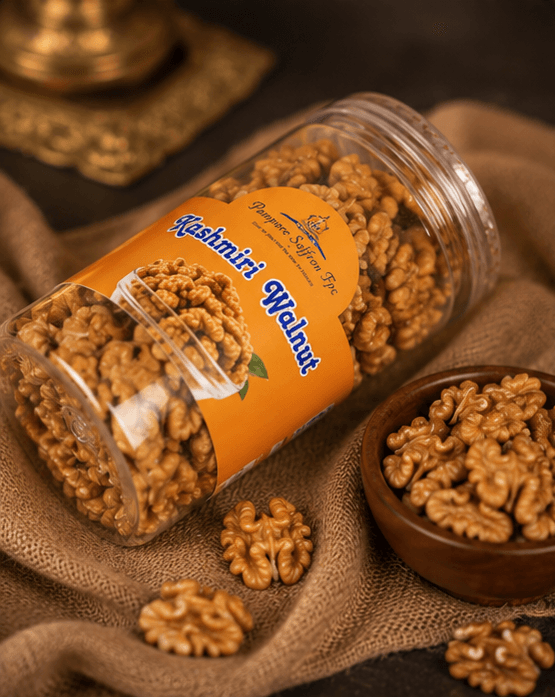
Akhrot is the walnut. Giri is the kernel — the part inside the shell. And one kilogram of in-shell walnuts yields only about 400–450 g of kernel, which is the entire reason in-shell prices look so much better than they are. Almost every confused walnut purchase in India traces back to those two sentences not being said out loud. This page says them, does the arithmetic, and then tells you which one to actually buy.
The vocabulary, settled
- Walnut / akhrot — the same thing in two languages. Akhrot is Hindi and Urdu. No difference in the nut, no difference in quality, no hidden meaning.
- Kernel / giri — the edible part, shell removed. “Akhrot giri” on a label means shelled walnut kernels.
- In-shell — sold whole, shell on. You crack them.
- Halves, quarters, pieces — how intact the kernel is after shelling, not how good it is.
The one that carries money is giri. When a pack says giri, the printed weight is edible weight. When it does not, you may be buying shell — and shell is roughly half of what you are lifting.
The conversion, done properly
Thin-shelled walnuts yield a little over 45% kernel by weight. Thick shells give considerably less. Take 45% as a working figure for good stock, and the picture changes completely:
| In-shell price | Kernel from 1 kg | Real cost per kg of kernel |
|---|---|---|
| ₹500 / kg | 450 g | ₹1,111 |
| ₹700 / kg | 450 g | ₹1,555 |
| ₹900 / kg | 450 g | ₹2,000 |
| ₹700 / kg (thick shell, 35%) | 350 g | ₹2,000 |
Read the last two rows together. The same ₹700 in-shell price is worth ₹1,555 or ₹2,000 per kilogram of actual food depending only on shell thickness — something you cannot judge from a photograph and that the listing will rarely state. This is why shell thickness is how Kashmir grades walnuts in the first place: Kagzi, Khanak, Burzul and Wonth describe exactly the variable that decides what you get for your money.
It also explains a common online experience: an in-shell listing at a headline price that seems far below every kernel seller, which on arrival produces a disappointing bowl. Nothing dishonest necessarily happened. The units were simply never reconciled.
The thing that argues against buying kernels
We sell kernels, so this section is against interest, and it is still true.
The shell is very good packaging. Walnut fat is roughly 65% of the nut and heavily polyunsaturated, which is the fat most vulnerable to oxidation. Light, warmth and oxygen are what drive that reaction, and a shell blocks all three. The moment a walnut is cracked, the clock speeds up.
So a bag of in-shell walnuts kept cool in a cupboard will usually outlast loose kernels bought on the same day. Kernels are not fresher because they look cleaner — they are simply further along.
The sensible conclusion is not “never buy kernels”. It is buy kernels in a size you will finish. A 250 g pack eaten over a few weeks is in far better condition at the last handful than a kilogram bought once and opened repeatedly for six months. If you do buy in bulk, the freezer is the honest answer.
Halves, quarters, pieces — and where the money goes
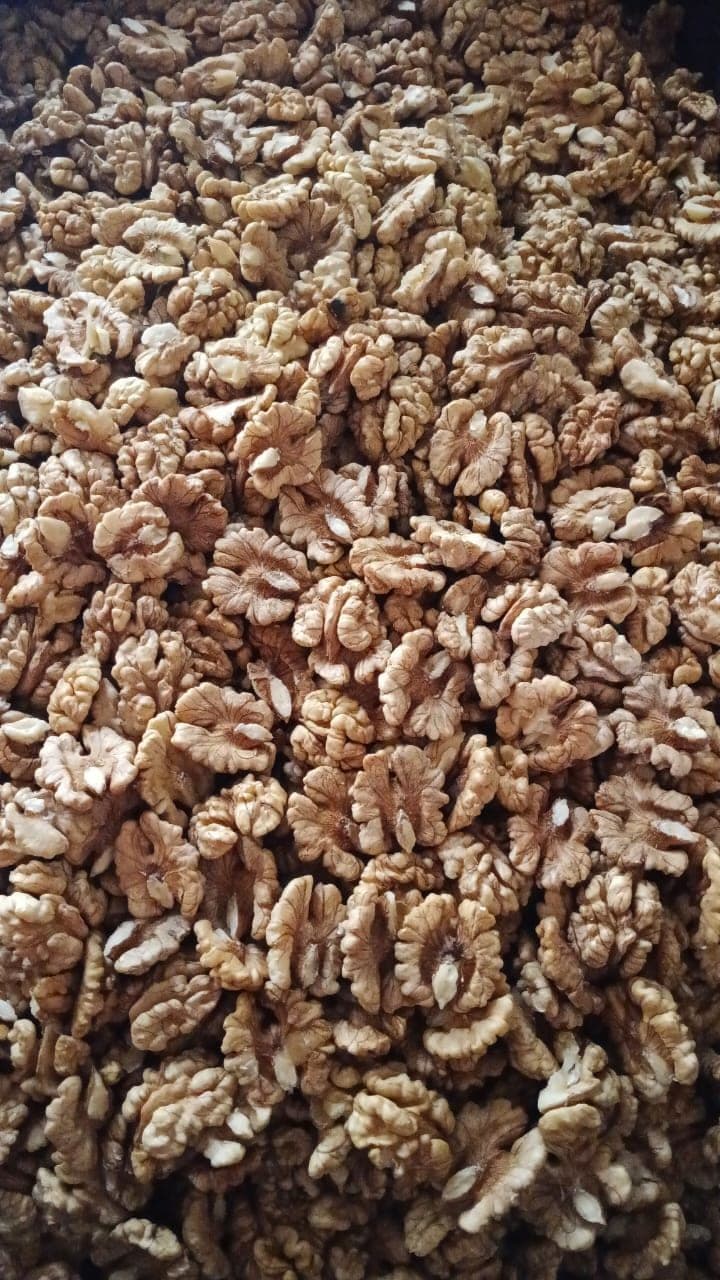
A walnut splits naturally into two halves. Shelling carefully enough to keep them intact takes time and skill, which is why halves cost more than quarters, and quarters more than pieces.
What you are paying for is appearance. There is no nutritional difference between a half and a piece of the same nut from the same lot, and no flavour difference either. If the walnuts are going into a cake batter, a chutney, a grinder or your hand, buying pieces instead of halves is one of the few completely free savings available in Indian dry fruit.
Halves earn their premium when the nut is seen — on a dessert, in gifting, across a festive plate. That is a real reason, and it is the only one. Hand-cracking is also why Kashmiri kernels tend to arrive as intact halves more often than machine-shelled stock: a person cracking one nut at a time can feel the seam.
How to judge a kernel in front of you
- Smell it first. Fresh walnut smells faintly sweet and buttery. Anything sharp, bitter or reminiscent of old paint is oxidation, and no amount of provenance repairs it.
- Snap a half. A fresh kernel breaks with a slight crispness. A limp, bendy kernel has taken on moisture and is on its way out.
- Look at the spread, not the shine. Uniform colour across an entire lot tells you it was graded. Some variation is normal in seedling-grown stock and is not a defect.
- Taste the skin. The papery skin carries most of the bitterness. A little is the walnut’s character; a harsh burn at the back of the throat is rancidity.
- Ask which harvest. Walnuts come off the tree in Kashmir around September and October. A seller who cannot name the harvest year is telling you something.
What we sell
We sell akhrot giri — shelled Kashmiri walnut kernels — at ₹1,550 a kilogram, in 250 g, 500 g and 1 kg packs. Kernels rather than in-shell, deliberately, because that is what most households actually use. The printed weight is edible weight; there is no shell in it.
Given everything above, the honest recommendation is to buy the pack size matching how fast you eat them rather than the one with the best per-kilogram figure. For most homes that is 250 g or 500 g. Ask us which harvest is current on WhatsApp at +91 95966 08297 — and if you want the wider daily-amount picture across almonds, walnuts and figs, the 30-gram rule is charted here.