Kahwa is green tea brewed with whole spices and a few saffron threads, drunk without milk. That makes it a good daily drink — warm, unsweetened, low in caffeine at roughly 25–35 mg a cup — and it does not make it a medicine. Nearly everything genuinely good about kahwa comes from what it replaces: a sweet milk chai, a soft drink, a fourth coffee. That is a real benefit and it is worth saying plainly, because the version of this article you usually find promises rather more.
What is actually in the cup
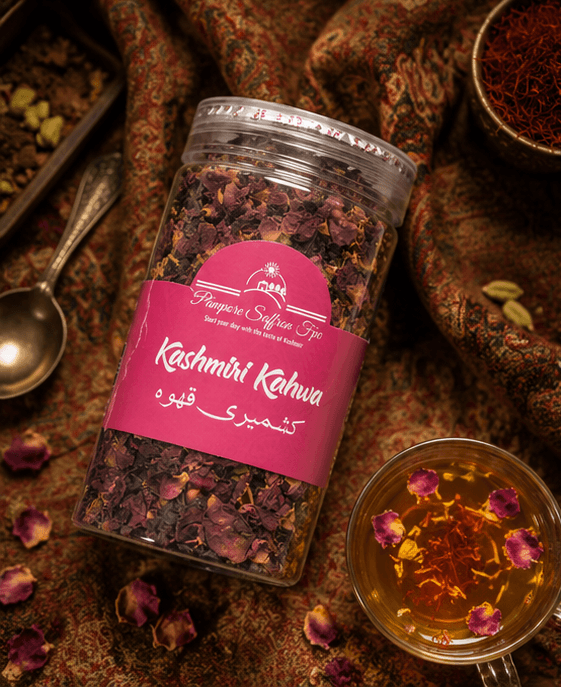
Kahwa is not a herbal infusion. It is a green tea at its base, brewed below boiling and served clear. Around it sit whole spices — green cardamom, a shard of cinnamon bark, a clove — plus dried rose petals, slivered almonds, and three or four threads of saffron. Sweetening is optional and traditionally light: a little honey or sugar, added off the heat.
Two things follow from that composition and they matter more than any individual ingredient. It is drunk without milk, so it carries no dairy and, unsweetened, almost no calories. And it is brewed below the boil, which is a flavour rule first — boiling water makes green tea bitter and destroys saffron’s aromatics — but also means the delicate compounds survive. The method is set out in full in the proper kahwa recipe.
The caffeine question, with numbers
This is the most common real question about kahwa and it has a straightforward answer: roughly 25–35 mg per cup, depending on leaf quantity and steeping time. For context:
| Drink | Approx. caffeine per cup |
|---|---|
| Kahwa | 25–35 mg |
| Plain green tea | 25–45 mg |
| Strong milk chai | 40–70 mg |
| Brewed coffee | 95–120 mg |
| Herbal infusion | 0 mg |
Low, then — but not zero. Kahwa is often described online as caffeine-free, and it is not. If you are avoiding caffeine on medical advice, or you are counting a pregnancy limit, kahwa belongs in the total. What the low figure does buy you is the thing Kashmiri households actually use it for: a cup after dinner that does not cost you the night.
What each ingredient does, and does not
Green tea. The base carries catechins, the best-studied of which is EGCG, and there is a genuine body of research on them. The honest summary is that measured human effects — on metabolism, on blood lipids — are real but small, often inconsistent between trials, and generally observed at intakes higher than a cup or two. Green tea is a good thing to drink. It is not an intervention.
Cardamom, cinnamon, clove. Long culinary and traditional-medicine use across South Asia, particularly as digestive spices. In a cup of kahwa the quantities are small — a pod or two, a shard of bark. They are there for aroma and for the warmth of the drink, and any claim resting on the pharmacology of a single clove should be read with that in mind.
Saffron. Three or four threads per cup, so roughly 20–30 mg. That is genuinely the same order of magnitude as the doses used in saffron mood research, which cluster around 30 mg a day. But those trials used standardised extracts, swallowed daily, and we cannot tell you what fraction of the active compounds actually leaves a thread and ends up in your cup. So: an interesting coincidence of numbers, not a claim. If you want the fuller picture, what saffron does and does not do goes through it properly, and the safe daily amount covers the upper limits.
Rose petals and almonds. Flavour, aroma and texture. Nobody should be buying kahwa for the nutritional contribution of four slivers of almond.
Three claims that do not hold up
- “Kahwa detoxes your body.” “Detox” has no clinical meaning outside poisoning and substance withdrawal. Your liver and kidneys do the work; no tea assists them. This claim is the clearest marker of a page written to sell rather than to inform.
- “Kahwa burns fat.” The catechin evidence does not support it at cup-scale intakes. Where kahwa helps with weight it is because it displaced something sweeter — real, but it is subtraction, not combustion.
- “Kahwa boosts immunity.” A phrase that sounds like a mechanism and is not one. Warm fluids are comforting when you are unwell. That is a genuinely nice thing and it is not immunology.
The two real cautions
Tannins and iron. Tea tannins bind non-haem iron — the form in plant foods — and reduce how much you absorb. For most people this is irrelevant. If you are managing iron-deficiency anaemia, or you eat little or no meat, it is worth taking kahwa between meals rather than alongside them. Roughly an hour either side of a meal is the usual practical advice.
What you put in it. Kahwa unsweetened is close to calorie-free. Kahwa with two spoons of sugar, three times a day, is a sugar delivery system with tea in it. Nothing about the spice blend changes that arithmetic. If you sweeten, do it off the heat and lightly — and if you use honey, adding it to boiling liquid defeats the point of buying good honey, as the honey piece explains.
How to actually drink it
After meals, which is what Kashmir does — it suits a heavy meal better than a milk tea. Through the afternoon and evening, where the low caffeine is an advantage rather than a compromise. And through winter, where the honest benefit is that a hot unsweetened drink is a good habit in cold weather and always has been.
One heaped teaspoon of blend makes a cup, so a 100 g pack is around twenty cups. Our Kashmiri kehwa blend is ₹400 for 100 g, with whole spices, rose petals and our own Grade I saffron rather than flavouring — which is why you can see the petals and threads in the jar. Questions, or which harvest the saffron in it came from, on WhatsApp at +91 95966 08297.
None of the above is medical advice, and this page deliberately does not tell you kahwa will fix anything. If you have a condition or take regular medication, ask your doctor before making any strongly spiced drink a daily fixture. What we can say without hedging is that it is a good cup of tea with a real history behind it.