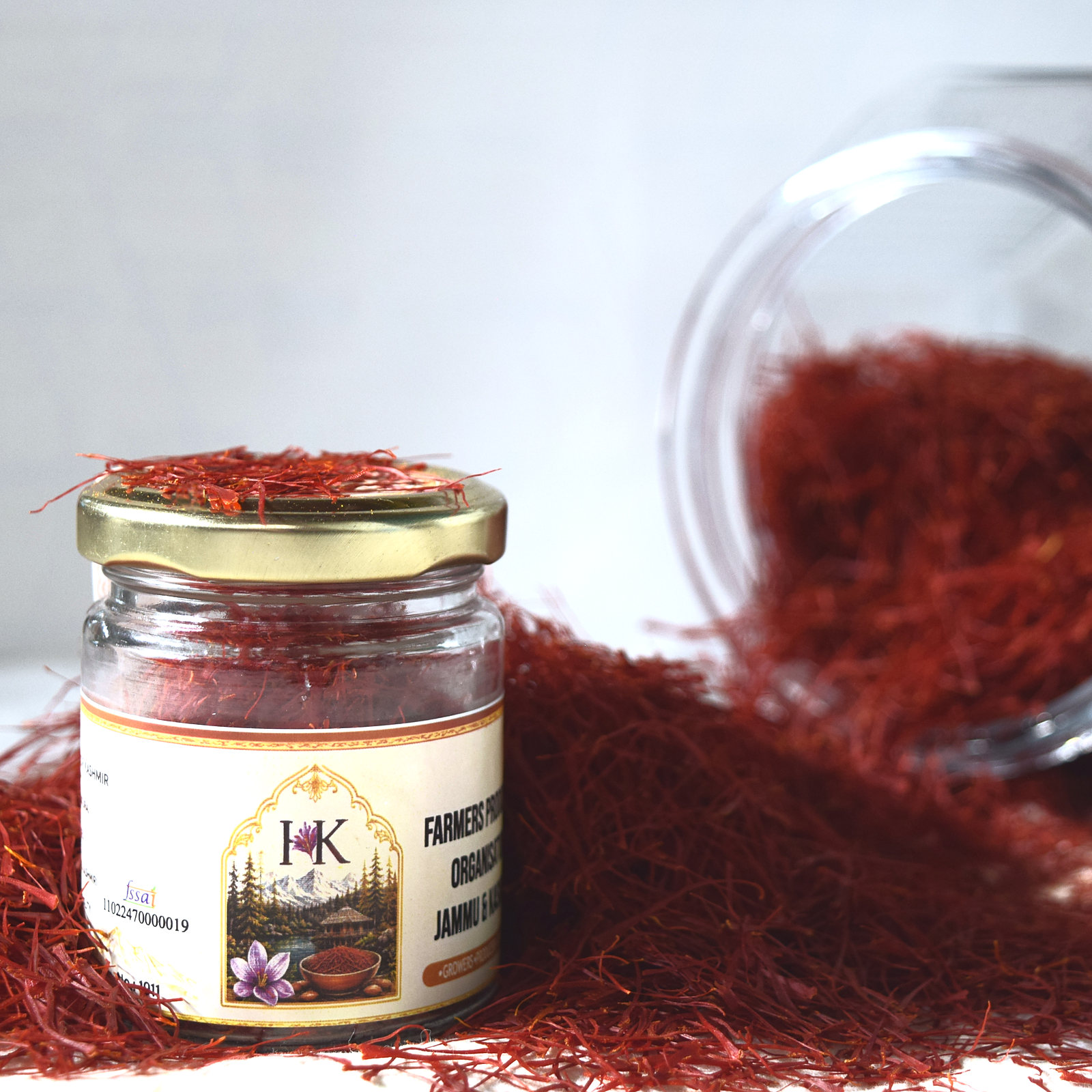
Every saffron method is one rule wearing different clothes: bloom the threads in warm liquid for 10–15 minutes, and never let them touch a boil. Do that, and 3–5 strands will colour and perfume anything you make. Skip it — sprinkle threads dry into hot rice, drop them in boiling milk — and most of what you paid for burns away as steam. This is the complete usage guide we give our own buyers.
The base technique: blooming
- Count, don’t pinch. 3–5 strands per glass; 10–15 for a family dish. (The full arithmetic is in how much saffron per day.)
- Warm 2–3 tablespoons of milk or water — drinkable warmth, roughly 60–70°C at most.
- Cover and wait 10–15 minutes. Real kesar releases colour slowly and keeps deepening; that patience is the point.
- Add everything at the end — golden liquid and threads — to the dish, off the heat.
Why so gentle? Saffron’s aroma compound, safranal, is volatile — it evaporates fast above steeping temperatures. Crocin, the colour, survives heat better but extracts fully only with time in liquid. Warm plus patient beats hot plus hasty, every single time.
Method by method
In milk — the daily classic
3–5 strands, warm milk, optional honey, ideally at night. Kesar doodh deserves its own essay, and has one: saffron milk benefits and method.
In water — the lightest ritual
The morning empty-stomach version: 3–4 strands, warm water, 10 minutes. Covered fully in saffron water benefits.
In kahwa — the Kashmiri way
2–3 strands per cup, added after the green tea and whole spices come off the boil. Our family kahwa recipe — or start from the kahwa blend we pack with the saffron already matched.
In biryani and pulao
Bloom 10–15 strands in warm milk while the rice cooks, then drizzle over the top layer before the final dum. Streaks of gold through white rice — never a uniform yellow, which is the signature of food colour, not kesar. The full method, with strands per kilo of rice, is in saffron in biryani; the sweet version is zarda rice.
In kheer and desserts
8–10 strands bloomed in warm milk, stirred in during the last five minutes. Saffron + cardamom + slow-cooked milk is the entire dessert canon of North India in one line. With chopped anjeer for sweetness, kheer needs no sugar at all. Full recipes: kesar kheer and the Kashmiri kesar phirni.
On skin — the gentle tradition
A few strands steeped in milk or rose water, applied 10 minutes, rinsed. Pleasant, plausible, patch-test first — and the deeper routine is in saffron oil for skin. Honest frame as always: ritual and antioxidants, not treatment.
The five mistakes that waste kesar
- Boiling it. Aroma gone in seconds. Steep warm, add late.
- Dry sprinkling. Unbloomed threads on rice look pretty and give nothing.
- Grinding fresh threads. Crushing before steeping helps only if the saffron is already weak — good Mongra needs no help.
- Fridge storage. Condensation ruins threads. Airtight, dark, room temperature.
- Using more to fix less. If 10 strands give no colour, the saffron is fake — not underdosed. Run the five purity tests.
Technique assumes the threads are real
Every count above calibrates to Grade I Kashmiri Mongra — the top band of the international ISO 3632 grading standard. Weaker or adulterated saffron needs double the threads for half the result, which is how cheap kesar becomes expensive. Ours is our family’s own Pampore harvest — ISO-graded, GI-origin, batch-coded — in the shop, with the whole range on the home page. One jar, used the way this page teaches, outlasts and outperforms three jars used wrong.
The other half of making a jar last is where you keep it between uses — how to store saffron covers the shelf life, the humidity problem, and the refrigerator habit that quietly ruins more saffron in India than bad cooking does.
Why every method here starts with steeping
The techniques on this page look like separate recipes but they are one rule applied repeatedly, and the rule comes from what saffron is made of.
| Compound | Gives you | Behaves like | So you must |
|---|---|---|---|
| Crocin | Colour | Water-soluble, slow to release | Give it 10–15 minutes in warm liquid |
| Safranal | Aroma | Volatile — leaves with steam | Keep it warm, never boiling; cover the cup |
| Picrocrocin | The bitter edge | Dominates if you overdose | Use fewer threads than instinct suggests |
Read down the last column and you have every technique on this page. Steep, because crocin is slow. Stay off the boil, because safranal escapes. Use less than you think, because picrocrocin punishes excess. Frying saffron in hot ghee at the start of a biryani breaks all three rules at once, which is why it is the most common and most expensive mistake in an Indian kitchen.
It is also why the water-bloom test works as a purity check: real saffron releases its gold slowly, over ten minutes or more, because that is how crocin behaves. Dye has no such patience. The full set of checks is in how to identify real Kashmiri saffron.
How many threads, by dish
| Dish | Threads | Steep in |
|---|---|---|
| Kesar doodh, one glass | 3–4 | The warm milk itself, 10 min |
| Biryani or pulao, serves 4–6 | 8–10 | 2 tbsp warm milk, added at dum |
| Kheer or phirni, serves 4 | 8–10 | 2 tbsp warm milk, stirred in at the end |
| Kahwa, per cup | 3–4 | The brew, off the boil |
| Saffron water, one glass | 3–4 | Warm water, 15 min, covered |
At 8–10 threads a dish, a single gram — roughly 450–500 threads — covers about fifty dishes. That works out near ₹7 per dish for Grade I saffron, which is less than the cardamom in the same recipe. The full arithmetic is in what Kashmiri saffron costs per gram, and it is the argument that real saffron works out cheaper than weak saffron once you count per plate rather than per jar.