In Kashmir, kahwa is not a beverage; it is hospitality with a temperature. It arrives when guests arrive, after wazwan feasts, and all winter long from the family samovar. Most recipes online get the spices roughly right and the method quite wrong — usually by boiling everything, which murders both the green tea and the saffron. Here is how it is actually made in a saffron-growing household.
What is Kashmiri kahwa?
Kahwa (also written kehwa, or qahwa elsewhere in the subcontinent) is Kashmir’s everyday green tea: whole-leaf green tea simmered briefly with green cardamom, a shard of cinnamon bark and a clove, then finished off the heat with slivered almonds, a few saffron threads and a little honey. No milk — milk makes it noon chai. No boiling — boiling makes it bitter. It is the cup a Kashmiri household offers a guest before anything else, and the one most visitors remember after the saffron fields themselves.
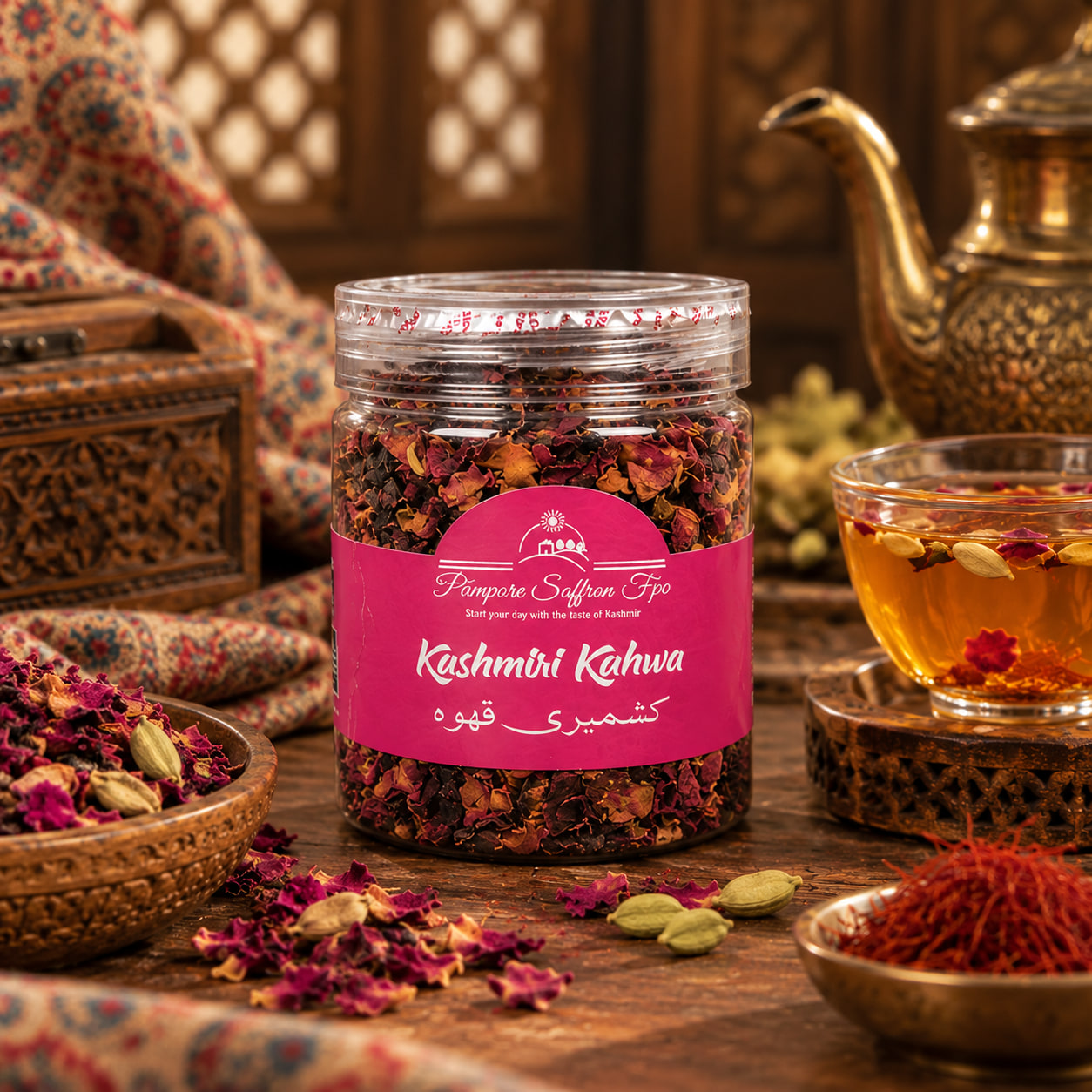
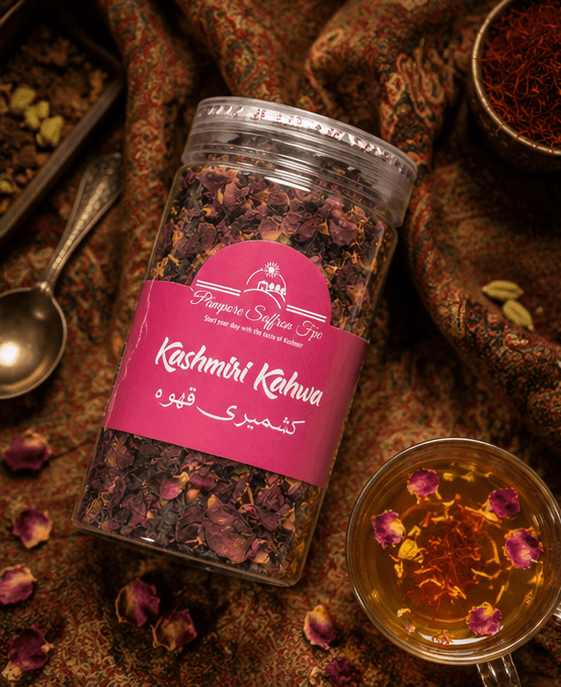
For the leaf-and-spice mix without assembling seven ingredients, our Kashmiri kehwa is the same blend we brew at home, packed in the Valley.
What goes in (and what does not)
- Green tea — the base. Kashmiri kahwa leaf, or any clean whole-leaf green tea.
- Green cardamom — 2 pods per cup, lightly crushed.
- Cinnamon bark — a small shard, not powder.
- Clove — one per cup, optional but traditional.
- Saffron — 4–6 strands per cup, pre-steeped (details below).
- Almonds — crushed or slivered, added to the cup.
- Honey or sugar — to taste, off the heat.
Not in kahwa: milk (that is noon chai, a different Kashmiri tea), star anise in quantity (a modern shortcut that bullies the saffron), and anything called “kahwa flavour”.
The method — four steps, one rule
The rule: saffron and green tea never touch boiling water.
- Steep the saffron first. Put the strands in two tablespoons of warm water while you brew. By the time the tea is ready, the liquid is deep gold and the strands have opened.
- Simmer the spices. Cardamom, cinnamon and clove in water, 2–3 minutes at a gentle simmer — this is where the body of the flavour comes from.
- Brew the tea off the boil. Kill the heat, wait ~30 seconds (80–90°C), add the green tea, cover, and steep 2–3 minutes. Longer = bitter, not stronger.
- Assemble. Strain into cups, stir in the saffron concentrate, add crushed almonds and honey. A strand or two floated on top is the Kashmiri signature.
Shortcut for daily drinking: one heaped teaspoon of our Kashmiri kehwa blend per cup — the spices and saffron are already balanced; just follow the temperature rule.
Why kahwa earned its reputation
Kahwa’s wellness standing rests on sensible foundations: green tea’s catechins, warming spices that aid digestion after rich meals, saffron’s crocin and safranal, and caffeine mild enough (~25–35mg a cup) for evenings. Kashmiris drink it after wazwan for a reason. We will not promise it cures anything — it is tea, not therapy — but as daily rituals go, it is one of the better-engineered ones. (Saffron’s evidence base is covered in Kashmiri saffron benefits.) Whether the cup itself is good for you, and who should skip it, is answered in is kahwa good for health.
Three mistakes that ruin kahwa
- Boiling the tea. Bitterness has no antidote; brew off the boil.
- Skipping the saffron steep. Strands dropped straight in give up a fraction of their colour. Ten patient minutes changes the whole cup.
- Weak saffron. Dyed or old kesar makes beige kahwa. Real Grade I Mongra — here’s how to check yours — turns the cup gold with four strands.
Everything in our kahwa comes from places we can name: the saffron from our own Pampore fields (see how it’s grown), the blend packed and sealed at source. Start with the kehwa, add a jar of Mongra saffron for the float, or browse the whole pantry from the home page.
The temperature rule that decides the cup
Kahwa fails in the same place almost every time, and it is not the spice ratio — it is heat. Two ingredients in this cup are damaged by a rolling boil.
- Green tea leaf. Boiling water extracts catechins and tannins fast, which is the bitterness people then try to cure with sugar. Green tea wants water around 75–85 °C — water brought to the boil and then rested two or three minutes.
- Saffron. Safranal, which carries the aroma, is volatile. Add saffron to a boiling pot and a good part of what you paid for leaves as steam. Take the pot off the heat, then add the threads and cover it.
The traditional samovar does this naturally: charcoal in the central flue keeps the brew hot without a hard boil. A steel pan on a gas ring does not, which is why kahwa made at home is so often harsher than kahwa made in Kashmir. The fix costs nothing — take it off the flame before the saffron goes in.
Proportions, per cup
| Ingredient | Per cup | Note |
|---|---|---|
| Kahwa green tea leaf | ~1 tsp | Off the boil, steeped not stewed |
| Saffron | 3–4 threads | Added off the heat, pot covered |
| Green cardamom | 1 pod, bruised | Bruised, not powdered |
| Cinnamon | Small piece of bark | Bark, not cassia powder |
| Almond slivers | 4–5 | Added to the cup, not boiled in the pot |
At 3–4 threads a cup, a single gram of saffron makes well over a hundred cups. Kahwa is one of the cheapest ways to drink real saffron daily — the per-cup arithmetic is in saffron price per gram.
If you sweeten, honey goes in once the cup has cooled below scalding — the same reasoning as the saffron, since heat degrades raw honey’s enzymes and aromatics. Our saffron honey was made for this cup, and the reason crystallisation in the jar is a good sign rather than a fault is in the saffron honey guide.