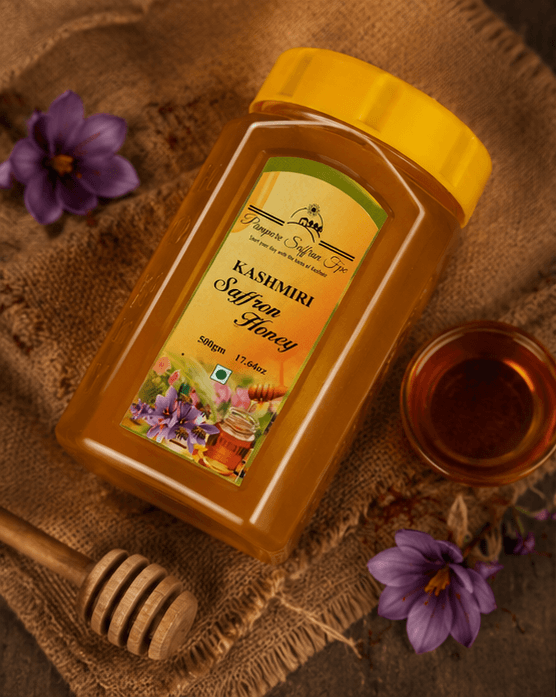
Saffron honey is raw honey with saffron threads steeped in it — the crocin and safranal migrate into the honey over weeks, deepening the colour and adding an earthy warmth. Real infusion leaves visible threads in the jar. Uniform gold with nothing to see is a flavouring, not an infusion. The awkward part is that this product combines the two most adulterated things sold in an Indian grocery: saffron and honey. Both are expensive, both are hard to judge by eye, and both have a mature industry built around faking them.
How the infusion actually works
Saffron’s three signature compounds behave differently in honey. Crocin, which carries the colour, is water-soluble, and honey’s residual water content — typically 17–20% — is enough to draw it out slowly. Safranal, the aroma compound, is volatile, which is why infusion must happen cold and why heating the finished jar destroys the point of it. Picrocrocin, responsible for saffron’s characteristic bitter edge, migrates least, which is why saffron honey tastes rounder than you would expect.
The process is patience, not technology: threads go into raw honey and sit. Over several weeks the honey deepens from light amber toward a richer gold. Nothing is heated, because heat would defeat both ingredients at once — the same reason saffron should be steeped in warm milk rather than fried in ghee.
The number every honey buyer in India should know
In 2020 the Centre for Science and Environment ran an investigation into honey sold in India. It picked 13 brands — large national names and smaller ones — and sent 22 samples for testing, including Nuclear Magnetic Resonance (NMR) spectroscopy at a German laboratory.
77% of the samples were adulterated with sugar syrup. Only three of the thirteen brands passed the NMR tests. Several of India’s best-known honey brands failed. The finding that mattered most was not the failure rate but the sophistication: the syrups had been specifically engineered to pass the tests India actually runs.
Why India’s standard test misses it
Plants fix carbon by different photosynthetic pathways, and those pathways leave measurably different carbon-isotope signatures in the sugars they produce. Sugarcane and maize are C4 plants. India’s standard honey purity testing is built to detect C4 sugars, and for years that was sufficient, because cane sugar was the cheap adulterant.
The industry adapted. Syrups made from rice and beetroot — both C3 plants, like the nectar sources bees actually visit — carry an isotope signature the C4 test was never designed to flag. A jar can pass the official test and still be substantially syrup.
NMR spectroscopy takes a different approach: instead of asking which isotope, it profiles the molecular structure of the whole sugar mixture, and it catches both C3 and C4 syrups. India made NMR mandatory for honey exported to the United States from 1 August 2020. It is still not required for honey sold inside India. That asymmetry is the single most useful fact in this article: the same country enforces one standard for foreign buyers and another for its own citizens.
Crystallisation is a good sign, not a fault
The most common complaint about raw honey is the one that should reassure you. Honey crystallises according to its glucose-to-fructose ratio; glucose is less soluble and comes out of solution first. Unheated, unfiltered honey crystallises readily — some floral sources within weeks.
Commercial honey usually does not, because it has been heated and ultra-filtered to remove the pollen grains and micro-crystals that seed the process. That treatment produces a jar that stays glassy for years and has lost most of what distinguished it from syrup. If a honey has never crystallised in your cupboard, ask why.
To reverse it: stand the sealed jar in a bowl of warm water for fifteen to twenty minutes. Not boiling water, and never a microwave — both destroy the enzymes, and in a saffron honey they drive off the safranal as well.
Judging a jar without a laboratory
Be honest about the limits here: the folk tests circulating online — the thumb test, the water test, the burning-matchstick test — do not reliably separate real honey from modern syrups. They were designed for cruder adulteration than the market now practises. What actually helps:
- Does it crystallise? The single most useful everyday signal, for the reasons above.
- Can the seller name the floral source and the harvest? Acacia, kikar, multiflora — a real beekeeping operation knows where the boxes were and when they came off.
- Is there an NMR report? If a brand has commissioned one, it will say so loudly, because it is expensive and it is the only test that settles the question.
- For the saffron half: visible threads, and the colour releasing slowly rather than instantly — the same test that works for loose saffron.
What it is good for, without the health claims
Saffron honey is a sweetener with an unusually good flavour. Stirred into kahwa once it has cooled below scalding, drizzled over yoghurt or toast, spooned into warm milk on a cold night. That is a real pleasure and it does not need to be dressed up as medicine.
What we will not claim: that it boosts immunity, cures coughs, or treats any condition. Raw honey retains trace enzymes, pollen and antioxidants that processing destroys, and saffron contributes carotenoids — but the quantities involved are small and the evidence for clinical effect at those doses is not there. The same discipline we apply to saffron’s own limits applies here.
One genuine safety point: never give honey to a child under twelve months. Honey can carry Clostridium botulinum spores which an infant gut cannot yet handle, and infant botulism is a serious illness. This applies to all honey, raw or processed, and it is not a marketing caveat.
What we sell, stated plainly
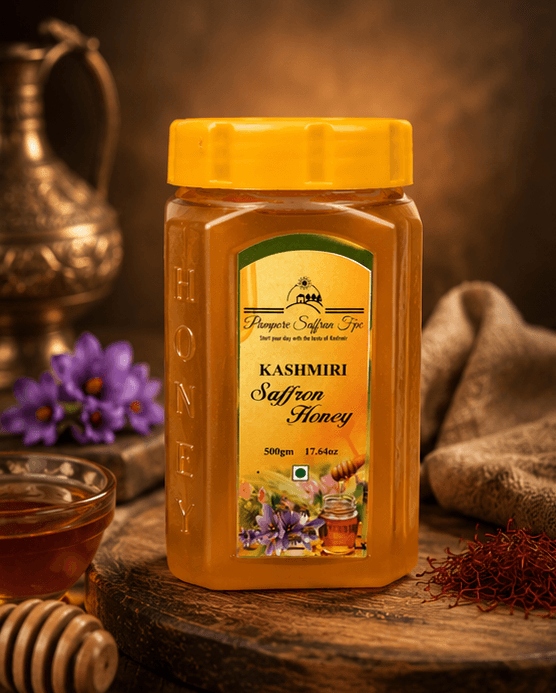
Our Saffron-Infused Wild Honey is raw multi-floral honey from Acacia and Kikar forests in Kashmir, harvested by traditional beekeepers, coarse-sieved only, and infused with our own ISO 3632 Grade I Mongra saffron — the same saffron we sell in jars. Not heated. Not ultra-filtered. No added sugar or syrup. It will crystallise, and that is the intended behaviour.
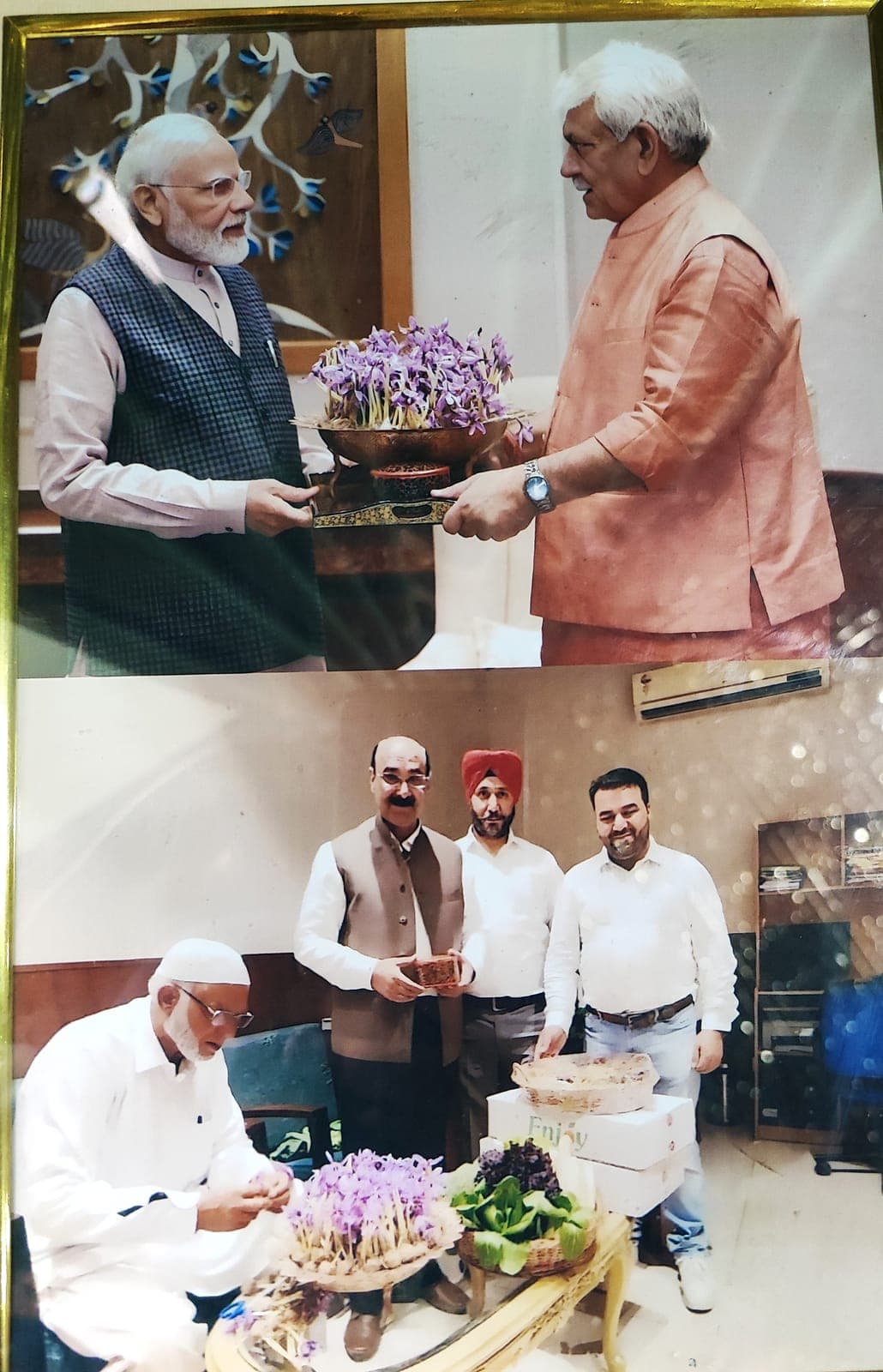
We are an FSSAI-licensed Farmer Producer Organization in Pampore, licence 11022470000019 — printed so you can look it up. Our work with the Directorate of Agriculture Kashmir, the Spices Board and at national agricultural events is documented here, with photographs rather than adjectives.
And the thing this article has spent 800 words arguing matters: we have not commissioned an NMR test on this honey. It would be easy to leave that unsaid on a page about honey fraud. If we run one, the report and its reference number go on the product page. Until then, what we can offer is a named floral source, a named harvest, a licence number you can verify, and honey that behaves like honey in your cupboard.