
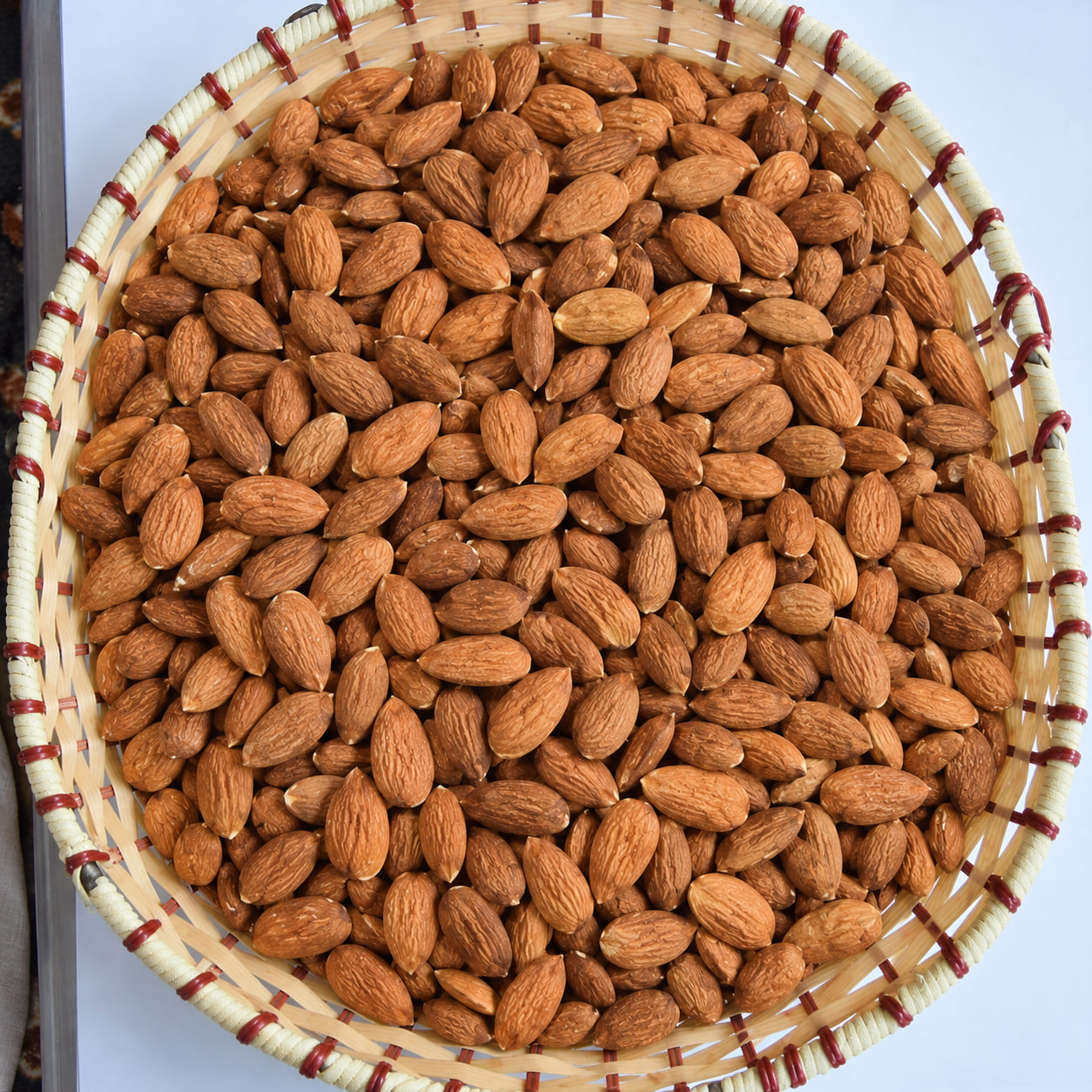
Search for almonds in India and the questions that come up most are simple ones: how many calories in one almond, how much protein in ten? We grow and sell almonds, but we are not going to answer that from our own kitchen scale. The numbers below come from two public food composition tables: the US Department of Agriculture’s FoodData Central, and India’s own Indian Food Composition Tables 2017 from ICMR’s National Institute of Nutrition in Hyderabad.
Where the arithmetic is ours, we say so. Where the two tables disagree, we show both and explain why. And all of it is typical values for almonds (USDA / ICMR-NIN IFCT 2017), not a lab test of our batch. We have not had our own lot analysed, and we would rather tell you that than print a number we can’t stand behind.
The short answer
- 1 almond (about 1.2 g): about 7 kcal and 0.25 g protein
- 5 almonds (about 6 g): about 35 kcal and 1.3 g protein
- 10 almonds (about 12 g): about 70 kcal and 2.5 g protein
- 23 almonds (1 oz, 28 g): about 164 kcal and 6 g protein
- 100 g of almonds: about 579 kcal and 18–21 g protein
Typical values for almonds from USDA FoodData Central and ICMR-NIN IFCT 2017, not a lab test of our batch. Soaking doesn’t change the numbers per almond.
Calories and protein by number of almonds
USDA FoodData Central weighs one almond at 1.2 g and counts 23 whole kernels to the ounce (28.35 g). Multiply those portions by its per-100 g values and you get the table below. The starting numbers are USDA’s (record 170567, “Nuts, almonds”); the multiplication is ours.
| Almonds | Weight | Calories (kcal) | Protein (g) | Fat (g) | Fibre (g) | Vitamin E (mg) | Magnesium (mg) | Calcium (mg) |
|---|---|---|---|---|---|---|---|---|
| 1 almond | 1.2 g | 6.9 | 0.25 | 0.6 | 0.15 | 0.31 | 3.2 | 3.2 |
| 4 almonds | 4.8 g | 27.8 | 1.02 | 2.4 | 0.6 | 1.23 | 13 | 12.9 |
| 5 almonds | 6 g | 34.7 | 1.27 | 3 | 0.75 | 1.54 | 16.2 | 16.1 |
| 6 almonds | 7.2 g | 41.7 | 1.52 | 3.59 | 0.9 | 1.85 | 19.4 | 19.4 |
| 10 almonds | 12 g | 69.5 | 2.54 | 5.99 | 1.5 | 3.08 | 32.4 | 32.3 |
| 20 almonds | 24 g | 139 | 5.08 | 11.98 | 3 | 6.15 | 64.8 | 64.6 |
| 23 almonds (1 oz) | 28.35 g | 164 | 6 | 14.16 | 3.54 | 7.27 | 76.5 | 76.3 |
| 30 g handful (about 25) | 30 g | 174 | 6.35 | 14.98 | 3.75 | 7.69 | 81 | 80.7 |
| 100 g (about 83) | 100 g | 579 | 21.15 | 49.93 | 12.5 | 25.63 | 270 | 269 |
Source: USDA FoodData Central, SR Legacy FDC 170567, with its portions “1 almond = 1.2 g” and “1 oz (23 whole kernels) = 28.35 g”. Vitamin E is alpha-tocopherol. Typical values for almonds, not a lab test of our batch.
Read across the 10-almond row and you have the answer to most of the questions people search for: about 70 kcal and 2.5 g of protein. The Indian table, which measured more fat and a little less protein, puts one almond nearer 7.3 kcal and 0.22 g of protein. For a kitchen, about 7 kcal and 0.2–0.25 g of protein per almond covers both.
Almond calculator: any number, raw or soaked
For counts the table doesn’t show, type your own. Switch to grams if you weigh your almonds, which is the more accurate way; the calculator uses the same USDA values as the table above.
Almond calculator
- Calories
- 69.5kcal
- Protein
- 2.54g
- Fat
- 5.99g
- Fibre
- 1.5g
- Vitamin E
- 3.08mg
- Magnesium
- 32.4mg
- Calcium
- 32.3mg
Almond nutrition per 100 g: the US and Indian tables side by side
Two serious sources publish almond nutrition per 100 g, and they don’t agree to the decimal. USDA has two records: the long-standing SR Legacy entry (2019), and a newer 2022 “Foundation” analysis of raw whole almonds. India has the Indian Food Composition Tables 2017 (IFCT), compiled by ICMR’s National Institute of Nutrition, where almond is food code H001.
| Per 100 g | USDA SR Legacy (2019) | USDA Foundation, raw whole (2022) | IFCT 2017 (ICMR-NIN) |
|---|---|---|---|
| Energy | 579 kcal (2423 kJ) | 583.6 kcal* | 2549 kJ ≈ 609 kcal |
| Protein | 21.15 g | 21.45 g | 18.41 g |
| Total fat | 49.93 g | 51.09 g | 58.49 g |
| Saturated / mono / polyunsaturated fat | 3.80 / 31.55 / 12.33 g | 3.79 / 31.31 / 11.18 g | 4.36 / 38.34 / 13.22 g |
| Carbohydrate | 21.55 g (includes fibre) | 20.03 g (includes fibre) | 3.04 g (available only) |
| Dietary fibre | 12.5 g | 10.78 g | 13.06 g |
| Sugars | 4.35 g | – | 2.23 g (free sugars) |
| Calcium | 269 mg | 253.6 mg | 228 mg |
| Iron | 3.71 mg | 3.74 mg | 4.59 mg |
| Magnesium | 270 mg | 257.6 mg | 318 mg |
| Potassium | 733 mg | 732.8 mg | 699 mg |
| Zinc | 3.12 mg | 2.87 mg | 3.5 mg |
| Vitamin E (alpha-tocopherol) | 25.63 mg | – | 24.88 mg |
| Water | 4.41 g | 4.26 g | 4.37 g |
* Using almond-specific energy factors. The same USDA record gives 625.8 kcal with the general factors. “–” means the record does not list that nutrient. Typical values for almonds, not a lab test of our batch.
Why the carbohydrate looks so different
21.55 g against 3.04 g is not a different almond; it is a different definition. USDA’s carbohydrate is “by difference”: everything that isn’t water, protein, fat or ash, and that includes the fibre. IFCT counts only available carbohydrate, the sugars and starch your body digests, and lists fibre on its own line. Take USDA’s 12.5 g of fibre off its 21.55 g and you are at about 9 g; what remains of the gap is samples and laboratory method.
Why the protein and calories differ
The Indian samples measured less protein (18.41 g) and more fat (58.49 g) than the American ones, and more fat means more energy: about 609 kcal against 579. Neither table is wrong. They tested different almonds in different labs, so we give protein as a range: about 18–21 g per 100 g. The energy line has its own wrinkle: even inside USDA, the 2022 record gives 583.6 kcal or 625.8 kcal depending on which conversion factors you apply. That is part of why calorie counts for the same 100 g vary from one website to the next.
How much protein is in badam, really?
By weight, almonds carry more protein than the other two dry fruits we sell: about 21 g per 100 g in USDA’s figures, against 15.2 g for walnuts and 3.3 g for dried figs, all from the same database.
- Almonds
- 21.15 g
- Walnuts
- 15.23 g
- Dried figs
- 3.3 g
But nobody eats 100 g of almonds at a sitting. Per portion the protein is modest: 10 almonds give about 2.5 g, and a 30 g handful about 6.35 g, with 174 kcal attached. On USDA’s figures, every gram of almond protein comes with roughly 2.4 g of fat. Almonds are a food you eat for the whole package (the fat, fibre, vitamin E and magnesium as much as the protein), not a protein supplement. For more on the other two, see our pages on Kashmiri walnuts and anjeer.
Soaked vs raw almonds: do calories or protein change?
Per almond, no. Soaking adds water. A soaked almond weighs more, but water carries no calories and no protein, so one soaked almond still has about 7 kcal and 0.25 g of protein, exactly what it had dry. Per 100 g, soaked almonds only look lower, because part of that 100 g is now water. We haven’t yet weighed how much water our own mamra takes up overnight, so we are not printing a per-100 g soaked column we can’t back.
What about “activated” almonds, soaked to unlock more nutrition? Researchers at the University of Otago in New Zealand tested that idea. Soaking changed phytate levels only slightly (anywhere from 12% lower to 10% higher across the nuts they tested) and lowered some mineral concentrations; whole soaked almonds actually measured 563 mg of phytate per 100 g against 531 mg unsoaked. In a crossover trial where 76 adults ate 30 g of almonds a day, soaking did not improve gut symptoms, and soaked whole almonds were rated higher for flatulence.
So soak for the reasons our grandmothers did: a softer bite, a skin that slips off, a kernel that grinds smooth for kesar badam milk, and an easier chew for children and elders. Just not for extra nutrition.
Mamra vs California almonds: is the nutrition different?
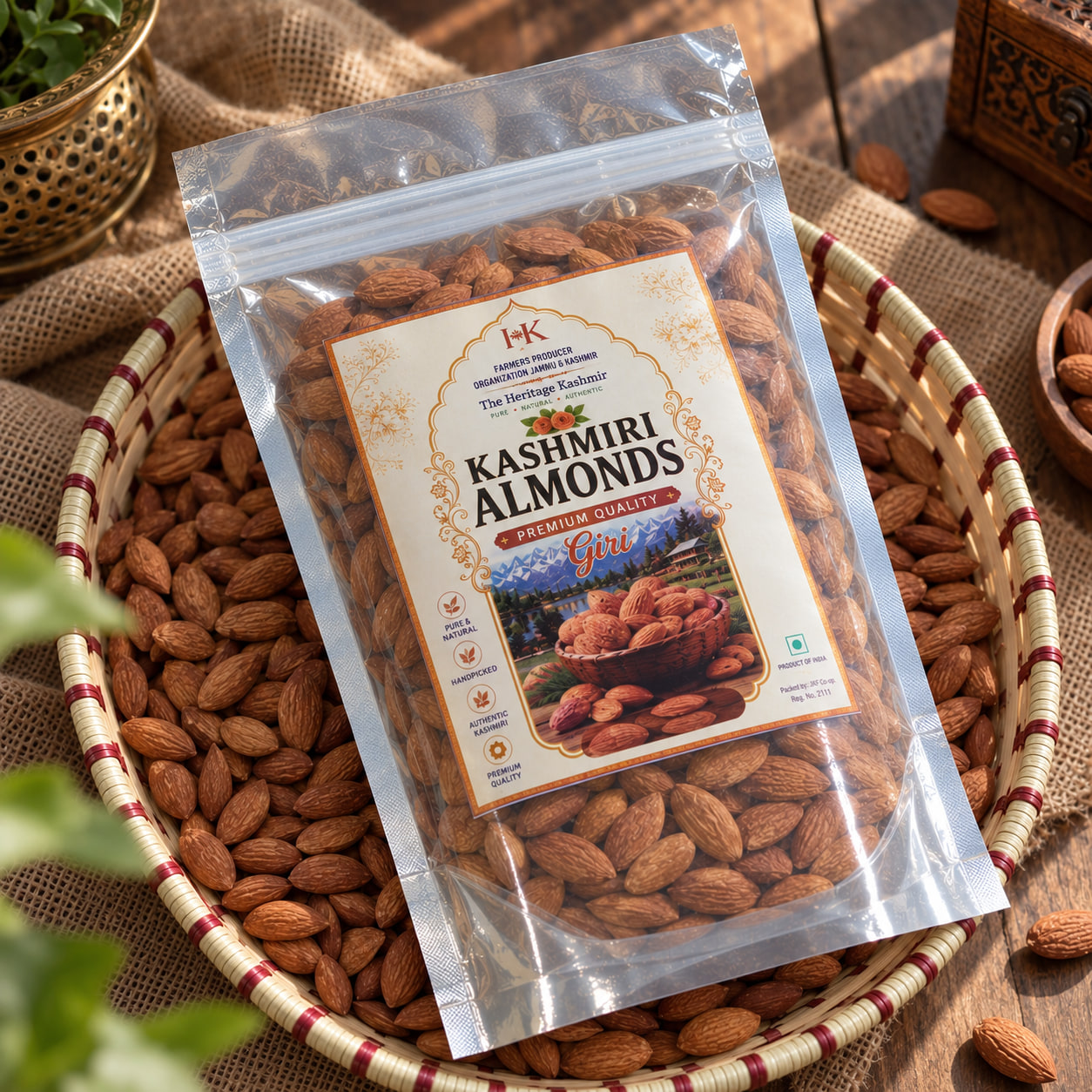
The honest answer is that nobody has measured it in a way we would quote. We looked for a study comparing Kashmiri mamra with California almonds for protein and calories, and found none we trust.
On oil there is one clue. A study of 25 almond genotypes in Iran, published in Acta Horticulturae, found kernel oil ranging from 43.85% to 58.8% of dry weight, and the local Iranian cultivars Mamaei, Rabei and Sefid were oilier than most of the foreign cultivars, Nonpareil included. That is Iranian-grown Mamaei, not Kashmiri mamra, but it points the same way as the sheen you see when you split one of our kernels.
Keep it in proportion. Ordinary almonds are already about half fat: 49.93–51.09 g per 100 g in the USDA records, and 58.49 g in the Indian table. A mamra kernel five points oilier would add at most about 45 kcal per 100 g, or roughly half a calorie per almond. That is a different taste, not a different food. So treat the per-almond numbers on this page as applying to mamra and California alike; mamra-type kernels are reported to be somewhat oilier.
Vitamin E, magnesium and calcium in a daily handful
Protein gets the searches, but vitamin E is where almonds stand apart from the rest of the dry-fruit box. Per 100 g, USDA lists 25.63 mg of vitamin E (alpha-tocopherol) in almonds, against 0.7 mg in walnuts and 0.35 mg in dried figs. India’s table agrees closely at 24.88 mg.
- 10 almonds (12 g): 3.08 mg vitamin E, 32.4 mg magnesium, 32.3 mg calcium, 1.5 g fibre.
- A 30 g handful (about 25 almonds): 7.69 mg vitamin E, 81 mg magnesium, 80.7 mg calcium, 3.75 g fibre.
The Indian samples found more magnesium than USDA (318 mg against 270 mg per 100 g) and a little less calcium (228 mg against 269 mg), so treat the minerals as a range too.
How many almonds in 100 g, 250 g and 1 kg?
Every per-almond number on this page hangs on USDA’s average almond of 1.2 g. Real kernels vary with variety and grade, and mamra kernels are smaller and less uniform than the big, smooth almonds most shops sell. Our own pack counts, as we state on the product page, run at roughly 700–900 kernels a kilogram and 350–400 in a 500 g pack.
| Count in | 100 g | 250 g | 500 g | 1 kg |
|---|---|---|---|---|
| At USDA’s 1.2 g average | about 83 | about 208 | about 417 | about 833 |
| Our mamra, by pack count | about 70–90 | about 175–225 | about 350–400 | about 700–900 |
A count is only ever a stand-in for weight. If you want the numbers exact, put your almonds on a kitchen scale and use the grams setting in the calculator above.
How many almonds a day?
The short version, from our 30-gram rule for dry fruits: about 30 g of dry fruits a day in total, one small handful. If almonds are the whole handful, that is about 25 of them, roughly 174 kcal and 6.35 g of protein by the table above. If they share the handful with walnuts and figs, it is the 4–6 almonds that page suggests.
Our almonds, and what we don’t claim
We sell genuine Kashmiri mamra almonds, grown in our own orchards and our FPO member families’ orchards in the valley, hand-graded and vacuum-sealed at source. What genuine mamra costs, and how to tell it from ordinary almonds sold under the name, is on our mamra badam price page. They sit alongside our walnuts and figs on the Kashmiri dry fruits page.
What we don’t do is put a nutrition claim on the jar. Every number on this page is a typical value for almonds from USDA and ICMR-NIN, not a lab test of our batch, so there is no “high protein” badge on our almonds. If you have a question about the current lot, our WhatsApp line is open at +91 95966 08297.
Sources
- USDA FoodData Central, SR Legacy FDC 170567, “Nuts, almonds” (published 1 April 2019): nutrients and portions.
- USDA FoodData Central, Foundation FDC 2346393, “Nuts, almonds, whole, raw” (published 28 October 2022): nutrients.
- Longvah T. et al., Indian Food Composition Tables 2017, National Institute of Nutrition (ICMR), Hyderabad; almond, food code H001: IFCT 2017 (PDF).
- USDA FoodData Central, SR Legacy FDC 170187, “Nuts, walnuts, english”, and FDC 174665, “Figs, dried, uncooked”: walnuts, dried figs.
- University of Otago, on soaked (“activated”) nuts: Kumari et al. on phytate and minerals, and Taylor et al., the 76-adult almond trial.
- Torabi, Imani and Rabiei, oil content of 25 almond genotypes, Acta Horticulturae 912 (ISHS).