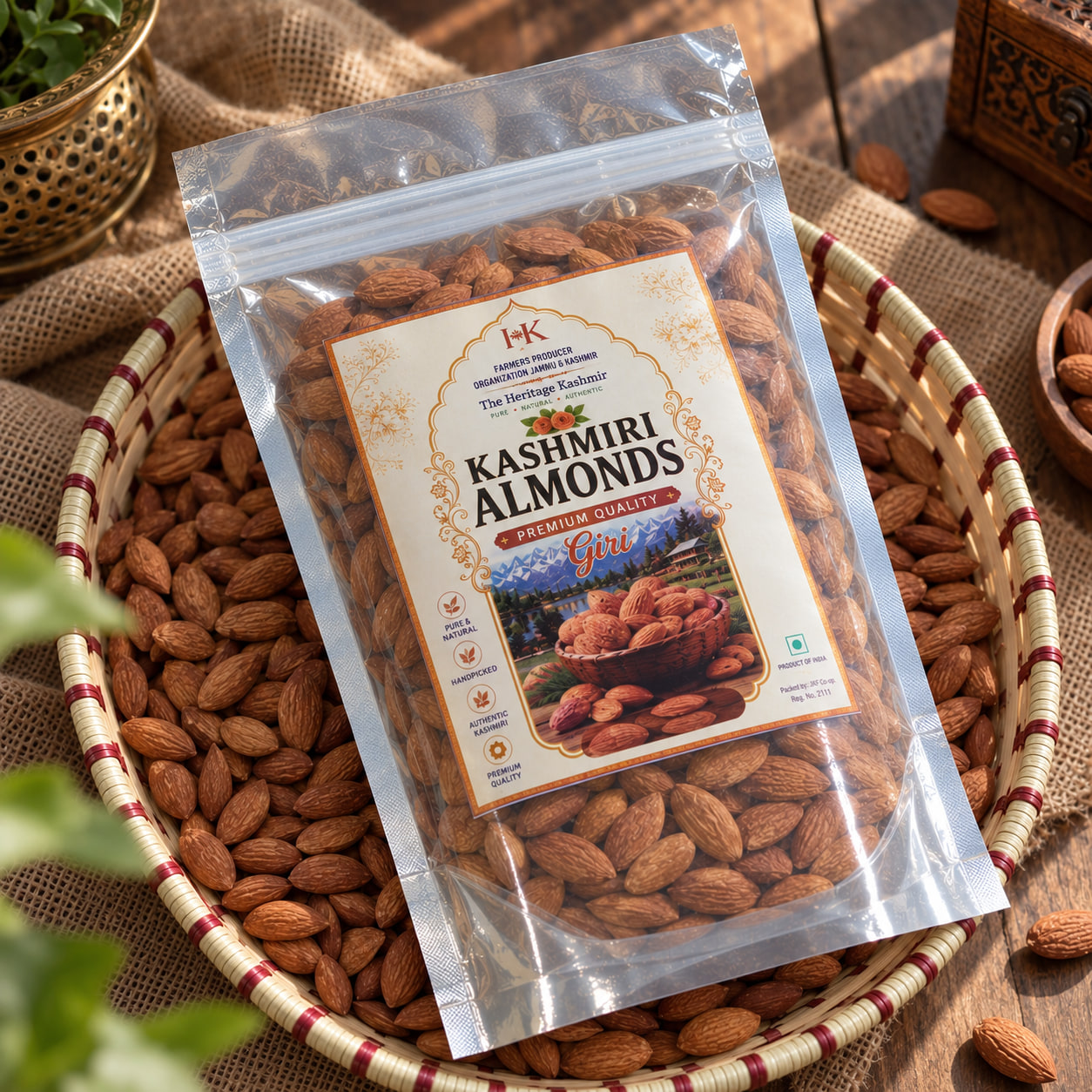
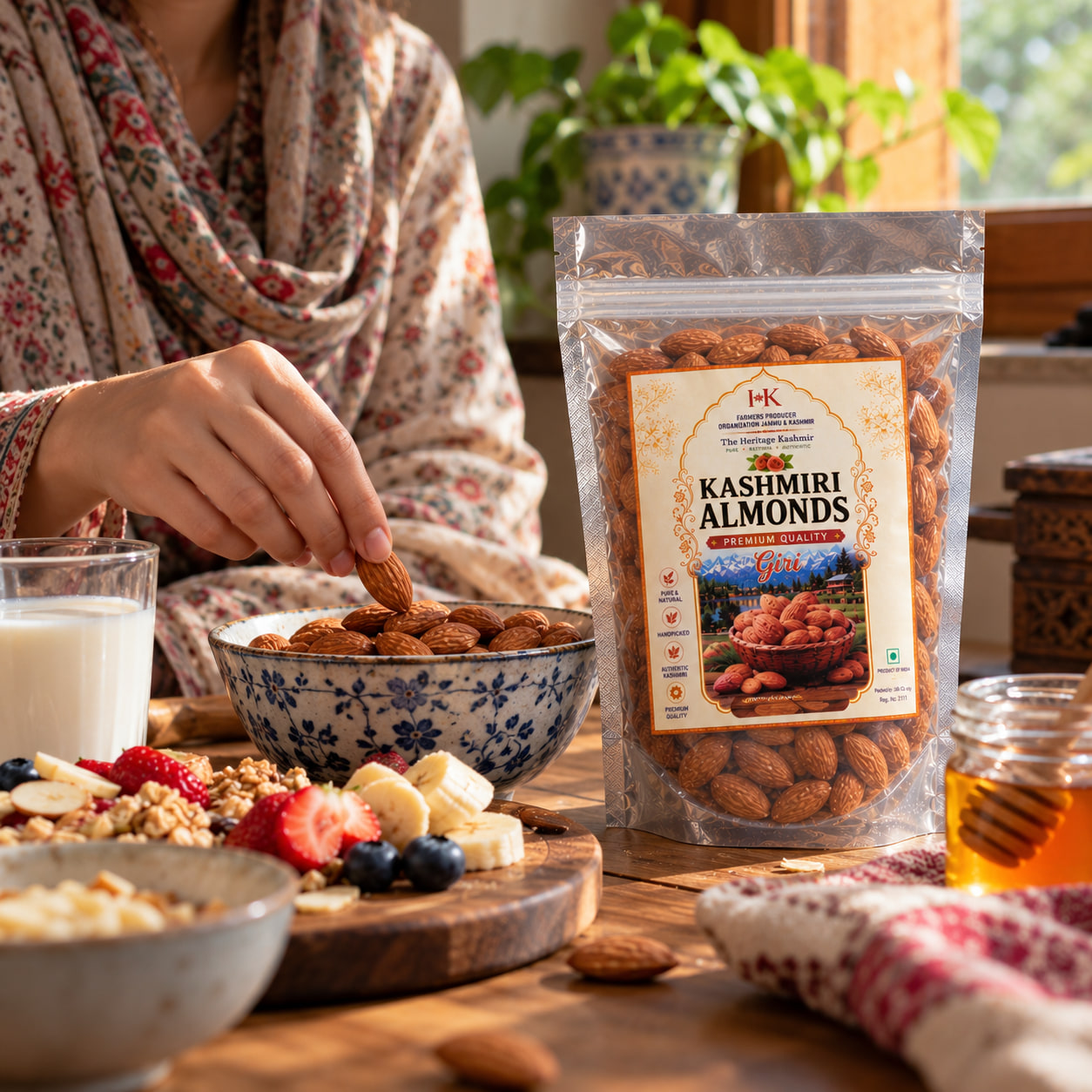
A daily handful of almonds gives you vitamin E, magnesium, fibre, some protein and mostly unsaturated fat. Controlled trials, often with more almonds than a handful, have found small effects on blood cholesterol levels and on appetite. For most adults, 4–6 almonds as part of a 30 g mixed dry-fruit handful is plenty, or about 20–25 if almonds are your only dry fruit. Soaking changes the texture, not the nutrition.
We grow almonds, so you might expect us to tell you they do everything. They don’t. Below is what studies in people have actually measured, what they haven’t, how many to eat at each age, and the honest answer on soaking. Where a popular claim has no good evidence behind it, we say so, and we cite every study we lean on so you can read it yourself.
The short answer
- What’s in them: 30 g of almonds has about 7.7 mg of vitamin E (roughly half the US daily amount for adults), 81 mg of magnesium, 3.75 g of fibre and 6.3 g of protein.
- What trials found: LDL cholesterol a little lower on average in almond groups than in comparison groups, and people eating less at later meals after an almond snack.
- What they didn’t: no effect on memory in a 12-week trial, and no good evidence for hair growth, fairness or “brain boosting”.
- How many: 4–6 a day in a 30 g mixed handful, or about 20–25 if almonds are the whole handful. Children less, and no whole almonds under age 5.
- Soaked or raw: the same calories, protein and vitamins. Soak for softness and tradition, not for extra nutrition.
Typical values for almonds from USDA FoodData Central, not a lab test of our batch. Nothing on this page is medical advice.
What is in a daily handful of almonds
The portion that matters is the one people actually eat: about 30 g, a small handful, which at USDA’s average of 1.2 g an almond is about 25 almonds. Here is what that carries, from USDA FoodData Central’s record for almonds (FDC 170567); the multiplication is ours.
| In 30 g of almonds | Amount | Worth knowing |
|---|---|---|
| Vitamin E (alpha-tocopherol) | 7.7 mg | About half the US recommended daily amount for adults (15 mg) |
| Magnesium | 81 mg | Alongside 81 mg calcium, 220 mg potassium and 1.1 mg iron |
| Fat | 15 g | Of which 9.5 g monounsaturated, 3.7 g polyunsaturated, 1.1 g saturated |
| Protein | 6.3 g | Useful in a meal; not a protein supplement |
| Fibre | 3.75 g | Most of the almond's 6.5 g of total carbohydrate |
| Energy | 174 kcal | The reason a handful, not a bowl, is the portion |
Source: USDA FoodData Central, SR Legacy FDC 170567, per 100 g × 0.3. The 15 mg vitamin E figure is the US Recommended Dietary Allowance cited in the Jambazian trial below. Typical values for almonds, not a lab test of our batch.
Read the table plainly: a handful carries about half a day’s vitamin E by the US yardstick, and smaller, useful amounts of everything else. For calories and protein per almond, per 10 and per 100 g, see our almond calories and protein chart; in short, 5 almonds are about 35 kcal.
Almond benefits: what the research has actually looked at
Almonds are one of the most studied nuts, partly because the Almond Board of California, the Californian almond industry’s marketing board, has paid for a good share of the research. That does not make the results wrong, but it is worth knowing, so we note the funding wherever a paper states it. Everything below was measured in people, not in test tubes or rats.
Blood cholesterol
Two systematic reviews have pooled the controlled trials. The first, Musa-Veloso and colleagues (2016), combined 18 publications with 27 almond-versus-control comparisons and found LDL cholesterol was on average 0.124 mmol/L (about 4.8 mg/dL) lower in the almond groups, with total cholesterol and triglycerides also a little lower and HDL unchanged. The Almond Board of California funded that review.
The second, Lee-Bravatti and colleagues (2019), took 15 trials with 534 adults, using in each trial the almond dose closest to 42.5 g a day. LDL came out 5.83 mg/dL lower on average and total cholesterol 10.69 mg/dL lower, while HDL was slightly lower too (1.26 mg/dL). The authors wrote that the “substantial heterogeneity” between the trials “precludes firmer conclusions”.
Read those numbers for what they are: small average differences in groups of volunteers, often eating more almonds than our 30 g handful (the second review picked the dose nearest 42.5 g a day), for weeks rather than years. It is a finding about a food, not a treatment. If your cholesterol is high, your doctor’s advice comes first; almonds don’t replace anything they prescribe.
Feeling full
In a study of 32 healthy women by Hull and colleagues (2015), a mid-morning snack of 28 g or 42 g of almonds left them less hungry before lunch, and they ate less at lunch and dinner, enough that their total calories for the day came out about the same as on the day with no almonds. The Almond Board of California supported the study.
In a four-week trial by Tan and Mattes (2013), 137 adults given 43 g of almonds a day ate less of other foods without being told to, and their body measurements did not differ from the no-almond group at the end. All the volunteers had a raised risk of type 2 diabetes, which limits how far the result travels, and the Almond Board funded and supplied the almonds.
Neither study tested weight loss. What they show is narrower: people who ate almonds ate less of something else, so the almonds did not simply pile on top of the day’s calories.
One more number worth knowing. A USDA study by Novotny and colleagues (2012) measured how much energy 18 adults actually absorbed from almonds and found about 129 kcal per 28 g, against the 168–170 kcal the standard calculation predicts: a 32% overestimate. Food tables, including the USDA figures on this page, are calculated from an almond’s fat, protein and carbohydrate rather than measured this way. The study was supported by the USDA and the Almond Board of California.
Vitamin E
In a crossover feeding trial by Jambazian and colleagues (2005), 16 healthy adults ate a control diet and two almond diets, with almonds supplying 10% or 20% of their calories, for four weeks each. On the almond diets the alpha-tocopherol (vitamin E) in their blood went up, and the effect grew with the dose. In Tan and Mattes’s trial above, vitamin E intake rose in every almond group too. It is the least surprising finding on this page: almonds carry a lot of vitamin E, and eating them puts it into your blood.
What almonds have not been shown to do
- Memory and “brain power”. The trial we found that tested this directly, Coates and colleagues (2020), gave 128 overweight adults aged 50 to 80 either almonds (15% of their calories) or carbohydrate-rich snacks with the same calories for 12 weeks. Working memory, other thinking tests and mood were no different from the nut-free group. We found no good trial in children or students. “Badam for the brain” is tradition, not evidence.
- Hair growth, skin and fairness. We found no good human evidence that eating almonds grows hair, clears skin or lightens complexion.
- “Garam” almonds. Calling almonds hot (garam taseer) is a household belief, not something nutrition science measures. Soaking them in summer is a perfectly good habit, but for texture.
- Curing or preventing disease. Almonds don’t cure or prevent any illness, and we don’t sell them as if they did.
Almond benefits for women and for men
The almond is the same food for everyone; what changes is what people hope it will do.
For women: a 30 g handful adds about 81 mg of calcium, 1.1 mg of iron, 81 mg of magnesium and 7.7 mg of vitamin E. That helps, but a handful won’t meet a day’s calcium or iron needs on its own. There is no good evidence that almonds balance hormones, help with PCOS or fertility, or improve skin and hair. In pregnancy and while breastfeeding, the same 30 g handful applies unless your doctor tells you otherwise.
For men: the same handful has about 6.3 g of protein, a useful part of a meal rather than a protein supplement. Claims that almonds raise testosterone, stamina or sexual performance have no good evidence behind them, and Indian advertising rules don’t allow a food to be sold on such claims. We don’t.
Badam for diabetes and weight: the numbers only
These are medical questions, so here are the facts and nothing more. Almonds carry little sugar or starch:
| Amount | Total carbohydrate | of which fibre | Sugars | kcal |
|---|---|---|---|---|
| 5 almonds (6 g) | 1.3 g | 0.75 g | 0.26 g | 35 |
| 30 g handful (about 25) | 6.5 g | 3.75 g | 1.3 g | 174 |
| 100 g | 21.55 g | 12.5 g | 4.35 g | 579 |
Source: USDA FoodData Central, SR Legacy FDC 170567. USDA’s carbohydrate is “by difference” and includes the fibre. India’s IFCT 2017 (ICMR-NIN) counts only the carbohydrate the body digests: 3.04 g per 100 g, under 1 g in a 30 g handful.
Diabetes: how almonds fit your meals, and how many, is for your doctor or dietitian to say, especially if you take medicine for blood sugar.
Weight: a 30 g handful is about 174 kcal, which matters if you are counting. The satiety studies above found people ate less at later meals, but none was a weight-loss trial. Eat almonds instead of a fried snack, not as well as one, and ask a doctor or dietitian for a plan.
How many almonds to eat per day
Our rule for all dry fruit is the 30-gram handful: about 30 g a day in total. If almonds share that handful with walnuts or figs, 4–6 almonds is your share. If almonds are the whole handful, that is about 20–25 of them. Either way the limit is the handful, not the count: three handfuls are three times the calories, not three times the benefit.
By age, this is how we portion them at home:
| Age | In a mixed dry-fruit handful | If almonds are the only dry fruit | How |
|---|---|---|---|
| Under 5 | Ground only, never whole | A little ground almond (start with 1–2 kernels' worth) | Soaked, peeled and ground fine into milk, porridge or kheer. Whole nuts can choke a small child. |
| 5 to 12 years | 2–4 almonds | About 10–12 (around 15 g) | Whole once they chew well; sliced or soaked for younger children. |
| Teenagers and adults | 4–6 almonds | About 20–25 (around 30 g) | Raw or soaked, as you prefer. Instead of a fried snack, not on top of one. |
| Older adults | 4–6 almonds | About 20–25 (around 30 g) | Soaked and peeled, or ground into milk, if chewing is hard. |
Our household portions, scaled from the 30 g adult handful; not an official chart. The NHS advises no whole nuts for children under 5, nuts crushed or ground from weaning, and talking to your doctor before any nut if there is a history of allergy in the family.
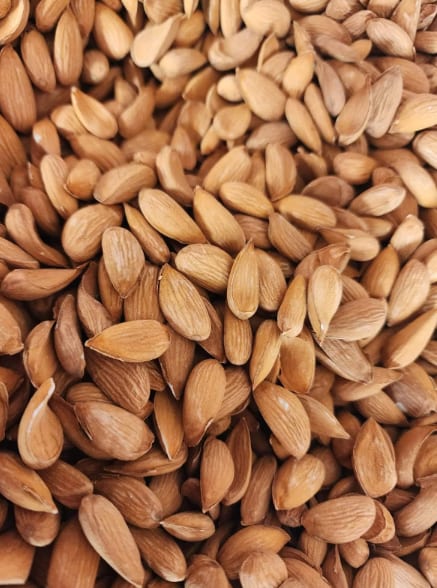
Mamra counts differently. The 20–25 figure assumes USDA’s average almond of 1.2 g. Mamra kernels run smaller: our own 500 g pack holds roughly 350–400 kernels, which puts a 30 g handful at about 21–24 mamra almonds. Weigh your handful once on a kitchen scale and you will know what it looks like.
When to eat them. Morning, soaked, on an empty stomach is the tradition, and it is ours too. We found no trial showing that the hour changes what almonds do; how much, and instead of what, matters far more.
Soaked vs raw almonds: what soaking changes
A katori of almonds soaking overnight is an old habit in Kashmiri homes, ours included. Here is what soaking actually changes, and what it doesn’t.
| Raw | Soaked overnight | |
|---|---|---|
| Calories and protein per almond | About 7 kcal, 0.25 g | The same. Soaking adds water, not nutrients |
| Phytate and minerals | — | Phytate changed by −12% to +10% across the nuts tested; minerals slightly lower |
| Gut comfort | Well tolerated in the trial | No better; flatulence was rated higher for soaked whole almonds |
| Texture | Crisp | Soft, easy to chew and to grind smooth |
| Skin | Stays on | Slips off between your fingers |
| Keeping | Months, airtight and cool | Eat within a day or two; refrigerate |
The evidence comes from a research group at the University of Otago in New Zealand, which tested the idea that soaking (“activating”) nuts unlocks more nutrition. Kumari and colleagues (2020) soaked almonds, hazelnuts, peanuts and walnuts for 4 or 12 hours, in salted or plain water. Phytate, the compound soaking is supposed to remove, changed by only −12% to +10%; mineral levels mostly went down; and the balance of phytate to minerals did not improve.
In their trial, Taylor and colleagues (2018) gave 76 adults 30 g of almonds a day in four forms (whole or sliced, soaked or not) for 12 days each. Soaking did not improve gut comfort or how much people liked the almonds, and flatulence was rated higher for soaked whole almonds than unsoaked ones. Whole soaked almonds even measured slightly more phytate: 563 mg per 100 g against 531 mg. It is one research group and a modest trial in healthy adults, but it is the best direct evidence there is, and it points one way.
So soak for the reasons our grandmothers did. At home we put 4–6 almonds in a small bowl of water at night, leave them 8–10 hours, slip the skins off in the morning and eat them that day. A soaked kernel is softer for children and elders, and it grinds smooth for kesar badam milk. If you like the crunch of a raw almond, eat it raw; you lose nothing.
Who should go easy on almonds
- Anyone with a tree-nut allergy should avoid them entirely.
- People who have had kidney stones. Almonds contain oxalate, about 344 mg per 100 g in India’s IFCT 2017, so roughly 100 mg in a 30 g handful. Ask your doctor before making them a daily habit.
- Small children, for the choking risk above: ground, never whole, under 5.
- Anyone counting calories, because 30 g is about 174 kcal and handfuls add up quickly.
Prefer to read in Hinglish? Our giri badam page covers badam ke fayde, roz kitne khayein and bhigo kar kyun.
Our almonds
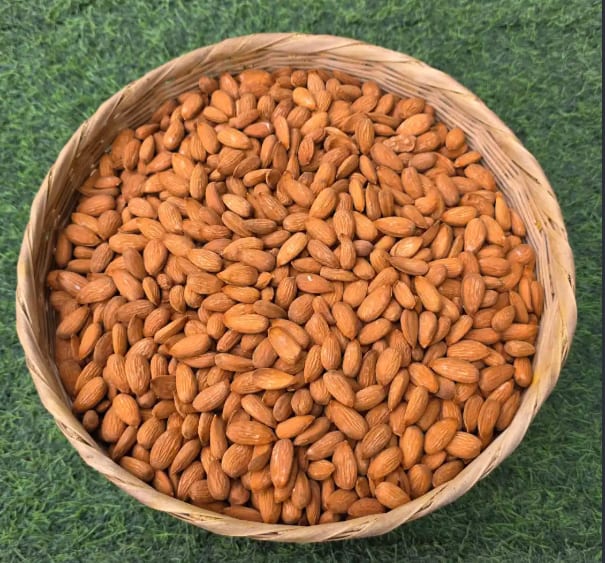
We sell genuine mamra almonds, grown in our own orchards and our FPO member families’ orchards in the valley, at ₹1,500 a kilogram: ₹375 for 250 g, ₹750 for 500 g and ₹1,500 for 1 kg. Why genuine mamra costs what it does is on our mamra badam price page, and how it differs from the almonds most shops sell is in mamra vs California almonds.
Everything on this page is about almonds in general. We have not had our own lot tested in a laboratory, so we make no nutrition or health claim about our pack. If you have a question about the current batch, our WhatsApp line is open at +91 95966 08297.
Sources
- USDA FoodData Central, SR Legacy FDC 170567, “Nuts, almonds”: nutrients and portions.
- Longvah T. et al., Indian Food Composition Tables 2017, ICMR-National Institute of Nutrition, Hyderabad; almond, food code H001: IFCT 2017 (PDF).
- Musa-Veloso K. et al., Journal of Nutritional Science, 2016; systematic review and meta-analysis of almond trials and blood lipids: PubMed 27752301.
- Lee-Bravatti M.A. et al., Advances in Nutrition, 2019; meta-analysis of 15 almond trials: PubMed 31243439.
- Hull S. et al., European Journal of Nutrition, 2015; mid-morning almond snack and satiety in 32 women: PubMed 25182142.
- Tan S.Y. and Mattes R.D., European Journal of Clinical Nutrition, 2013; four-week trial of almonds with meals or as snacks: PubMed 24084509.
- Novotny J.A. et al., American Journal of Clinical Nutrition, 2012; measured energy value of almonds: PubMed 22760558.
- Jambazian P.R. et al., Journal of the American Dietetic Association, 2005; almonds and blood alpha-tocopherol: PubMed 15746835.
- Coates A.M. et al., Nutrients, 2020; 12-week almond trial on memory, mood and other measures: PubMed 32340150.
- Kumari S. et al., Food Chemistry, 2020; soaking nuts, phytate and minerals: PubMed 32199146.
- Taylor H. et al., European Journal of Nutrition, 2018; soaked almonds, acceptance and gut tolerance in 76 adults: PubMed 28956139.
- NHS, foods to avoid giving babies and young children: whole nuts and choking.