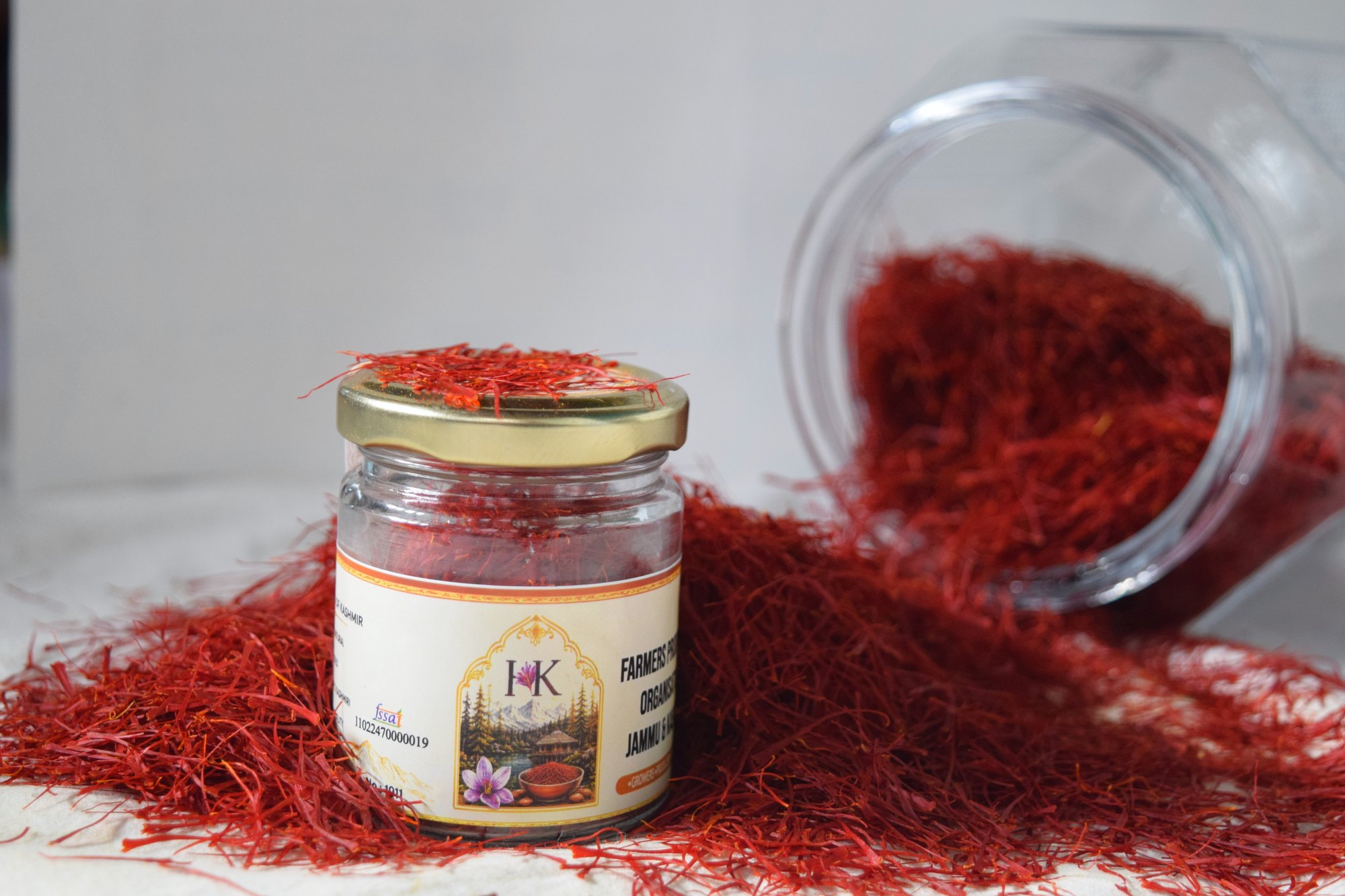
Kashmiri saffron comes in three types, and the official text names them: Mongra, Lachha and Guchhi. Mongra is the red stigma alone, with the yellow tail cut off. Lachha is the whole thread, tail and all. Guchhi is Lachha tied into small bundles. Those three words describe the cut. They are not lab grades, which is what ISO 3632 and AGMARK give, and they are not Iranian grades, although Super Negin, Negin and Sargol sometimes turn up beside them. We grow saffron in Pampore, and this page puts the official texts side by side so you can see which word answers which question.
The short answer
- Mongra: red stigma only, the yellow tail cut off by hand. The costliest Kashmiri type, “considered of the highest quality”, with 10 per cent more pigment than Lachha or Guchhi (Kashmir Saffron GI registration).
- Lachha (Lacha, Lachcha): the whole thread, red top and yellow tail, dried without further processing.
- Guchhi (Gucchi): Lachha tied into small bundles with cloth thread, mostly from Poochal in Kishtwar.
- Lab grades are separate. ISO 3632 Categories I, II and III and AGMARK’s Special, Standard and General are measured in a laboratory; Category I needs a colouring strength (crocin) of at least 200.
- Iranian names (Super Negin, Negin, Sargol, Pushal) describe a cut and say nothing about where the saffron grew.
- Price, 2026: genuine Kashmiri Mongra ₹300–600 a gram; Lachha ₹150–280. Ours is ₹359 (long thread) and ₹329 (short thread), both Mongra.
Three words, three different questions
Most confusion about saffron grades comes from three separate questions being answered with one word. It helps to pull them apart.
- What was cut? Mongra, Lachha and Guchhi, and the Iranian names too, describe the thread: red stigma only, or red stigma with its yellow tail still on.
- What did the lab measure? ISO 3632 Categories I to III and AGMARK’s Special, Standard and General are lab results for colour, flavour, aroma and moisture, measured on a sample from a named lot.
- Where was it grown? That is the job of the Kashmir Saffron geographical indication. Our GI tag guide explains what the tag certifies and how to check it.
A jar can be one of these without the others. Lachha from Pampore is still Kashmir saffron. Iranian saffron trimmed to all-red threads is still not Kashmiri. Mongra that was badly dried can still fail a lab test. A label you can trust answers all three questions.
The three types of Kashmiri saffron, in the GI registration’s words
The Kashmir Saffron geographical indication was applied for by the Directorate of Agriculture, Kashmir, facilitated by SKUAST-Kashmir and the Saffron Research Station at Dussu in Pampore. It is application 635, advertised in GI Journal No. 127 on 1 January 2020 and registered the same year as certificate 366. Its specification is blunt:
“The saffron available in Kashmir is of three types”
Lachha: the thread as it left the flower
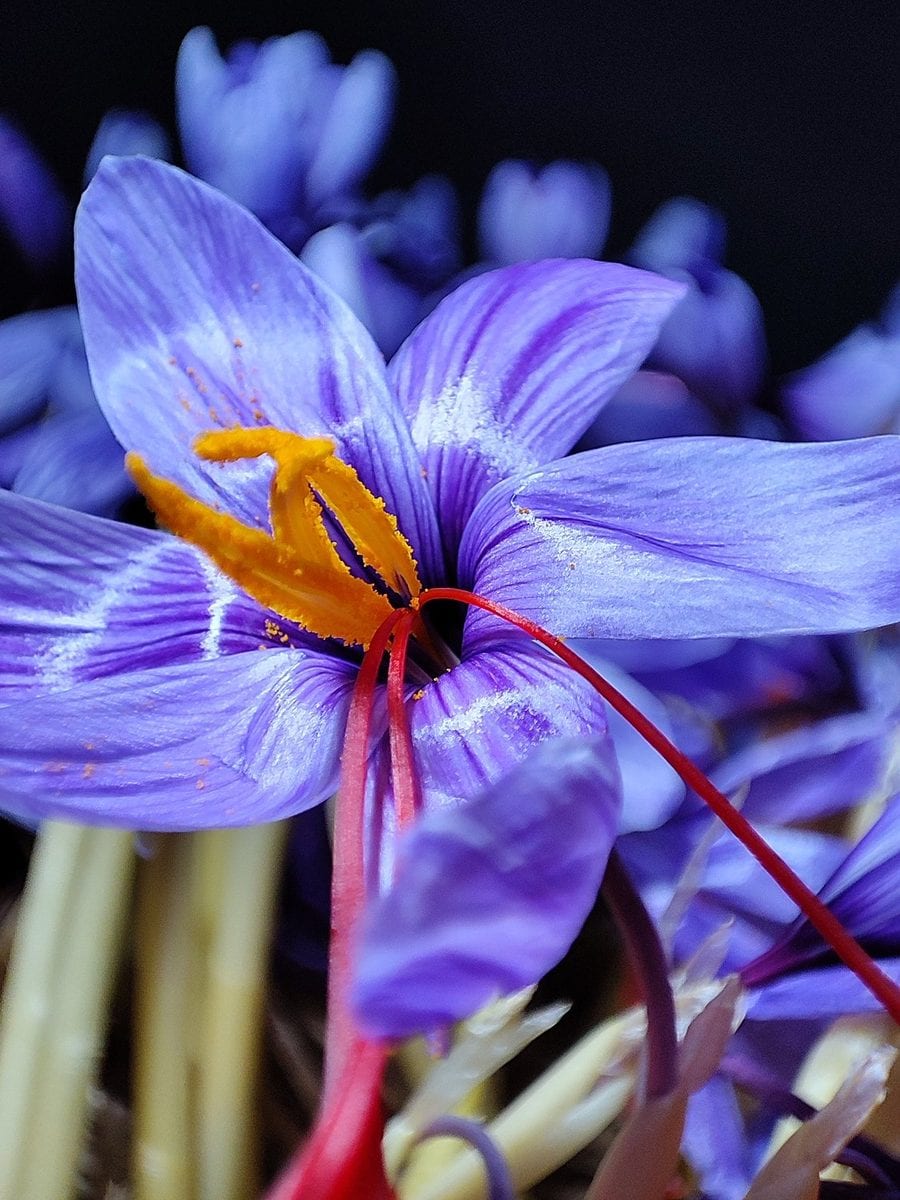
“This saffron consists of the stigmas just separated from the flowers and dried up without any further processing. In this type of saffron, the only difference is that the yellow colour tail of the stigmas is not cut, i.e., its length remains the same as taken out from the flower.”
Lachha is real saffron, uncut. Each thread is a red stigma running into a pale yellow tail (the style). The tail carries little of the colour, so part of every gram of Lachha is weight without much colour in it.
Mongra: the tail cut away
“The traditional method, commonly known as Loût Czhttun meaning ‘Tail Cutting’ is the unique process, by which the Kashmir farmers cut the yellow colored tail of Lachha saffron and separate the red color head/top portion of the stigma from the yellow-color tail. … The separated only red color stigmas constitute the Mongra saffron.”
The registration describes the stigmas being rubbed between the thumbs so that the yellow part comes away from the red. What is left is Mongra: red stigma only. The same text says Mongra “is considered of the highest quality since it consists only of the red-colored stigmas”, and in its post-harvest section it puts a number on it: “Mongra saffron contains 10 percent more pigment in comparison to corresponding Laccha & Gucchi.”
Guchhi: Lachha in a bundle
“This type of saffron is same as Lachha Saffron, the only difference between the two is that in Lachha saffron dried stigmas are packed loose in the air tight containers, whereas in Guchhi saffron, the stigmas are joined together and tied with cloth thread making a bundle of the stigmas. In local dialect Guchha/Guchhi means ‘small bundle’.”
The registration adds that Guchhi is grown in Poochal, Kishtwar and nearby areas, and that most Poochal growers sell their crop as small bundles to traders in Pampore or Srinagar. By the official definition, then, Guchhi is not a third, lower grade. It is Lachha, tied up.
Two notes on spelling and language. The registration itself spells the names more than one way (Lachha and Laccha, Guchhi and Gucchi), the BIS standard writes Lachcha, and the trade adds Lacha and Mogra, so do not read anything into the spelling on a label. In Hindi the question is usually asked as kesar ke prakar (केसर के प्रकार), and the answer is the same three: मोंगरा, लच्छा and गुच्छी.
What the registration leaves out matters as much. It never uses Super Negin, Negin, Sargol, Pushal or A++, and it sets no laboratory thresholds. Grading by laboratory is a different system, covered further down.
Mongra vs Lachha vs Guchhi, side by side
| Compared on | Mongra | Lachha (Lacha, Lachcha) | Guchhi (Gucchi) |
|---|---|---|---|
| Cut | Yellow tail cut off by hand after drying (Loût Czhttun, “tail cutting”) | Not cut: the thread as it came out of the flower | Not cut, as Lachha; the threads tied into small bundles with cloth thread |
| Colour | Deep red all the way along | Red top, yellow tail | Red tops and yellow tails, in a tied bundle |
| What is in it | Red stigma only: “whole stigmatic portion without any style”; 10% more pigment than the other two | Stigma and style together: “total filament” | The same as Lachha; mostly from Poochal, Kishtwar |
| Price band, 2026 | Long thread ₹340–600/g (₹3.4–6.0 lakh/kg); short thread ₹300–450/g (₹3.0–4.5 lakh/kg) | ₹150–280/g (₹1.5–2.8 lakh/kg) | No separate band in our price guide; judge it against Lachha |
| Best use | Biryani, kheer, kahwa, kesar milk and gifting, where you want the most colour from a pinch | Everyday cooking, if it is priced as Lachha; you need a little more for the same colour | As Lachha. Most of it is sold by Poochal growers to traders in Pampore or Srinagar |
Cut, contents and origin are from the Kashmir Saffron GI registration. Price bands are what genuine material sells for across Indian retail in 2026, the same bands as our kesar price per kg guide.
Why Mongra costs more
The registration answers this one too: “Since the process of tail cutting is an additional step and is painstaking process, the Mongra saffron becomes more costly. Moreover, the weight of the saffron gets decreased when the yellow portion is cut-out from the rest of the top portion of the stigma, leaving only red-colored stigmas.” You pay for the extra hand work, and for the weight that was cut off so that only red is left. That is also why Lachha sold at a Mongra price is such a common trick: the buyer pays for the tail at the stigma’s rate.
What India’s standards call them
The Bureau of Indian Standards’ saffron specification, IS 5453 (Part 1):1996, uses the same split in its foreword, under different names:
“Saffron presently sold as selected quality and the unselected quality. Selected quality also known as MONGRA, is all red and consists of mainly broken stigmas of the flower. The unselected quality, generally known as LACHCHA, contains some yellow filaments besides the stigmas and floral wastes.”
Two things follow. India’s own standard agrees with the GI registration that Mongra is the all-red cut. And it describes Mongra as “mainly broken stigmas”, so short threads are normal for Mongra. Long, unbroken threads are the top of the sort, not the definition of it.
The other Indian text is the AGMARK rules: the Saffron Grading and Marking Rules, 2012 (G.S.R. 771(E), 18 October 2012). They do not use Mongra or Lachha at all. Their grades are Special, Standard and General, set by laboratory numbers, and they are the closest Indian match to ISO 3632.
AGMARK and ISO 3632: the grades a laboratory gives
| AGMARK / ISO 3632-1 | Colouring strength (crocin), min | Flavour (picrocrocin), min | Aroma (safranal) | Moisture, max: AGMARK | Moisture, max: ISO (threads) |
|---|---|---|---|---|---|
| Special / Category I | 200 | 70 | 20–50 | 10% | 12% |
| Standard / Category II | 170 | 55 | 20–50 | 11% | 12% |
| General / Category III | 120 | 40 | 20–50 | 12% | 12% |
Absorbance readings on a dry basis: crocin at 440 nm, picrocrocin at 257 nm, safranal at 330 nm. AGMARK figures are from Schedule II of the 2012 rules, which also caps floral waste at 0.5%, 4% and 6% for the three grades. ISO 3632-1:2011 Category I limits are as printed on our IIKSTC lab report; Categories II and III are from published summaries of the standard.
The colour, flavour and aroma thresholds are the same in both systems. AGMARK is stricter on moisture in its top two grades. Neither uses the words Mongra or Lachha, because a laboratory grade measures how strong a sample is, not how it was cut, and not where it grew: ISO 3632 is an international standard, applied to saffron from any country. Labs and sellers, ourselves included, often call ISO Category I “Grade I”; it is the same thing. Our Grade 1 Kashmiri saffron page shows what that looks like on a real report.
Cut does not guarantee strength. The GI registration itself records that traditional post-harvest practices “result in post harvest losses to the tune of 30% in the product quality”. Mongra that was dried or stored badly is still Mongra, and it can still test below Category I.
Three more things worth knowing:
- Old labels, old system. The 1996 BIS standard was written “on the lines of ISO 3632 (Part 1): 1993”, which sorted saffron threads into four grades. That is why some labels still speak of “ISO grades I to IV”. The current ISO 3632-1 has three categories.
- A++ is not a grade. A, A+, A++ and A+++ appear in none of these texts: not the GI registration, not BIS, not AGMARK, not ISO. They are a seller’s adjectives.
- AGMARK guards its own words. On an AGMARK-graded pack, the packer’s trade mark may not “indicate quality other than that indicated by the grade designation mark” (rule 7(4) of the 2012 rules).
Iranian names: Super Negin, Negin, Sargol and Pushal
Iran grows far more saffron than Kashmir and has its own trade names for cuts. They turn up in Indian listings too, sometimes next to the word Kashmiri. Here is how they line up with the Kashmiri types, by cut only:
| Iranian trade name | What the thread is | Nearest Kashmiri type, by cut only |
|---|---|---|
| Super Negin | Red stigma only, no style; the longest, most evenly trimmed threads. Iran’s top trade grade. | Mongra |
| Negin | Long red threads, trimmed less evenly than Super Negin; sources differ on whether a trace of style is left. | Mongra |
| Sargol | Red tips only, in shorter or broken threads. | Mongra |
| Pushal (Pushali) | Red stigma with 1–3 mm of yellow style left on. | Between Mongra and Lachha |
| Bunch (Dasteh, Khooshe) | The whole stigma and style, tied in a bundle. | Guchhi |
| Konj | Yellow or white style only, no red. | None: it is the tail that Mongra cuts away |
Iranian trade usage as described in published grading guides. We could not read Iran’s national saffron standard itself, so treat the boundaries between Negin and Sargol as trade practice, not law.
The point that matters: these names describe the cut, and they say nothing about origin. “Super Negin” on a label tells you the threads are long and all red. It does not tell you they are Iranian, and it certainly does not tell you they are Kashmiri. None of the Iranian names appears in the Kashmir Saffron GI registration, the BIS standard or the AGMARK rules.
The same is true the other way round. Trimming saffron to all-red threads is done in Iran too (that is exactly what Super Negin is), so the word Mongra on its own does not prove where a thread grew. In October 2026 we found an Iranian “Super Negin” lot on an international trade directory listed as “Grade: Mongra, A+”, and on one Indian B2B marketplace, listings titled “Kashmiri Mongra” ran from ₹70 to ₹600 a gram. Iranian saffron re-packed in India trades at roughly ₹80–200 a gram; it is often real saffron, just not Kashmiri. The word that should carry the origin is Kashmiri, and it needs proof behind it. For how the two compare thread by thread, see Kashmiri vs Iranian saffron.
How to check what you bought
You can settle the cut at home. Strength and origin need paper. In order:
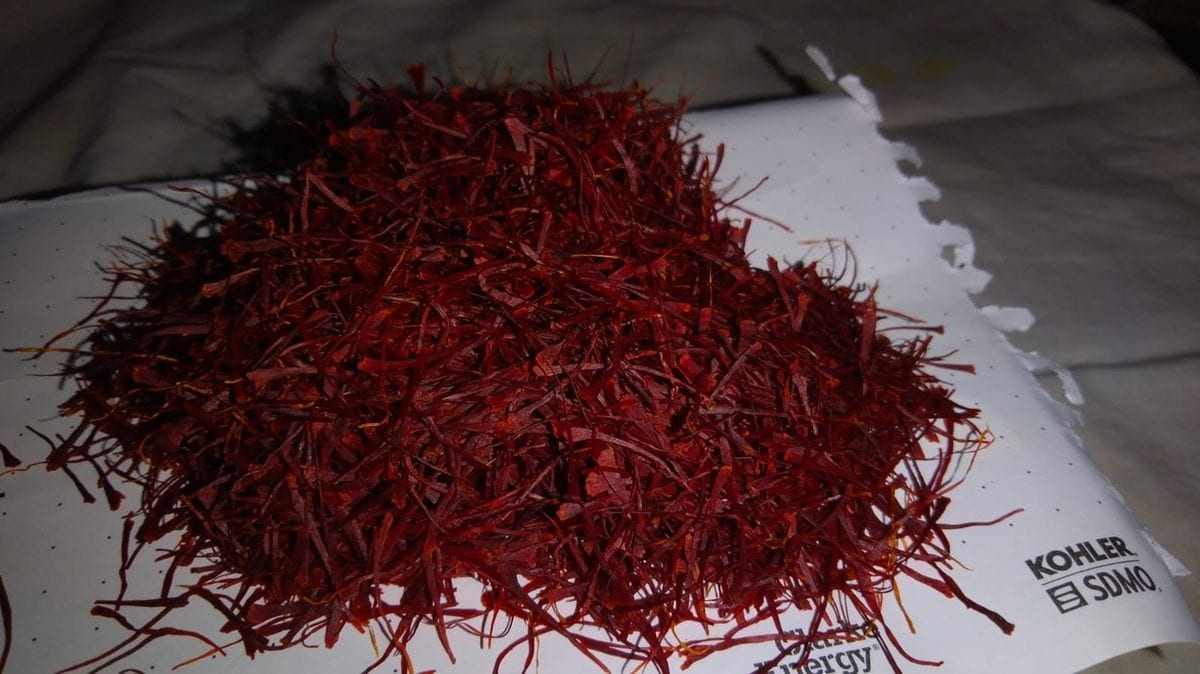
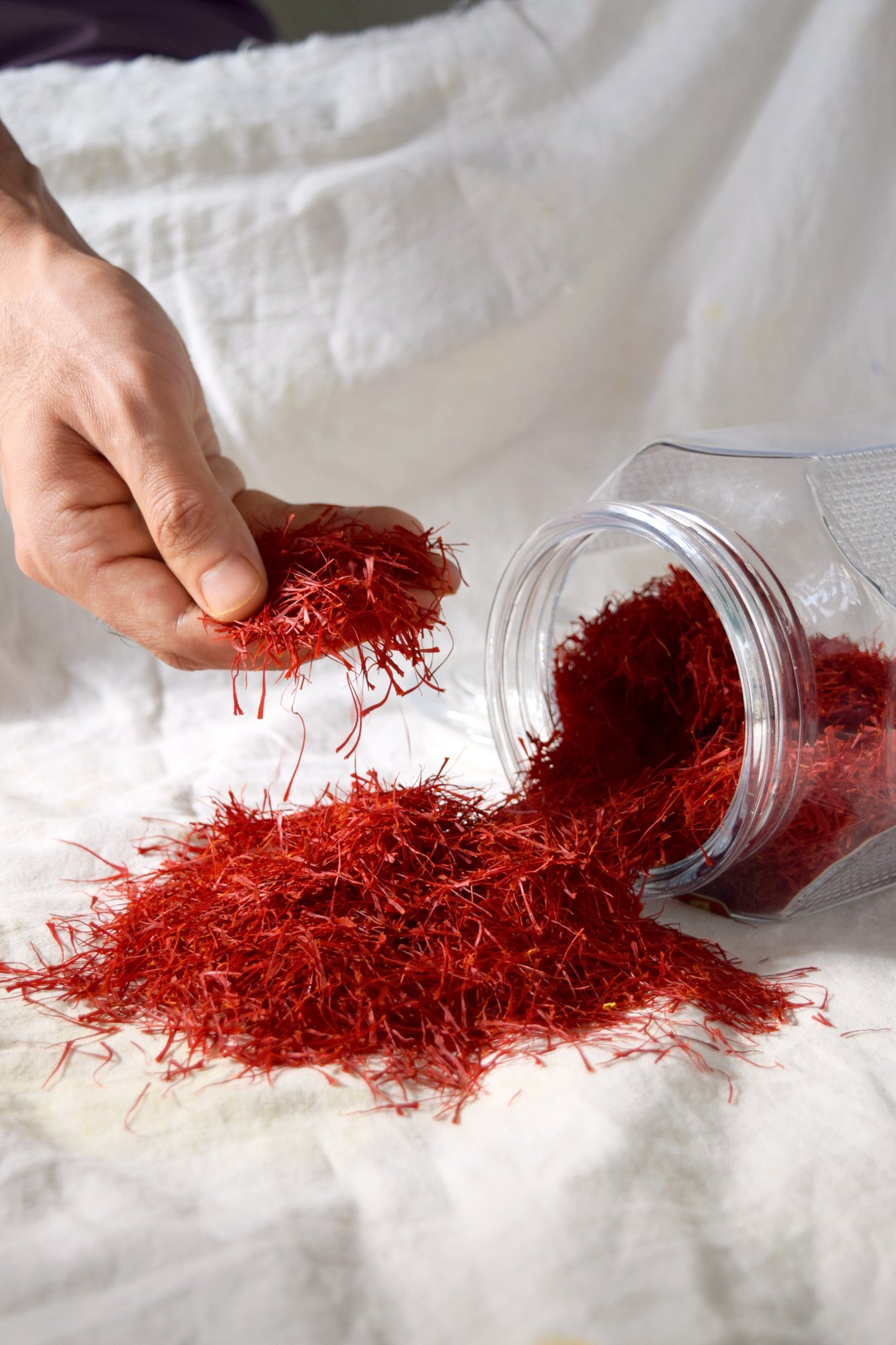
- Look at the threads. Lay a few on white paper. Deep red all along, flaring slightly at the tip, is Mongra. A red top running into a yellow or pale tail is Lachha. Threads tied in a little bundle, tails on, are Guchhi. If most threads have tails and you paid a Mongra price, you know what happened.
- Check it is saffron at all. Drop three or four threads in warm water. Real saffron releases a golden-yellow colour slowly over 10–15 minutes while the threads stay whole; red water or instant colour means dye. The full method, with four more tests, is in how to identify real Kashmiri saffron.
- Ask for the lab report that names the lot. ISO 3632 Category I needs crocin of at least 200. A report should name the lab, the standard, the lot and the date, and the lot should match your jar. Ours is published in full on our lab reports page.
- Check the origin separately. A GI-tagged pack carries a code you can trace; a grower can show you the fields. Neither the cut nor the lab grade proves origin on its own.
- Price it against the band. “Kashmiri Mongra” for under about ₹150 a gram is below the cost of picking the flowers. It is usually Lachha, an Iranian re-pack or not saffron at all.
If you are choosing between sellers rather than testing a jar, our seven checks before you buy any saffron put all of this in one list.
Our two jars
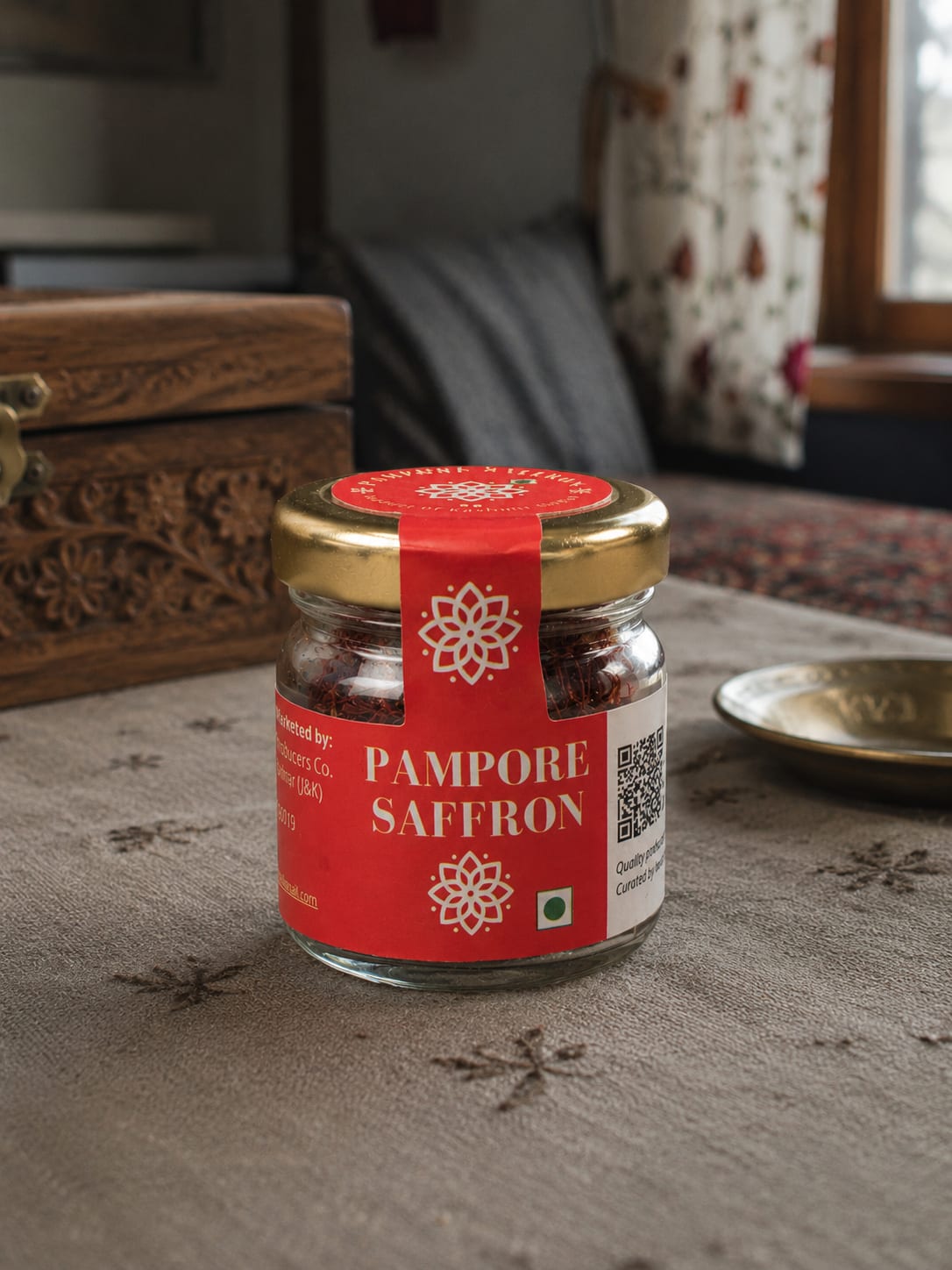
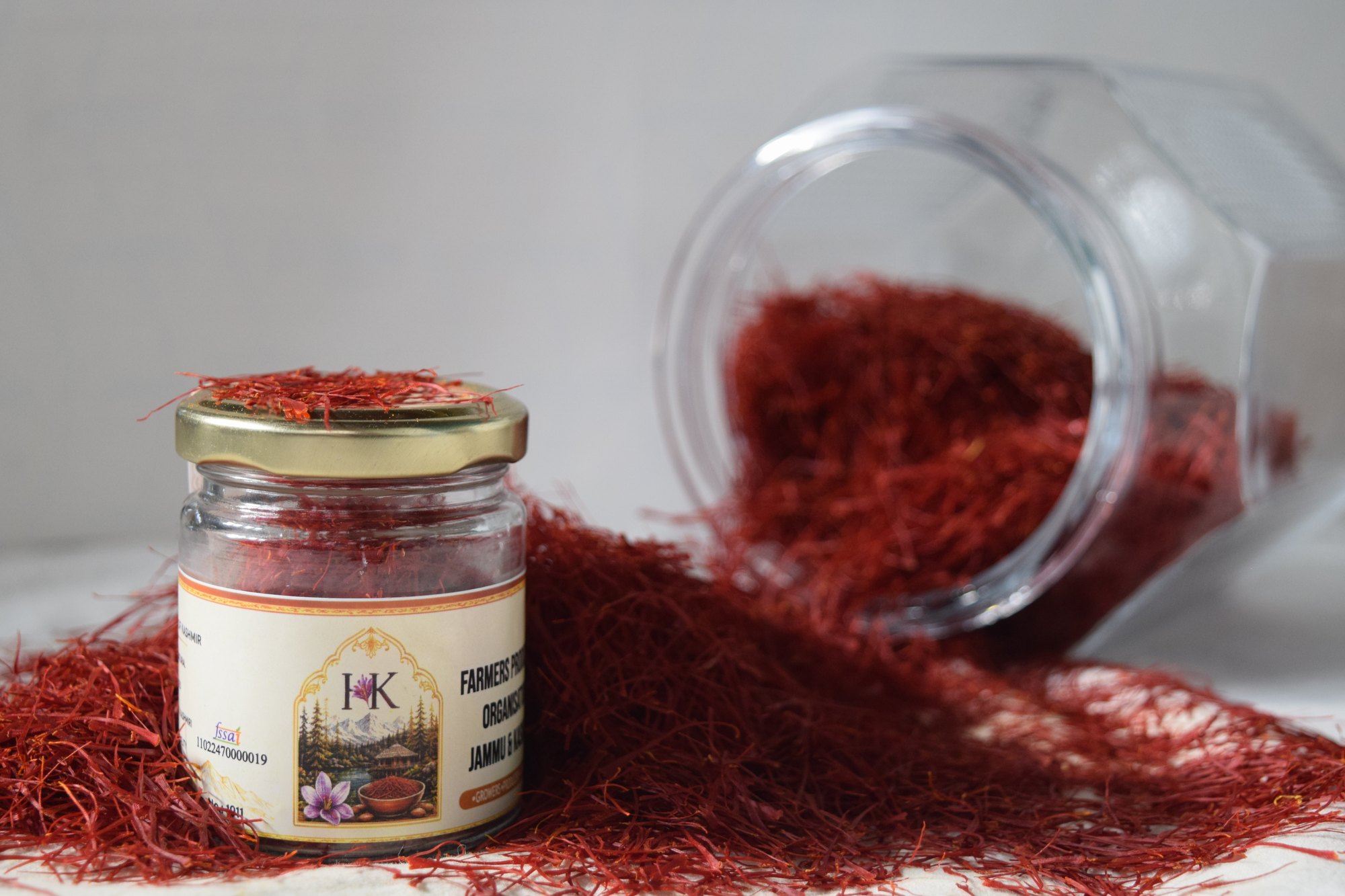
Both of our jars are Mongra, from our family’s fields in Pampore, from the same harvest and the same all-red sort. The longest, thickest threads are picked out by hand and sold as Kashmiri Mongra saffron at ₹359 a gram. The rest of the sort, still all red, is Kashmiri Mongra Saffron (Short Thread) at ₹329 a gram. As BIS says, short threads are normal for Mongra; in the pot, colour and aroma come from the chemistry, not the length. Both jars are sold at the same rate per gram at every size, from 1 g to 10 g.
Both are tested by the IIKSTC Quality Evaluation Laboratory in Pampore and graded ISO 3632 Grade I: colouring strength (crocin) 217.51 against a minimum of 200, moisture 11.72% against a maximum of 12%. The report was issued on 5 October 2026 and is published with every value and the lab’s own notes. Our fields are in Pampore, inside Kashmir’s GI-registered saffron area. Our separate GI-tagged lot is out of stock, so the jars on sale today are sold on their lab grade, not on a GI tag. We do not sell Lachha or Guchhi.
Our WhatsApp line is open at +91 95966 08297 if you want to see the threads in the current jar before you order.
The texts quoted on this page
- Kashmir Saffron geographical indication, application 635: the specification as advertised in GI Journal No. 127, 1 January 2020 (applicant: Directorate of Agriculture, Kashmir).
- Bureau of Indian Standards, IS 5453 (Part 1):1996, Saffron: Specification (second revision), foreword and clause 4.
- Saffron Grading and Marking Rules, 2012, G.S.R. 771(E), 18 October 2012 (AGMARK), Schedule II and rule 7(4).
- ISO 3632-1:2011: Category I limits as printed on our IIKSTC report; Categories II and III from published summaries of the standard.