The honest answer to "which saffron is best in India" is not a brand name. It is a specification: ISO 3632 Category I, all-red Mongra, grown inside the Kashmir Saffron GI area, sealed at source with a stated harvest year, from a seller who will name the field. That is a list of checkable facts. A brand name is not. Below are the seven checks that specification breaks down into — apply them to us and to everyone else, and you will not need anyone's ranking.
Why we are not writing a "top 10 brands" list
Because we sell saffron, and any list we wrote would put us at the top, and you would be right to discount it entirely. Every such list you find is written either by a seller ranking itself or by an affiliate site ranking whoever pays the highest commission. Neither tells you anything about what is in a jar.
A checklist is different. It survives the writer's self-interest, because we have to pass it too — and if a competitor passes all seven checks and we do not, you should buy from them. That is the point.
Check 1 — Origin, stated specifically
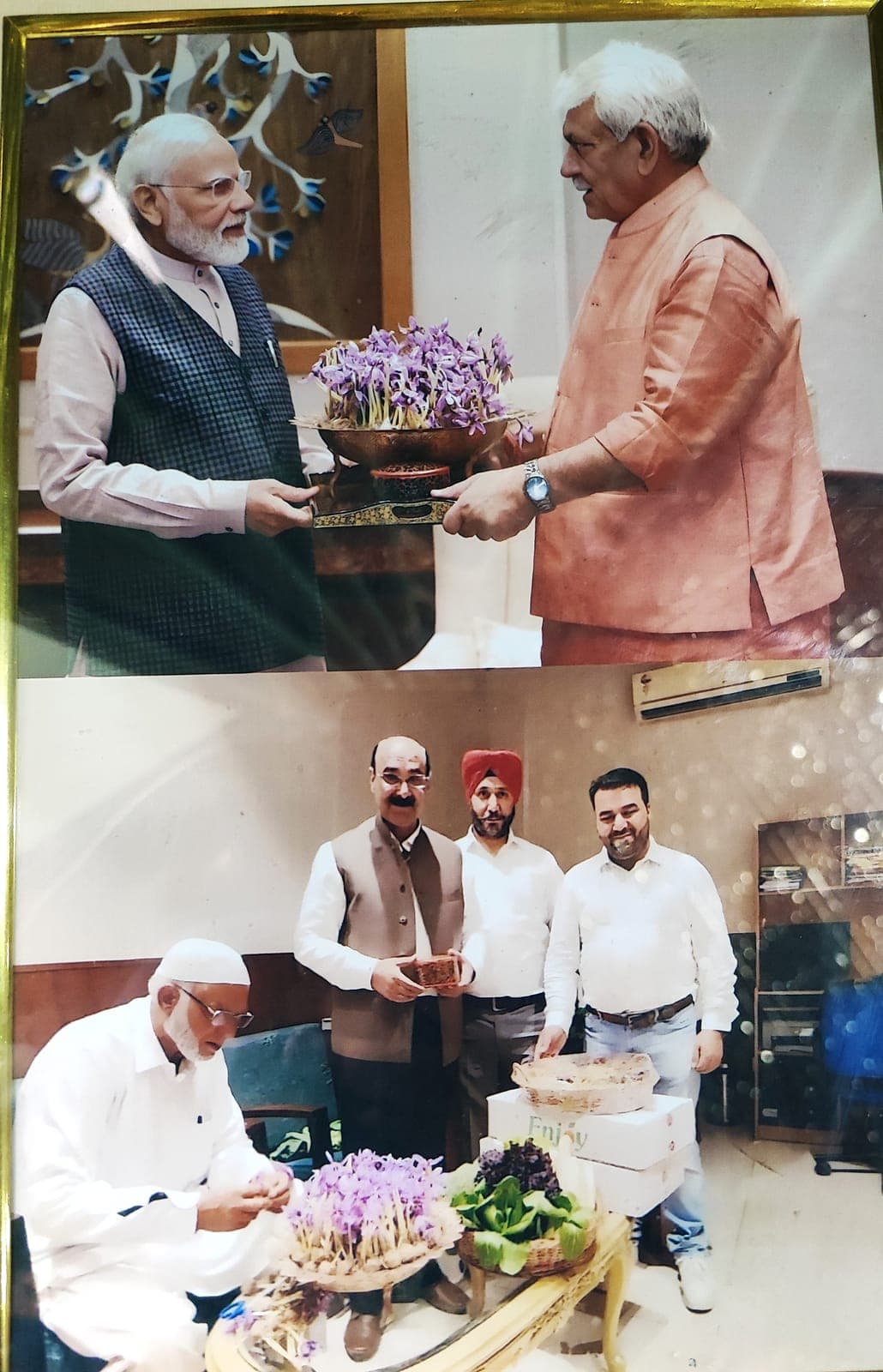
"Kashmiri saffron" on a label is a claim, not a credential. The credential is a named place: a district, a village, ideally a family. Kashmiri saffron grows almost entirely on the karewa plateaus around Pampore in Pulwama district — that is where ours comes from, and a seller who genuinely grows it can tell you which karewa without pausing.
The relevant formal protection is the Kashmir Saffron Geographical Indication, granted by the Government of India in 2020. It legally restricts the name to saffron grown in the valley. It does not police a market stall, so treat it as a floor rather than a guarantee.
The test: ask which village and which harvest. A grower answers immediately. A repacker changes the subject to "100% pure".
Check 2 — ISO 3632 Category I, not "Grade A"
This is where most buyers get lost, and it is the easiest thing to fix. There is a real standard and there is marketing vocabulary, and they look similar on a label.
- ISO 3632 is the international saffron standard. It lab-measures three things — crocin (colouring strength), picrocrocin (taste) and safranal (aroma). Category I is the top band. This is a measurable, falsifiable claim.
- "Grade A", "A++", "premium", "organic-grade" mean whatever the printer was asked to print. There is no body that defines them.
The test: does the label reference ISO 3632, and does it say Category I? If it says A++ and nothing else, you have a marketing term where a standard should be.
Check 3 — Mongra, not Lachha
Same flower, different cut, and the difference is most of the price.
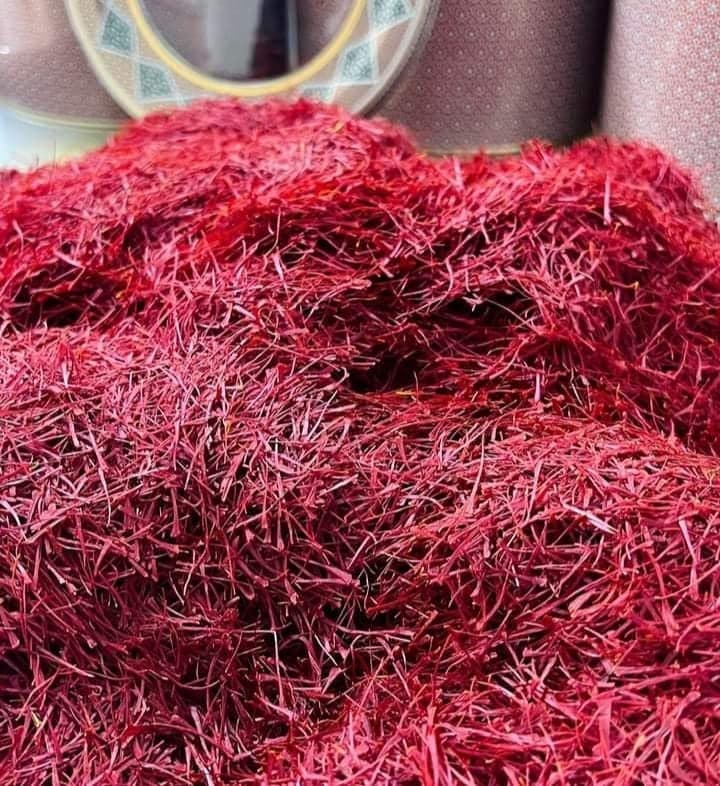
- Mongra (also sold as Super Negin) is only the dark-red stigma tips. All the crocin, all the aroma, none of the dead weight.
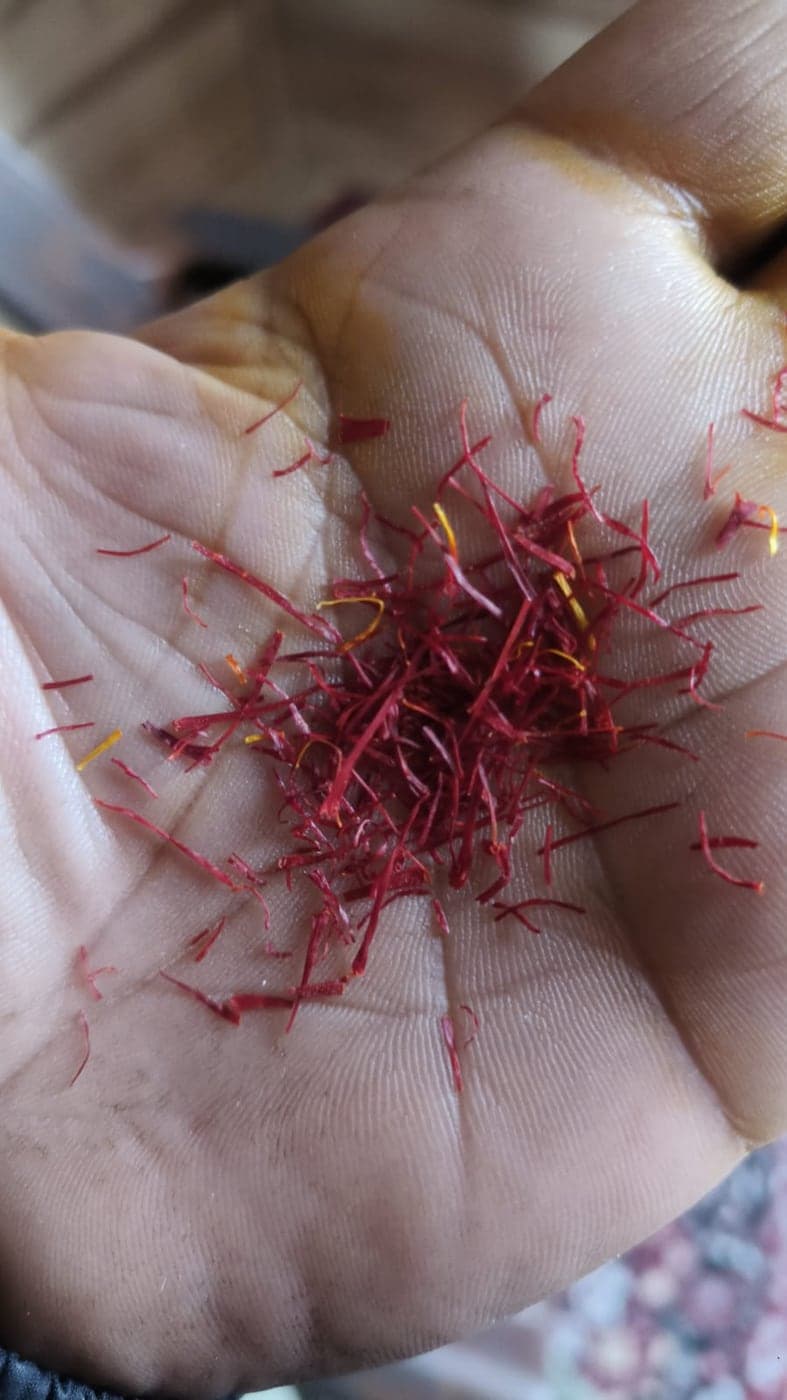
- Lachha keeps the yellow-orange style attached to the thread. It is real saffron — but the style carries almost no colour or aroma, so you are paying by the gram for mass that does nothing.
This is the single most common way a "Grade 1" price gets quietly discounted in an Indian bazaar. When a seller comes down on price after a negotiation, check what grade you actually agreed to.
The test: look at the threads. Uniformly dark red with a small trumpet flare at the tip is Mongra. Any yellow or orange tail is Lachha. Photographs on a product page should show this clearly; if they are all shot from a distance, ask why.
Check 4 — A harvest year on the jar
Kashmir's crocus flowers over roughly three weeks from late October to mid-November. There is exactly one harvest a year, and any real grower knows which one is in the jar. Saffron holds its character for two to three years stored properly, so an older harvest is not a problem — an unstated one is.
The test: is there a harvest year or a batch code on the packaging? A seller who cannot tell you which autumn the saffron came out of is not close enough to the field to know.
Check 5 — Sealed at source, never loose by weight
Loose saffron scooped from an open tin has three problems at once. It has no batch code, so there is no traceability. It has no tamper evidence, so it can have been topped up with anything. And it is hygroscopic — it has been absorbing moisture from the shop air, and you are buying it by weight.
That last point is worth a moment because almost nobody says it out loud: damp saffron weighs more. A sealed jar filled and weighed at source in dry conditions puts dry saffron on the label.
The test: tamper-evident seal, glass you can see through, weight printed by whoever filled it. If the answer is a paper twist from a tin, walk.
Check 6 — The price floor holds everywhere
Each Crocus sativus flower gives three stigmas. Roughly 160 flowers make one gram. Every one of them is picked at dawn by hand and separated by hand the same day, across a three-week window, in one valley. That arithmetic sets a floor that does not move because a shop is having a sale.
- ₹330–360 per gram — direct from a Kashmiri grower family. This is the origin price and it is the same whether the parcel goes to Gurugram or Kavaratti.
- ₹450–900 per gram — Indian retail, varying by distance from the supply chain. Delhi at the low end; Guwahati, Imphal and Itanagar at the top, where four or five margins have stacked up. Our state-by-state pages set out the local number for each.
- Under ₹300 per gram — Iranian repack, Lachha grade, or adulterated. Under ₹150, it is not saffron at all.
The full breakdown of how the market prices itself is in what kesar really costs.
Check 7 — A licence, an address and a person
An FSSAI licence number that you can look up on the FSSAI portal. A physical address, not a PO box. A phone number that a human answers in March, not only in October. A returns policy that survives you opening the jar and running the water test.
None of that guarantees good saffron. All of it means someone is accountable for it, which is the difference between a business and a stall. Ours: Pampore Saffron Farmers Producers Organization, Lethpora, Pampore, Pulwama, J&K, FSSAI 11022470000019, WhatsApp +91 95966 08297. Look us up.
Then run the ten-minute test at home
Every check above happens before you pay. This one happens after, and it settles the question:
- Water. Three threads in warm — not hot — water. Real saffron gives a slowly deepening gold over ten minutes while the threads stay whole and dark red. Dyed material stains the water red within seconds and goes pale and limp.
- Crush. A dry thread should be brittle and powder between your fingers. Soft, bending threads have taken on moisture.
- Smell. Honeyed, hay-like, faintly metallic. If it smells of nothing, it is faded; if it smells sweet and perfumed, be suspicious.
The full set, including the baking-soda test and the two that catch the cleverer fakes, is in five tests you can do at home.
Where to buy, ranked by risk rather than by brand
- Lowest risk: direct from a Kashmiri grower family with a named village, a harvest year, a sealed jar and an FSSAI licence. You are one hop from the field.
- Low risk: the J&K government emporiums, which sell verified stock at fixed rates. A genuinely safe walk-in option and the strongest recommendation we will make for a place we do not own.
- Moderate risk: a named national brand at a modern-trade store. Real saffron, a company behind it, and usually no stated origin — often Iranian in a well-designed jar at a Kashmiri price.
- High risk: loose weight from an open tin in any bazaar; small packets in pilgrim and temple markets; gift-box vials with no grade printed on them.
- Highest risk: roadside stalls on the Srinagar–Pampore highway and in Pahalgam and Gulmarg. Sold to people who will never return, and adulterated accordingly. We live twenty minutes from that road and we would not buy from it.
The one-line version
Buy ISO 3632 Category I all-red Mongra, from a named Pampore grower, sealed with a harvest year, at ₹330–360 a gram, from someone with a licence and a phone number — then run the water test within the return window. If a jar passes all of that, it is the best saffron India produces, whoever's name is on it.