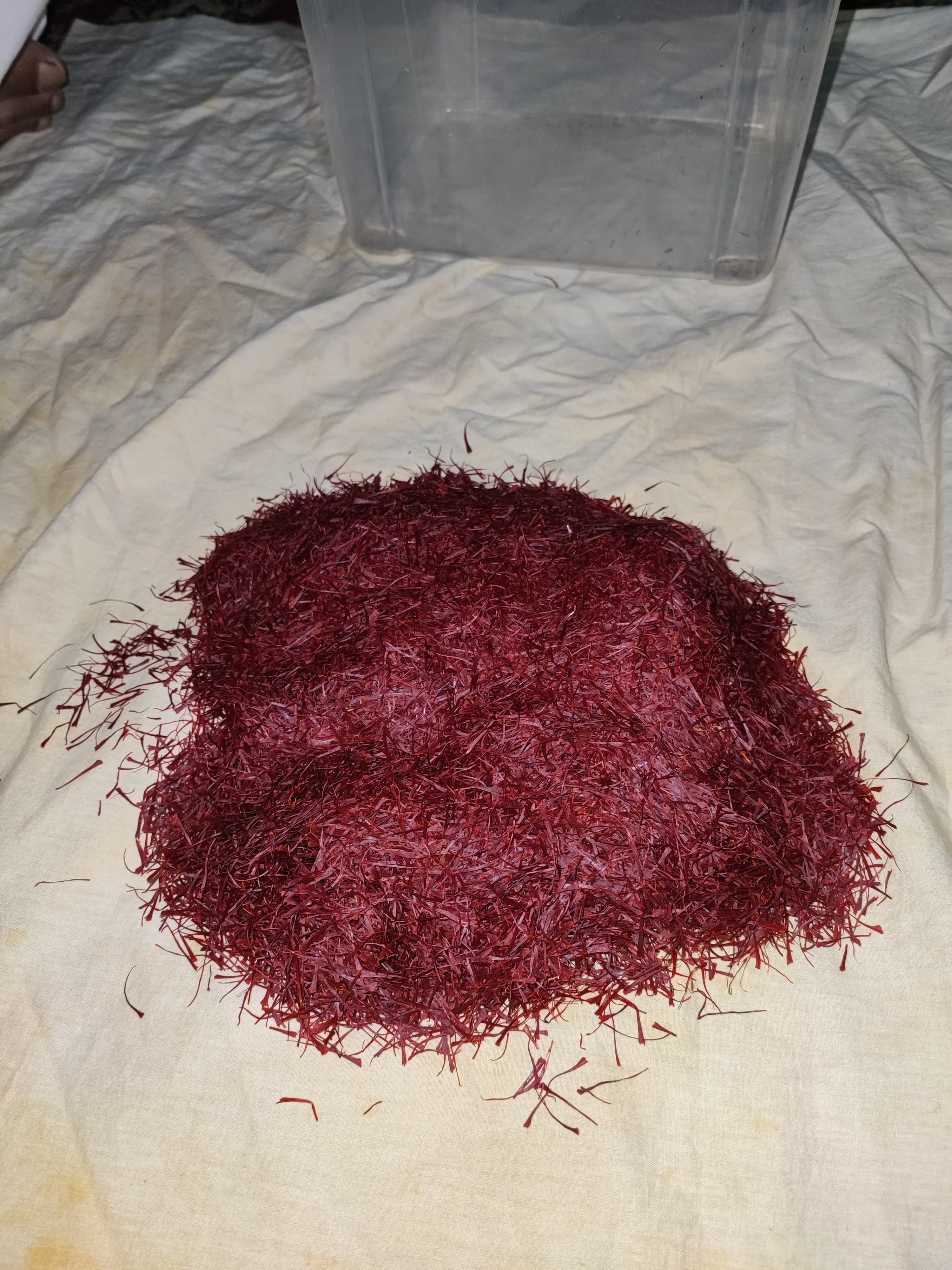
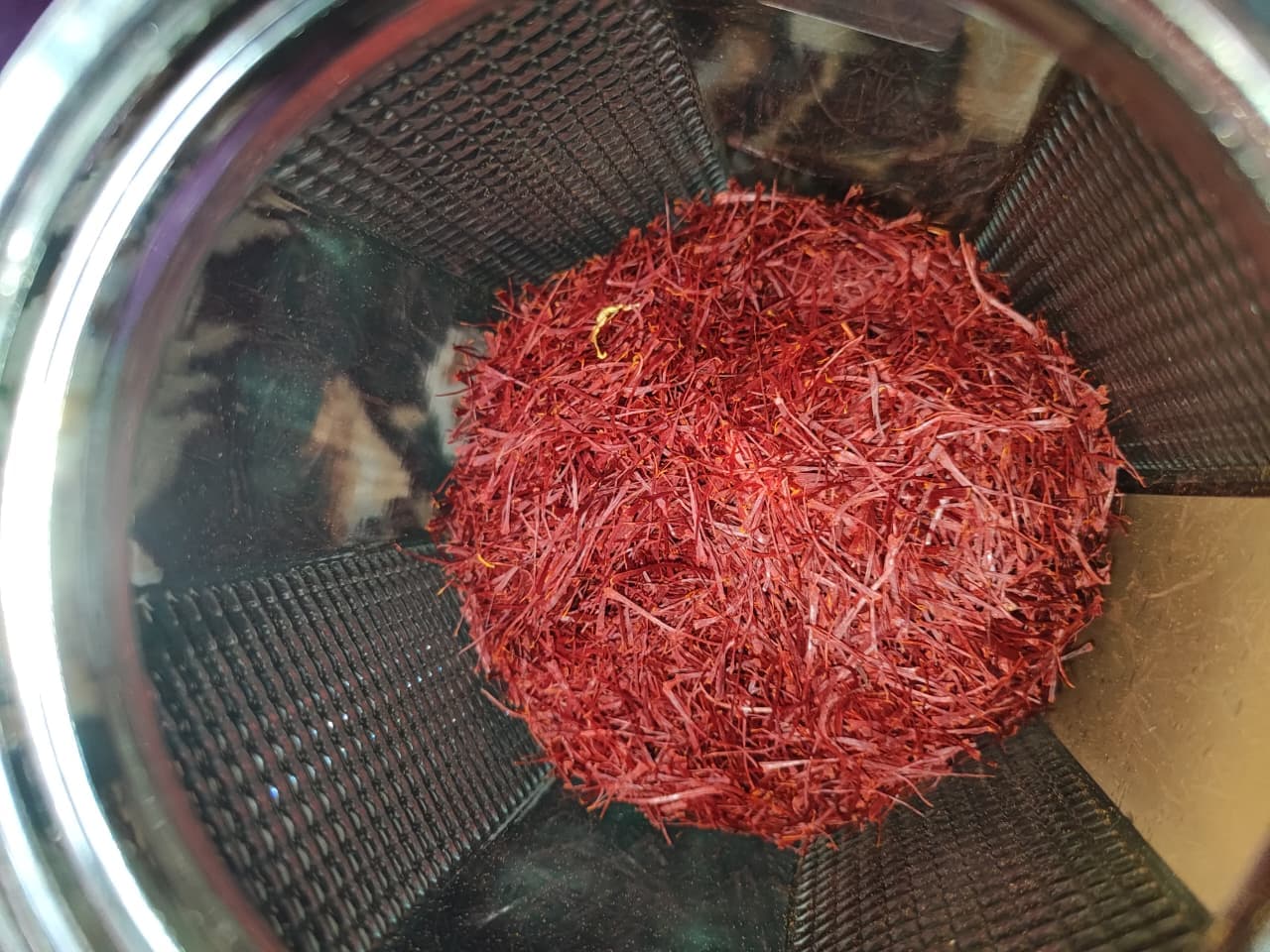
The short answer: an airtight glass jar, in a dark dry cupboard, at room temperature, away from the stove — and never in the refrigerator. Stored that way, good Kashmiri saffron holds its full colour, taste and aroma for two to three years. Stored badly, the same jar is noticeably weaker in a few months, and the first thing you lose is the aroma you paid the most for.
What actually degrades saffron
Saffron's value sits in three compounds, and ISO 3632 — the international grading standard — measures exactly these:
- Crocin gives colour. It is the most robust of the three and the last to go, which is why old saffron still turns milk yellow.
- Picrocrocin gives the bitter-honey taste.
- Safranal gives the aroma. It is volatile — that is what makes it a smell — and it is the first thing you lose to heat, light and time.
Three things break them down: light, which drives photodegradation of crocin; moisture, which lets the threads clump and accelerates chemical breakdown; and heat, which speeds everything up and drives safranal off. Oxygen contributes over long periods. A closed dark jar in a cupboard defeats all of them at once, which is why the method is so short.
The fridge mistake
It is the single most common thing people do wrong, and it comes from a sensible instinct: cold preserves food. For saffron it backfires.
Every time you take a cold jar out into a warm kitchen, water vapour condenses on the cold glass and on the threads. Saffron is hygroscopic — it absorbs that water rather than shedding it. Do that twice a week for a year and you have a jar of clumped, damp threads that have lost far more aroma than they would have sitting quietly in a cupboard. The freezer is the same problem with a bigger temperature gap.
The only case for refrigeration is a sealed, unopened, vacuum-packed commercial quantity you genuinely will not touch for years — and even then you must let it reach room temperature fully before opening. For a household jar, the answer is simply the cupboard.
The method, in full
- Container: airtight glass with a screw cap or a good gasket. Tinted or dark glass is better than clear; clear glass in a dark cupboard is fine. Avoid thin plastic, which is permeable over time, and avoid anything that has held another spice.
- Place: a dark, dry cupboard at room temperature. Not a spice rack on the counter, not a shelf above the hob, not a windowsill. Heat and light are both worse near a cooking surface.
- Handling: open, take what you need, close. Do not leave the jar open while you cook, and do not open it directly over a steaming pot — you are inviting moisture straight in.
- Never dip a wet spoon in. Dry fingers or a dry spoon, every time.
- Do not decant into a masala dabba. An open steel spice box in a working Indian kitchen is the worst environment for saffron in the house — warm, humid, and opened twenty times a day.
Storing saffron in Indian humidity
The advice above is universal. In much of India it needs sharpening, because humidity is the dominant variable and it varies enormously across the country.
- Coastal and high-rainfall: Mumbai, Goa, Kochi, the Konkan, Kolkata, the whole Northeast, Lakshadweep and the Andamans. The hardest conditions in the country. Buy 1–2 grams at a time and finish it within a year. Airtight glass with a proper seal, driest cupboard, well away from the sink.
- Hot and dry: Rajasthan, Gujarat, inland Maharashtra, Haryana, Punjab in summer. Heat and light are the concern rather than moisture. A dark cupboard away from the kitchen handles it, and saffron keeps noticeably better here than on the coast.
- Cold and dry: Ladakh, the Himachal and Uttarakhand high country, Kashmir itself. The kindest storage climate in India. A sealed jar here will hold its character at the top of the two-to-three-year range.
- Monsoon everywhere: for three or four months a year most of India becomes a coastal climate as far as a spice jar is concerned. Check the seal at the start of the season.
Each of our state pages carries the local version of this, because the honest advice for a household in Kavaratti is genuinely different from the advice for one in Leh.
How to tell a jar has faded
Three checks, in order of usefulness:
- Smell. The first and best test. Good Kashmiri Mongra has a distinct honeyed, hay-like, faintly metallic aroma you notice the moment the jar opens. Faded saffron smells of very little. Aroma goes first, so this catches decline long before the colour does.
- Snap. Take a thread and press it between your fingers. Properly dry saffron is brittle and crushes to a fine powder. A thread that bends and flattens instead has absorbed moisture.
- Steep. Three threads in warm water. Fresh saffron gives a deepening gold over ten minutes and the thread stays whole and dark red. Faded saffron gives a weaker, slower colour. This test also happens to be the basic authenticity test — dyed material stains the water red within seconds.
Faded saffron is not unsafe and does not need throwing away. Use more of it, or use it where the colour matters more than the aroma — a pulao rather than a glass of kesar doodh, where there is nothing to hide behind.
The buying implication
Two practical consequences follow from all of this, and both are worth money.
First, buy a jar sized to a year of your actual use. At 3–4 threads a glass and 15–20 for a family dish, one gram is roughly 250 glasses of milk or a dozen large dishes. Most households need 1 to 3 grams a year. Buying 10 grams because the per-gram price looked better means most of it will fade before it is used, which is not a saving.
Second, this is the real argument against loose-weight saffron. Saffron scooped from an open tin in a humid shop has been absorbing atmospheric moisture, and you are buying it by weight. A sealed jar filled and weighed at source puts dry saffron on the label. It is also, incidentally, the only format that carries a batch code back to a harvest — which is a separate argument, made properly in our price per gram guide.
We seal ours in Pampore, in tamper-evident packaging, filled from the current harvest in the same building it was sorted in. What you do with it after that is the cupboard, not the fridge.