
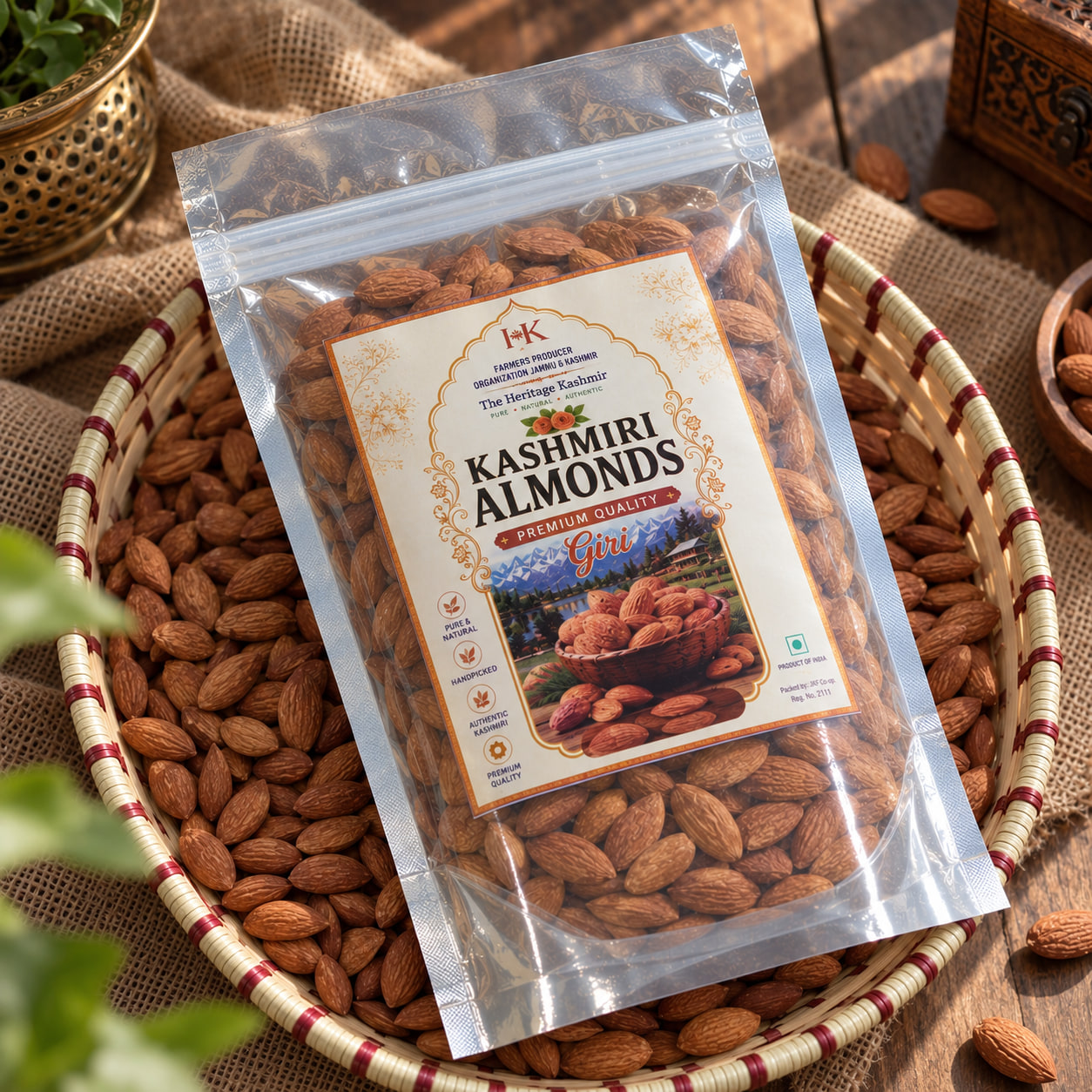
Walk into any dry-fruit shop and you’ll see two price tags for “badam” that differ by 3–4x. The gap is real — mamra and California almonds are genuinely different products — but the label on the expensive tray is only sometimes telling the truth. Here is the difference explained by a Kashmiri family that grades kernels by hand, and the checks that protect your money.
Two different agricultural stories
California almonds are a triumph of scale: irrigated orchards, mechanical harvesting, steam pasteurisation, and global supply at a stable price. Uniform, clean, reliable — the office-snack almond.
Mamra almonds are the opposite: low-yield heirloom trees on high-altitude slopes in Kashmir, Iran and Afghanistan, largely hand-harvested, naturally dried in the shell. Yields per tree are a fraction of California’s, which is the entire price story.
Oil content: closer than you have been told
You will read online that mamra carries 45–50% oil against 25–30% in California almonds. The food tables do not support that. USDA’s almond record, built mostly on California almonds, lists about 50 g of fat per 100 g (49.9 g in SR Legacy, 51.1 g in the 2022 Foundation record). India’s IFCT 2017 lists 58.5 g for the almonds it sampled. Every almond is roughly half oil, and in all of them that oil is mostly monounsaturated, the “good fats” almonds are eaten for. The full table is in our almond calories and protein guide.
We have not found a lab study that compares Kashmiri mamra with California almonds head to head. The closest is a study of 25 almond genotypes in Iran, published in Acta Horticulturae, where kernel oil ran from 43.9% to 58.8% of dry weight and the local mamra-type cultivar Mamaei was oilier than most foreign cultivars, Nonpareil (California’s main almond) included. So mamra-type kernels are reported to be somewhat oilier: a few points, not double. What you notice more is the bite: mamra kernels are denser, crisper and sweeter, with a slow finish that regular almonds don’t have.
Side-by-side
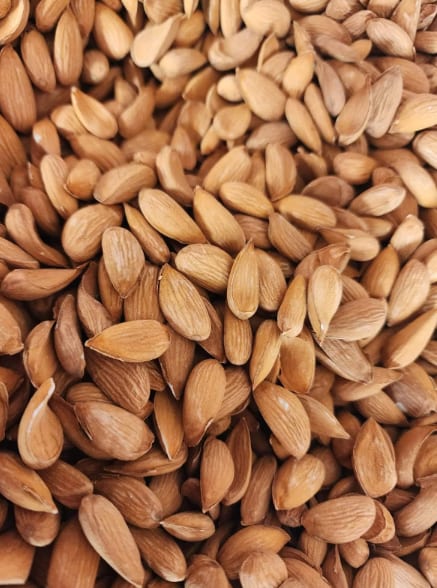
- Size & look: mamra — small, wrinkled, striated, irregular; California — large, smooth, uniform.
- Texture: mamra — dense and crisp; California — drier, softer crunch.
- Taste: mamra — naturally sweet, buttery; California — mild, neutral.
- Processing: mamra — naturally dried, genuinely raw; California — typically pasteurised.
- Price: mamra 3–4x higher. If it isn’t, it isn’t mamra.
The soak-and-peel ritual (and why it exists)
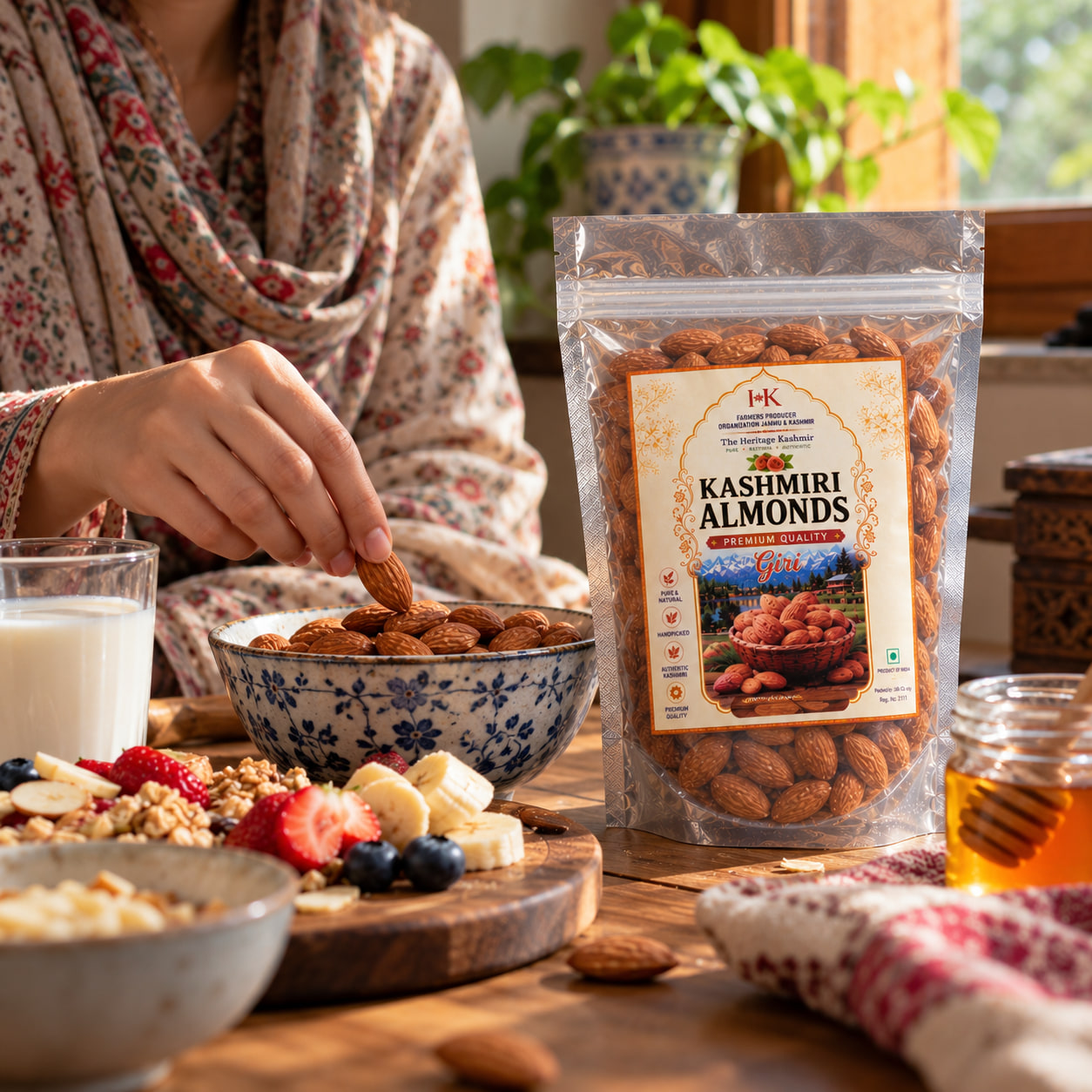
The classic Kashmiri method — soak 8–12 kernels overnight, peel in the morning — is practical, not ceremonial: soaking softens the skin’s tannins and makes the dense kernel easier to digest. Genuine mamra skin slips off cleanly after a night’s soak; stubborn skin is another quiet authenticity tell.
How the fake-mamra trade works
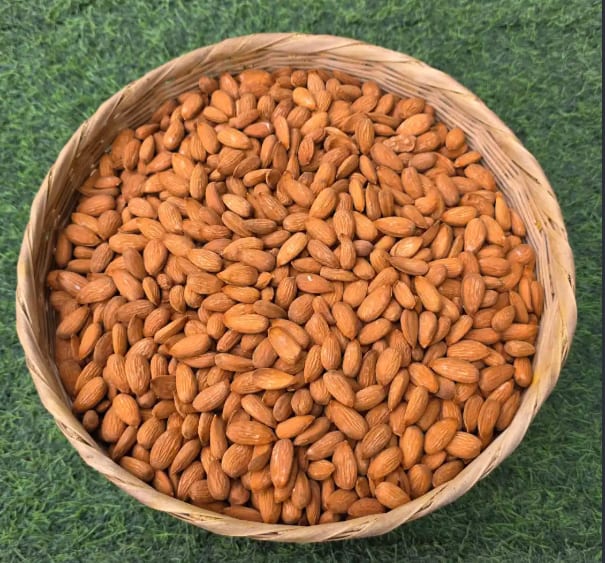
Because mamra commands mountain prices, plains almonds routinely get promoted into the label. The tells, in order of reliability: price (genuine mamra is never cheap), uniformity (nature doesn’t produce identical kernels), texture (dense and crisp, not soft), and taste (bland means Californian). The same logic that protects saffron buyers protects almond buyers — verify the seller, not the adjective. Ours are grown in our own orchards and our FPO member families’ rather than bought in and relabelled, then hand-graded and vacuum-sealed at source; see the Kashmiri almonds page for the current harvest.
Which should you buy?
For bulk baking and office snacking, California almonds are honest value. For the daily soaked-badam ritual, gifting, kheer and badam milk — where density and sweetness are the point — mamra-grade Kashmiri kernels earn their price. They also anchor our dried figs alongside Kashmiri walnuts and saffron. Browse the full pantry at the shop or from the home page — everything ships sealed, direct from Kashmir. Our page on Kashmiri dry fruits online shows the almonds, walnuts and figs together.
What actually explains the price gap
It is not a dramatic oil gap; the food tables put every almond at roughly half fat, and mamra-type kernels are at most a few points oilier. The bigger difference is in the trees and how they are grown:
| Mamra-type | Commodity California | |
|---|---|---|
| Fat per 100 g | About half by weight; somewhat oilier in one Iranian study (no Kashmiri lab figure) | About 50 g (USDA) |
| Shape | Small, irregular, often wrinkled | Large, uniform, flat |
| Growing | Seedling trees, high altitude, slow | Grafted orchards, irrigated, high yield |
| Yield per hectare | Low | High |
Mamra kernels are small and wrinkled because they come from slow-growing seedling trees on cold slopes rather than irrigated, grafted orchards. Buyers pay for that dense, crisp kernel and its sweet, buttery taste, not for a different nutrition label.
The last row is the honest explanation of the price. A California orchard is engineered for tonnes per hectare. A Kashmiri seedling tree is not engineered at all. You are paying for scarcity created by agronomy, not for a marketing story — though plenty of marketing stories have been built on top of it.
What mamra does not buy you
Being fair to the California almond, which is a perfectly good food:
- Protein, fibre and fat are broadly comparable. Almonds of every type sit near 50% fat and 18–21 g of protein per 100 g in the food tables.
- Neither is a meaningful omega-3 source. Almonds carry only trace ALA — their fat is mostly oleic acid. If omega-3 is the goal, walnuts are the nut, at roughly 1.9 g of ALA per 30 g handful.
- “Mamra” is a type, not a protected origin. Unlike Kashmir saffron’s GI tag, nothing legally restricts the word. It describes a kernel type grown in Iran, Afghanistan and Kashmir. Ask where a specific batch grew rather than trusting the category name.
Badam price per kg in India: what Kashmiri almonds actually cost in 2026
“Kashmiri almonds price” is the single most-typed query in this category, and “badam price” and “badam price 1kg” are not far behind — yet none of them has a single answer, because the listings being compared are frequently not describing the same thing. Here are the bands observed across Indian wholesale directories and retail listings through 2026.
| Band | What it is | Read it as |
|---|---|---|
| ~₹780 / kg | Kashmiri badam giri, wholesale | Kernel, mandi level. Grade unstated. |
| ₹1,080–1,320 / kg | Cleaned mamra, wholesale | The genuine mamra wholesale band. |
| ~₹1,200–1,250 / kg | Mamra, mid-2026 listings | Where most honest mamra sits. |
| ₹1,500 / kg | Our genuine mamra, grower-direct | No trader or gifting markup, 250 g to 1 kg. |
| ₹1,600–2,200 / kg | Premium retail mamra | Branding and packaging included. |
| Up to ~₹3,200 / kg | Top of the observed range | Gifting presentation territory. |
Two things to take from that spread. First, the gap between ₹780 and ₹1,250 is largely the gap between “Kashmiri almonds” as a general description and mamra-grade kernels specifically — which is exactly the ambiguity the fake-mamra trade lives in. Second, anything at the very bottom of the range being sold as mamra deserves the questions in the section above, because the wholesale floor for real mamra does not go there.
Our Kashmiri almonds are ₹375 for 250 g, ₹750 for 500 g and ₹1,500 for a kilogram — a flat per-kilo rate, so the pack size is a question of how fast you eat them rather than of value. That sits above the wholesale band and below premium retail, which is roughly where selling direct without a retail chain ought to land. What genuine mamra costs elsewhere, and why the range is so wide, is in our mamra badam price guide.
If you are buying for badam milk specifically, the difference in taste is at its most obvious there — the method is in kesar badam milk.