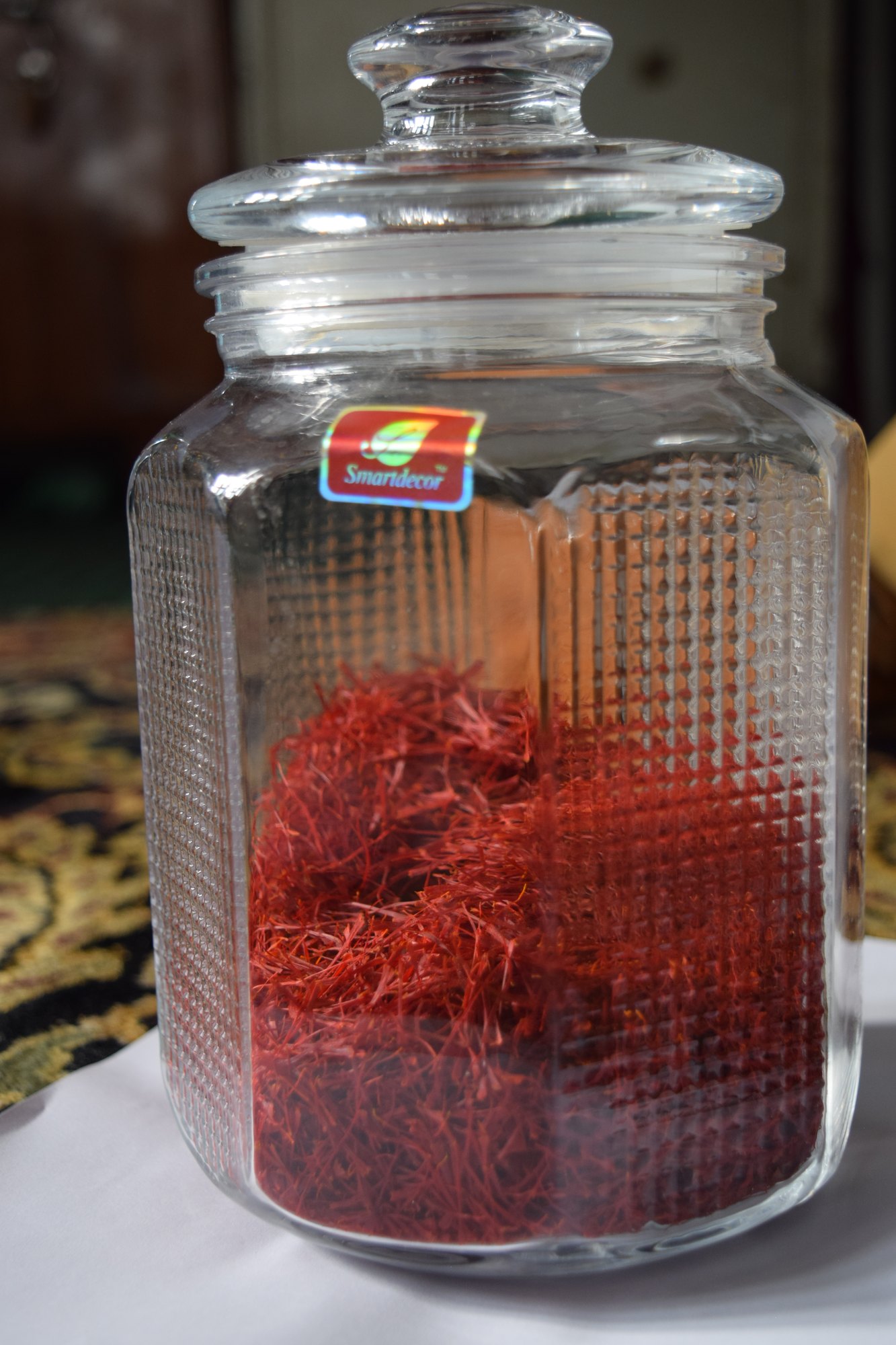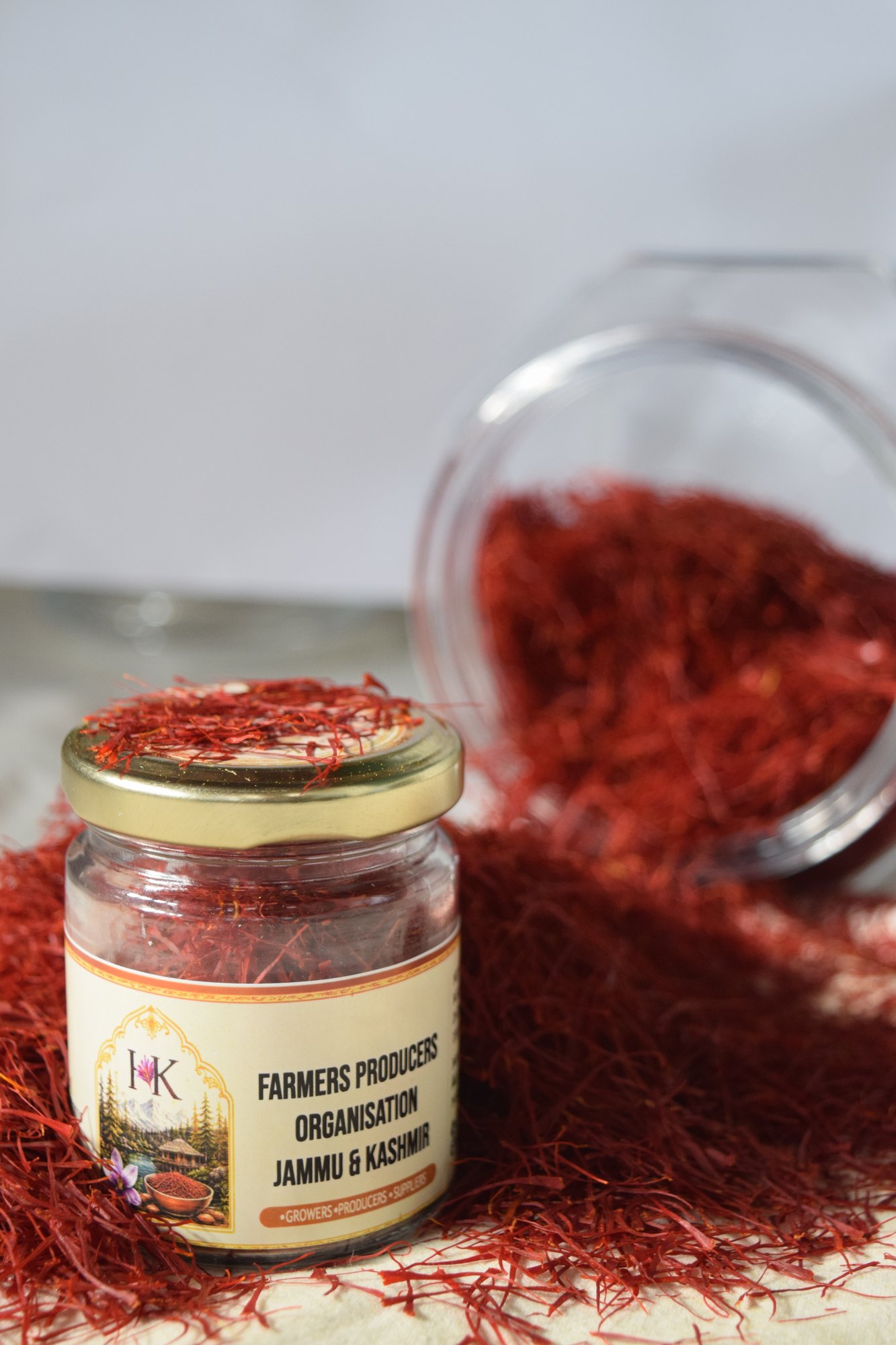
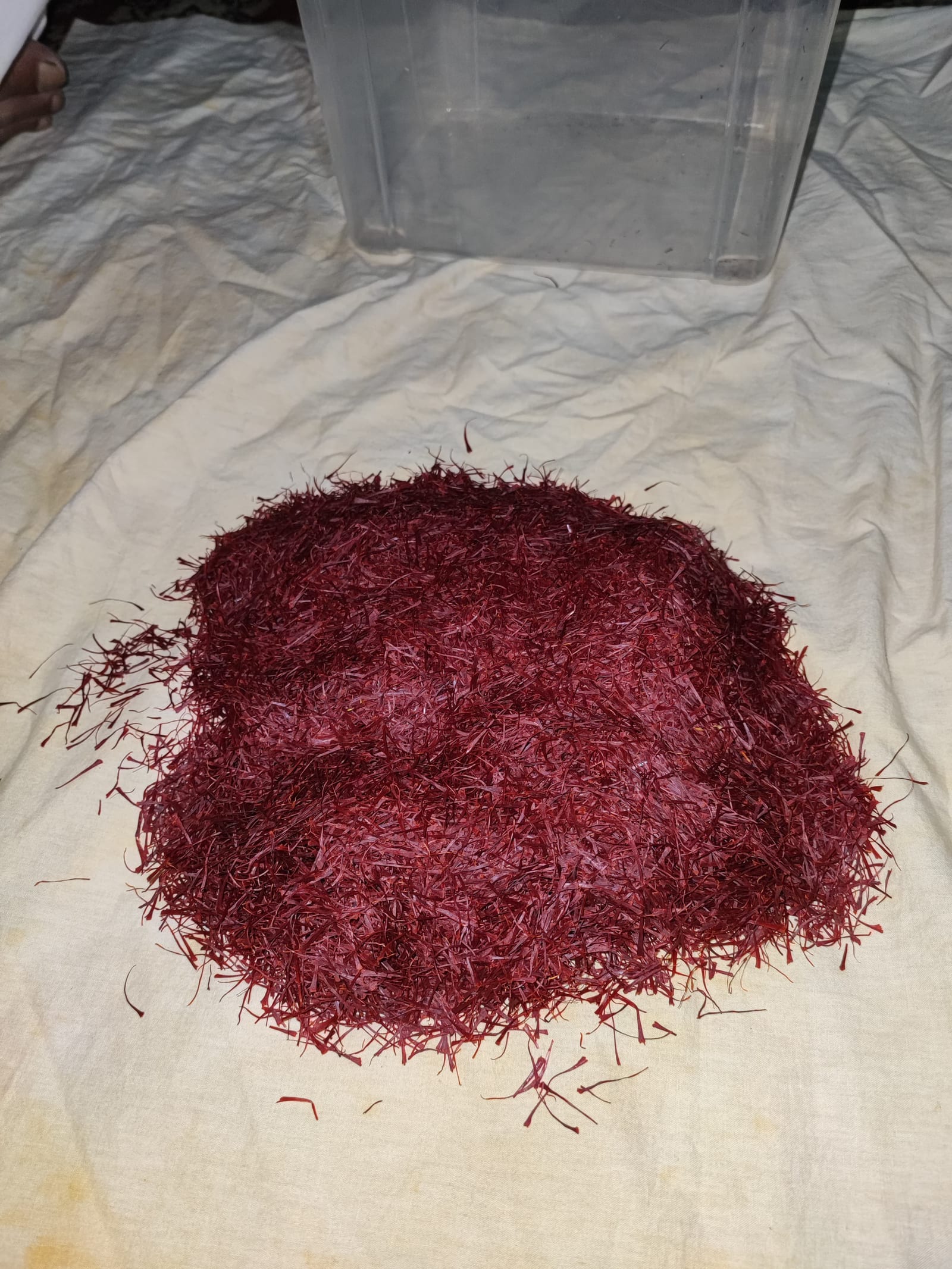
In 2026, 1 kg of genuine Kashmiri kesar costs roughly ₹3 lakh to ₹6 lakh, depending on grade. At our grower-direct rates it works out to ₹3,29,000 per kg for Mongra Short Thread and ₹3,59,000 per kg for Mongra Saffron (Super Negin). Those two figures are simple arithmetic — our per-gram price times 1,000 — because we do not sell a kilo jar on the site. Anything offered as “1 kg pure Kashmiri kesar” for far less than ₹1.5 lakh is not what it says it is.
Kesar price per kg at a glance
Prices as of 5 October 2026. The market column is the range for genuine Kashmiri saffron across Indian retail; the other two columns are our own jars, priced at the same rate per gram at every size.
| Quantity | Genuine Kashmiri, market range | Ours: Mongra Short Thread | Ours: Mongra Saffron (Super Negin) |
|---|---|---|---|
| 1 gram | ₹300–600 | ₹329 | ₹359 |
| 10 grams | ₹3,000–6,000 | ₹3,290 | ₹3,590 |
| 100 grams | ₹30,000–60,000 | ₹32,900* | ₹35,900* |
| 1 kg | ₹3–6 lakh | ₹3,29,000* | ₹3,59,000* |
* Per-gram rate times the quantity, shown for comparison. The shop sells 1 g, 2 g, 5 g and 10 g jars; for 100 g or a kilo, send a bulk enquiry and ask for a bulk quote.
We are a saffron-growing family in Pampore, so we see these prices from the field end. If you only need a few grams, our kesar price per gram guide covers the small jars in more detail. This page is about the kilo: what it costs, why two “1 kg” quotes can be lakhs apart, and how to buy a large quantity without paying for water, dye or somebody else’s saffron.
Why one kilogram of kesar costs lakhs
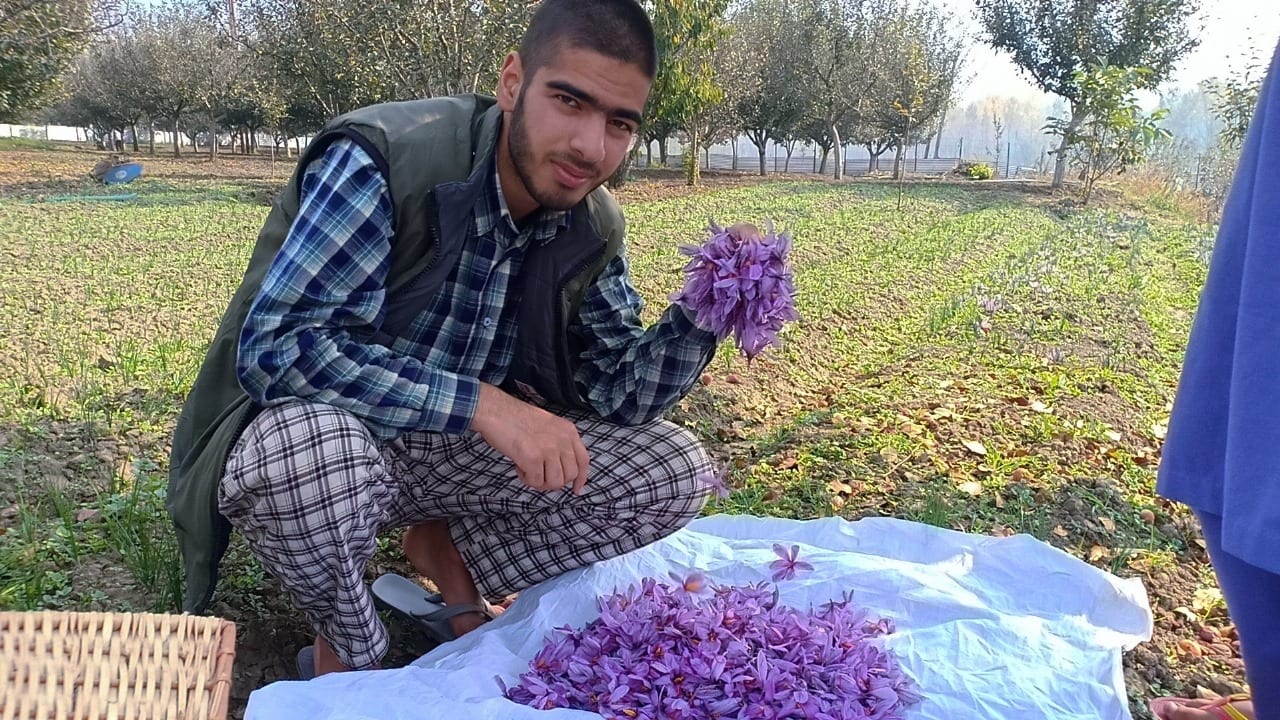
One gram of Mongra saffron is the dried stigma of roughly 150–160 crocus flowers. A kilogram is therefore about 1,50,000–1,60,000 flowers, every one picked by hand at dawn during a two-week autumn bloom and separated by hand the same day. No machine does any step. Before the bloom there is a year of field work — sorting and planting corms, weeding, protecting the crop — on the karewa highlands around Pampore, the only place Kashmiri saffron grows. There is no second region to absorb a bad season.
That is why there is a hard floor under the price. Below about ₹150 a gram — ₹1.5 lakh a kilo — the money does not cover the picking, let alone the field. A kilo quote under that line is telling you something about the product, not about a bargain.
Why per-kg kesar prices vary so much
Search “kesar price 1kg” and you will find quotes that differ by a factor of five or more, all calling themselves pure Kashmiri. Five things explain almost all of that spread.
1. Grade: Mongra, Lacha and Zarda
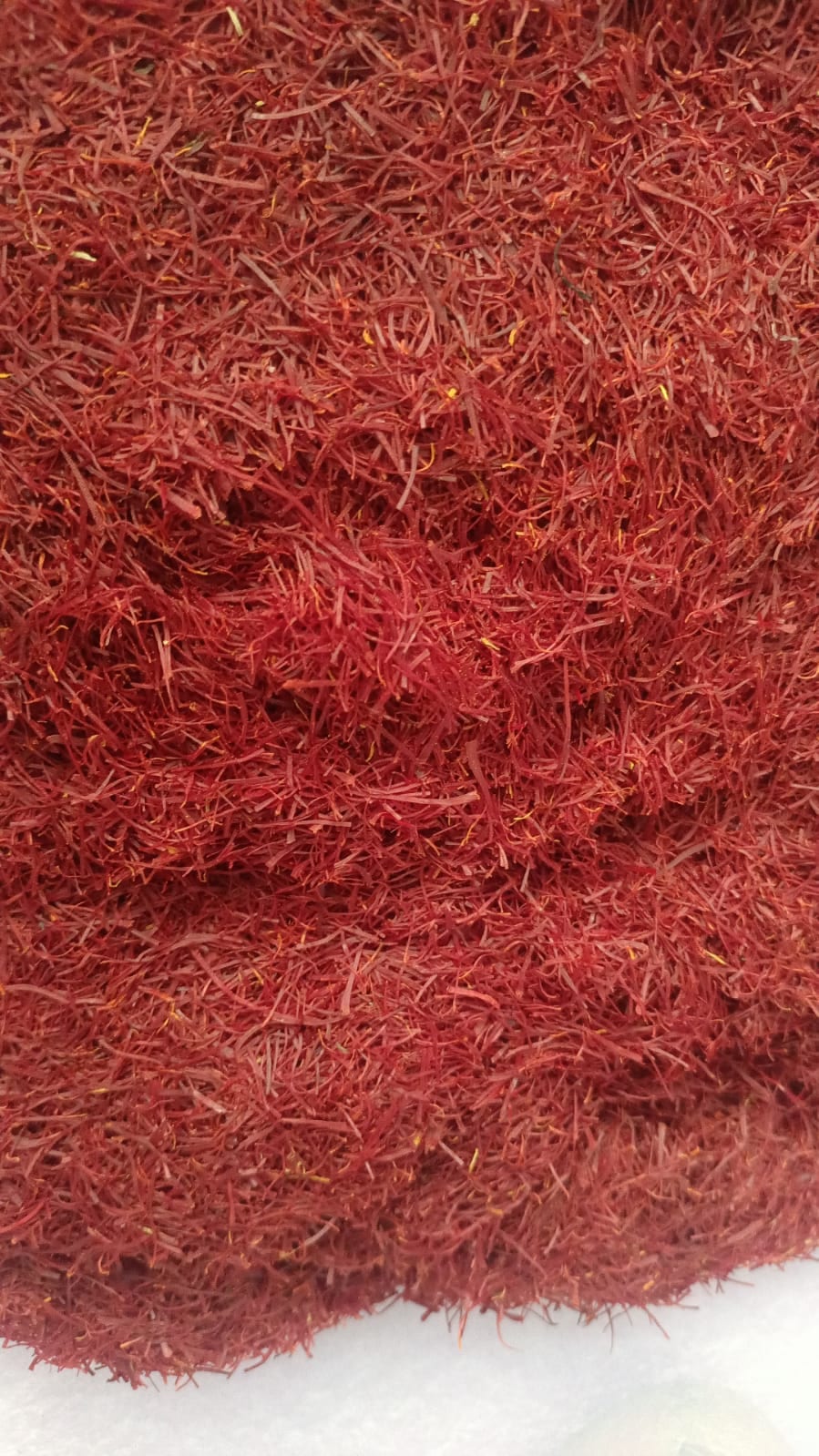
Each saffron thread is a red stigma joined to a pale yellow style. Mongra is the all-red stigma with the style cut away — the part that carries the colour, taste and aroma. Lacha (or Lachha) keeps the yellow style attached, so part of every gram is weight with no colour in it. Zarda is the yellow style on its own, the lowest grade. A per-kg price means nothing until you know which of the three you are being quoted.
| What is being sold | Per kg, Indian retail | What you are actually getting |
|---|---|---|
| Mongra Super Negin (long thread) | ₹3.4–6.0 lakh | Longest all-red threads, style fully cut away. |
| Mongra short thread | ₹3.0–4.5 lakh | Same all-red sort, shorter threads. Identical chemistry. |
| Lacha / Lachha | ₹1.5–2.8 lakh | Yellow style still attached — weight that carries no colour. |
| Iranian, re-packed | ₹0.8–2.0 lakh | Often real saffron, but not Kashmiri — and often sold as if it were. |
| Under ₹1.5 lakh as “Kashmiri Mongra” | — | Below the labour floor. Dyed fibre, safflower, or bulked stock. |
Ranges are what genuine material trades at across Indian retail in 2026, the same bands as our price-per-gram guide. Our own prices are the only ones here we can vouch for directly.
2. Origin: Kashmiri or re-packed Iranian
Iran produces far more saffron than Kashmir, and much of it reaches India in bulk to be re-packed. It is often genuine saffron, but a different product, and it should not carry a Kashmiri price — or a Kashmiri label. Kashmiri Mongra threads are thicker and score high on crocin, the compound that gives colour. The differences are set out in Kashmiri vs Iranian saffron.
3. Moisture: the hidden part of a kilo
Saffron absorbs water from the air, and at kilo scale that matters. ISO 3632 allows at most 12% moisture for Grade I; our current lot tested at 11.72%. Saffron scooped from an open tin in a humid shop can carry far more, and when you pay by weight you pay for that water at the saffron rate. A sealed lot, weighed dry at source and backed by a moisture figure on a lab report, removes the guesswork.
4. Crop year
Saffron is harvested once a year, in late autumn. Stored well it keeps its character for two to three years, but aroma fades first, and an old lot can still look red while smelling of very little. A cheap bulk lot may simply be an old one. Ask which harvest you are buying.
5. Retail, wholesale or mandi
The same kilo is priced differently depending on who is selling and to whom. A trade or mandi rate for loose, ungraded stock is not a retail price for sealed, lab-graded jars, and the reverse is true too: a metro shop counter adds several hands of margin between the field and you. When you compare two per-kg quotes, make sure both describe the same grade, the same origin, the same packing and the same proof.
What our kilo price includes
Both of our jars come from the same Pampore harvest and the same all-red Mongra sort. The difference is thread length: the longest, unbroken threads are picked out as Mongra Saffron (Super Negin) at ₹359 a gram, and the rest is Mongra Short Thread at ₹329 a gram. In the pot there is no difference worth paying for; colour and aroma come from the chemistry, not the length.
Our saffron is tested by the IIKSTC Quality Evaluation Laboratory in Pampore, a NABL-accredited government lab, and graded ISO 3632 Grade I: colouring strength (crocin) 217.51 against a Grade I minimum of 200. The report was issued on 5 October 2026 and is published in full, with every value and the lab’s own notes, on our lab reports page. Like any lab report, it covers the lot it names — which is exactly what you should expect a serious bulk seller to show you.
Our saffron is grown in Pampore, inside Kashmir’s GI-registered saffron region. Our separate GI-tagged lot is currently out of stock, so the jars on sale today are sold on their lab grade, not on a GI tag.
Shop orders ship across India for a flat ₹60 delivery on prepaid orders: DTDC Airmax in 3–5 days or DTDC Express in 7–8 days. Bulk orders are quoted separately.
How to buy kesar in bulk without being cheated
- Get the grade in writing. Mongra, Lacha or Zarda, and Kashmiri or not. A per-kg price without a grade is not a price.
- Ask for a lab report that names the lot. ISO 3632 Grade I, with crocin and moisture figures, from an accredited lab — and check that the lot on the report is the lot you are buying.
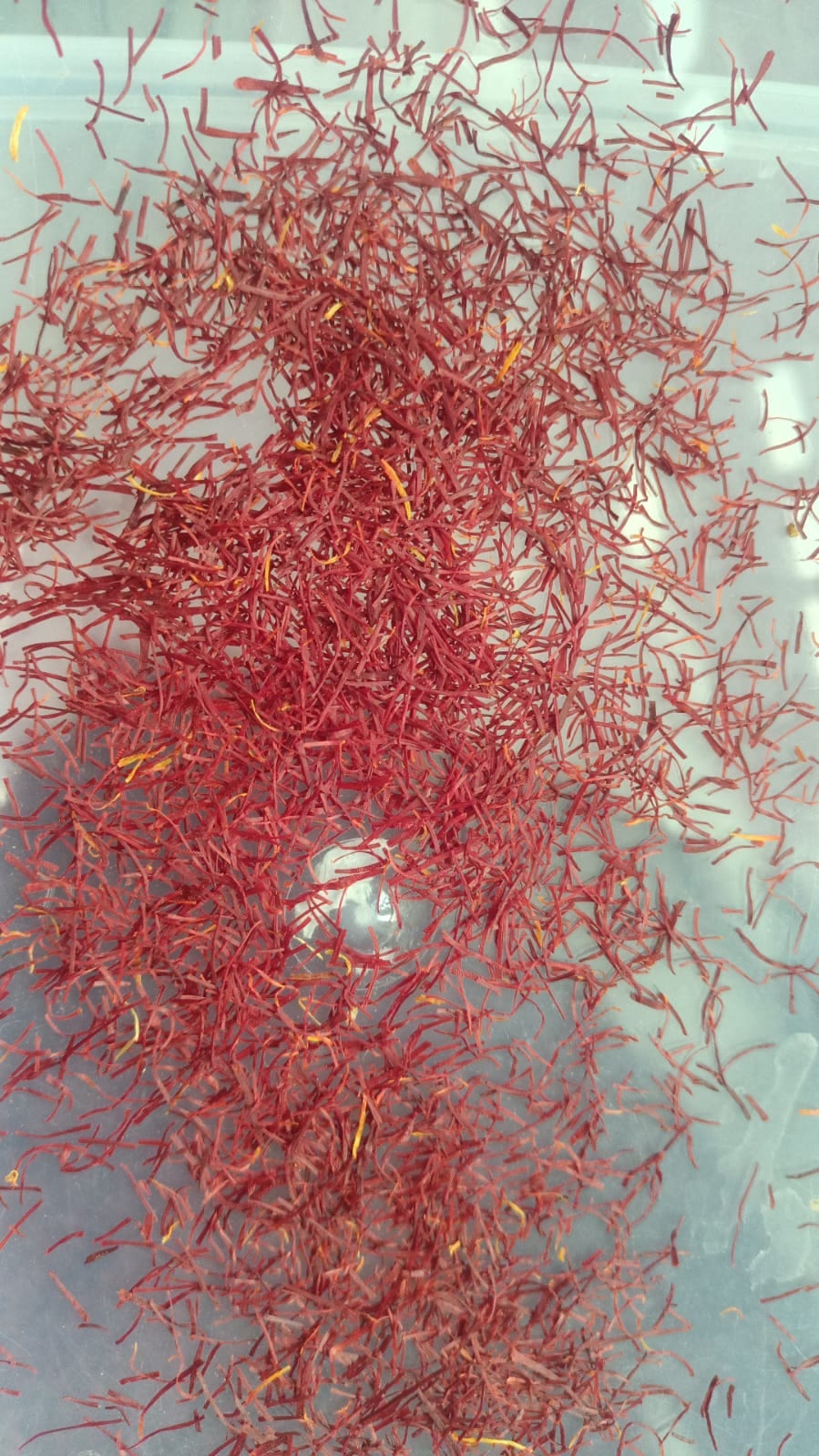
- Test a sample before the full order. Real saffron releases golden-yellow colour slowly in warm water over 10–15 minutes while the threads stay whole; dyed fibre bleeds red almost instantly. The full method is in how to identify real Kashmiri saffron.
- Treat a price below the labour floor as data. Under ₹1.5 lakh a kilo, the product is the lie.
- Plan the storage before it arrives. Split a large lot into smaller sealed jars and keep them dark, dry and at room temperature. See how to store saffron.
Buying 100 g, 1 kg or more from us
Most households never need a kilo — a 5 g jar holds roughly 2,500 threads, which is months of daily cooking. Bulk buyers are usually weddings, corporate gifting and resale. If that is you, send a bulk enquiry with the quantity, the date you need it and the delivery city, or WhatsApp us at +91 95966 08297. Ask for a bulk quote and we will tell you exactly which harvest your saffron comes from.
For smaller amounts, the shop is quicker: our Super Negin and Short Thread jars come in 1 g, 2 g, 5 g and 10 g, at the same rate per gram at every size.