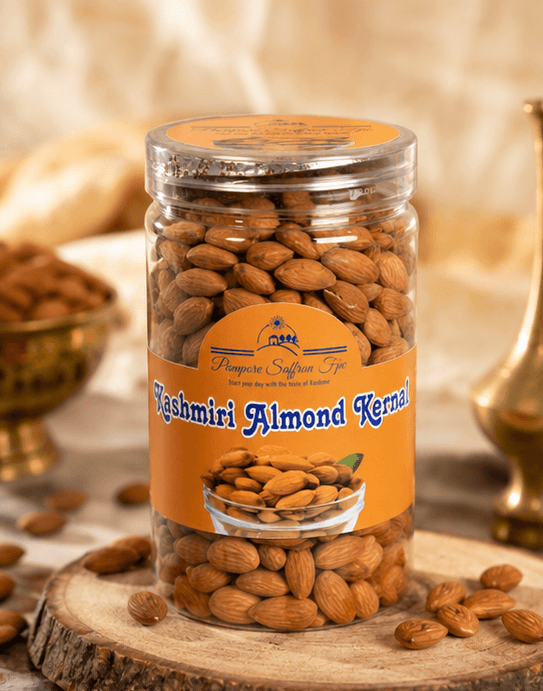
Genuine mamra badam retails for roughly ₹1,200–2,200 a kilogram in India. Almonds sold under the same name for well under ₹1,000/kg are almost always a different, more common almond wearing the label. Our own mamra badam is genuine — grown in our own Kashmir orchards — and priced at ₹1,500/kg flat: ₹375 for 250 g, ₹750 for 500 g, ₹1,500 for 1 kg. That price sits inside the honest band, not below it, because selling direct from the orchard removes a trader’s and a gifting-brand’s markup — not because the almond is lesser. This page lays out why the name is worth ₹1,000 of difference on its own, and what to check before you pay for it.
What “mamra” actually names
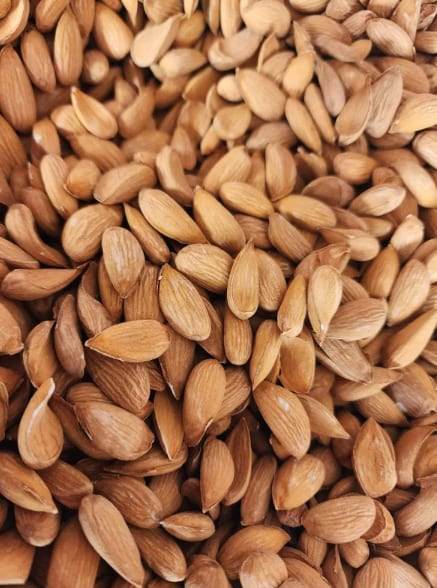
Mamra is, properly, a specific type of almond: small, wrinkle-shelled, denser in oil than the smooth almonds most people know, and traditionally grown in a handful of high-altitude pockets rather than on any large scale. It was valued in Ayurvedic and Unani preparations precisely because it was hard to get, and genuine supply still is.
“Badam” is simply the Hindi/Urdu word for almond — it names nothing special on its own. So “mamra badam” should mean one particular almond variety. In practice, on a great many Indian e-commerce and marketplace listings, it has become a search term more than a botanical claim: ordinary Kashmiri, Iranian or even Californian almonds get sold under it because far more people search “mamra badam” than search “almonds,” and the word carries a premium association the seller collects without necessarily supplying the almond it names.
The price ladder, and why it is so wide
Wholesale and retail listings gathered across Indian marketplaces through 2026 make the split visible in the numbers alone:
| Band | What it usually is | Where you see it |
|---|---|---|
| ₹700–900/kg | Ordinary Californian almonds | Retail, rarely called mamra honestly |
| ₹1,000–1,300/kg | Kashmiri badam giri, not the mamra cultivar | Retail — often relabelled “mamra” here |
| ₹1,200–2,200/kg | Genuine, cleaned mamra badam | Retail — the honest band for the real cultivar |
| ₹1,500/kg | Our own genuine mamra badam | 250 g, 500 g and 1 kg packs, vacuum-sealed at source |
| ₹2,200/kg and up | Genuine mamra, gift-boxed or boutique-branded | Presentation and brand markup, not a different almond |
A seller quoting well under the genuine band should be able to say so plainly — “this is Kashmiri badam giri, not mamra” — rather than let the name do work the almond does not back up.
What moves the price, ranked
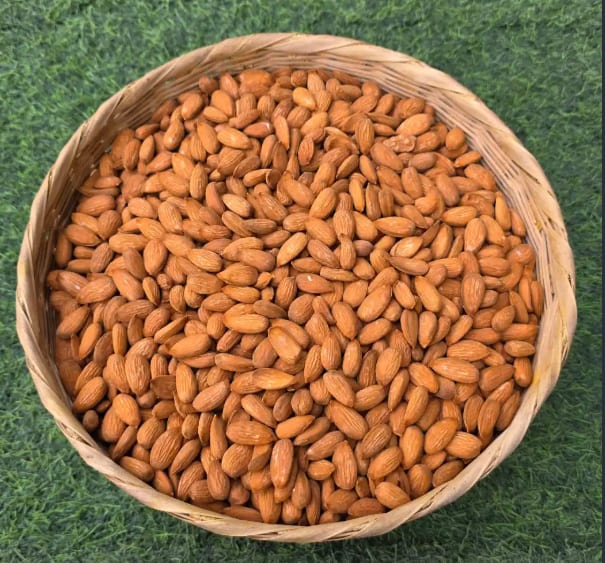
- Which almond it actually is. The single biggest factor, and the one the name obscures rather than reveals. Genuine mamra and an ordinary almond relabelled as mamra are not two grades of the same product — they are two different almonds.
- Trader and brand markup. The same genuine kernel costs more once it passes through a wholesaler, a retailer and a gifting brand than it does sold direct from the orchard that grew it — the reason genuine mamra can honestly be found anywhere from ₹1,200 to well over ₹2,200/kg.
- Skin-on versus blanched. Skin-on kernels, like ours, keep more of the natural oil and flavour and are priced slightly below the peeled, cosmetic-grade almonds sold for garnishing.
- Grading uniformity. Hand-graded, size-sorted kernels cost more to produce than a loose, mixed-size bag and are priced accordingly.
- Origin. Genuine mamra is grown on a tiny scale compared with Californian almonds, which dominate world supply at industrial cost — see our mamra vs California comparison for that specific gap.
What ₹1,500/kg buys here
Our mamra almonds are genuine mamra badam, grown in our own orchards and our FPO member families’ orchards in the valley — not bought in bulk and relabelled — then hand-graded for size and oil content and vacuum-sealed at source. A 500 g pack holds roughly 350–400 whole kernels. The rate is flat across sizes: ₹375 for 250 g, ₹750 for 500 g, ₹1,500 for 1 kg — inside the genuine retail band, kept there by selling direct rather than through a trader or a gifting brand.
For daily amounts and how to use them, see the 30-gram rule, or add threads of our Mongra saffron for the classic badam-kesar milk.
How to buy without paying for the word alone
- Ask what you are actually being sold. A seller who can say plainly “this is Kashmiri badam giri, not mamra” or “this is genuine mamra, here is why” is more trustworthy than one who only repeats the word.
- Look at the kernel, not the listing photo. Small and wrinkled is genuine mamra. Large and smooth is a different almond, whatever the title says.
- Price against the band, not the name. A kilogram under ₹1,000 calling itself mamra is the ordinary-almond band wearing a better label.
- Check the pack, not just the price. Origin, grading and a sealed date tell you more than the search term ever will.
Our WhatsApp line is open at +91 95966 08297 if you want to see the current batch — kernel size, orchard and grading — before you decide.