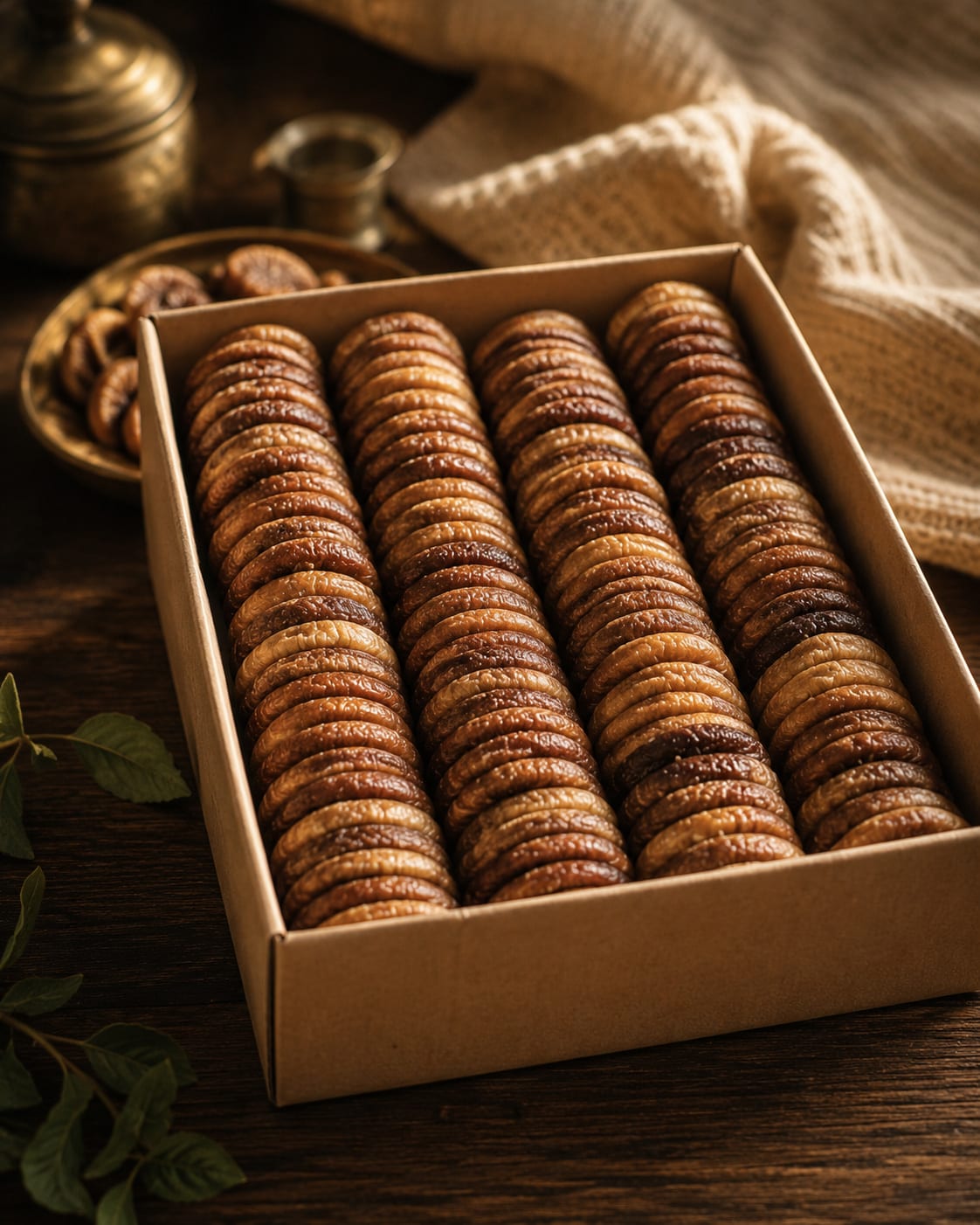
Anjeer price per kg in India through 2026 has run from about ₹500 for loose budget stock to ₹1,800 or more for soft-dried premium figs. Our own Kashmiri figs are ₹1,350 a kilogram — ₹340 for 250 g and ₹675 for 500 g. The spread is not mostly about origin, and it is not arbitrary. It is about moisture, size, wholeness and crop age — the four things a listing rarely states and a price tag quietly encodes. This page lays the bands out and then explains what actually moves them, so you can tell two listings apart without tasting either.
The ladder, honestly laid out
These are ranges observed across Indian wholesale directories and retail listings during 2026. Treat them as a map of the market rather than today’s quote — fig prices move with the crop, the season and the seller.
| Band | Typical form | What it usually means |
|---|---|---|
| ₹500–800 / kg | Loose, mixed sizes | Small, hard-dried, often old-crop. The band where syrup weight shows up. |
| ₹800–1,200 / kg | Standard retail packs | Ordinary whole figs, the band most households buy in. |
| ₹1,200–1,800 / kg | Soft-dried, hand-sorted | Pale, plump and bendable — the grade that eats well raw. |
| ₹1,350 / kg | Our Kashmiri packs | Valley figs, soft-dried and packed at source; 250 g and 500 g. |
| ₹1,800+ / kg | Gift packing | Presentation, not fruit. The same figs in a wooden box. |
We sit inside the soft-dried band, below the gifting premium. That is a position, not a boast, and the rest of this page is the argument for and against paying it.
What actually moves the price, ranked
- Moisture, including added syrup. The largest single factor, and the least visible. Soft-dried figs carry more water than hard-dried ones; sugared figs carry more still. You are buying fig and water, and water is the cheap half.
- Size and wholeness. Large intact figs are graded, counted and priced higher. Broken fruit from the same lot is the same food at a lower grade — fine for cooking, wrong for a cheese board.
- Soft-dried versus hard-dried. Soft figs take more careful drying and packing; hard figs travel and store cheaply. This single choice explains a large part of the ₹700-versus-₹1,300 gap.
- Colour and sulphur. Uniform pale-golden figs are often sulphur-treated to hold that colour. Naturally dried figs are darker and less photogenic, and not worse.
- Origin and crop. Afghanistan, Turkey and Iran supply most of the market; Kashmir supplies a small valley crop. Crop age matters everywhere: last season’s figs are drier, harder and cheaper, and taste it.
- Packaging and channel. Loose bulk is cheapest per kilogram; a wooden gift box is the most expensive. The fruit can be identical.
The syrup-weight trick
A kilogram of syrup-heavy figs can contain a good deal less than a kilogram of fruit. It is not counterfeiting — the label usually still says figs — but it changes the maths of every per-kilogram comparison on this page. Two tells: a sticky coating that stays on your fingers after handling, and a uniform glossy shine on figs that are not naturally that shiny. Natural sugar bloom is the opposite: a dry, faint white dusting that wipes off with a thumb.
Kashmiri figs in an imported market
Walk into a Delhi dry-fruit shop and most of the anjeer you will be offered is Afghan or Turkish. That is not a scandal — imported figs are genuine figs — but it does mean the phrase “Kashmiri anjeer” is used loosely, and priced loosely with it. Our figs are grown in our own orchards and our FPO member families’ orchards in the valley, dried soft rather than hard, hand-sorted and sealed at source. The batch is small, which is why this page quotes a price rather than matching the cheapest listing: we cannot manufacture volume the valley does not grow.
How to compare two listings without tasting
- Convert to whole-fruit kilograms. If a pack is syruped, count the added weight at zero value and redo the maths.
- Count a 250 g pack. Twelve to eighteen figs is a normal count. Twenty-five small ones is not the same product as sixteen large ones.
- Look at the bend. A good soft-dried fig bends. One that cracks when you press it is over-dried or old.
- Ask for the pack date and origin. A seller who cannot say either is selling you anonymous fruit at a confident price.
- Weigh the bloom. White sugar bloom, yes. Grey fuzz, walk away.
What ₹1,350 buys here
Our Kashmiri dried figs are ₹340 for 250 g and ₹675 for 500 g — effectively ₹1,350 a kilogram, rounded by a rupee or two on the small pack. The rate is deliberately flat across sizes, so buy the size you will finish rather than the one that looks efficient. To eat them well, the anjeer benefits guide covers soaking and daily amounts, and the 30-gram rule places figs in a daily handful. Everything ships prepaid across India from the Kashmiri dry fruits page.
When you should not buy from us
If you are baking, simmering or making a syrup where the fig is going to be cooked and sweetened anyway, buy cheap hard-dried stock from a wholesaler. You will not taste the difference and you will pay half. If you want a jammy, sweet fig to eat whole with tea, pay for the soft-dried grade — and if the kilo price is your binding constraint, the honest move is to buy 250 g of good figs rather than a kilogram of the other kind. Our WhatsApp line is open at +91 95966 08297 if you want to know what is in the current pack before you decide.