
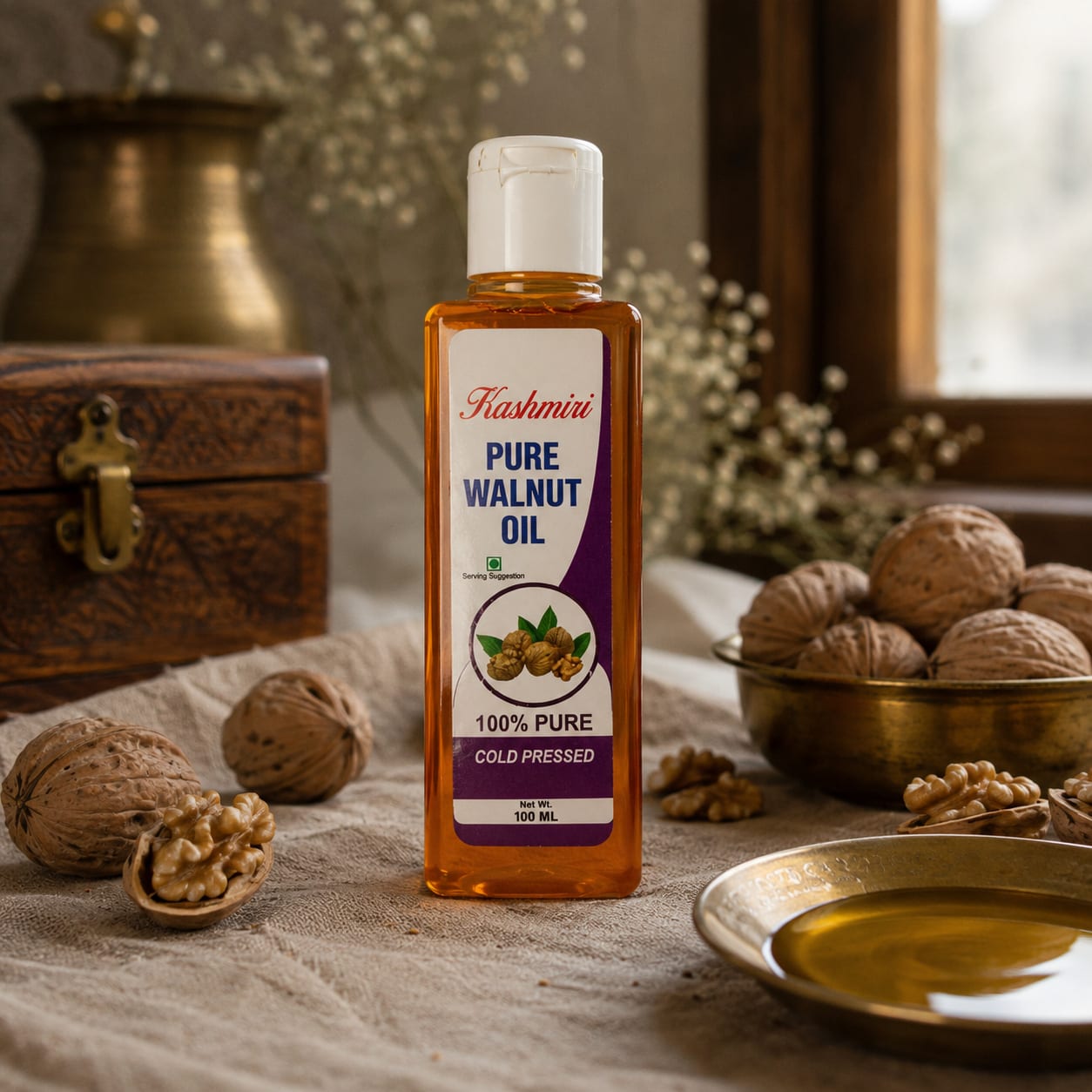
Cold-pressed walnut oil earns its place three ways: a finishing oil rich in plant omega-3, a night facial oil for dry skin, and a conditioning scalp oil. That is the honest, complete list. In Kashmir, where walnut trees outnumber almost everything except willows, pressing akhrot into oil is old household economy — the valley’s butteriest kernels, concentrated into a bottle.
What’s actually in the bottle
Walnut oil is one of the few common plant oils genuinely rich in alpha-linolenic acid (ALA) — the plant omega-3 that makes walnuts themselves famous — alongside vitamin E and polyphenols. Cold pressing keeps those intact; industrial refining strips them for shelf life, which is the entire quality divide in this category. The same slow-growth logic that makes high-altitude kernels denser (the mamra story in almonds) makes Kashmiri walnut oil noticeably nuttier than plains pressings.
In the kitchen: finish, never fry
Omega-3 fats are delicate — high heat breaks them and turns the flavour bitter. So walnut oil works like a condiment, not a cooking medium: a spoon over salads, steamed vegetables, dal, porridge or pasta after the heat is off. One tablespoon carries roughly a day’s worth of ALA for most adults — food-level nutrition framed the way we frame everything: it supports, it does not treat, and India’s FSSAI rightly frowns on oils sold as medicine.
On skin: the night-oil ritual
- Wash, leave skin slightly damp.
- Warm 2–3 drops between palms.
- Press — don’t rub — into face and neck.
- Leave overnight; start alternate nights if your skin is rich already.
Dry, flaky and mature skin takes to walnut oil best; its fatty-acid profile suits barrier repair. Oily skin types should patch-test first. For the saffron-forward version of the same ritual — and the fragrance-fake problem in that market — see saffron oil for skin.
On hair: conditioner, not miracle
A weekly pre-wash: warm a spoon of oil, massage into scalp and lengths, sit 30 minutes, shampoo out. Omega-3s and vitamin E calm flaky scalps and smooth the shaft — real, modest, repeatable benefits. Anyone promising regrowth from a bottle is selling the bottle.
The storage rule everyone breaks
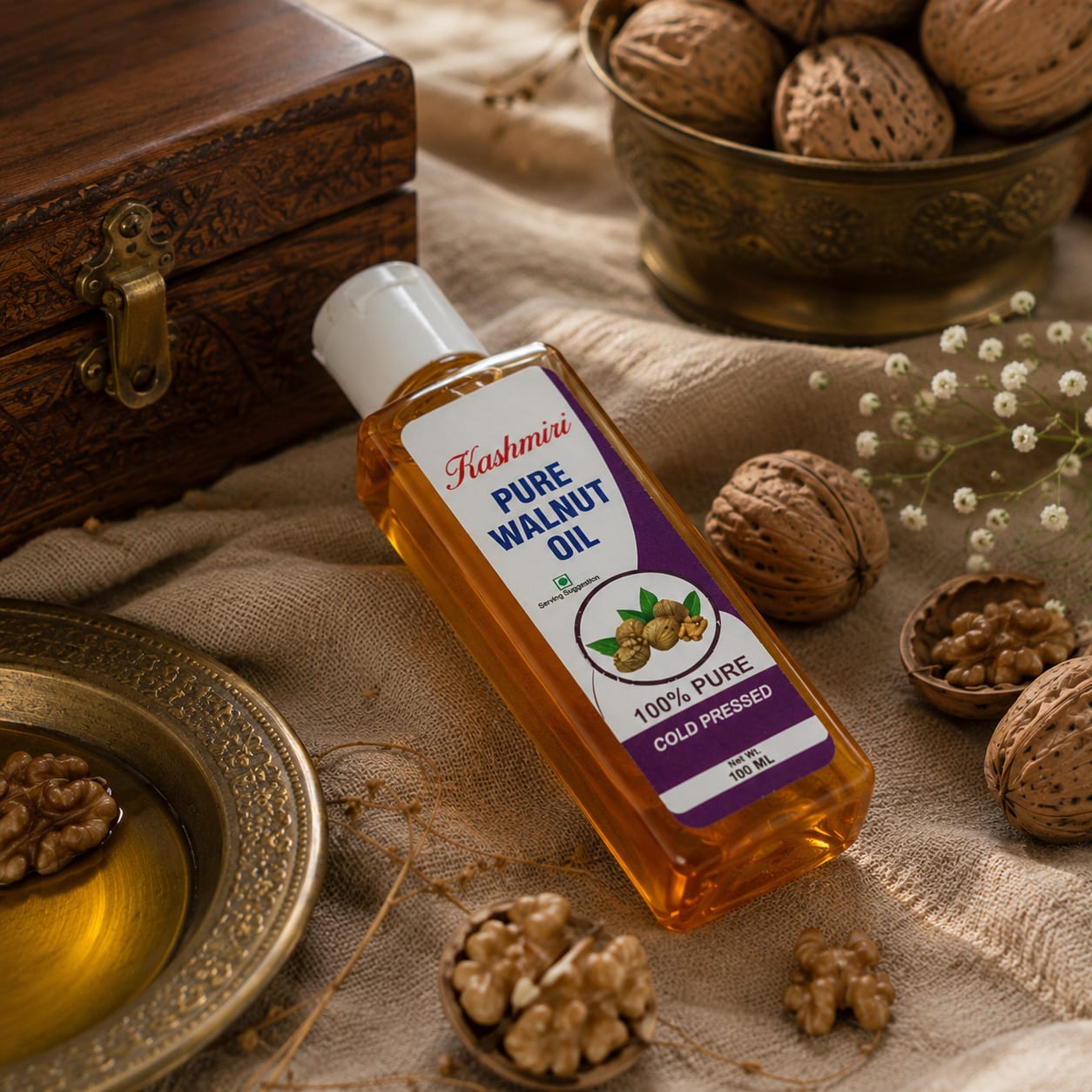
The omega-3 that makes walnut oil valuable also makes it perishable: it oxidises with light, heat and air. Cool, dark cupboard; lid tight; used within 3–6 months of opening. A rancid bottle smells like old paint — bin it. This fragility is also your authenticity test: an oil that sits happily for two years in a clear bottle by the stove is refined, not cold-pressed.
Buying it right
One ingredient, cold-pressed stated, pressing date printed, dark glass. We don’t sell walnut oil at the moment; what we sell is the paper-shell Kashmiri walnut kernels it is pressed from, and the household logic of the whole pantry is on the daily dry fruits chart. Start at the home page or go straight to the shop — and keep the bottle in the dark, where good oil belongs.
The omega-3 claim, sized honestly
Walnut oil is genuinely unusual among culinary oils for its alpha-linolenic acid content — the plant omega-3. Whole walnut kernels run near 9 g of ALA per 100 g, and a 30 g handful carries about 1.9 g. The pressed oil concentrates that fat fraction further, which is why a tablespoon does real work.
For context, intakes of roughly 1–2.5 g of ALA per day are the range most often cited in cardiovascular literature. A tablespoon of walnut oil sits comfortably inside it.
The caveat that walnut-oil marketing tends to skip: ALA is not EPA or DHA. Human conversion of ALA into the long-chain omega-3s found in oily fish is inefficient, and lower in men than women. Walnut oil is an excellent plant source of omega-3. It is not interchangeable with fish oil, and anyone telling you otherwise is selling something.
Why this oil goes off, and how to tell
Everything that makes walnut oil valuable also makes it fragile. Polyunsaturated fats oxidise readily on contact with light, heat and air — the same chemistry that makes ALA biologically interesting makes it chemically unstable.
| Fresh | Oxidised | |
|---|---|---|
| Smell | Distinctly nutty, faintly sweet | Sharp, paint-like, crayon |
| Taste | Buttery, clean finish | Bitter, lingering |
| Colour | Pale gold | Darkened, sometimes cloudy |
A long shelf life on a walnut oil label is a warning, not a feature. It usually means the oil was refined — heat and often solvents used to strip the compounds that spoil, which are the compounds you were buying. Cold-pressed walnut oil should carry a pressing date and be used within three to six months of opening, kept cool and dark. Refrigeration in an Indian summer is sensible rather than fussy.
The same rule governs almond oil, though almond oil is more forgiving because it is dominated by oleic acid rather than polyunsaturates. If you want the whole nut instead, the storage picture is in Kashmiri walnut benefits.