Heritage Kashmir · Northeast India
Kashmiri Saffron in Tripura
- জাফরানjafran · Bengali
- কেশরkeshar · Bengali
The short answer
Tripura is culturally Bengali in its majority and Tripuri in its indigenous traditions, and its saffron use follows the Bengali pattern — payesh at birthdays and celebrations, and jafran as the common word for the spice. Agartala's Battala and Maharajganj markets stock it at ₹550–950 a gram, supplied through Guwahati or across the border trade routes from Bengal, against ₹330–360 direct from a Pampore grower family. Kharchi Puja, the fourteen-deity festival held at Old Agartala each July, is the state's largest festival and its celebration food carries the demand alongside Durga Puja and the wedding season.
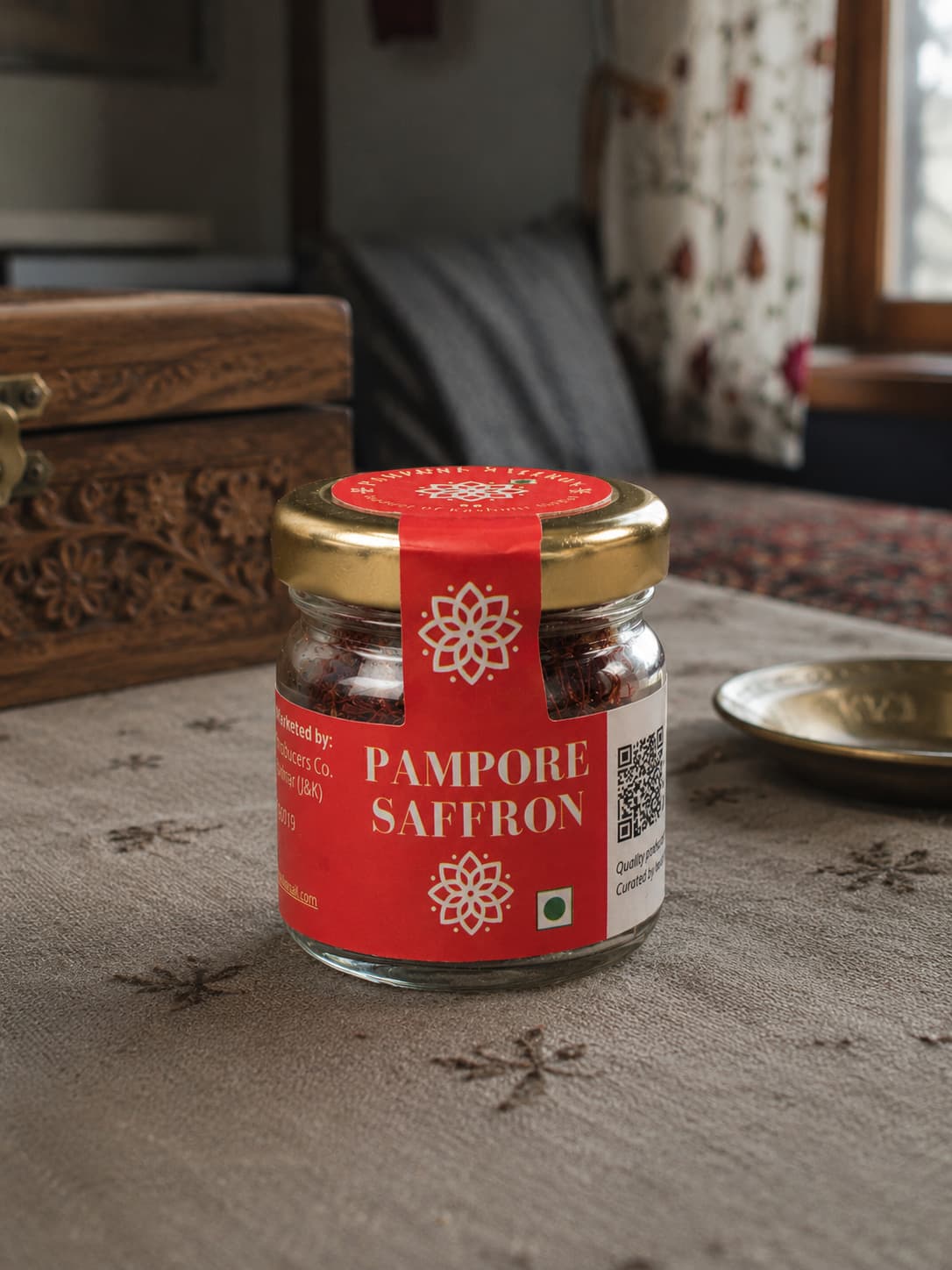
Agartala's supply, and a state ringed by Bangladesh
Tripura is surrounded on three sides by Bangladesh, and its overland connection to the rest of India runs through a narrow corridor via Assam. That geography is the whole story of retail pricing here: everything arrives through Guwahati or by the longer Bengal route, and the transport cost lands on the shelf.
Agartala's Battala Bazar, Maharajganj and Lake Chowmuhani markets are the state's retail centre and stock saffron as part of a general dry-fruit and provision trade. Dharmanagar, Kailashahar and the northern districts buy through Agartala with a further hop.
There is no local production, no batch-coded stock and no local price authority. What Tripura does have is a Bengali food culture that genuinely uses saffron, so the demand is real rather than occasional — which makes the origin-to-retail gap here more consequential than in the states around it.
- A narrow corridor to the rest of India via Assam — transport cost lands on the shelf.
- Battala, Maharajganj and Lake Chowmuhani are the state's retail centre.
- Real Bengali-pattern saffron demand, so the retail gap costs households more here.
- No local production and no batch-coded stock in the state.
Payesh, Kharchi Puja and the Tripuri table
Payesh carries the household demand, as it does in Bengal — Gobindobhog or short-grain rice simmered in milk with sugar or gur and finished with saffron, made for birthdays, annaprashan, Jamai Shashthi and Durga Puja. Mishti doi, sandesh and the Bengali sweet tradition run through Agartala's mishti shops.
Kharchi Puja, held at the Chaturdasha Devata temple in Old Agartala over seven days each July, is Tripura's largest festival and draws very large crowds. It is a Tripuri royal tradition with its own ritual structure, and the celebration food and prasad around it are where a good deal of the state's festival cooking happens.
Indigenous Tripuri food — mui borok, berma, gudok, chakhwi, awan bangwi — is a fermented-fish and bamboo-shoot tradition that uses no saffron. Awan bangwi, the sticky rice with cashew and raisin steamed in banana-leaf cones, is the one traditional sweet-adjacent dish and it does not take saffron either.
- Payesh at birthdays, annaprashan and Durga Puja — saffron steeped in warm milk, stirred in off the heat.
- Kharchi Puja at Old Agartala each July — the state's largest festival.
- Not in mui borok, berma, gudok or awan bangwi.
- Agartala's mishti shop trade and the wedding sweet run.
Delivery to Tripura
Agartala typically arrives 9–13 business days after dispatch, routing through Guwahati; Udaipur, Dharmanagar, Kailashahar, Belonia and Ambassa usually 10–15. Monsoon conditions on the Assam corridor extend that. We dispatch from Pampore within 24–48 hours of a confirmed prepaid order, sealed and batch-coded, with DTDC tracking emailed on despatch.
We deliver across
- Agartala
- Udaipur
- Dharmanagar
- Kailashahar
- Belonia
- Ambassa
Every serviceable PIN code in Tripura — not only the cities listed. DTDC Express is ?60 for 7-day delivery, and DTDC Airmax is ?120 for faster air delivery.
Saffron in Tripura — common questions
- What is the price of jafran in Agartala?
- Battala and Maharajganj retail runs roughly ₹550–950 a gram, reflecting a long supply route through Guwahati into a state connected to the rest of India by a narrow corridor. Direct from a Pampore grower family, ISO 3632 Grade I Kashmiri Mongra is ₹330–360 a gram, sealed and batch-coded with the harvest year, delivered in about 9–13 business days after dispatch.
- How much saffron goes into payesh?
- About 10–12 threads for a payesh serving six. Crush them, steep in two tablespoons of warm milk for fifteen minutes until the milk is deep gold, and stir that in after the pot comes off the heat. Adding dry threads to simmering milk at the start boils away the safranal that carries the aroma — you keep the colour and lose the point. Payesh has nothing else in it to hide behind, so this is where good saffron shows most clearly.
- Do you deliver saffron to Tripura?
- Yes, to every serviceable PIN code. Agartala typically runs 9–13 business days after dispatch via Guwahati; Udaipur, Dharmanagar, Kailashahar, Belonia and Ambassa usually 10–15, with monsoon conditions on the Assam corridor extending that. We ship prepaid only, sealed at source in Pampore, with DTDC tracking emailed the moment the parcel leaves.
- Is saffron used in Tripuri food?
- Not in the indigenous tradition. Mui borok — the Tripuri way of cooking, built around berma fermented fish — plus gudok, chakhwi, and the bamboo-shoot preparations use no saffron, and awan bangwi, the sticky rice steamed in banana-leaf cones, does not either. Saffron in Tripura belongs to the Bengali-majority food culture: payesh, mishti and the festival sweet tradition.
- Is jafran the same as kesar?
- Yes — the same spice, Crocus sativus, under different names. 'Jafran' is the Bengali form, from the Persian zafran, and is the common word in Tripura; 'keshar' is the Sanskrit-derived form; 'kesar' is the Hindi. All of them mean the three dried red stigmas hand-picked from each autumn crocus flower. The name tells you nothing about quality — ISO 3632 Category I grading and a stated Kashmiri origin do.
- How should I store saffron in Tripura's climate?
- Airtight glass in a dark cupboard, away from the stove, and never in the fridge. Tripura's monsoon is heavy and humid, and saffron pulls moisture out of the air — it clumps and loses aroma within months in a loosely closed container. Take out what you need quickly and shut it. Given the long transit, a 1- or 2-gram jar finished within a year keeps far better than a larger one opened across two monsoons.
We grow and hand-sort this saffron ourselves in Pampore, seal it there in tamper-evident glass, and ship it prepaid to Tripura. One hop, no repacking, a batch code on the jar.
Also shipping to Tripura: Mixed dry fruits from the valley.
Pampore Saffron FPO, J&K · FSSAI 11022470000019