Heritage Kashmir · Northeast India
Kashmiri Saffron in Arunachal Pradesh
- केसरkesar · Hindi (link language)
- གུར་གུམgur-gum · Monpa/Tibetan
The short answer
Arunachal Pradesh is one of the states where India has actually been trying to grow saffron outside Kashmir — NECTAR's Northeast saffron programme has run trial plantings here alongside Sikkim, Meghalaya and Mizoram, using Kashmiri corms in the high-altitude districts. Nothing is commercial yet, so the saffron sold in Itanagar and Naharlagun still arrives through Guwahati at ₹600–1,000 a gram, one of the highest retail prices in India, against ₹330–360 direct from a Pampore grower family. Local demand is small and concentrated in the Monpa Buddhist ritual tradition around Tawang and Bomdila, in the state's Hindi- and Assamese-speaking settled population, and in the government and hospitality sector.
The end of the longest supply chain in India
Arunachal buys through Guwahati, which itself buys through Siliguri and Kolkata. That makes Itanagar about five margins from an import counter, and the retail prices reflect it. Beyond Itanagar and Naharlagun there is very little organised retail of any premium grocery at all, and in the high-altitude districts — Tawang, Anini, Mechuka — the practical answer for anything like this is to order it.
The NECTAR trials are the genuinely interesting development. The North East Centre for Technology Application and Reach has been working on saffron cultivation across the Northeast, including in Arunachal, on the reasoning that the high-altitude districts share the cool dry autumn and well-drained slopes that saffron needs. Yields so far are research-scale. As a Pampore grower family we have no reason to be defensive about it — if Tawang can grow good saffron, that is a better outcome for Indian buyers than another container of relabelled import stock.
For now, though: nothing sold in Arunachal is local, and nothing sold in Arunachal carries a batch code.
- About five margins from an import counter — the longest retail chain in India.
- NECTAR has run saffron trials in Arunachal's high-altitude districts using Kashmiri corms.
- Very little organised premium retail outside Itanagar and Naharlagun.
- Order ahead: transit into the interior districts is slow and weather-dependent.
Where saffron appears in Arunachal
The state's indigenous food traditions — Adi, Nyishi, Apatani, Galo, Mishmi and many more — are built on rice, millet, bamboo shoot, forest greens, smoked meat and fermented preparations, and saffron has no traditional place in any of them. That is worth saying plainly rather than inventing a connection.
Where saffron genuinely appears is in the Monpa Buddhist tradition of Tawang and West Kameng. Tawang Monastery and the Gompa network use saffron water in ritual purification and in offering bowls, and saffron is among the substances placed in a stupa at consecration — the same Tibetan Buddhist practice found in Ladakh and Sikkim. Losar and the monastic calendar are when that use concentrates.
The rest is the settled and service population: Hindi- and Assamese-speaking households making kheer and payesh at festivals, the government and hospitality sector, and Itanagar's restaurant trade running a north-Indian menu with biryani and kesar kulfi on it.
- Not part of Adi, Nyishi, Apatani, Galo or Mishmi food traditions.
- Monpa Buddhist ritual at Tawang and Bomdila — saffron water, offering bowls, stupa consecration.
- Settled-population kheer and payesh at festivals.
- Itanagar's restaurant and government hospitality trade.
Delivery to Arunachal Pradesh
Itanagar and Naharlagun typically arrive 9–13 business days after dispatch, routing through Guwahati; Pasighat, Tezu, Bomdila and Ziro usually 10–15; Tawang and the far interior districts longer again, and some addresses are seasonally unserviceable. Monsoon landslides regularly extend everything. Order three to four weeks ahead of any date. We dispatch within 24–48 hours of a confirmed prepaid order with DTDC tracking emailed on despatch.
We deliver across
- Itanagar
- Naharlagun
- Pasighat
- Tawang
- Ziro
- Tezu
- Bomdila
Every serviceable PIN code in Arunachal Pradesh — not only the cities listed. DTDC Express is ?60 for 7-day delivery, and DTDC Airmax is ?120 for faster air delivery.
Saffron in Arunachal Pradesh — common questions
- Is saffron grown in Arunachal Pradesh?
- At trial scale. The North East Centre for Technology Application and Reach (NECTAR) has run saffron cultivation trials in Arunachal's high-altitude districts as part of a wider Northeast programme that also covers Sikkim, Meghalaya and Mizoram, working from Kashmiri corms. The reasoning is sound — the high districts share the cool dry autumn and well-drained slopes Crocus sativus needs. But nothing has reached commercial volume, so what is sold in Itanagar today is Kashmiri or Iranian saffron that came up through Guwahati.
- Why does saffron cost ₹1,000 a gram in Itanagar?
- Because Itanagar sits at the end of the longest retail chain in India for this product — an import or Kashmir-wholesale margin, then Burrabazar, then Siliguri, then Guwahati, then local retail, with very little competing supply to push any of it down. None of that markup is quality. Direct from a Pampore grower family the same ISO 3632 Grade I Mongra is ₹330–360 a gram, sealed and batch-coded, with shipping calculated separately at checkout.
- Do you deliver saffron to Arunachal Pradesh?
- Yes, to serviceable PIN codes, with a realistic timeline. Itanagar and Naharlagun typically 9–13 business days after dispatch; Pasighat, Tezu, Bomdila and Ziro 10–15; Tawang and the far interior longer again, with some addresses seasonally unserviceable and monsoon landslides regularly extending everything. Order three to four weeks ahead of any date you actually need it.
- Is saffron used in Arunachali food traditions?
- Not in the indigenous ones. Adi, Nyishi, Apatani, Galo, Mishmi and the state's many other communities cook with rice, millet, bamboo shoot, forest greens, smoked meat and fermented preparations, and saffron has no traditional place in any of that. It appears in the Monpa Buddhist ritual tradition around Tawang — saffron water in offering bowls and in stupa consecration — and in the kitchens of the state's settled Hindi- and Assamese-speaking population, who make kheer and payesh at festivals.
- Can I pay cash on delivery in Arunachal Pradesh?
- No — we are prepaid-only everywhere in India, and on a two-week route into the Northeast interior it is not a policy we could bend. A refused COD parcel on that lane is effectively a total loss for a grower-scale business. Prepaid also means the jar is sealed at source in Pampore and opened by you, with nothing in between across the whole journey.
- How should I store saffron in Arunachal's climate?
- It depends where you are, and the state spans both extremes. In the high districts — Tawang, Bomdila, Ziro — the air is dry and cold and saffron keeps unusually well in a closed jar. In the foothill and Siang belt the humidity is closer to Assam's and storage needs more care: airtight glass, dark cupboard, away from the stove, never the fridge. Either way, given the transit times, buy a jar you will finish within a year rather than stockpiling.
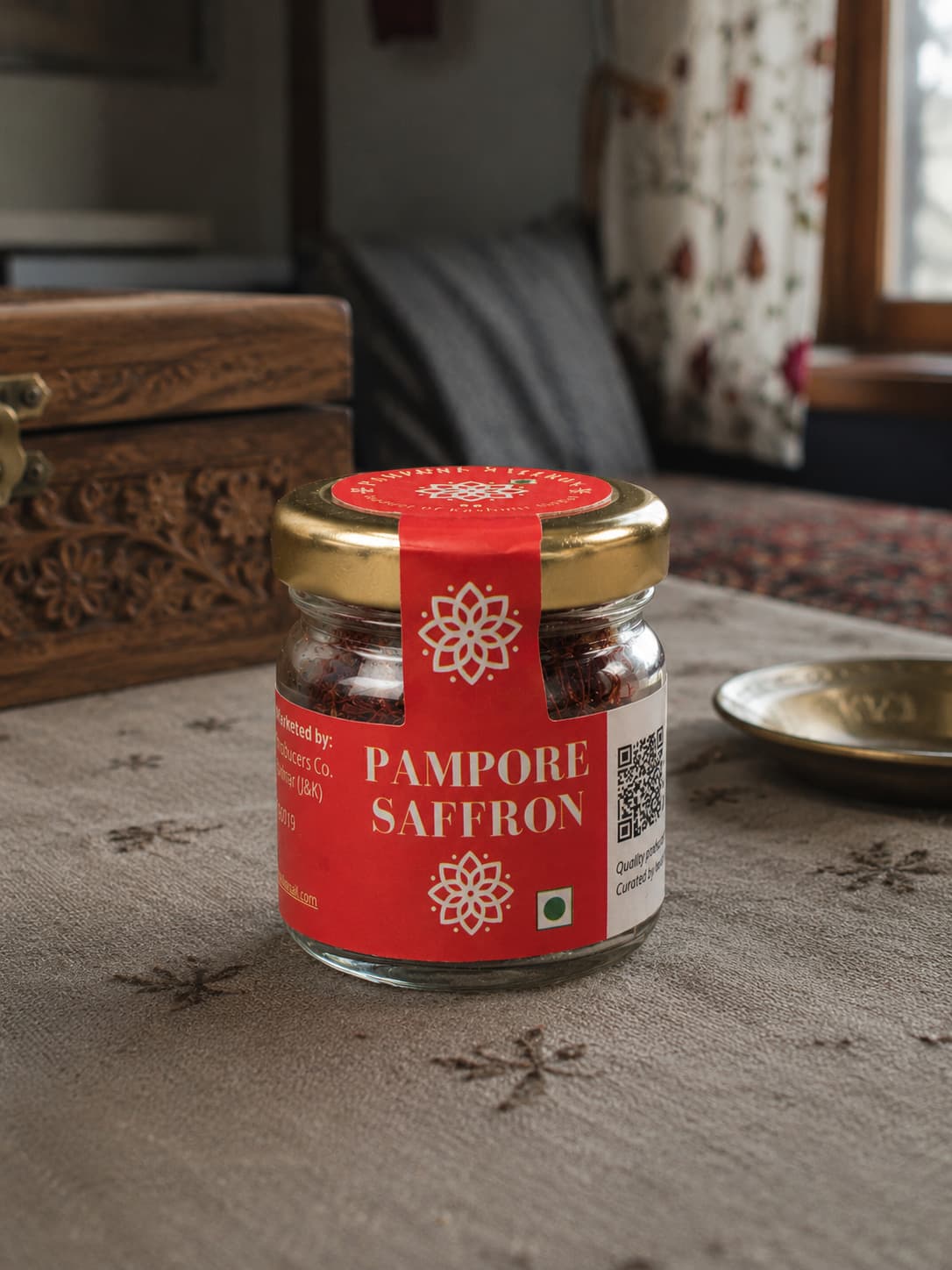
We grow and hand-sort this saffron ourselves in Pampore, seal it there in tamper-evident glass, and ship it prepaid to Arunachal Pradesh. One hop, no repacking, a batch code on the jar.
Also shipping to Arunachal Pradesh: Mixed dry fruits from the valley.
Pampore Saffron FPO, J&K · FSSAI 11022470000019