Heritage Kashmir · Northeast India
Kashmiri Saffron in Meghalaya
- केसरkesar · Hindi (link language)
The short answer
Meghalaya is another state in NECTAR's Northeast saffron trial programme — Kashmiri corms have been planted experimentally in the higher parts of the state on the same reasoning as Sikkim and Arunachal. Nothing is commercial, so the saffron in Shillong's Police Bazaar and Iewduh arrives through Guwahati at ₹600–950 a gram, against ₹330–360 direct from a Pampore grower family. Local demand is modest: Khasi, Garo and Jaintia food traditions do not use saffron, so the state's buying comes from its Christian festive baking, its restaurant and hotel trade, and its settled Bengali, Assamese, Marwari and Nepali communities.
Iewduh, Police Bazaar, and a market with no local demand base
Iewduh — Bara Bazar — in Shillong is one of the oldest and largest traditional markets in the Northeast, and like Ima Keithel in Imphal it is excellent for local produce and beside the point for imported premium goods. Saffron in Shillong comes through Guwahati, about four margins out, and is stocked thinly because the underlying local demand is small.
That thinness is itself a quality issue: slow-moving saffron sits on a shelf for a long time, in a state with very high rainfall and humidity, often in packaging that was never meant to hold it for a year. Even genuine saffron loses aroma under those conditions.
The NECTAR trials are worth watching. Meghalaya's higher elevations have been included in the Northeast saffron cultivation programme alongside Sikkim, Arunachal and Mizoram, using corms from Kashmir. Research scale for now, and honestly reported as such.
- Iewduh and Police Bazaar stock saffron thinly — small local demand base.
- Slow-moving stock plus very high humidity is a genuine quality problem, even for real saffron.
- NECTAR has run trial saffron plantings at Meghalaya's higher elevations.
- Buy small, sealed and recent rather than whatever has been on the shelf longest.
Where saffron fits in Meghalaya
Khasi, Garo and Jaintia food is built on rice, pork, fish, local greens and minimal spicing — jadoh, doh khleh, dohneiiong, pukhlein, and the Garo nakham bitchi tradition. None of it uses saffron and there is no reason to pretend it does. Pukhlein, the rice-flour-and-jaggery fried sweet, and the state's other traditional sweets are rice and jaggery preparations.
Meghalaya is a majority-Christian state, and the festive baking tradition around Christmas and Easter is where a domestic saffron use has grown up — in rich fruit cakes, sweet breads and festive rice, following the wider Indian Christian pattern found in Kerala and Goa.
The rest is the settled communities and the trade. Shillong's Bengali, Assamese, Marwari and Nepali households make payesh, kheer and festival sweets; the city's substantial restaurant and hotel sector runs a north-Indian menu; and the Muslim community makes biryani and sheer khurma at Eid.
- Not part of Khasi, Garo or Jaintia cooking — jadoh, dohneiiong and pukhlein use none.
- Christmas and Easter baking — fruit cake, sweet bread and festive rice.
- Settled-community payesh, kheer and festival sweets in Shillong.
- Hotel and restaurant north-Indian menus; Eid biryani and sheer khurma.
Delivery to Meghalaya
Shillong and Nongpoh typically arrive 8–12 business days after dispatch, routing through Guwahati; Tura, Jowai, Williamnagar and Baghmara usually 9–14. Meghalaya's rainfall is the heaviest in India and monsoon conditions regularly extend transit. We dispatch from Pampore within 24–48 hours of a confirmed prepaid order, sealed and batch-coded, with DTDC tracking emailed on despatch.
We deliver across
- Shillong
- Tura
- Jowai
- Nongpoh
- Williamnagar
- Baghmara
Every serviceable PIN code in Meghalaya — not only the cities listed. DTDC Express is ?60 for 7-day delivery, and DTDC Airmax is ?120 for faster air delivery.
Saffron in Meghalaya — common questions
- Is saffron grown in Meghalaya?
- At trial scale. Meghalaya's higher elevations are part of the North East Centre for Technology Application and Reach programme that has planted Kashmiri saffron corms experimentally across Sikkim, Arunachal Pradesh, Mizoram and Meghalaya. The reasoning is the cool dry autumn and well-drained slopes at altitude. Nothing has reached commercial volume, so all the saffron sold in Shillong today came through Guwahati from Kashmir or Iran.
- What is the price of saffron in Shillong?
- Police Bazaar and Iewduh price Kashmiri-labelled Grade 1 at roughly ₹600–950 a gram, at the end of a four-margin chain from an import counter through Burrabazar, Siliguri and Guwahati. Direct from a Pampore grower family, ISO 3632 Grade I Mongra is ₹330–360 a gram, sealed and batch-coded with the harvest year, delivered in about 8–12 business days after dispatch.
- How do I store saffron in Meghalaya's rainfall?
- This is the wettest state in India and saffron is hygroscopic, so storage matters more here than almost anywhere. Airtight glass jar, tightly closed, in the darkest and driest cupboard you have, well away from the stove and any open window. Never the refrigerator — condensation on opening is worse than the ambient damp. Take out what you need quickly and shut it. Buy a 1-gram jar you will finish within a year rather than a large one that clumps through a Cherrapunji monsoon.
- Is saffron used in Khasi or Garo cooking?
- No. Khasi, Garo and Jaintia cooking is built on rice, pork, fish, local greens and restrained spicing — jadoh, doh khleh, dohneiiong, nakham bitchi — and saffron has no place in any of it. The traditional sweets, pukhlein among them, are rice-flour and jaggery preparations. Saffron demand in Meghalaya comes from the Christian festive baking tradition, the restaurant and hotel trade, and the state's settled Bengali, Assamese, Marwari and Nepali communities.
- How much saffron goes into a Christmas fruit cake?
- It is optional in most recipes and, where used, a light hand is right — 8 to 10 threads for a standard 1 kg cake. Crush them and steep in two tablespoons of warm milk for fifteen minutes, then add that with the wet ingredients. In a cake already carrying soaked fruit, spice and often rum, saffron is a background note rather than a lead flavour; adding more will not make it read as saffron, it will just cost more.
- Do you deliver saffron to Tura and the Garo Hills?
- Yes, to every serviceable PIN code in Meghalaya. Shillong and Nongpoh typically 8–12 business days after dispatch; Tura, Jowai, Williamnagar and Baghmara usually 9–14, with monsoon conditions extending that further. We dispatch within 24–48 hours of a confirmed prepaid order and email you the DTDC tracking number when the parcel leaves Pampore.
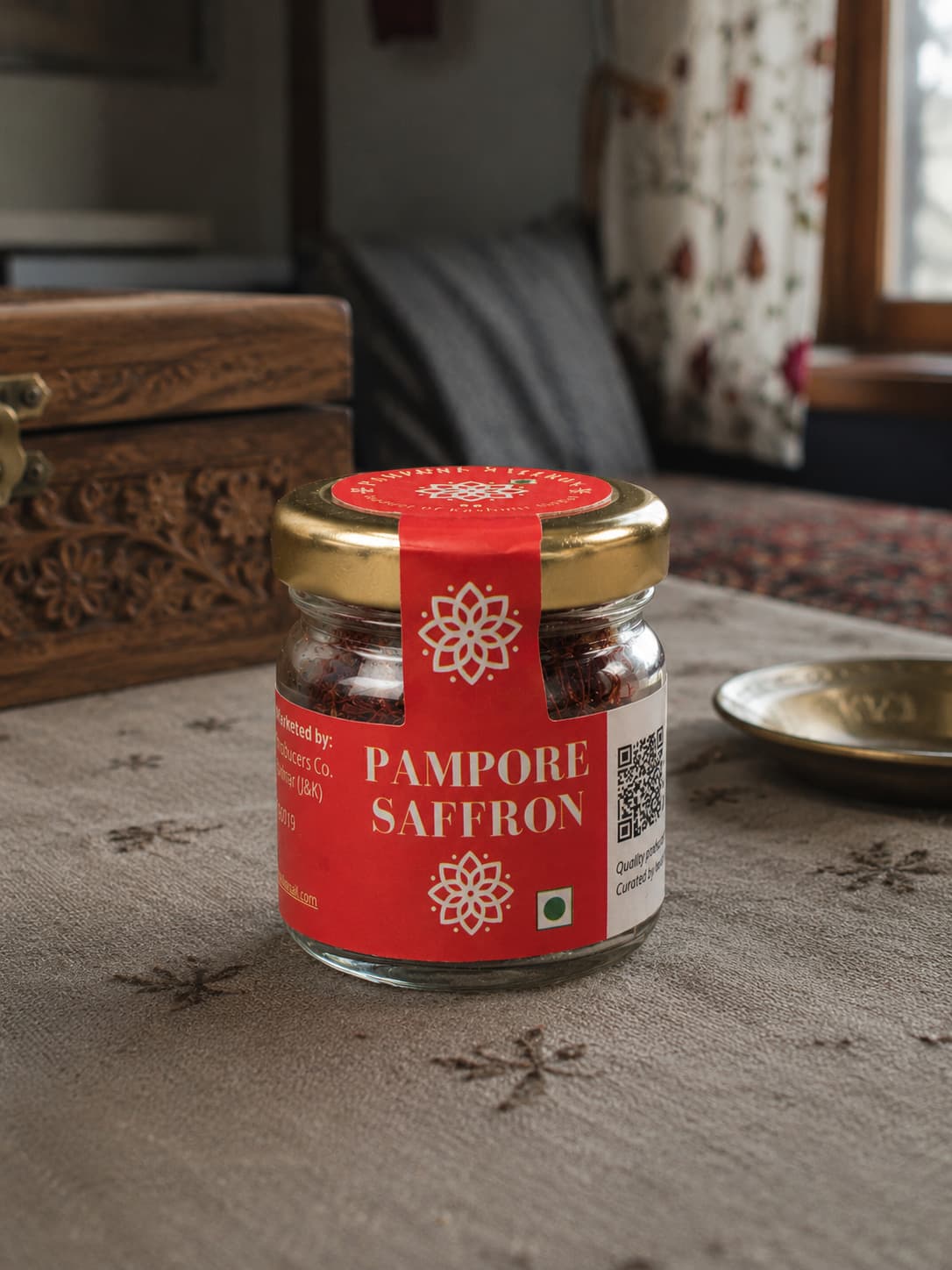
We grow and hand-sort this saffron ourselves in Pampore, seal it there in tamper-evident glass, and ship it prepaid to Meghalaya. One hop, no repacking, a batch code on the jar.
Also shipping to Meghalaya: Mixed dry fruits from the valley.
Pampore Saffron FPO, J&K · FSSAI 11022470000019