Heritage Kashmir · Northeast India
Kashmiri Saffron in Mizoram
- केसरkesar · Hindi (link language)
The short answer
Mizoram is included in NECTAR's Northeast saffron trials, with Kashmiri corms planted experimentally in the state's higher country — a genuinely interesting programme that has not yet reached commercial volume. What is sold in Aizawl's Bara Bazar arrives through Silchar and Guwahati at ₹600–1,000 a gram, against ₹330–360 direct from a Pampore grower family. Mizo food traditions use no saffron: the cuisine is built on rice, boiled and steamed vegetables, bai, bamboo shoot and smoked meat with very little spice. Local demand comes from the restaurant trade, the settled non-Mizo population, and Christmas festive baking in a state that is over eighty per cent Christian.
A small market at the end of a long road
Aizawl's Bara Bazar and the Solomon's Cave market area stock a limited range of imported groceries, brought up through Silchar from Guwahati. Saffron is a slow-moving item here with no local demand base to keep the stock turning, so what is on a shelf may have been there a long time.
Mizoram's own agriculture — jhum cultivation, then the shift to horticulture, ginger, turmeric, bird's eye chilli and the state's excellent passion fruit and grape — is genuinely interesting and has nothing to do with saffron. The NECTAR trials are the exception, planted on the reasoning that Mizoram's higher elevations share the cool dry autumn that Crocus sativus needs.
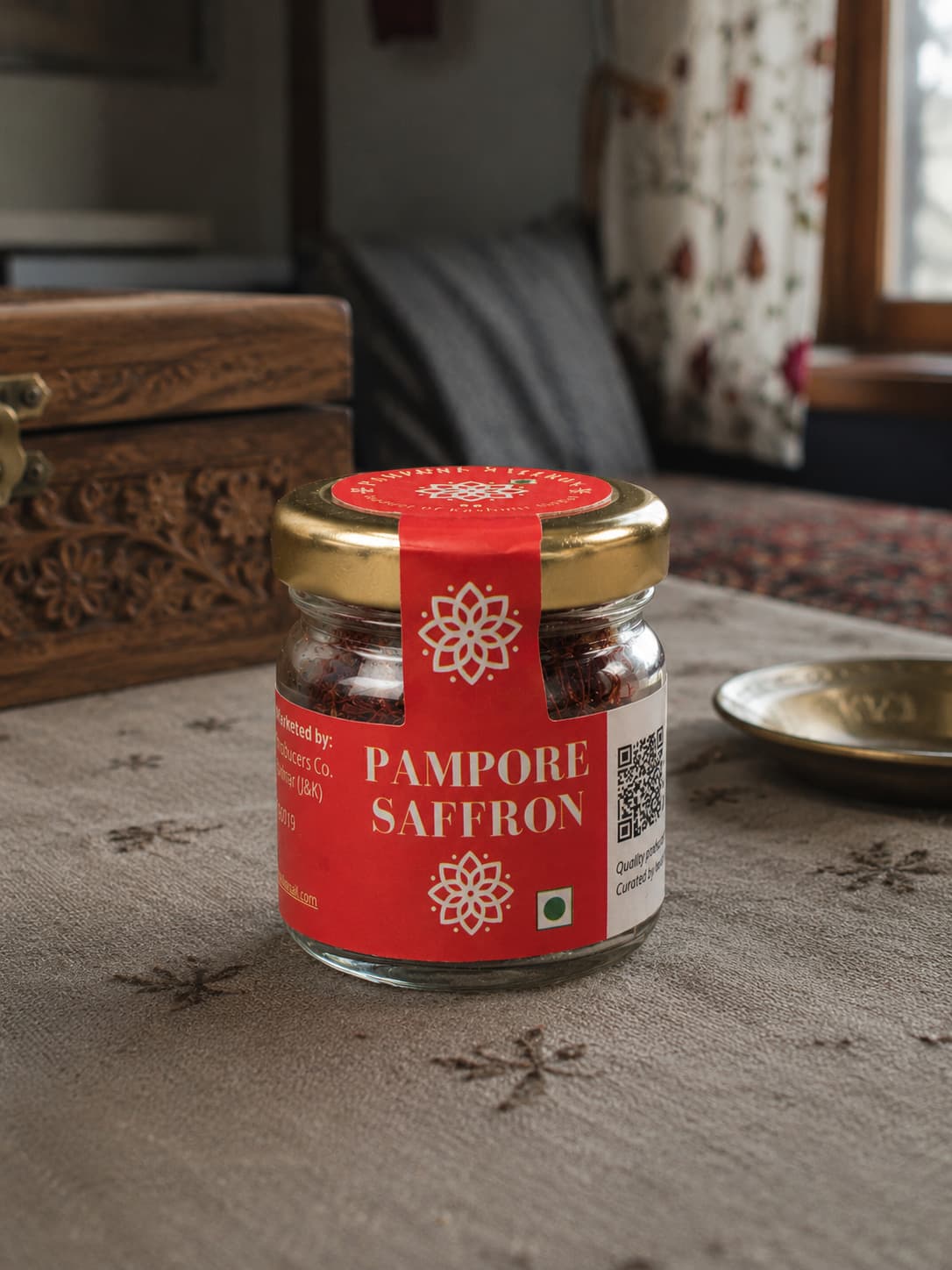
For a buyer in Aizawl, Lunglei or Champhai, ordering direct from source is the only route that gives you a stated origin and a recent harvest. It is also, at ₹330–360 against ₹600–1,000, substantially cheaper.
- Supply arrives via Silchar and Guwahati — several margins and a long road.
- Slow-moving stock in a humid climate: shelf age is a real quality issue.
- NECTAR has trialled saffron in Mizoram's higher country using Kashmiri corms.
- Direct-from-source is both cheaper and fresher here, not a compromise.
Saffron and the Mizo table
Mizo cooking uses almost no spice by the standards of the rest of India — bai, the staple boiled vegetable dish with bekang or sa-um, vawksa rep, chhum han, and rice at every meal. Saffron has no traditional place and there is no reason to invent one.
Where saffron appears is Christmas. Mizoram is over eighty per cent Christian and Christmas is the year's great festival, with community feasts, church programmes and a substantial home-baking tradition. Rich fruit cakes, sweet breads and festive preparations are where a household here would use saffron, following the pattern of Christian festive baking across India.
The rest is the restaurant trade in Aizawl, the settled Bengali, Nepali, Bihari and Marwari population making their own festival sweets, and the hotel sector serving a north-Indian menu.
- Not part of bai, vawksa rep, chhum han or any traditional Mizo dish.
- Christmas baking — fruit cake, sweet bread and festive preparations.
- Settled-community festival sweets and kheer in Aizawl.
- Restaurant and hotel north-Indian menus.
Delivery to Mizoram
Aizawl typically arrives 10–14 business days after dispatch, routing through Guwahati and Silchar; Lunglei, Champhai, Serchhip, Kolasib and Saiha usually 11–16. Monsoon landslides on the Silchar–Aizawl corridor regularly extend that. Order three to four weeks ahead of any date. We dispatch within 24–48 hours of a confirmed prepaid order, sealed and batch-coded, with DTDC tracking emailed on despatch.
We deliver across
- Aizawl
- Lunglei
- Champhai
- Serchhip
- Kolasib
- Saiha
Every serviceable PIN code in Mizoram — not only the cities listed. DTDC Express is ?60 for 7-day delivery, and DTDC Airmax is ?120 for faster air delivery.
Saffron in Mizoram — common questions
- Do you deliver saffron to Aizawl and Mizoram?
- Yes, to serviceable PIN codes, with a realistic timeline. Aizawl typically runs 10–14 business days after dispatch via Guwahati and Silchar; Lunglei, Champhai, Serchhip, Kolasib and Saiha usually 11–16, and monsoon landslides on the Silchar–Aizawl corridor extend that further. Order three to four weeks ahead of Christmas or any date you need it.
- Is saffron grown in Mizoram?
- At trial scale only. Mizoram's higher elevations are part of the North East Centre for Technology Application and Reach programme that has planted Kashmiri saffron corms experimentally across the Northeast, alongside Sikkim, Arunachal Pradesh and Meghalaya. Nothing has reached commercial volume. Mizoram's own successful horticulture — ginger, turmeric, bird's eye chilli, passion fruit, grapes — is a separate and much larger story.
- What is the price of saffron in Aizawl?
- Bara Bazar and the Aizawl grocery trade price it at roughly ₹600–1,000 a gram, among the highest in India, at the end of a long chain through Guwahati and Silchar with no local demand base to keep prices competitive. Direct from a Pampore grower family, ISO 3632 Grade I Kashmiri Mongra is ₹330–360 a gram, sealed and batch-coded with the harvest year, and it arrives fresher than anything that has been sitting on an Aizawl shelf.
- Is saffron used in Mizo cooking?
- No. Mizo cooking is deliberately restrained with spice — bai, vawksa rep, chhum han, sa-um and rice — and saffron has no traditional place in any of it. Saffron demand in Mizoram comes from Christmas festive baking in a state that is over eighty per cent Christian, from the Aizawl restaurant and hotel trade, and from the settled Bengali, Nepali, Bihari and Marwari communities making their own festival sweets.
- How much saffron for a Christmas cake or sweet bread?
- 8 to 10 threads for a standard 1 kg fruit cake, or 6 to 8 for a sweet bread. Crush them and steep in two tablespoons of warm milk for fifteen minutes, then add that with the wet ingredients — dropped in dry, the threads will not release into a batter or a dough. In a cake carrying soaked fruit and spice, saffron sits in the background; more of it costs more without reading as more saffron.
- How should I store saffron in Mizoram?
- Airtight glass, darkest and driest cupboard, away from the stove, never the fridge. Mizoram's monsoon is long and heavy, and saffron pulls moisture out of humid air — it will clump and lose aroma within months in a loosely closed container. Given the two-week transit and the climate, buy a 1-gram jar you will finish within the year rather than a larger one that sits open through two rainy seasons.
We grow and hand-sort this saffron ourselves in Pampore, seal it there in tamper-evident glass, and ship it prepaid to Mizoram. One hop, no repacking, a batch code on the jar.
Also shipping to Mizoram: Mixed dry fruits from the valley.
Pampore Saffron FPO, J&K · FSSAI 11022470000019