Heritage Kashmir · Northeast India
Kashmiri Saffron in Manipur
- কেশরkesar · Meiteilon/Manipuri
The short answer
Manipur's saffron demand is small and specific, and it runs through the Meitei Vaishnav tradition — Kang Chingba, the Manipuri Rath Yatra held each July, is the state's biggest Hindu festival and its prasad and celebration food is where saffron appears. Everything sold in Imphal's Khwairamband Bazaar arrives through Guwahati and Silchar at ₹600–1,000 a gram, against ₹330–360 direct from a Pampore grower family. The state's most distinctive dish for saffron is chak-hao kheer — black rice pudding made from the GI-tagged Manipuri black rice, where saffron is used sparingly against a deep purple grain rather than to colour it.
Khwairamband Bazaar and a very long road
Imphal's Khwairamband Bazaar — the Ima Keithel, run entirely by women and one of the oldest markets of its kind anywhere — is the centre of retail in the state. It is a superb market for Manipuri produce and a difficult one for imported premium goods, saffron included: everything of that kind arrives through Guwahati or Silchar, several margins out, and sits at the end of a road that closes for weather and for other reasons.
Supply into Manipur has been genuinely unreliable in recent years, and it is not our place to pretend otherwise. What that means practically for a buyer is straightforward: order ahead, expect transit variability, and do not plan a festival purchase on a one-week assumption.
As everywhere in the Northeast, there is no local production, no local price authority, and nothing on a shelf that carries a batch code.
- Ima Keithel is a great market for Manipuri produce, not for imported premium goods.
- Supply routes through Guwahati and Silchar, several margins out.
- Transit into Manipur is variable — order well ahead of any festival date.
- No local production and no batch-coded stock on any local shelf.
Chak-hao kheer, Kang Chingba, and the Meitei table
Chak-hao kheer is the dish worth knowing. Chak-hao is Manipur's black glutinous rice, GI-tagged and grown in the valley, with a deep purple colour and a distinct nutty aroma. Simmered slowly in milk with cardamom and sugar it makes a pudding unlike any other in India, and saffron is used in it very sparingly — the colour is already spoken for, so the saffron is there purely for aroma. This is one of the few Indian dishes where you would use saffron and see no colour change at all.
Kang Chingba, the Manipuri Rath Yatra held in July over eight days, is the state's biggest Hindu festival and draws enormous crowds in Imphal. The Meitei Vaishnav tradition, established in Manipur in the eighteenth century, brought Bengali and Odia ritual food conventions with it, and prasad, kheer and celebration sweets follow those patterns.
Everyday Meitei food — eromba, singju, ooti, nga thongba — uses no saffron, and nor do the hill communities' traditions. Manipuri Muslim (Pangal) households use it in biryani and Eid sweets. Madhurjan, the besan-based Manipuri sweet, is not traditionally a saffron dish.
- Chak-hao kheer — saffron for aroma only, since the black rice already carries the colour.
- Kang Chingba in July — the state's largest Hindu festival and its prasad tradition.
- Not in eromba, singju, ooti or the everyday Meitei table.
- Pangal Muslim biryani and Eid sweets.
Delivery to Manipur
Imphal typically arrives 9–14 business days after dispatch, routing through Guwahati or Silchar; Thoubal, Bishnupur, Churachandpur, Ukhrul and the hill districts usually longer, and transit into the state can be variable. Order three to four weeks ahead of any date you need it. We dispatch from Pampore within 24–48 hours of a confirmed prepaid order, sealed and batch-coded, with DTDC tracking emailed on despatch.
We deliver across
- Imphal
- Thoubal
- Bishnupur
- Churachandpur
- Ukhrul
- Kakching
Every serviceable PIN code in Manipur — not only the cities listed. DTDC Express is ?60 for 7-day delivery, and DTDC Airmax is ?120 for faster air delivery.
Saffron in Manipur — common questions
- What is the price of saffron in Imphal?
- Local retail runs roughly ₹600–1,000 a gram, among the highest in India, because everything arrives through Guwahati or Silchar at the end of a four- or five-margin chain with no competing local supply. Direct from a Pampore grower family, ISO 3632 Grade I Kashmiri Mongra is ₹330–360 a gram, sealed and batch-coded with the harvest year, with shipping calculated separately at checkout from your PIN code.
- How much saffron goes into chak-hao kheer?
- Very little — 6 to 8 threads for a batch serving six, and purely for aroma. Chak-hao's deep purple already gives the dish its colour, so saffron here is doing a job it does nowhere else in Indian cooking: contributing scent with no visual effect at all. Crush the threads, steep in a tablespoon of warm milk for fifteen minutes, and stir that in at the very end. Using more will not make the dish more saffron-coloured; it will just make it taste medicinal.
- Do you deliver saffron to Manipur?
- Yes, to serviceable PIN codes, with a realistic timeline and an honest caveat. Imphal typically runs 9–14 business days after dispatch via Guwahati or Silchar, and the hill districts longer; transit into the state can be variable for reasons outside any courier's control. Order three to four weeks ahead of any date you need it, and we will email DTDC tracking as soon as the parcel leaves Pampore.
- Is saffron used in Manipuri food?
- Rarely, and not in the everyday Meitei table — eromba, singju, ooti and nga thongba use no saffron, and nor do the hill communities' traditions. Where it appears is in the Vaishnav festival food brought into Manipur with the eighteenth-century Meitei adoption of Vaishnavism: kheer and prasad at Kang Chingba and other festivals, chak-hao kheer in its richer versions, and Pangal Muslim biryani and Eid sweets.
- Is chak-hao black rice related to saffron?
- No — different plants, different purposes, and they are used together rather than as alternatives. Chak-hao is Manipur's GI-tagged black glutinous rice, whose deep purple comes from anthocyanins in the bran. Saffron is Crocus sativus, whose colour comes from crocin. In chak-hao kheer the two meet, and saffron's usual job — colour — is redundant, so it is added only for aroma and in very small amounts.
- How should I store saffron in Imphal's climate?
- The Imphal valley is temperate but the monsoon is heavy, so moisture is the concern. Keep the jar airtight, in a dark cupboard away from the stove, and out of the fridge — condensation each time you open a chilled jar does more harm than the ambient humidity would. Given the long and variable transit into the state, buy a 1- or 2-gram jar you will finish within a year rather than a larger one that sits open through two monsoons.
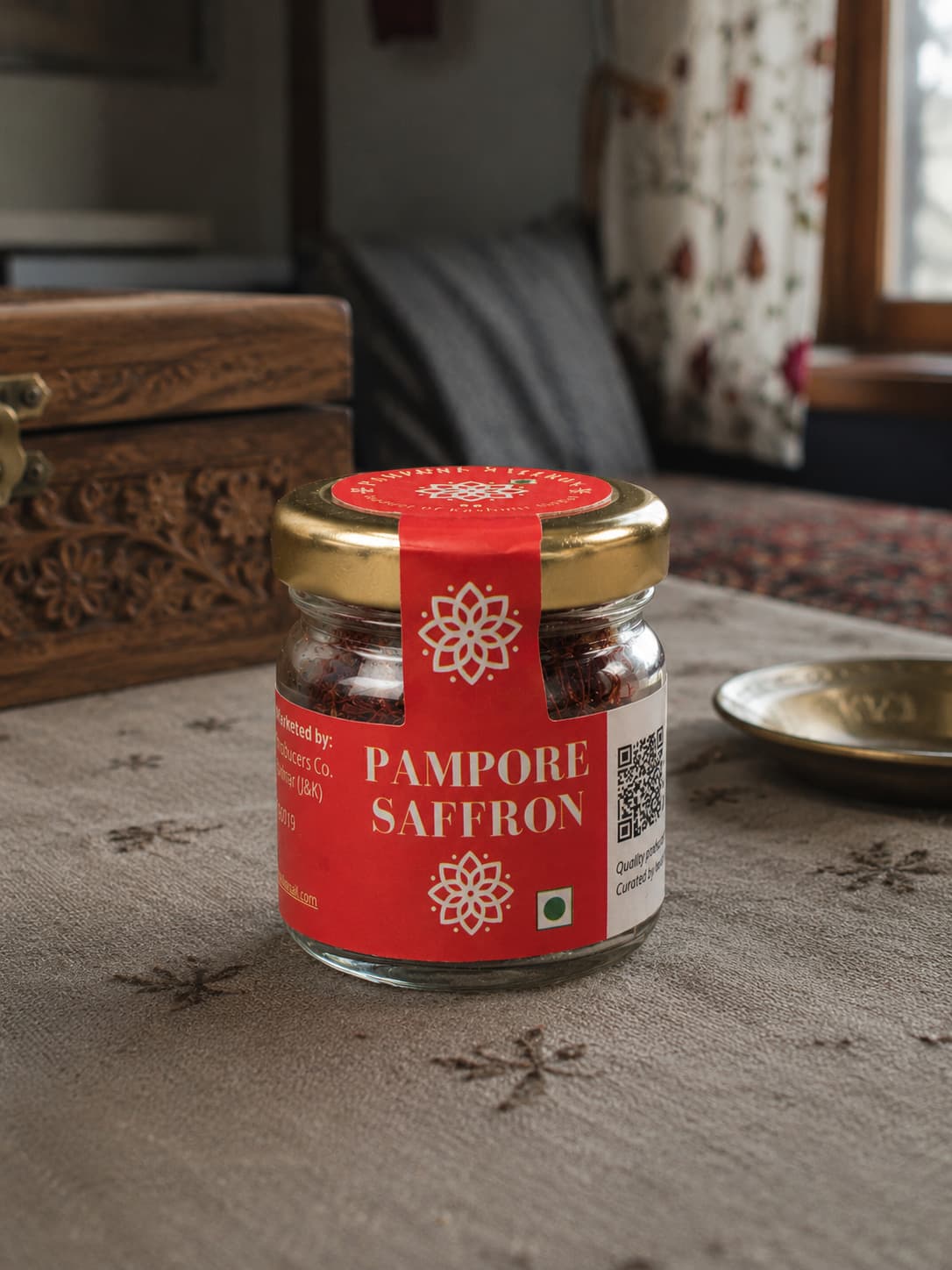
We grow and hand-sort this saffron ourselves in Pampore, seal it there in tamper-evident glass, and ship it prepaid to Manipur. One hop, no repacking, a batch code on the jar.
Also shipping to Manipur: Mixed dry fruits from the valley.
Pampore Saffron FPO, J&K · FSSAI 11022470000019