Heritage Kashmir · East India
Kashmiri Saffron in West Bengal
- জাফরানjafran · Bengali
- কেশরkeshar · Bengali
The short answer
West Bengal calls saffron জাফরান (jafran) more often than কেশর (keshar), and its defining saffron dish is payesh — the rice pudding made for every Bengali birthday, for Jamai Shashthi and for Durga Puja bhog. Real Kashmiri Mongra is ₹330–360 a gram direct from a Pampore grower family; Kolkata retail in New Market, Gariahat and the Burrabazar trade runs ₹450–850. Burrabazar is eastern India's largest spice wholesale market and the point through which almost all saffron sold anywhere east of Patna passes, which makes Kolkata well-supplied and, in the usual way, the place where Iranian stock most reliably acquires a Kashmiri label.
Burrabazar supplies the east — and renames it on the way
Burrabazar is the wholesale hub for the entire eastern region: Bengal, Odisha, Bihar, Jharkhand and much of the Northeast draw their spice supply through it. For saffron that means the same pattern as Mumbai and Hyderabad — large volumes of Iranian import stock, traded honestly at wholesale as what it is, and then described as Kashmiri once it reaches a retail counter. The distance between those two descriptions is about half a kilometre.
Kolkata's retail split is worth knowing. New Market and the older Esplanade shops sell to a mixed and often tourist trade at wide margins. Gariahat and the south Kolkata provision shops sell to households who buy small amounts occasionally. The Burrabazar edge sells closer to wholesale if you buy meaningfully. None of the three will give you a batch code.
Siliguri is a separate node — it supplies the hills, Sikkim and much of the Northeast, and its saffron trade carries an extra hop and an extra margin. Darjeeling's tourist shops sell saffron alongside tea at holiday prices.
- Burrabazar is the wholesale source for the whole eastern region — mostly Iranian stock.
- New Market and Esplanade retail carries the widest margins in the city.
- Siliguri supplies the hills and Northeast at one hop further out.
- Kashmiri Mongra is short, thick and all dark red with a flared tip; Iranian threads are longer and thinner.
Jafran in the Bengali kitchen
Payesh is the dish. Gobindobhog rice simmered slowly in full-fat milk with sugar or nolen gur, and saffron stirred in at the end — made for every birthday in a Bengali household, for Jamai Shashthi, for annaprashan, and as bhog through Durga Puja. This is a milk dish with nothing to hide behind, so it is where the difference between real jafran and colour is most obvious.
Kolkata biryani is the other one, and it is its own thing entirely — lighter than the Hyderabadi, with the famous potato and the boiled egg, and a restrained hand with the spice. Saffron steeped in warm milk goes over the rice at dum. The Awadhi lineage of the dish, brought by Wajid Ali Shah's household to Metiabruz in the 1850s, is exactly why it uses saffron the Lucknowi way.
Beyond those two: mishti doi in its finer versions, sandesh and rajbhog at the better sweet shops, and the Durga Puja bhog khichuri-and-payesh combination that Kolkata's pandals serve to thousands. Poila Boishakh, Jamai Shashthi and the wedding season carry the rest.
- Payesh — Gobindobhog rice, milk, and saffron steeped in warm milk stirred in off the heat.
- Kolkata biryani — Awadhi lineage, restrained spicing, steeped saffron at dum.
- Durga Puja bhog: khichuri and payesh at pandal scale.
- Mishti doi, rajbhog and the wedding sweet run.
Delivery to West Bengal
Kolkata, Howrah, Barasat and Durgapur typically arrive 5–8 business days after dispatch; Siliguri, Asansol, Kharagpur and the district towns usually 6–9, and Darjeeling and the hill subdivisions 7–10. We dispatch from Pampore within 24–48 hours of a confirmed prepaid order, tamper-sealed and batch-coded, with DTDC tracking emailed on despatch.
We deliver across
- Kolkata
- Howrah
- Siliguri
- Durgapur
- Asansol
- Darjeeling
- Kharagpur
- Barasat
Every serviceable PIN code in West Bengal — not only the cities listed. DTDC Express is ?60 for 7-day delivery, and DTDC Airmax is ?120 for faster air delivery.
Saffron in West Bengal — common questions
- জাফরানের দাম কত? What is the price of saffron in Kolkata?
- Genuine ISO 3632 Grade I Kashmiri Mongra is ₹330–360 per gram direct from a Pampore grower family. Kolkata retail in New Market, Gariahat and the general provision trade runs ₹450–850 per gram for the same claimed grade, and Burrabazar wholesale sits lower for what is mostly Iranian import stock. Around 160 hand-picked flowers make one gram — that arithmetic is what puts a floor under the price.
- How much jafran goes into payesh?
- About 10–12 threads for a payesh serving six. Crush them, steep in two tablespoons of warm milk for fifteen minutes until the milk is deep gold, and stir that in after the payesh comes off the heat. Dropping dry threads into the simmering milk at the start is the common mistake — safranal, the compound carrying the aroma, boils away, and you are left with colour. Payesh has nothing else in it to mask that, which is why good saffron shows here more than in any other Bengali dish.
- Is Burrabazar saffron genuine?
- Usually genuine saffron and usually Iranian. Burrabazar is eastern India's spice wholesale hub and it moves real Crocus sativus in volume, correctly traded as import stock. What happens is that the same material picks up a Kashmiri description at retail further along. Iranian saffron is not fake and much of it is good — it is a different origin at a lower price. The only thing to refuse is a Kashmiri price for it.
- How much saffron for Kolkata biryani?
- About 15–20 threads for 1 kg of raw rice — slightly less than a Hyderabadi biryani would take, because the Kolkata style is deliberately restrained and the saffron is meant to sit behind the meat, potato and the light whole-spice base rather than lead. Crush the threads, steep in three tablespoons of warm milk for fifteen minutes, and drizzle over the top layer before you seal for dum. Never fry saffron in the ghee at the start.
- Do you deliver saffron to Siliguri and North Bengal?
- Yes, to every serviceable PIN code in the state. Kolkata, Howrah and Durgapur typically arrive 5–8 business days after dispatch; Siliguri, Asansol and the district towns usually 6–9; Darjeeling, Kalimpong and the hill subdivisions 7–10. We ship prepaid only, sealed and batch-coded from Pampore, with DTDC tracking emailed when it leaves.
- Is jafran the same as keshar?
- Yes — two names for one spice, both in use in Bengali. 'Jafran' comes from the Persian zafran and is the more common Bengali word; 'keshar' comes from Sanskrit and appears in more formal or Sanskritised usage. Both mean Crocus sativus, the three dried red stigmas of the autumn crocus. The word tells you nothing about the quality; ISO 3632 Category I and a stated Kashmiri origin do.
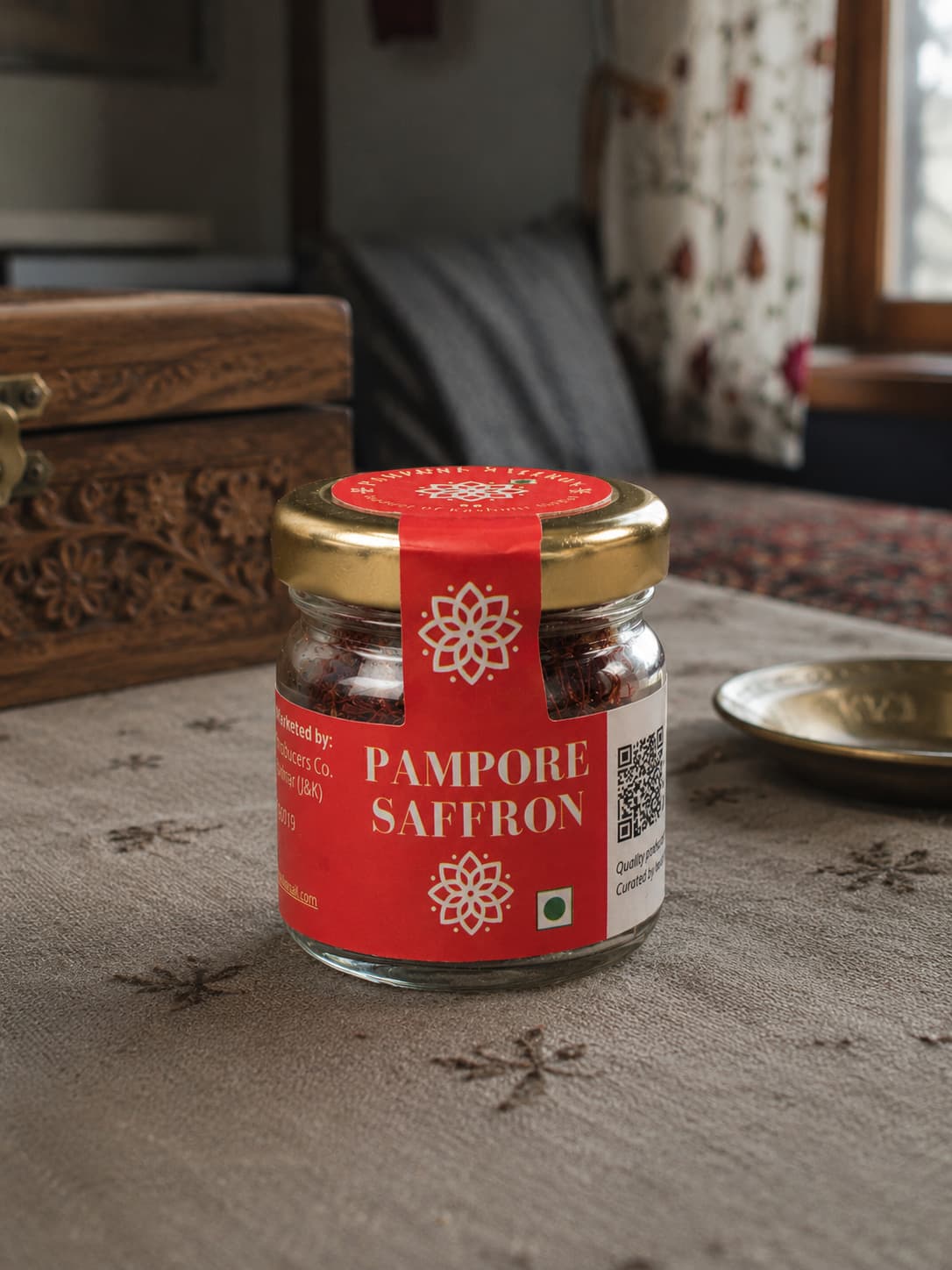
We grow and hand-sort this saffron ourselves in Pampore, seal it there in tamper-evident glass, and ship it prepaid to West Bengal. One hop, no repacking, a batch code on the jar.
Also shipping to West Bengal: Mixed dry fruits from the valley.
Pampore Saffron FPO, J&K · FSSAI 11022470000019