Heritage Kashmir · East India
Kashmiri Saffron in Jharkhand
- केसरkesar · Hindi
The short answer
Jharkhand buys its saffron through Kolkata and Patna, so local retail in Ranchi, Jamshedpur and Dhanbad carries two wholesale hops before it reaches a counter — roughly ₹450–850 a gram, against ₹330–360 direct from a Pampore grower family. The state's saffron demand is concentrated in its urban, industrial and migrant population — Jamshedpur's Tata township, Bokaro and Dhanbad's coal and steel workforce, and Ranchi's administrative class — which between them bring Bihari, Bengali, Odia and Punjabi festival traditions into one market. Deoghar's Baidyanath Dham pilgrim economy adds a separate stream of ritual buying, with the usual shrine-market caveat about safflower.
Two hops from the wholesale, four traditions in the market
Ranchi's Upper Bazaar and Jamshedpur's Bistupur and Sakchi markets stock saffron as part of a general dry-fruit trade, supplied from Kolkata or Patna. There is no specialist saffron trade in the state and no local price authority — you are buying at the end of a chain that started in Mumbai or at an Iranian import counter.
What makes Jharkhand distinct as a market is its demographic composition. The industrial townships drew workers and managers from across eastern and northern India across the twentieth century, and the result is a state where Bihari Chhath, Bengali Durga Puja, Odia festivals and Punjabi wedding traditions all run in the same city in the same year, each with its own saffron dish. Add the Adivasi majority in much of the state, whose food traditions do not use saffron at all, and you get a market that is urban, occasion-driven and quite small relative to the population.
Deoghar is the exception with its own rhythm. Baidyanath Dham draws very large numbers through Shravan, and the pilgrim market there sells saffron for ritual use in small packets — much of it safflower, as at every major shrine in India.
- Supply arrives via Kolkata and Patna — two wholesale hops before Ranchi.
- Urban and industrial demand: Bihari, Bengali, Odia and Punjabi traditions in one market.
- Adivasi food traditions across much of the state use no saffron at all.
- Deoghar's Shravan pilgrim market sells substantial quantities of safflower as kesar.
Four festival calendars, one state
Chhath Puja is observed across Jharkhand as seriously as in Bihar, and the kheer prasad is where household saffron goes — steeped in warm milk, stirred in off the heat, with the same strict purity conventions around the cooking.
The Bengali households of Jamshedpur, Dhanbad and Bokaro make payesh at birthdays and through Durga Puja. The Odia community makes rasabali and malpua. The Punjabi and Marwari trading families make kheer, phirni and the Diwali mithai run. The state's Muslim population uses zafran in biryani and sheer khurma at Eid.
Sarhul and the Adivasi festival calendar — the state's own oldest traditions — use handia, rice-flour preparations and forest ingredients, and saffron has no traditional place in them. That is worth stating plainly rather than pretending otherwise: Jharkhand's indigenous food culture is not a saffron culture, and the state's saffron demand is essentially the demand of the communities who settled around its industry.
- Chhath kheer prasad — the state's largest single saffron occasion.
- Bengali payesh at Durga Puja in the industrial townships.
- Diwali and wedding mithai in the Punjabi and Marwari trading households.
- Eid biryani and sheer khurma; Deoghar ritual use through Shravan.
Delivery to Jharkhand
Ranchi, Jamshedpur, Dhanbad and Bokaro typically arrive 6–9 business days after dispatch; Deoghar, Hazaribagh, Giridih and the smaller district towns usually 7–10. We dispatch from Pampore within 24–48 hours of a confirmed prepaid order, tamper-sealed and batch-coded, with DTDC tracking emailed on despatch.
We deliver across
- Ranchi
- Jamshedpur
- Dhanbad
- Bokaro
- Deoghar
- Hazaribagh
- Giridih
Every serviceable PIN code in Jharkhand — not only the cities listed. DTDC Express is ?60 for 7-day delivery, and DTDC Airmax is ?120 for faster air delivery.
Saffron in Jharkhand — common questions
- What is the price of kesar in Ranchi or Jamshedpur?
- Local retail runs roughly ₹450–850 a gram for Kashmiri-labelled Grade 1, supplied through Kolkata or Patna with two wholesale hops and a local margin before it reaches the counter. Direct from a Pampore grower family, ISO 3632 Grade I Mongra is ₹330–360 a gram, sealed and batch-coded with the harvest year, delivered in about 6–9 business days after dispatch.
- Where can I buy genuine saffron in Jharkhand?
- In person, Ranchi's Upper Bazaar and Jamshedpur's Bistupur and Sakchi dry-fruit shops are the practical options, and none of them will give you a batch code or a harvest year. There is no specialist saffron trade in the state. Buying direct from a Kashmiri grower is the only route that gives you a stated origin you can hold someone to — sealed jar, ISO 3632 Category I, harvest year, FSSAI licence, delivered prepaid.
- Is the kesar sold at Deoghar's Baidyanath Dham market real?
- Much of it is safflower rather than Crocus sativus. Shrine markets everywhere in India sell small packets at saffron prices to pilgrims buying quickly, and Deoghar through Shravan is one of the busiest of them. Safflower is a legitimate traditional material with its own name and its own uses; the problem is only the pricing. Three threads in warm water settles it — real saffron gives slow deepening gold over ten minutes with the thread staying whole and dark red.
- How much saffron goes into Chhath kheer?
- About 10–12 threads for a kheer serving eight to ten. Crush them, steep in two tablespoons of warm milk for fifteen minutes, and stir the infusion in after the pot comes off the heat. Chhath cooking carries strict purity conventions — separate vessels, separate fuel, no tasting while preparing — which is a good reason to use saffron from a sealed jar with a stated origin and no additives rather than an unlabelled sachet from a festival stall.
- Do you deliver to Bokaro, Deoghar and the smaller towns?
- Yes, to every serviceable PIN code in Jharkhand. Ranchi, Jamshedpur, Dhanbad and Bokaro typically arrive 6–9 business days after dispatch; Deoghar, Hazaribagh, Giridih and the district towns usually 7–10. We ship prepaid only, sealed at source in Pampore, with DTDC tracking emailed the moment the parcel leaves.
- How much saffron does a household need for a year?
- For most Jharkhand households, 2 to 3 grams comfortably covers a year. At 10–12 threads for a festival kheer or payesh and 3–4 threads for a glass of milk, a single gram runs to roughly 250 glasses or twenty festival dishes. Saffron use here is occasion-driven rather than daily, which is exactly why it is worth spending on grade instead of quantity: a whole year of genuinely good saffron costs about the same as one Diwali sweet box.
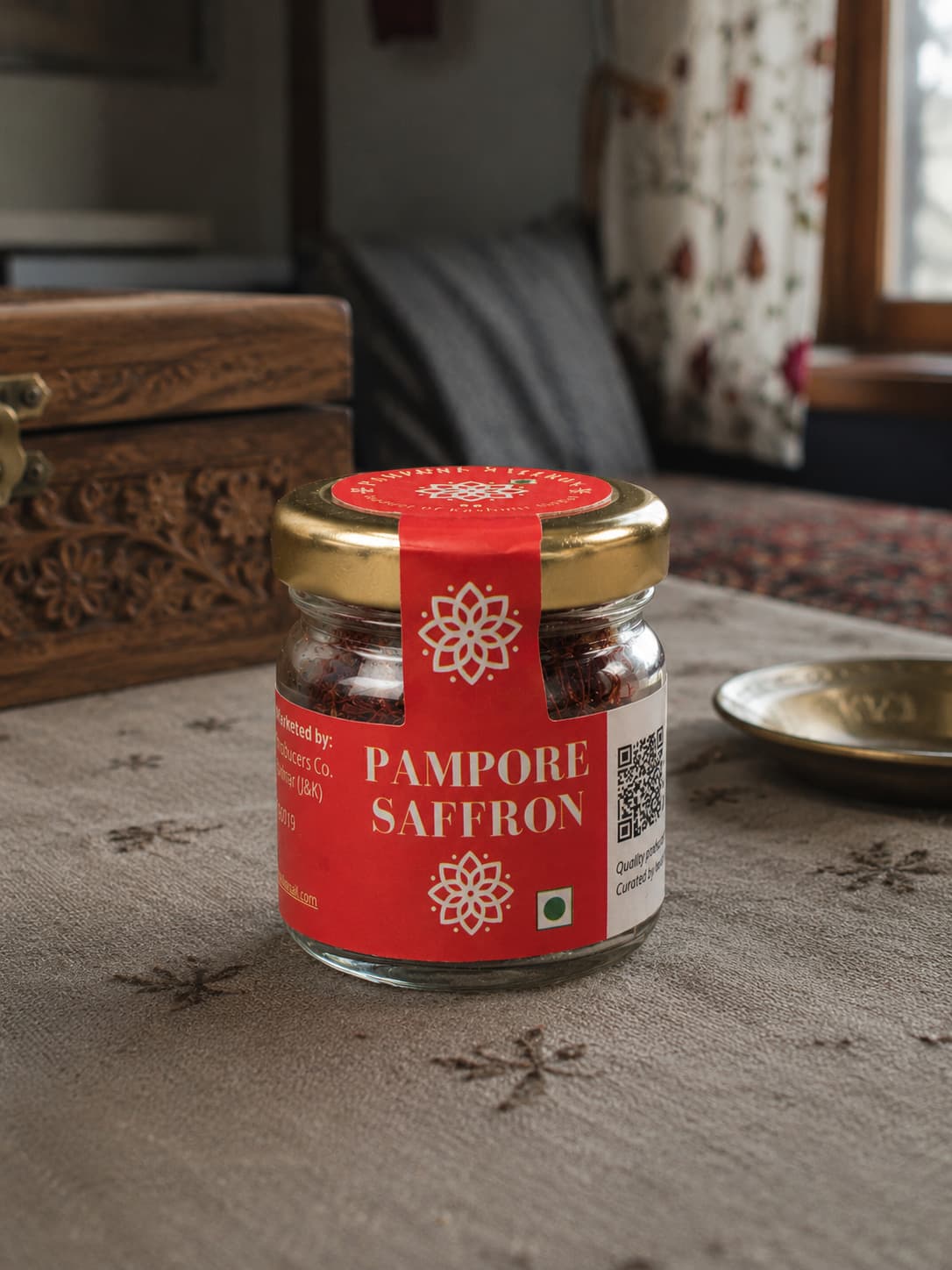
We grow and hand-sort this saffron ourselves in Pampore, seal it there in tamper-evident glass, and ship it prepaid to Jharkhand. One hop, no repacking, a batch code on the jar.
Also shipping to Jharkhand: Mixed dry fruits from the valley.
Pampore Saffron FPO, J&K · FSSAI 11022470000019