Heritage Kashmir · East India
Kashmiri Saffron in Sikkim
- केसरkesar · Nepali
- གུར་གུམgur-gum · Bhutia/Tibetan
The short answer
Sikkim is one of the few Indian states outside Kashmir where saffron cultivation has actually been attempted seriously — the North East Centre for Technology Application and Reach has run trial plantings at Yangyang in South Sikkim as part of a wider Northeast saffron programme, and the results have been encouraging enough to keep going. Volumes remain experimental, so the saffron sold in Gangtok's MG Marg and Lal Bazaar is still Kashmiri or Iranian, arriving via Siliguri at ₹550–900 a gram against ₹330–360 direct from a Pampore grower family. Sikkim's fully organic-certified agriculture and its Buddhist ritual traditions both shape how saffron is bought and used here.
Siliguri supply, and the Yangyang trials
Everything sold in Sikkim arrives through Siliguri, which is itself one hop from Kolkata's Burrabazar. That makes Gangtok about three margins from the wholesale and the prices show it — MG Marg and the Lal Bazaar shops carry some of the highest saffron retail in eastern India, with a tourist premium on top in the season.
The Yangyang trials are the genuinely interesting story. NECTAR — the North East Centre for Technology Application and Reach — has grown saffron at Yangyang in South Sikkim and extended the programme to parts of Arunachal Pradesh, Meghalaya and Mizoram, working from Kashmiri corms. The agro-climatic logic is sound: high altitude, cool dry autumn, well-drained slopes. Yields so far are small and research-scale. If Sikkim ever produces saffron commercially it will be genuinely notable, and as growers in Pampore we would rather see that succeed honestly than see more Iranian stock relabelled.
Sikkim's status as India's first fully organic state gives its buyers an unusually high baseline expectation about how food is grown and documented, which is a good instinct to apply to saffron — where the relevant documents are the ISO 3632 grade, the GI origin and the FSSAI licence.
- Gangtok is about three margins from wholesale: Mumbai or import, Burrabazar, Siliguri, then retail.
- NECTAR has run saffron trials at Yangyang, South Sikkim, using Kashmiri corms — research scale, not commercial.
- MG Marg and Lal Bazaar carry a tourist premium in season.
- Ask for ISO 3632 Category I, GI origin and an FSSAI number — the documents that actually mean something.
Saffron in Sikkimese use
Sikkimese cooking — Nepali, Bhutia and Lepcha — is not a saffron cuisine at its base. Momos, thukpa, gundruk, sel roti and phagshapa carry no saffron, and nor does the everyday food of any of the three communities.
Where saffron appears is in Buddhist ritual and in the Nepali Hindu festival calendar. In the monasteries at Rumtek, Pemayangtse and Tashiding, saffron water is used in ritual purification and in offering bowls, and saffron is among the substances placed in a stupa at consecration — the same tradition as in Ladakh and Tibet. The Nepali Hindu households make kheer at Dashain, Tihar and weddings, and that takes saffron in the richer versions. Sel roti, the ring-shaped rice bread central to Tihar, is sometimes given a saffron tint in festive versions.
Gangtok's hotel and restaurant trade, serving a large tourist economy, uses saffron across a north-Indian menu — biryani, kheer, kesar kulfi — which is where most of the state's saffron actually gets eaten.
- Monastery ritual — saffron water in offering bowls and in stupa consecration.
- Nepali Hindu kheer at Dashain, Tihar and weddings.
- Festive sel roti with a saffron tint.
- Gangtok's hotel and restaurant trade — the state's largest actual consumer.
Delivery to Sikkim
Gangtok and Rangpo typically arrive 7–10 business days after dispatch, routing through Siliguri; Namchi, Gyalshing, Mangan and the upper districts usually 8–12, and monsoon landslides on the NH-10 corridor can extend that considerably. We dispatch from Pampore within 24–48 hours of a confirmed prepaid order, tamper-sealed and batch-coded, with DTDC tracking emailed on despatch.
We deliver across
- Gangtok
- Namchi
- Gyalshing
- Mangan
- Yangyang
- Rangpo
Every serviceable PIN code in Sikkim — not only the cities listed. DTDC Express is ?60 for 7-day delivery, and DTDC Airmax is ?120 for faster air delivery.
Saffron in Sikkim — common questions
- Is saffron grown in Sikkim?
- At trial scale, yes. The North East Centre for Technology Application and Reach (NECTAR) has grown saffron at Yangyang in South Sikkim using Kashmiri corms, as part of a wider programme that also covers parts of Arunachal Pradesh, Meghalaya and Mizoram. The agro-climatic case is sound — high altitude, cool dry autumn, well-drained slopes. But the volumes are research-scale, not commercial, so anything you buy in a Gangtok shop is still Kashmiri or Iranian saffron that arrived via Siliguri.
- What is the price of saffron in Gangtok?
- MG Marg and Lal Bazaar shops price it at roughly ₹550–900 a gram, among the highest in eastern India, because Gangtok sits about three margins from the wholesale — Mumbai or an import counter, then Burrabazar, then Siliguri, then local retail — with a tourist premium in season. Direct from a Pampore grower family, ISO 3632 Grade I Kashmiri Mongra is ₹330–360 a gram, sealed and batch-coded, delivered in about 7–10 business days after dispatch.
- Do you deliver saffron to Sikkim?
- Yes, to every serviceable PIN code. Gangtok and Rangpo typically run 7–10 business days after dispatch, routing through Siliguri; Namchi, Gyalshing, Mangan and the upper districts usually 8–12. Monsoon landslides on the NH-10 corridor can extend that considerably, so order well ahead for anything with a date attached. We ship prepaid only, with DTDC tracking emailed on despatch.
- Is saffron used in Sikkimese Buddhist ritual?
- Yes. In the monasteries at Rumtek, Pemayangtse, Tashiding and elsewhere, saffron water is used in ritual purification and in the offering bowls set before a shrine, and saffron is among the substances placed inside a stupa at consecration — the same Tibetan Buddhist tradition found in Ladakh. Note that the 'saffron' colour of monastic robes is a colour name rather than a saffron dye; actual robes have been coloured with far cheaper materials for over a thousand years.
- Does Sikkim's organic certification apply to saffron sold there?
- No — Sikkim's organic status covers agriculture grown within the state, and saffron sold in Sikkim is imported from Kashmir or Iran, so it falls outside that framework entirely. What is relevant for saffron is a different set of documents: ISO 3632 grading for quality, the Kashmir Saffron GI for origin, and an FSSAI licence for the food business. Our saffron is grown without synthetic pesticide or chemical treatment on family land in Pampore, but the honest statement is 'grower-family, single-origin, hand-sorted' rather than a certification Sikkim's own scheme could recognise.
- How much saffron for kheer at Dashain or Tihar?
- About 10–12 threads for a kheer serving eight. Crush them, steep in two tablespoons of warm milk for fifteen minutes until deep gold, and stir the infusion in after the pot comes off the heat. For a saffron-tinted festive sel roti, steep 6–8 threads in a spoon of warm milk and work that into the batter — added dry, the threads will not release into a rice-flour dough at all.
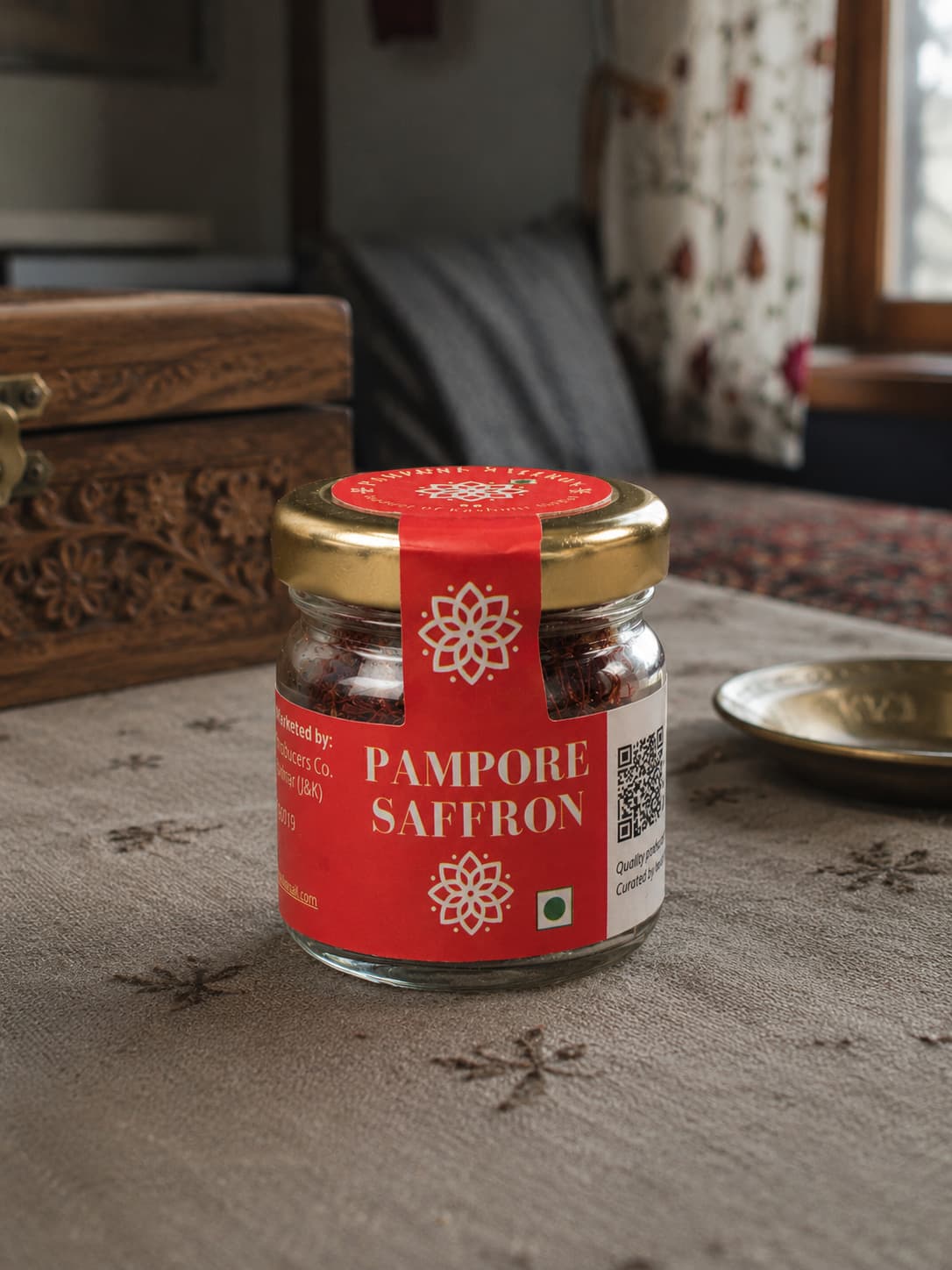
We grow and hand-sort this saffron ourselves in Pampore, seal it there in tamper-evident glass, and ship it prepaid to Sikkim. One hop, no repacking, a batch code on the jar.
Also shipping to Sikkim: Mixed dry fruits from the valley.
Pampore Saffron FPO, J&K · FSSAI 11022470000019