Heritage Kashmir · East India
Kashmiri Saffron in Odisha
- କେଶରkeshara · Odia
- ଜାଫରାନjafran · Odia
The short answer
Odisha calls saffron କେଶର (keshara) and has one dish where saffron is not a garnish but the dominant flavour: rasabali, the Kendrapara sweet of fried chhena patties soaked in thickened saffron rabri. Real Kashmiri Mongra is ₹330–360 a gram direct from a Pampore grower family; Bhubaneswar and Cuttack retail runs ₹450–850, supplied through Kolkata's Burrabazar. The state's other large saffron demand is the Jagannath temple economy at Puri — Mahaprasad, the Rath Yatra season and the pilgrim sweet trade — which sustains a steady year-round buying pattern that most states do not have.
Cuttack's sweet trade, Puri's pilgrims, and Kolkata's supply line
Odisha buys through Kolkata. Burrabazar supplies Bhubaneswar, Cuttack and Rourkela, so the state pays a Kolkata wholesale price plus a transport hop plus local retail — and inherits Burrabazar's Iranian-stock-relabelled-as-Kashmiri pattern along with the goods.
Cuttack's sweet trade is the volume buyer that matters. The chhena sweet tradition here — rasabali, chhena poda, chhena gaja, khiramohana — is one of India's great regional confectionery cultures, and rasabali in particular uses saffron heavily enough that a Cuttack halwai buys in tens of grams rather than by the gram. That is exactly the scale at which origin pricing versus bazaar pricing stops being a detail.
Puri's pilgrim market sells saffron in small packets alongside puja items, with the usual shrine-market caveat: a substantial share of it is safflower rather than Crocus sativus. Berhampur, Sambalpur and Balasore have thinner supply again.
- All Odisha supply routes through Kolkata's Burrabazar — a Kolkata price plus a hop plus retail.
- Cuttack's chhena sweet trade is the state's real volume buyer.
- Puri pilgrim-market kesar is frequently safflower — test it in water.
- At halwai volumes, origin pricing is a line in the accounts, not a rounding error.
Rasabali, Mahaprasad, and the Odia sweet tradition
Rasabali is the dish to know. Deep-fried flattened patties of chhena, soaked in thick sweetened rabri heavy with saffron and cardamom — it originated as an offering at the Baladevjew temple in Kendrapara and the saffron in it is not decorative. This is one of the very few Indian sweets where saffron is a leading flavour rather than an accent, and it is consequently the dish where cheap saffron is most obvious.
The Jagannath temple at Puri and its Mahaprasad tradition — cooked in stacked earthen pots in the Rosha Ghara, one of the largest temple kitchens in the world — is the state's largest institutional food operation. Saffron appears in the richer preparations and in the sweet offerings; the Rath Yatra season in June and July is the peak.
Beyond that, malpua in Odisha takes saffron in the syrup and the batter, khaja carries it in the finer Puri versions, and the milk sweets across Cuttack and Bhubaneswar use it as a marker of the premium line. Raja Parba, Kartik Purnima and the wedding season carry the household demand.
- Rasabali — saffron as the leading flavour, not a garnish. Steep it in warm milk into the rabri.
- Jagannath Mahaprasad and the Rath Yatra season at Puri.
- Malpua and the finer Puri khaja.
- Chhena poda, khiramohana and the Cuttack premium sweet line.
Delivery to Odisha
Bhubaneswar, Cuttack and Puri typically arrive 6–9 business days after dispatch; Rourkela, Sambalpur, Berhampur, Balasore and the district towns usually 7–10. We dispatch from Pampore within 24–48 hours of a confirmed prepaid order, tamper-sealed and batch-coded, with DTDC tracking emailed on despatch.
We deliver across
- Bhubaneswar
- Cuttack
- Puri
- Rourkela
- Sambalpur
- Berhampur
- Balasore
Every serviceable PIN code in Odisha — not only the cities listed. DTDC Express is ?60 for 7-day delivery, and DTDC Airmax is ?120 for faster air delivery.
Saffron in Odisha — common questions
- What is the price of keshar in Bhubaneswar?
- Bhubaneswar and Cuttack retail runs roughly ₹450–850 a gram for Kashmiri-labelled Grade 1, supplied through Kolkata's Burrabazar with a transport hop and a local margin on top. Direct from a Pampore grower family, ISO 3632 Grade I Mongra is ₹330–360 a gram, sealed and batch-coded with the harvest year, delivered in about 6–9 business days after dispatch.
- How much saffron goes into rasabali?
- More than most Indian sweets need, because in rasabali saffron is a leading flavour rather than a garnish. For a batch serving eight to ten, use 25–30 threads — roughly 0.3 grams. Crush them and steep in a quarter cup of warm milk for twenty minutes, then stir that into the rabri as it thickens, off the direct heat. This is the dish where the difference between real Kashmiri Mongra and cheap saffron is most audible in the room: the aroma should reach people before the bowl does.
- Is saffron used in Jagannath Mahaprasad?
- In the richer preparations and the sweet offerings, yes. The Rosha Ghara at Puri — one of the largest temple kitchens in the world, cooking in stacked earthen pots over wood fires — prepares a very wide range of items daily, and saffron appears in some of the sweet and milk-based ones rather than across the whole menu. The Rath Yatra season is the peak of that demand, along with the pilgrim sweet trade around the temple.
- Is the kesar sold in Puri's temple market real?
- A meaningful share of it is safflower rather than Crocus sativus. Pilgrim markets at Puri, like those at Haridwar, Tirupati and Ajmer, sell small packets quickly to visitors buying puja items and will not see most of those buyers again. Safflower is a legitimate traditional material with its own name — the problem is the saffron price on it. Test it: three threads in warm water should give slow deepening gold over ten minutes with the thread staying whole and dark red.
- Do you supply saffron in bulk to Cuttack and Bhubaneswar halwais?
- Yes. Odisha's chhena sweet trade is exactly the kind of volume buyer where origin pricing makes an accounting difference — a shop running rasabali and malpua through a festival season uses saffron in tens of grams, and at that scale ₹350 against ₹750 a gram is the whole saffron budget doubled. Message the WhatsApp order line with the quantity and the timing and we will quote from the current Pampore harvest.
- How long does saffron delivery to Odisha take?
- Bhubaneswar, Cuttack and Puri typically 6–9 business days after dispatch; Rourkela, Sambalpur, Berhampur, Balasore and the smaller district towns usually 7–10. We dispatch within 24–48 hours of a confirmed prepaid order and email you the DTDC tracking number as soon as the parcel leaves Pampore.
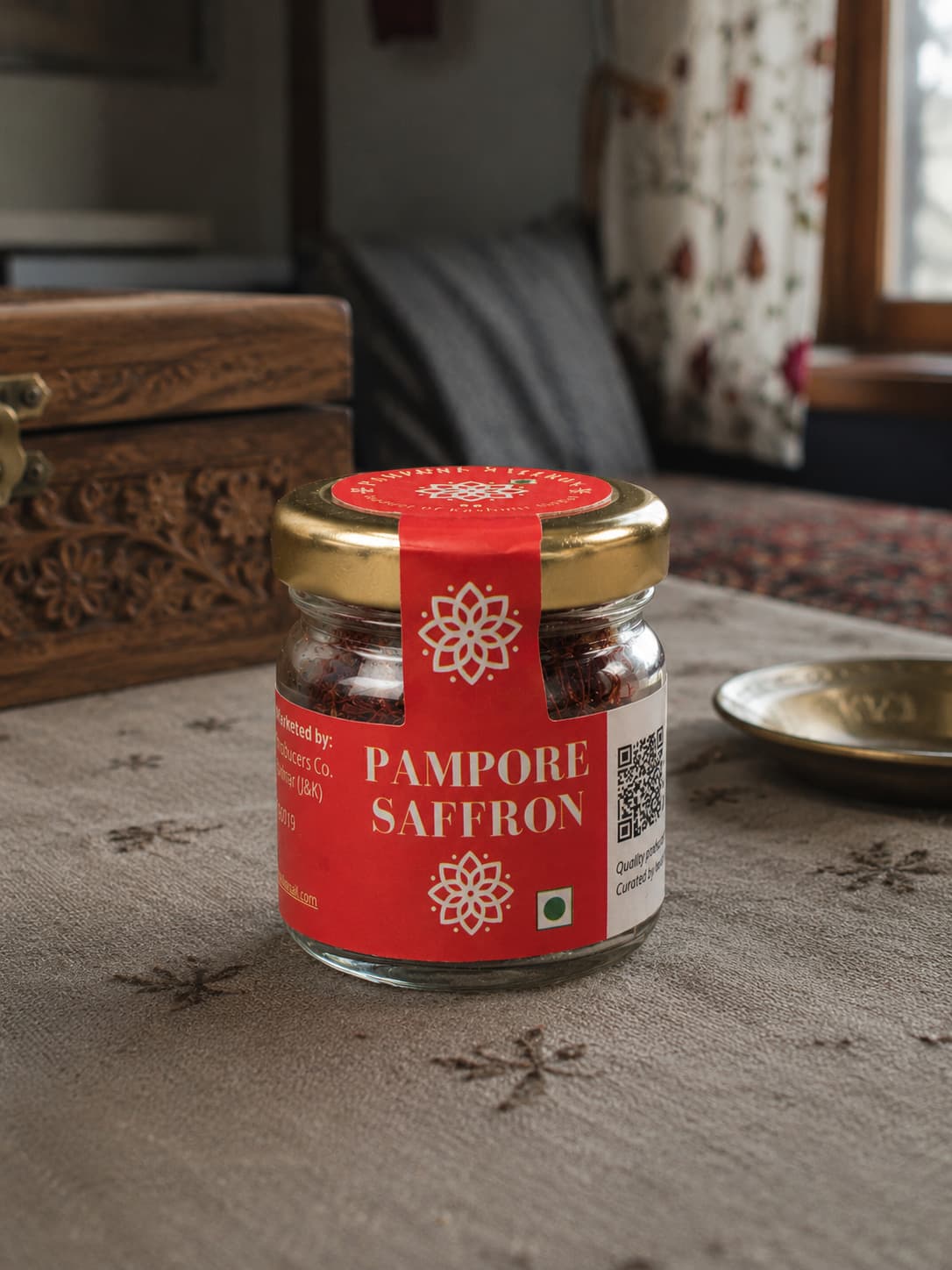
We grow and hand-sort this saffron ourselves in Pampore, seal it there in tamper-evident glass, and ship it prepaid to Odisha. One hop, no repacking, a batch code on the jar.
Also shipping to Odisha: Mixed dry fruits from the valley.
Pampore Saffron FPO, J&K · FSSAI 11022470000019