Heritage Kashmir · South India
Kashmiri Saffron in Telangana
- కుంకుమ పువ్వుkumkuma puvvu · Telugu
- زعفرانzafran · Urdu/Deccani
The short answer
Hyderabad is India's most saffron-serious food city outside Lucknow, and it uses the Deccani Urdu word zafran as readily as the Telugu kumkuma puvvu. Hyderabadi dum biryani, double ka meetha and qubani ka meetha all depend on it, and the Ramzan haleem season and the wedding calendar make the city a genuine volume market. Real Kashmiri Mongra is ₹330–360 a gram direct from a Pampore grower family; Begum Bazaar wholesale runs ₹250–450 for mostly Iranian stock, and Charminar and Laad Bazaar retail runs ₹500–900. Begum Bazaar is one of South India's largest spice wholesale markets, which makes Hyderabad both the best-supplied and most confidently mislabelled saffron market in the region.
Begum Bazaar, Laad Bazaar, and the confidence of a real spice city
Begum Bazaar is where most of South India's non-Chennai spice wholesale happens, and it moves saffron in real quantity. The stock is overwhelmingly Iranian, correctly and openly traded as such at wholesale — and then very often described as Kashmiri once it reaches a retail counter a kilometre away. This is not a Hyderabad-specific vice; it is what happens everywhere Iranian import stock meets a market that will pay more for the word Kashmir.
What is Hyderabad-specific is the level of expertise on the buying side. The city's biryani houses, its wedding caterers and its older Hyderabadi households genuinely know what saffron should smell like, because their cooking depends on it in a way that most Indian cooking does not. A shop in Laad Bazaar selling to a bride's family buying for a wedding is dealing with a knowledgeable customer; a shop selling a small packet to a Charminar tourist is not, and the prices reflect that difference more than the quality does.
For volume buyers — caterers, biryani houses, halwais working the Ramzan and wedding seasons — Hyderabad is one of the Indian markets where buying at origin makes the most obvious difference, because the quantities are large enough that the gap between ₹350 and ₹700 a gram becomes a real number.
- Begum Bazaar wholesale is mostly Iranian stock, honestly traded at wholesale and relabelled downstream.
- Laad Bazaar and Charminar retail carries a tourist premium over the same material.
- Hyderabad's caterers and biryani houses are among India's most knowledgeable saffron buyers.
- At catering volumes, origin pricing versus bazaar pricing is a line item, not a rounding error.
The Deccani saffron kitchen
Hyderabadi dum biryani is the dish, and the method is exact. Saffron steeped in warm milk — never fried in ghee, never boiled — is drizzled over the top layer of rice along with the fried onion and the mint just before the pot is sealed with dough for dum. The steam carries the aroma down through the rice. Get this wrong by tipping dry threads into hot ghee at the start and the whole point is lost; the biryani will be orange and will smell of nothing in particular.
Double ka meetha — toasted bread soaked in saffron-infused condensed milk and finished with ghee-roasted nuts — is the Deccani dessert where saffron is most prominent. Qubani ka meetha, the dried-apricot compote served with malai at weddings, takes it more lightly. Sheer khurma at Eid and the whole range of Hyderabadi milk sweets carry it.
The Ramzan season is the city's saffron peak. Haleem itself is not a saffron dish, but the iftar sweets, the sheer khurma and the wedding season that follows Eid all are. Bonalu, Bathukamma and the Telugu festival calendar bring the Telangana Hindu household traditions — payasam, paramannam and festival sweets — into the same demand curve.
- Hyderabadi dum biryani — saffron steeped in warm milk, poured over the top layer before the pot is sealed.
- Double ka meetha — the Deccani dish where saffron shows most clearly.
- Qubani ka meetha, sheer khurma and the Eid and wedding sweet calendar.
- Bonalu, Bathukamma and Telugu household payasam and paramannam.
Delivery to Telangana
Hyderabad and Secunderabad typically arrive 6–9 business days after dispatch; Warangal, Nizamabad, Karimnagar, Khammam and the district towns usually 7–10. We dispatch from Pampore within 24–48 hours of a confirmed prepaid order, tamper-sealed and batch-coded, with DTDC tracking emailed on despatch.
We deliver across
- Hyderabad
- Secunderabad
- Warangal
- Nizamabad
- Karimnagar
- Khammam
- Ramagundam
Every serviceable PIN code in Telangana — not only the cities listed. DTDC Express is ?60 for 7-day delivery, and DTDC Airmax is ?120 for faster air delivery.
Saffron in Telangana — common questions
- What is the price of saffron in Hyderabad?
- Begum Bazaar wholesale runs ₹250–450 a gram for mostly Iranian stock; Charminar, Laad Bazaar and general retail run ₹500–900 for the same material described as Kashmiri. Genuine ISO 3632 Grade I Kashmiri Mongra is ₹330–360 a gram direct from a Pampore grower family, sealed and batch-coded with the harvest year. If a Hyderabad shop quotes you Kashmiri Mongra at ₹250, one of those two words is doing work it cannot support.
- How much saffron goes into Hyderabadi biryani for 1 kg of rice?
- About 20 threads, roughly 0.2 grams, for 1 kg of raw rice. Crush them, steep in three tablespoons of warm milk for fifteen minutes until the milk is a deep gold, and drizzle that over the top layer of rice with the fried onion and mint just before you seal the pot for dum. Never fry the threads in hot ghee with the whole spices — they scorch in seconds, turn bitter, and the aroma leaves with the steam.
- Is Begum Bazaar saffron genuine?
- Usually genuine saffron and usually Iranian. Begum Bazaar is one of South India's largest spice wholesale markets and it moves real Crocus sativus in volume, correctly traded as import stock at the wholesale level. What happens downstream is that the same material picks up a Kashmiri description at retail. Iranian saffron is not fake and is often very good — it is a different origin at a lower price. The only problem is being charged a Kashmiri price for it.
- How much saffron for double ka meetha?
- About 15 threads, roughly 0.15 grams, for a dish serving six to eight. Crush them and steep in three tablespoons of warm milk for fifteen minutes, then stir that into the condensed-milk and rabri mixture you pour over the fried bread. Double ka meetha is the Deccani dessert where saffron is most exposed — there is very little competing aroma — so this is the dish that will tell you honestly whether the saffron you bought is any good.
- Do you supply saffron in bulk to Hyderabad caterers and biryani houses?
- Yes. Wedding, Ramzan-season and catering volumes are quoted separately from retail — message the WhatsApp order line with the quantity and the date and we will price it from the current Pampore harvest. Hyderabad is one of the markets where this matters most: at the quantities a busy biryani kitchen or a wedding caterer uses, the gap between origin pricing and bazaar retail runs into real money across a season.
- Zafran aur kesar mein farq kya hai?
- Koi farq nahin — ek hi cheez hai. 'Zafran' Farsi aur Arabi se aaya hai aur Deccani Urdu mein chalta hai; 'kesar' Sanskrit se aaya hai; Telugu mein 'kumkuma puvvu'. Teenon ka matlab Crocus sativus phool ke sookhe laal reshe. Sawaal naam ka nahin, grade ka hai: ISO 3632 Category I, poora laal Mongra, aur origin jiska koi naam le sake.
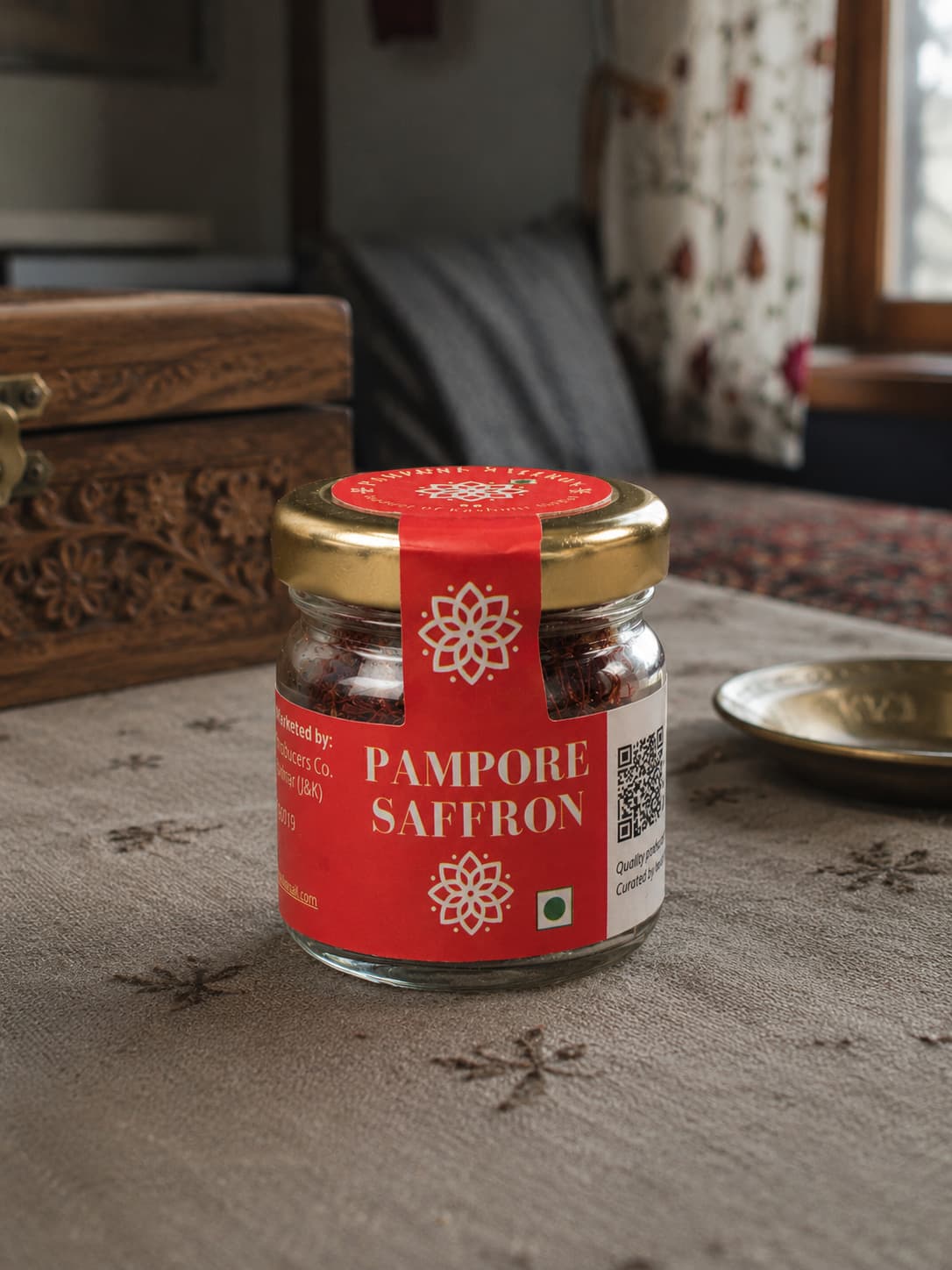
We grow and hand-sort this saffron ourselves in Pampore, seal it there in tamper-evident glass, and ship it prepaid to Telangana. One hop, no repacking, a batch code on the jar.
Also shipping to Telangana: Saffron-infused wild honey.
Pampore Saffron FPO, J&K · FSSAI 11022470000019
Also in South India