Heritage Kashmir · West India
Kashmiri Saffron in Rajasthan
- केसरkesar · Hindi/Marwari
The short answer
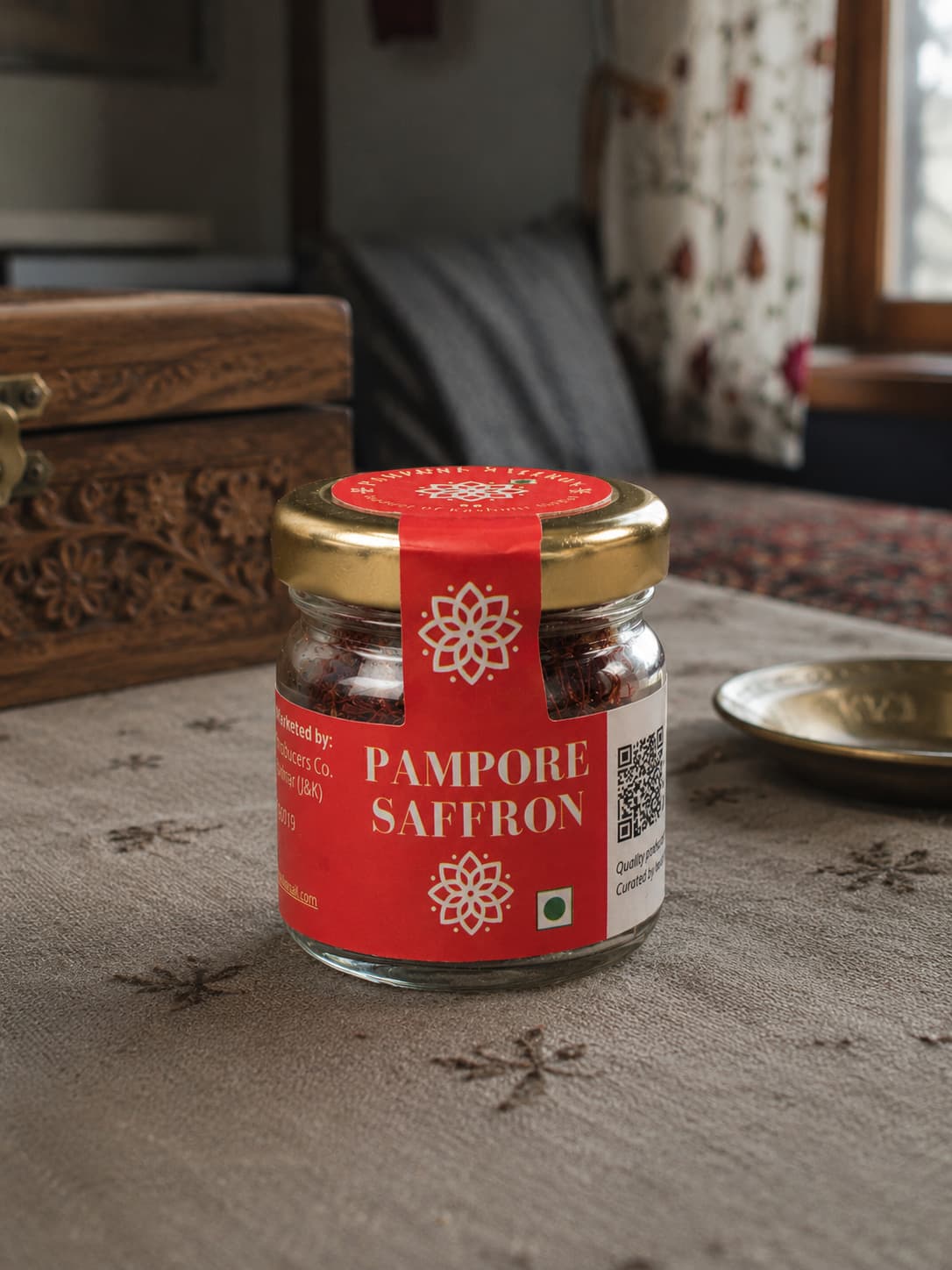
Rajasthan uses more saffron per festival than almost any state and buys most of it through Jaipur's Johari Bazaar and Chandpole trade at ₹500–850 a gram, against ₹330–360 direct from a Pampore grower. The word runs deeper here than the spice — kesariya is the colour of Rajput sacrifice, of the folk song 'Kesariya Balam', and of the saffron turban, and that association makes 'kesar' sell in Rajasthan on sentiment as much as on quality. Practically, the state's demand peaks around Teej ghevar, Diwali, and the wedding season, and the two dishes to get right are ghevar and malpua, both of which want steeped saffron rather than saffron cooked into hot syrup.
Johari Bazaar, Ajmer Sharif, and the tourist premium
Jaipur's Johari Bazaar, Chandpole and the Tripolia trade sell saffron alongside gemstones and textiles, largely to a mix of local halwais and visitors. That mix produces a wide price spread in one street: a halwai buying 50 grams pays one rate, a tourist buying 2 grams in a decorated box pays three times it for the same tin. Jodhpur's Sardar Market and Udaipur's Bapu Bazaar behave the same way.
Ajmer adds a distinct trade. The Dargah Sharif economy sells saffron for the chadar offerings and for tabarruk, and the shops in the Dargah Bazaar sell small quantities at high prices to pilgrims. As with Haridwar and Varanasi, a substantial share of what is sold as kesar in a shrine market is safflower or dyed thread.
Rajasthan's halwai trade is the volume buyer that actually matters. A Jaipur mithai shop running ghevar through the Teej and Rakhi season, or a Bikaner sweet house at Diwali, buys saffron in tens of grams — and at that scale the difference between origin pricing and bazaar pricing is a real line in the accounts, not a rounding error.
- One street, three prices: halwai rate, local rate, tourist rate — for the same tin.
- Dargah and shrine-market kesar is frequently safflower. Test it in water before you trust it.
- Halwai and wedding volumes should be quoted at origin, not at bazaar retail.
- Kesariya as a colour and kesar as a spice are two different things — a lot of 'kesariya' sweets contain no saffron at all.
Kesar in Rajasthani sweets and ritual
Ghevar is the state's signature and its trickiest saffron dish. The disc is deep-fried to a honeycomb and then soaked in sugar syrup — and the mistake almost everyone makes is boiling the saffron into the syrup, where the heat destroys the aroma. Steep the crushed threads in a little warm milk or warm water, and drizzle that over the ghevar with the rabri and the nuts at the end. Kesar ghevar made that way smells of saffron; kesar ghevar made the usual way is just orange.
Malpua takes the same treatment, and in the Pushkar and Nathdwara traditions malpua is a temple offering as much as a sweet. Kesariya bati, kesar peda, and the ghee-heavy Marwari mithai run through Diwali and the wedding season. Bikaner's sweet trade uses saffron across its rasgulla and rabri lines.
Ritually, saffron in Rajasthan reaches beyond food. Kesar tilak at Rajput ceremonies, saffron in the chadar at Ajmer Sharif, kesar in the shringar at Nathdwara's Shrinathji temple — the Pushtimarg tradition again — and the kesariya turban and flag as an emblem that predates the spice trade entirely.
- Ghevar and malpua — steep the saffron separately, drizzle at the end, never boil it into syrup.
- Kesariya bati, kesar peda and the Marwari Diwali mithai run.
- Nathdwara Shrinathji shringar and bhog; Ajmer Sharif chadar offerings.
- Kesar tilak at weddings and Rajput ceremonial use.
Delivery to Rajasthan
Jaipur, Alwar, Ajmer and Kota typically arrive 4–7 business days after dispatch; Jodhpur, Udaipur, Bikaner, Bhilwara and the desert districts usually 5–9, with Jaisalmer and Barmer at the longer end. We dispatch from Pampore within 24–48 hours of a confirmed prepaid order, sealed and batch-coded, with DTDC tracking emailed on despatch.
We deliver across
- Jaipur
- Jodhpur
- Udaipur
- Kota
- Ajmer
- Bikaner
- Alwar
- Bhilwara
Every serviceable PIN code in Rajasthan — not only the cities listed. DTDC Express is ?60 for 7-day delivery, and DTDC Airmax is ?120 for faster air delivery.
Saffron in Rajasthan — common questions
- What is the price of kesar in Jaipur?
- Johari Bazaar and Chandpole shops price Kashmiri-labelled Grade 1 at roughly ₹500–850 a gram, and tourist-facing shops higher again. Direct from a Pampore grower family, ISO 3632 Grade I Mongra is ₹330–360 a gram, sealed and batch-coded, delivered to Jaipur in about 4–7 business days after dispatch. Below ₹300 a gram anywhere in Rajasthan you are being sold Iranian repack, Lachha weight, or dye.
- How much saffron goes into ghevar, and when do I add it?
- For a batch of six to eight ghevars, 15–20 threads is right — but the timing matters more than the amount. Crush the threads and steep them in three tablespoons of warm milk or warm water for fifteen minutes, then drizzle that infusion over the soaked ghevar along with the rabri and the nuts, at the very end. Boiling saffron into the sugar syrup, which is the common shortcut, drives off the safranal and leaves you with colour and no aroma. That single change is the difference between kesar ghevar and orange ghevar.
- Is the kesar sold at Ajmer Dargah bazaar genuine?
- Much of it is safflower or dyed thread rather than Crocus sativus. Shrine markets everywhere in India — Ajmer, Haridwar, Varanasi, Shirdi — sell small packets at saffron prices to pilgrims who are buying quickly and will not return. Safflower is a legitimate traditional material with its own name; the problem is the pricing. Test what you buy: three threads in warm water, and real saffron gives slow, deepening gold over ten minutes with the thread staying whole and red.
- Does 'kesariya' always mean saffron is in the dish?
- No, and in Rajasthan especially it usually does not. Kesariya is a colour word — the saffron-orange of the turban, the flag and the folk song — and a great many sweets described as kesariya get that colour from food colouring, turmeric, or simply from ghee and browning. If you want to know whether a mithai actually contains saffron, look for threads in the finished sweet and smell it: real saffron has a distinct honeyed, hay-like aroma that no colour can imitate.
- Do you supply saffron in bulk to Rajasthani halwais and wedding caterers?
- Yes. Ghevar season, Diwali and the Rajasthani wedding calendar are exactly the volumes where buying at origin makes an accounting difference rather than a marginal one — at 50 or 100 grams, ₹350 against ₹750 a gram is the whole saffron line doubled. Message the WhatsApp order line with the quantity and the date and we will quote from the current Pampore harvest.
- How do I store saffron in Rajasthan's heat?
- Airtight, dark, and away from the kitchen heat — but do not refrigerate. Rajasthan's dry heat is actually less damaging to saffron than coastal humidity, because the real enemy is moisture; what dry heat and light do is degrade crocin and safranal over time. Keep the jar tightly closed in a dark cupboard, well away from the stove and out of direct sun, and it will hold its colour and aroma for two to three years. A jar left open on a summer windowsill in Jodhpur will be noticeably weaker within a month.
We grow and hand-sort this saffron ourselves in Pampore, seal it there in tamper-evident glass, and ship it prepaid to Rajasthan. One hop, no repacking, a batch code on the jar.
Also shipping to Rajasthan: Saffron-infused wild honey.
Pampore Saffron FPO, J&K · FSSAI 11022470000019
Also in West India