Heritage Kashmir · West India
Kashmiri Saffron in Maharashtra
- केशरkeshar · Marathi
The short answer
Maharashtra calls saffron केशर (keshar) and is, after Delhi, the largest single point of entry for saffron into India — Mumbai's importers and repackers supply half the country. That is why Maharashtra buyers face an unusual version of the problem: the state has excellent access to real saffron and is simultaneously where most of India's relabelling happens. Genuine ISO 3632 Grade I Kashmiri Mongra is ₹330–360 a gram direct from a Pampore grower; Mumbai and Pune retail runs ₹500–900, and the Crawford Market and Dadar loose trade runs ₹200–400 for material that is usually Iranian or Lachha. The state's saffron habit is real and daily — shrikhand, basundi, masala doodh and the Ganeshotsav modak season all depend on it.
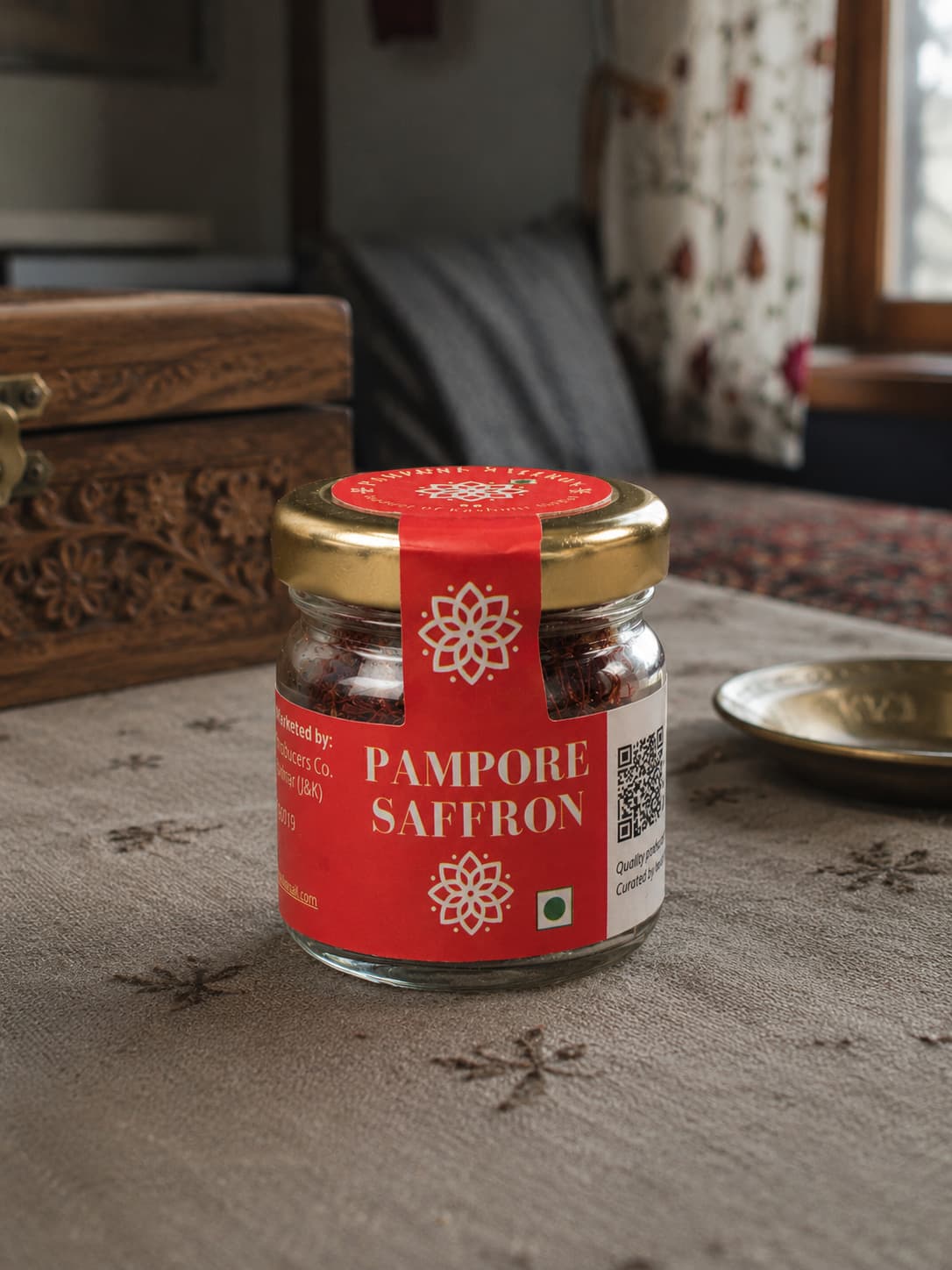
Mumbai is where saffron enters India — and where it changes its name
Mumbai's port and its Masjid Bunder and Crawford Market spice trade handle the bulk of India's imported saffron, almost all of it Iranian. Iranian saffron is real saffron and much of it is excellent. The issue is what happens next: it gets repacked in Mumbai, gets a label with a picture of a Kashmiri meadow on it, and goes out to the rest of the country as 'Kashmiri'. This is the single largest source of mislabelled saffron in India, and it happens two suburbs from where most Mumbai buyers shop.
That gives Maharashtra buyers one practical advantage and one trap. The advantage: Mumbai has genuine access to good saffron at close to import price, if you know a trader and buy volume. The trap: at retail, the Mumbai premium and the Kashmiri label are both applied to the same Iranian stock, so you pay a Kashmir price for an Iran product.
Pune's Tulshibaug and Laxmi Road provision shops and Nagpur's Itwari market run on Mumbai supply with an added margin. Nashik and Kolhapur are thinner. Across the state the same rule applies: sealed with a stated origin, a grade and a harvest year, or you are guessing.
- Most saffron entering India comes through Mumbai, and most of it is Iranian.
- Iranian saffron is not fake — it is a different origin at a different price. The fraud is the Kashmir label on it.
- Crawford Market loose saffron at ₹200–400/g is import stock, not Kashmiri Grade 1.
- Kashmiri Mongra threads are short, thick and all dark red with a flared tip; Iranian threads run longer and thinner.
Keshar in the Maharashtrian kitchen
Shrikhand is the anchor. Hung curd, sugar, cardamom and saffron, beaten smooth and chilled — and in the mango months, amrakhand. A good Maharashtrian shrikhand carries visible saffron threads and a real saffron aroma; the bright yellow shop version is usually colour. This is the dish where Maharashtra buyers can taste the difference between grades most clearly, because there is nothing else in the bowl to hide behind.
Basundi and its thicker cousin rabdi take saffron in the last few minutes off the heat. Puran poli is finished with saffron in some households. Masala doodh — hot milk with almonds, pistachio, cardamom and saffron — is the Maharashtrian winter and festival drink, and Mumbai's old milk bars have sold it by the glass for generations.
Ganesh Chaturthi is the state's biggest saffron week. Modak filled with coconut and jaggery are the offering, and the ukadiche modak steamed for the naivedya frequently carry saffron in the outer covering or in the accompanying kheer. Gudi Padwa, Diwali faral and the wedding season carry the rest of the year's demand.
- Shrikhand and amrakhand — saffron steeped in a spoon of warm milk, folded into the hung curd.
- Basundi and rabdi — added in the last five minutes, off the boil.
- Masala doodh — 3–4 threads a glass with almond, pistachio and cardamom.
- Ganesh Chaturthi modak and naivedya kheer; Gudi Padwa and Diwali faral.
Delivery to Maharashtra
Mumbai, Thane, Navi Mumbai and Pune typically arrive 4–7 business days after dispatch; Nashik, Nagpur, Chhatrapati Sambhajinagar, Kolhapur and Solapur usually 5–8. We dispatch from Pampore within 24–48 hours of a confirmed prepaid order, tamper-sealed and batch-coded, with DTDC tracking emailed on despatch.
We deliver across
- Mumbai
- Pune
- Nagpur
- Nashik
- Thane
- Chhatrapati Sambhajinagar
- Kolhapur
- Solapur
Every serviceable PIN code in Maharashtra — not only the cities listed. DTDC Express is ?60 for 7-day delivery, and DTDC Airmax is ?120 for faster air delivery.
Saffron in Maharashtra — common questions
- केशरची किंमत काय आहे? What is the price of keshar in Mumbai?
- Genuine ISO 3632 Grade I Kashmiri Mongra is ₹330–360 per gram direct from a Pampore grower family. Mumbai and Pune retail for the same grade runs ₹500–900 per gram, and the loose saffron in Crawford Market and Dadar at ₹200–400 is Iranian import stock or Lachha grade, not Kashmiri Mongra. About 160 hand-picked flowers make one gram — that arithmetic sets the floor no matter what a shop quotes.
- Is the saffron sold in Crawford Market real?
- It is usually real saffron and usually not Kashmiri. Mumbai is India's main import gateway for Iranian saffron, and the Crawford Market and Masjid Bunder trade moves that stock in volume — genuine Crocus sativus, correctly priced for what it is, and then very often relabelled as Kashmiri further down the chain. If a Mumbai shop is selling loose saffron at ₹250 a gram and calling it Kashmiri, both halves of that cannot be true.
- How much saffron goes into shrikhand for 500 g of hung curd?
- About 15–20 threads, roughly 0.15 g. Crush them, steep in two tablespoons of warm milk for fifteen minutes until the milk is deep gold, then beat that into the hung curd along with the sugar and cardamom. Do not sprinkle dry threads in and hope — they will not release into cold curd, and you will end up with red specks and no aroma. Shrikhand is the dish where good saffron shows most, because there is nothing else in it.
- How much keshar for Ganesh Chaturthi modak and naivedya?
- For a batch of 21 ukadiche modak, 8–10 threads steeped in a tablespoon of warm milk, worked into the rice-flour covering or into the accompanying kheer, is plenty. Saffron is used as a mark of respect in naivedya rather than for bulk flavour, so the traditional quantity is deliberately small. One gram will cover an entire Ganeshotsav household with plenty left over.
- Do you deliver saffron to Pune and Nagpur?
- Yes, to every serviceable PIN code in Maharashtra. Pune, Mumbai, Thane and Navi Mumbai typically arrive 4–7 business days after dispatch; Nagpur, Nashik, Chhatrapati Sambhajinagar, Kolhapur and Solapur usually 5–8. We dispatch within 24–48 hours of a confirmed prepaid order and email you the DTDC tracking number when it leaves Pampore.
- How do I store saffron in Mumbai's humidity?
- This matters more in Mumbai than almost anywhere in India. Saffron is hygroscopic — in Mumbai's monsoon it will pull water out of the air, clump, and lose aroma within months if it is stored loosely. Keep it in an airtight glass jar with the lid properly closed, in a dark cupboard away from the stove, and never in the fridge, where the temperature swing every time you open it drives condensation straight into the threads. Take out what you need fast and close it. Kept dry and dark, good saffron holds two to three years even on the coast.
We grow and hand-sort this saffron ourselves in Pampore, seal it there in tamper-evident glass, and ship it prepaid to Maharashtra. One hop, no repacking, a batch code on the jar.
Also shipping to Maharashtra: Saffron-infused wild honey.
Pampore Saffron FPO, J&K · FSSAI 11022470000019
Also in West India