No study has compared shilajit resin with capsules, tablets, powder or gummies, so no form can honestly be called stronger or better absorbed. What differs is what you are paying for: how many milligrams of shilajit the label states, what else is in the pack, whether there is a lab report for the batch with heavy-metal figures, and the price per gram of the shilajit itself. We sell one form, purified resin in a 20 g jar, so read this knowing that. The figures for other products below are taken from their own pharmacy listings, each one linked, and the arithmetic is shown so you can check it.
The short answer
- Resin is shilajit sold by weight. You portion it yourself (a pea-sized piece, about 300–500 mg), so the dose is approximate. In our check it was the cheapest form per gram of shilajit.
- Capsules and tablets give a measured dose, but in India most are blends with other herbs. Some listings state the milligrams of shilajit per unit; some do not.
- Gummies are the easiest to take. Shilajit is a small part of each one: 300 mg in 8 g of gummies on one listing.
- Powder and liquid measure easily; look for the milligrams of shilajit per serving, not just the pack weight.
- Every form starts as the same rock-formed resin, so every form needs the same thing: a lab report for your batch, with figures for lead, arsenic, mercury and cadmium.
What each form actually is
Resin
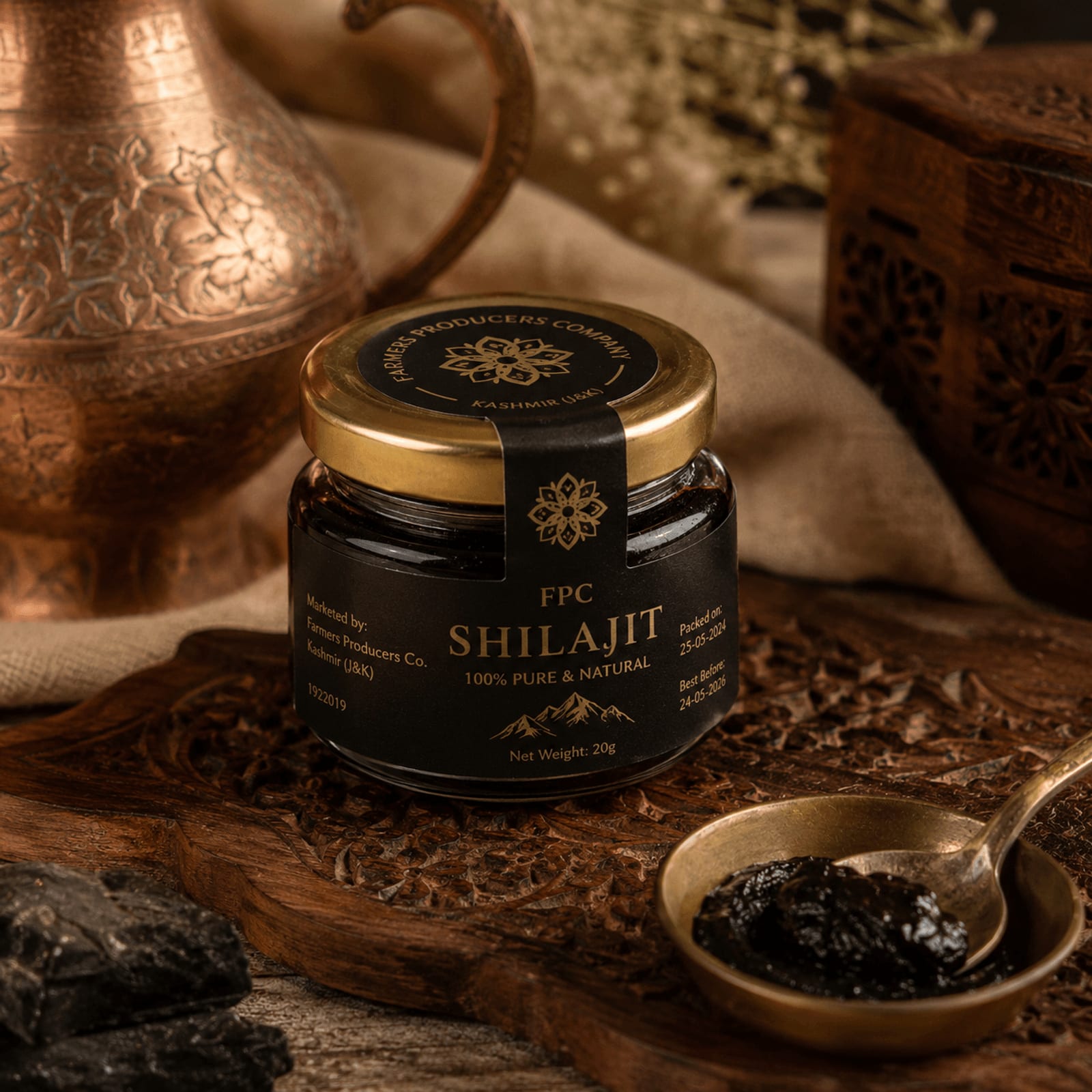
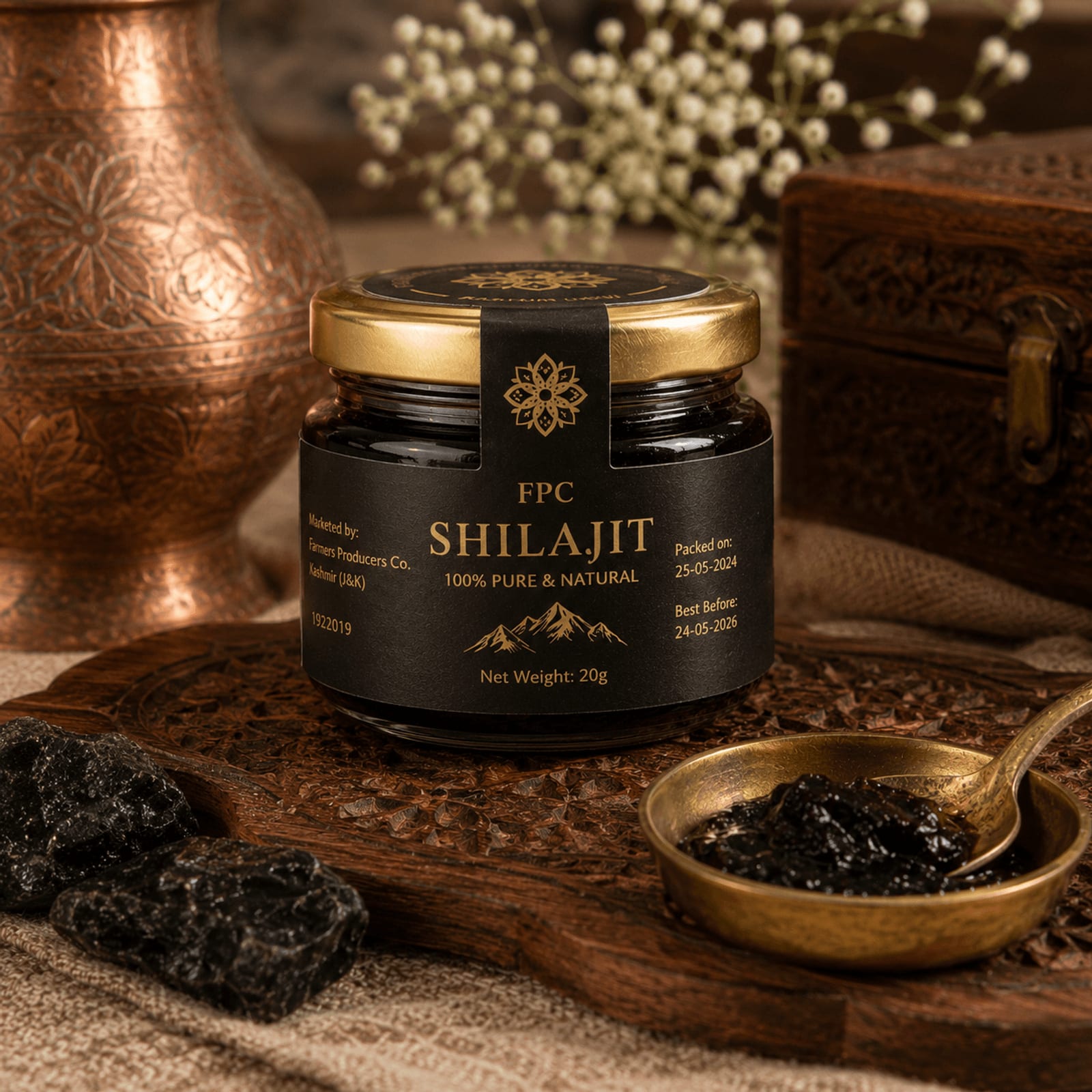
Resin is shilajit itself, purified and sold by weight as a thick, sticky paste. It softens in warmth, firms up in the cold and tastes bitter. You portion it yourself, usually a pea-sized piece of about 300–500 mg dissolved in warm water or milk, and a portion judged by eye is an estimate. If you want to know what yours weighs, a kitchen scale that reads to 0.01 g will tell you.
Capsules
A capsule holds a measured amount inside a shell: sometimes shilajit extract alone, and in India more often shilajit blended with herbs such as ashwagandha, gokshura or safed musli. The dose is the same every time, which is the point of a capsule. The figure to find is the milligrams of shilajit per capsule. The capsule’s total weight tells you nothing about how much of it is shilajit.
Tablets and rasayan vati
A tablet is powder pressed into shape with binders, which appear on the label as excipients. The common shilajit tablet in India is the rasayan vati: vati is the Ayurvedic word for a tablet, and rasayana the name for a class of rejuvenating preparations. A rasayan vati combines shilajit with several other herbs; Patanjali’s lists five. Two of the tablet and capsule listings we read name shilajit without a figure we could rely on.
Powder and liquid
Powder is shilajit that has been dried and ground, sold loose or used to fill capsules and tablets. Liquid shilajit is shilajit dissolved in a liquid and sold as drops or a shot. Both measure easily with a scoop or a dropper. For either, look for the milligrams of shilajit per serving and read what else is listed: the weight of the powder, or the volume of the liquid, is not the shilajit content.
Gummies
A gummy is a chewable sweet with shilajit in it. The two Indian gummy listings we checked do state their shilajit: 225 mg in one Kapiva gummy, and 300 mg in a two-gummy serving of Man Matters. Both say “no added sugar”, and the Man Matters listing gives its base as chicory-root inulin, pectin, maize starch and guar gum. Shilajit is still a small part of what you chew: 300 mg in 8 g of gummies is under 4%. Check the serving size (it may be two gummies) and the sugar per serving on the nutrition panel.
Resin, capsule, tablet, powder, gummy: side by side
| Form | Shilajit stated in mg? | What else is usually in it | Dose | Good for | Watch for |
|---|---|---|---|---|---|
| Resin | Sold by weight: the net weight is the shilajit, if nothing else is listed | Nothing, if the label lists only shilajit | You portion it: a pea-sized piece, about 300–500 mg | Lowest price per gram of shilajit in our check; a short ingredient list | An approximate dose; bitter taste; sticky to handle |
| Capsule | Usually per capsule; check | Often other herbs; the capsule shell; excipients | Fixed per capsule | A measured dose; no taste | Blends where shilajit is one of many ingredients; the figure may be for an extract, not resin |
| Tablet / rasayan vati | Not always stated on the listing | Several herbs; binders | Fixed per tablet | Convenience; a traditional formula | No milligrams of shilajit on the pack |
| Powder | Per scoop or serving, if stated | Varies; read the list | Measured with a scoop | Mixing into a drink | A pack weight with no shilajit figure per serving |
| Gummy | Per gummy or per serving on the two we checked | A chewable base (fibre, pectin and starch on the two we checked), herbs, flavouring | Fixed per gummy | The easiest to take | Shilajit is a few per cent of the gummy; serving may be two gummies; sugar per serving |
What seven real listings say
We read these product listings on 12 October 2026, our own included. Each figure is what the listing states; we have not tested any of these products. Where two listings for the same product disagreed, or a listing gave no figure, we have printed no number.
| Product (listing read) | Form | Shilajit per unit, as listed | What else is listed | Pack and price | Shilajit per pack | Price per gram of shilajit |
|---|---|---|---|---|---|---|
| Ours: Himalayan Shilajit Resin (our shop) | Resin | Sold by weight; a pea-sized piece is about 300–500 mg | Sold as purified Himalayan shilajit resin | ₹599 for a 20 g jar | 20 g | ₹30 |
| Kapiva Himalayan Shilajit Resin (PharmEasy) | Resin | Sold by weight; the listing suggests 250 mg once a day | The listing names shilajit as the main ingredient and lists no others | ₹1,004 for 20 g (MRP ₹1,499) | 20 g | ₹50 (₹75 at MRP) |
| Kapiva Shilajit Energy Capsule (Tata 1mg) | Capsule | 170 mg shudh shilajit extract per capsule | Ashwagandha 80 mg, vidarikand 80 mg, gokshura 40 mg; processed in triphala, erand mool and aloe; vitamin and mineral premix; potassium sorbate | ₹280 for 20 capsules | 3.4 g | ₹82 |
| Kapiva Shilajit Energy Gummies (ginger honey) (Netmeds) | Gummy | 225 mg shilajit per gummy | Full ingredient list not given on the listing; it says “no added sugar” and gelatin-free | ₹549 for 30 gummies (MRP) | 6.75 g | ₹81 |
| Man Matters Shilajit Gummies (tamarind) (Tata 1mg) | Gummy | 300 mg shilajit resin per serving of 2 gummies (4 g each) | KSM-66 ashwagandha 40 mg, ginger 10 mg, black musli, gokshura and kaunch 6 mg each, akarkara 4 mg; base of chicory-root inulin, pectin, citric acid, tamarind flavour, maize starch, guar gum; says “no added sugar” | ₹549 for 30 gummies | 4.5 g | ₹122 |
| Dabur Shilajit Gold (Tata 1mg, Truemeds, Apollo) | Capsule | Not printed here: two pharmacy listings give different figures | More than 15 listed ingredients, including ashwagandha, safed musli, kesar, gokshura, kaunch and about 1 mg swarna (gold) bhasma per capsule | ₹560 for 20 capsules (MRP) | — | Can’t be worked out |
| Patanjali Divya Shilajeet Rasayan Vati (PharmEasy, Netmeds) | Tablet | Not stated on either listing | Aqueous extract of shuddha shilajeet, with ashwagandha, bhumi amla, harad, baheda and amla | MRP ₹35 (PharmEasy) or ₹40.50 (Netmeds) for 60 tablets | — | Can’t be worked out |
How the last column is worked out: the listed price divided by the grams of shilajit the pack states. For the Kapiva capsules, 20 capsules × 170 mg = 3.4 g of shilajit, and ₹280 ÷ 3.4 = about ₹82 a gram. For the Man Matters gummies, 15 servings × 300 mg = 4.5 g, and ₹549 ÷ 4.5 = about ₹122 a gram. Ours: ₹599 ÷ 20 g = about ₹30 a gram, or roughly ₹9–15 a day at 300–500 mg.
Read that column as a rough guide, not a verdict, for three reasons. Prices on pharmacy sites change daily and discounts come and go. A milligram of resin and a milligram of a dried extract are made differently, so they are not like for like. And in a blend you are also paying for the other herbs, which you may want. The Dabur and Patanjali shilajit figures may well be printed on the pack itself; if you have one in your hand, the pack is the authority, not a pharmacy listing.
Which form did the studies use?
The controlled human trials we cover on our shilajit for men and shilajit for women pages gave 250–500 mg a day of a purified or standardised shilajit extract. The strength trial names its extract, PrimaVie, and gave it as one capsule a day (Keller and colleagues, 2019). No trial used resin from a jar, and none compared one form with another.
Two things follow. If you want what was studied, the closest match is a product that names the same extract and states its milligrams, not a resin, ours included. And because a resin and a standardised extract are made differently, the trial doses do not convert into a portion of resin with any precision. Our resin is not PrimaVie, and we do not claim the trial results for it.
Testing and lab reports: the same question for every form
Shilajit forms in rock and can carry lead, arsenic, mercury and cadmium from it. Putting it into a capsule, a tablet or a gummy does not change that; what changes is how much the label tells you. When researchers bought 193 Ayurvedic medicines online and tested them, about one in five contained detectable lead, mercury or arsenic (Saper and colleagues, JAMA, 2008). That study was not about shilajit alone, but the lesson carries to every form: a label is not a test.
So, whatever the form, ask for a report for your batch, from a named laboratory, with measured figures for those four metals set against the limits they are judged by. Our Himalayan shilajit guide sets out what a real report contains and what the word “purified” does and does not tell you. Our own shilajit is lab-tested for fulvic acid and for lead, arsenic, mercury and cadmium, and the jar you receive comes with its test report. We have not yet published that report on this website; if you want to see it before you order, ask us on WhatsApp at +91 95966 08297.
Shilajit and ashwagandha in one product
Four of the seven listings above (Patanjali’s rasayan vati, Kapiva’s Energy capsule, Dabur Shilajit Gold and the Man Matters gummies) list ashwagandha alongside shilajit. No trial has tested the two together, and none has compared them, so a combination is a formulation choice, not a tested one. If you already take ashwagandha on its own, check whether your shilajit product contains it too.
Ashwagandha has its own cautions. The US National Center for Complementary and Integrative Health says it should be avoided in pregnancy and while breastfeeding, is not recommended for people with thyroid or autoimmune disorders, has been linked to rare cases of liver injury, and may interact with medicines for diabetes, blood pressure and the thyroid, among others. If you take regular medication, ask your doctor before starting either.
How to read a shilajit label: a checklist
- Find the shilajit line and its milligrams per capsule, tablet, gummy or serving. No milligrams, no comparison.
- Read the serving size. “Per serving” may mean two gummies or two capsules; divide accordingly.
- Resin, purified or extract? “Shilajit resin”, “shudh” or “shuddha” (purified) shilajit, and “shilajit extract” are made differently. A named, standardised extract is the most precisely defined; a milligram of one is not a milligram of another.
- Count everything else: herbs, bhasmas, vitamins, and the excipients that hold a capsule, tablet or gummy together. In a blend you pay for those too.
- Check the sugar. On gummies, the nutrition panel gives sugar per serving. Read it whatever the front of the pack says.
- Work out the price per gram of shilajit: the price divided by (milligrams per unit × units in the pack ÷ 1,000).
- Find the batch number, and ask for that batch’s report: a named laboratory, a date, and figures for lead, arsenic, mercury and cadmium. “Lab tested” on its own is not a report.
- Look for the maker’s name and a licence number. Ours is FSSAI licence 11022470000019.
- Discount any promise of a cure. India’s FSSAI advertising and claims regulations of 2018 bar a food or supplement from claiming to prevent, treat or cure a disease. A label that does is promising more than the law allows.
Where our jar stands
Against that list: our Himalayan shilajit resin is purified resin in a sealed 20 g jar at ₹599, about ₹30 a gram. It is lab-tested for fulvic acid and for lead, arsenic, mercury and cadmium, and the report comes with your jar. What it does not give you is a measured dose (you portion it), a way to avoid the bitter taste, or the extract used in the trials. If those matter more to you than price per gram, a capsule that states its milligrams of a named extract may suit you better, and that is a fair choice.
For how to take resin, how long a jar lasts and the home purity tests, see the Himalayan shilajit guide. If you are comparing sellers, the shilajit buying guide puts purity and pricing on one page. Shilajit is a traditional preparation, not a medicine; if you are pregnant, breastfeeding or take regular medication, check with a doctor before using it in any form.