Shilajit has been tested in two small placebo-controlled trials in men. One found higher testosterone in healthy men aged 45–55 after 90 days. The other found that young men kept more of their leg strength after a tiring exercise test, at the higher of two doses, in half of the group. Both used a branded, standardised extract, not the purified resin that we, and most sellers, put in a jar. That is a real but narrow evidence base, and this page sets out exactly what it covers and what it does not. (Standard honesty: we sell shilajit, and we are not doctors. For anything medical, ask yours.)
Shilajit benefits for men: what the research actually shows
These are the controlled human trials of shilajit we could find. Two were in men. All three are small, and all three measured something in a laboratory or on a scan, not how the volunteers felt.
| Trial | Who | Dose | How long | What it found | Limits |
|---|---|---|---|---|---|
| Pandit 2016, Andrologia | Healthy men aged 45–55 | 250 mg twice a day of purified shilajit, or placebo | 90 days | Higher total testosterone, free testosterone and DHEAS than placebo; LH and FSH stayed normal | One trial; healthy men, not men with low testosterone; the published summary gives no headcount; funded by the extract’s maker |
| Keller 2019, J Int Soc Sports Nutr | 63 recreationally active men, average age 21 | 250 mg or 500 mg a day of a standardised extract (PrimaVie), or placebo | 8 weeks | At 500 mg, less loss of leg strength after a tiring exercise test | Seen only in the stronger half of the men; 250 mg did no better than placebo; one exercise test |
| Pingali 2022, Phytomedicine | 60 women aged 45–65, past menopause, with low bone density | 250 mg or 500 mg a day of a standardised extract, or placebo | 48 weeks | Less bone-density loss at the spine and hip than placebo | Women only, so it tells us nothing direct about men; one centre |
The bone-density trial is covered properly on our shilajit for women page. There are older and smaller studies as well, including some with no placebo group. We have left those out: a study without a comparison group cannot tell a real effect from chance or expectation.
Testosterone: a 90-day trial in healthy men aged 45–55
Researchers at a state Ayurvedic medical college in Kolkata gave healthy men aged 45 to 55 either 250 mg of purified shilajit twice a day or a placebo, for 90 days. It was randomised and double-blind: neither the men nor the researchers knew who was taking which. At the end, the shilajit group had significantly higher total testosterone, free testosterone and DHEAS (a hormone made mainly by the adrenal glands) than the placebo group. LH and FSH, the pituitary hormones that control the testes, stayed within normal levels.
What it does not tell you: whether the rise was large enough to matter to how anyone felt; whether the same happens in men with diagnosed low testosterone; whether it lasts beyond 90 days; or whether any other shilajit does the same. The study was funded by the company that makes the extract. That is normal in supplement research, and a good reason to want independent repeats. Low testosterone is diagnosed with a blood test and treated by a doctor; shilajit is not a substitute for either.
Strength and tiring exercise: an 8-week trial in 63 young men
At the University of Nebraska, 63 recreationally active men with an average age of 21 took 250 mg or 500 mg a day of a standardised extract, or a placebo, for eight weeks. Before and after, they did two sets of 50 all-out leg extensions, and their leg strength was measured before and after that tiring work.
The result the authors highlight came from the stronger half of the men. On 500 mg a day, they lost about 9% of their strength after the exercise, against about 16% on placebo and 17% on 250 mg. The lower dose did no better than placebo. So: one exercise test, one dose, half the group. It is a reason for more research, not a reason to expect a training effect, and nothing in it suggests shilajit builds muscle.
What these studies did not test
- Men with low testosterone, or with any illness. Both trials in men recruited healthy volunteers.
- Sexual function or fertility. Neither trial measured them, and we do not sell shilajit for either. If that is your concern, a doctor can look for the cause; a supplement cannot.
- Long-term use. The longest trial in men ran for 90 days.
- Resin from a jar. Both used an extract made to a fixed specification (more on that below).
- Combinations. No trial has tested shilajit with ashwagandha or any other herb.
Indian law draws the same line. The Drugs and Magic Remedies (Objectionable Advertisements) Act, 1954 bars advertising a remedy for sexual capacity or for any disease on its schedule, and the FSSAI’s 2018 advertising and claims regulations bar any food or supplement from claiming to prevent, treat or cure a disease. A seller promising more than the trials above is promising more than the evidence, and more than the law allows.
Why our jar is not the trial product
The trials did not use resin scooped from a jar. The strength trial names its extract, PrimaVie, made by the supplement company Natreon. The testosterone trial describes purified shilajit, and Natreon funded it. The bone-density trial used a standardised water-based extract. A standardised extract is made to a fixed specification, so each dose carries a consistent, measured amount.
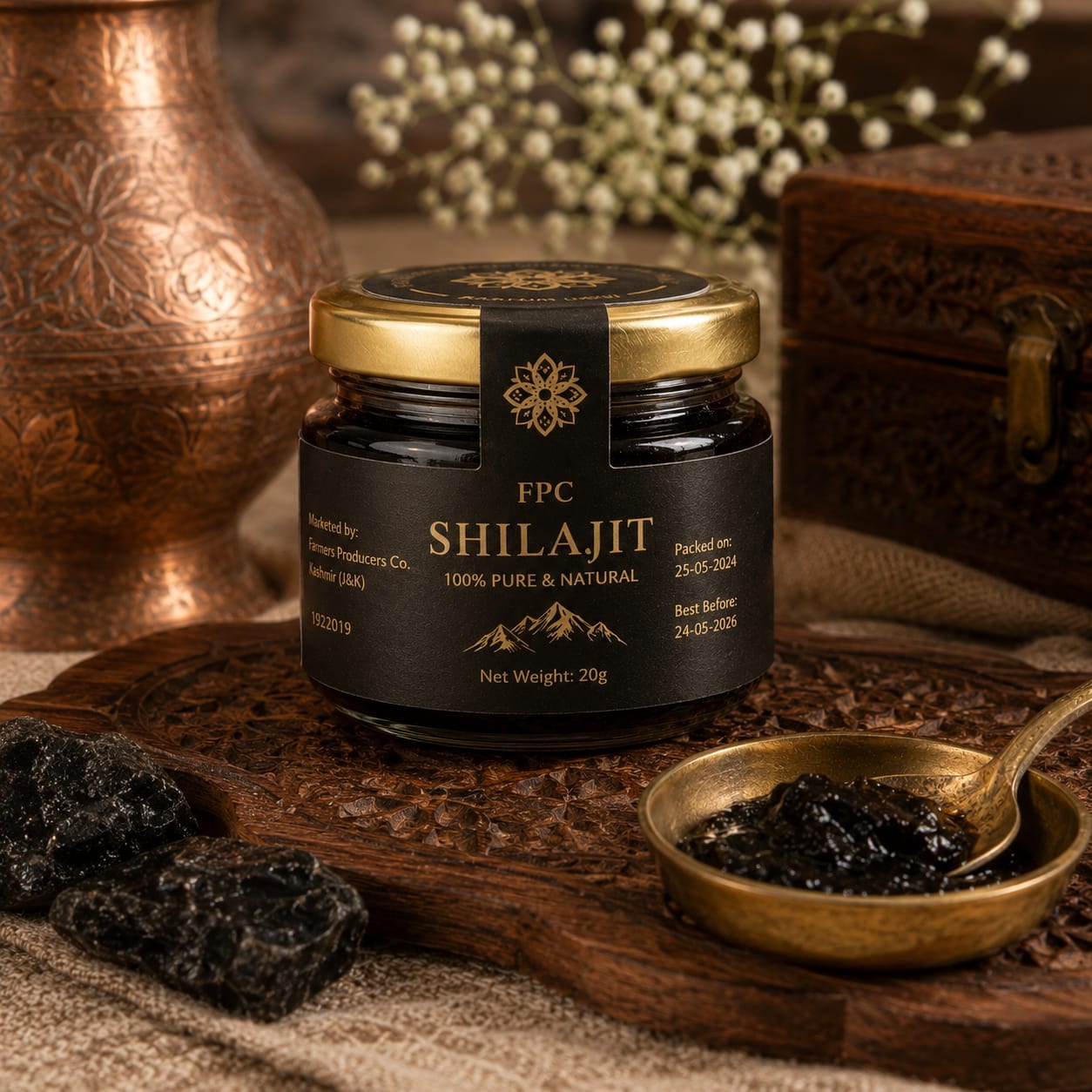
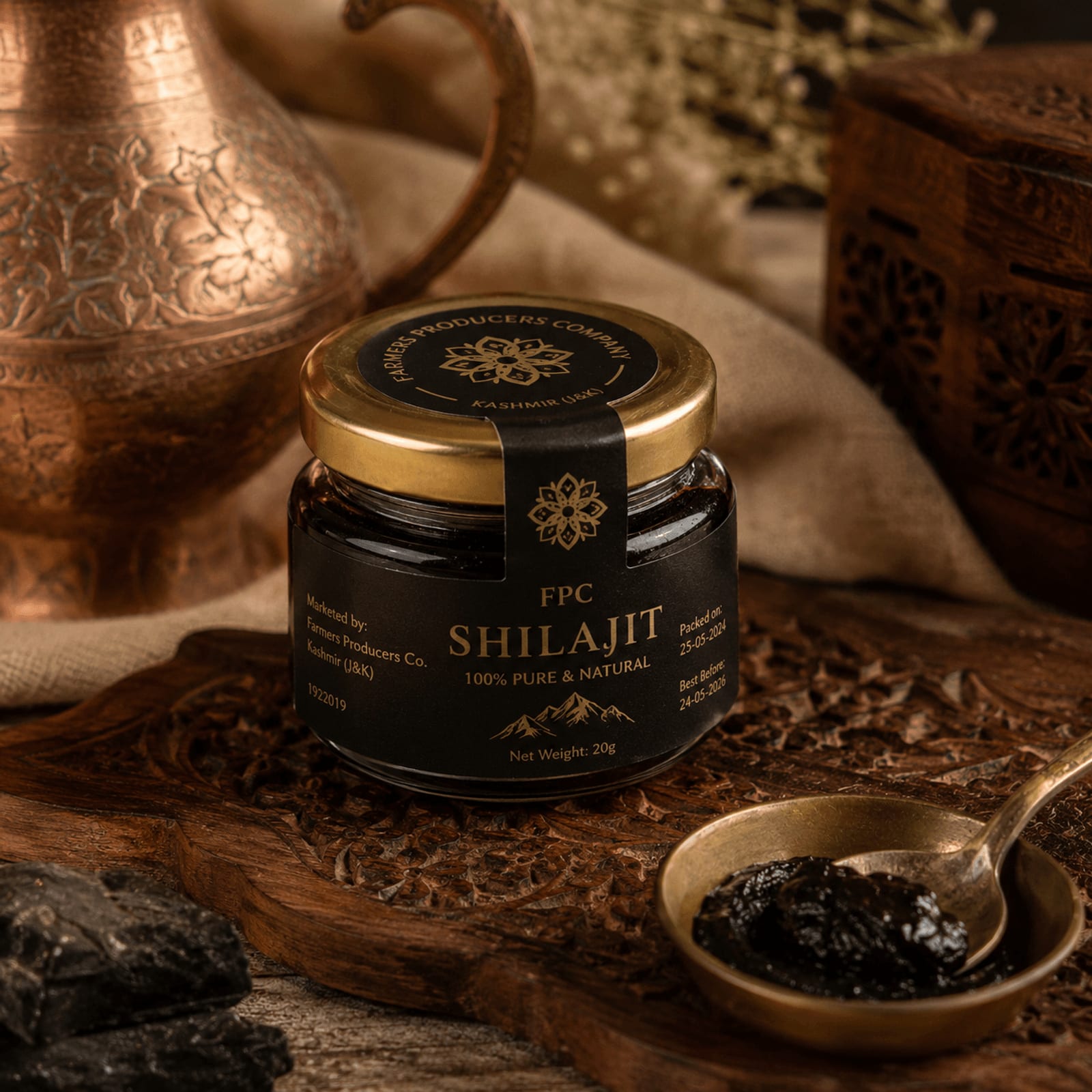
Ours is different. It is Himalayan resin from high-altitude rock, purified and sealed in a 20 g jar, and sold by the Pampore Saffron Farmers Producer Company. We are a saffron-growing family in Pampore; we do not dig shilajit ourselves. A resin and a standardised extract are made differently and carry different amounts of what is in them, so the trial results cannot simply be carried over to our jar, or to anyone else’s resin. You should know that before you buy, not after.
Shilajit uses for men: how it is usually taken
There is no men’s version and no men’s dose. Men take it the way everyone does: about 300–500 mg once a day, dissolved in warm (not boiling) water or milk, usually in the morning. The trials gave 250–500 mg a day of their extract, but that does not convert into a portion of resin with any precision, so start at the small end. Our Himalayan shilajit guide covers the method, the timing, how long a jar lasts and the home purity tests, so we have not repeated them here.
Shilajit with ashwagandha
It is a common pairing on Indian shelves and a common search. There is no trial of the two together and none comparing them, so any claim that the combination works better than either alone is a guess. They are different substances: a mineral resin and a plant root. If you take regular medication, check with your doctor before adding either.
Choosing shilajit: there is no “best for men” formula
Shilajit sold “for men” is usually the same resin in different packaging, or resin blended with herbs and minerals. Judge any of it, ours included, on four things:
- A heavy-metals report for the batch (see the section below). This matters more than anything on the label.
- Resin that passes the home tests in our guide: it softens with warmth, dissolves fully in warm water and tastes bitter, not sweet.
- A full ingredient list if it is a blend, so you know how much of what you are paying for is shilajit.
- A price that makes sense. Purification and testing cost money. Ours is ₹599 for a sealed 20 g jar, which lasts about 6–8 weeks at the usual portion.
Who should not take it
- Anyone under 18. No trial has included teenagers.
- Men with gout or high uric acid.
- Anyone with haemochromatosis or another iron-overload condition. Healthline also lists thalassaemia and sickle cell anaemia.
- Anyone taking medicine for blood pressure or diabetes, until their doctor has said yes.
- Anyone who gets a rash, a racing heart or dizziness after taking it: stop, and see a doctor.
The side effects that health sites list are mostly mild: stomach upset, nausea, headache, dizziness. They are the same for men and women.
Heavy metals: ask for the batch report
Shilajit forms in rock and carries whatever the rock gave it. When researchers bought 193 Ayurvedic medicines online and tested them, about one in five contained detectable lead, mercury or arsenic, and three-quarters of those claimed Good Manufacturing Practice (Saper and colleagues, JAMA, 2008). That study was not about shilajit alone, but the lesson carries: a label is not a test. Before you buy shilajit from anyone, ask for:
- A report for your batch, with a batch number that matches the one on your jar.
- The laboratory’s name, whether it is NABL-accredited (India’s accreditation body for testing labs), a report number and the test date.
- Measured figures for lead, arsenic, mercury and cadmium, in ppm (mg/kg), each shown beside the limit it is judged against.
- The test method, such as ICP-MS. “Lab tested” with no numbers is not a report.
Where we stand, against that list: our shilajit is lab-tested for fulvic acid and for heavy metals (lead, arsenic, mercury and cadmium), and the jar you receive comes with its test report. We have not yet published that report on this website, so you cannot check it here today. If you want to see it before you order, ask us on WhatsApp at +91 95966 08297, and hold it to the same list.
Our Himalayan shilajit resin is ₹599 for a sealed 20 g jar. If you are comparing sellers, the shilajit buying guide puts the purity tests and pricing on one page, and the women’s page covers the one trial in women. Reading in Hindi? शिलाजीत की पूरी जानकारी हिंदी में.