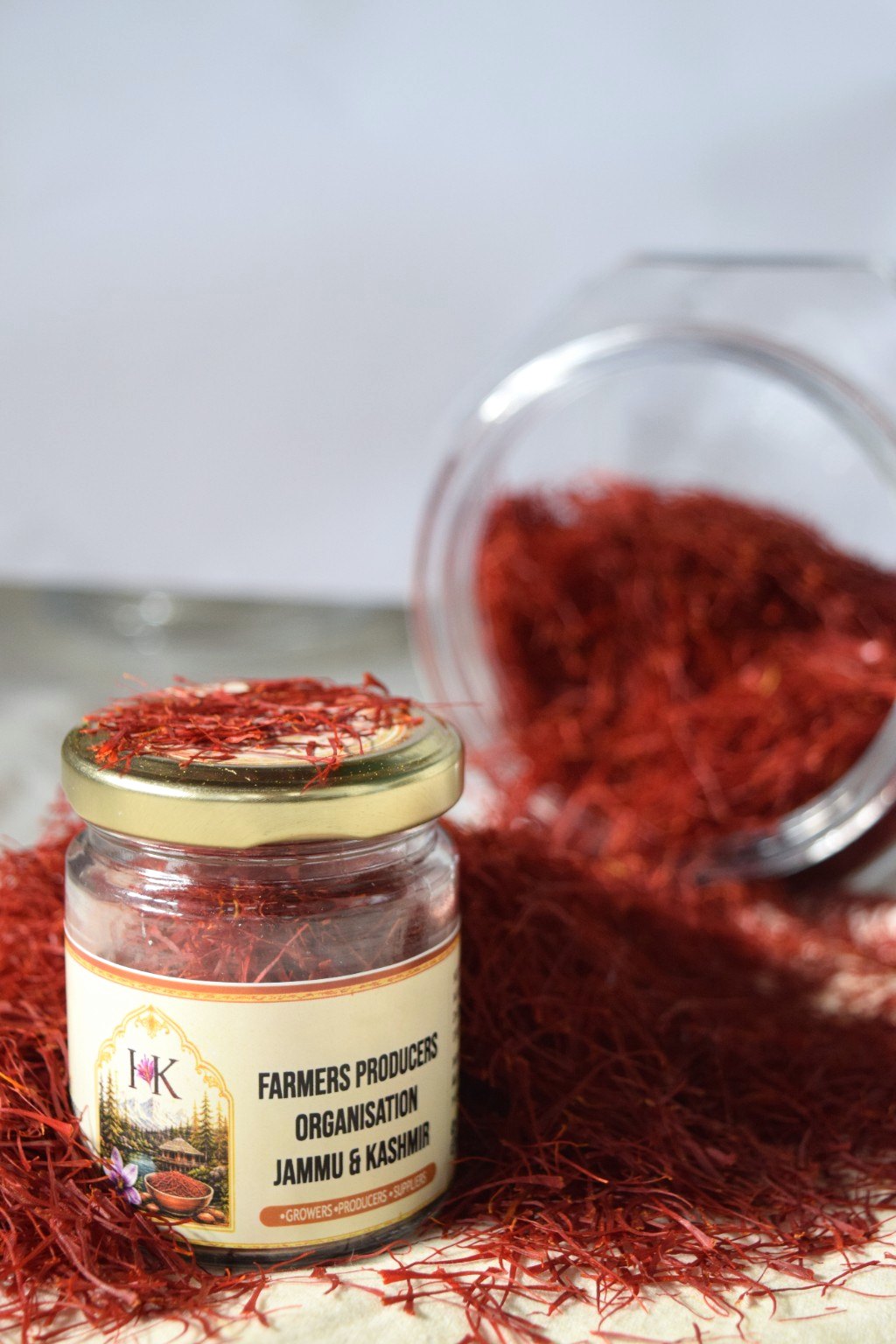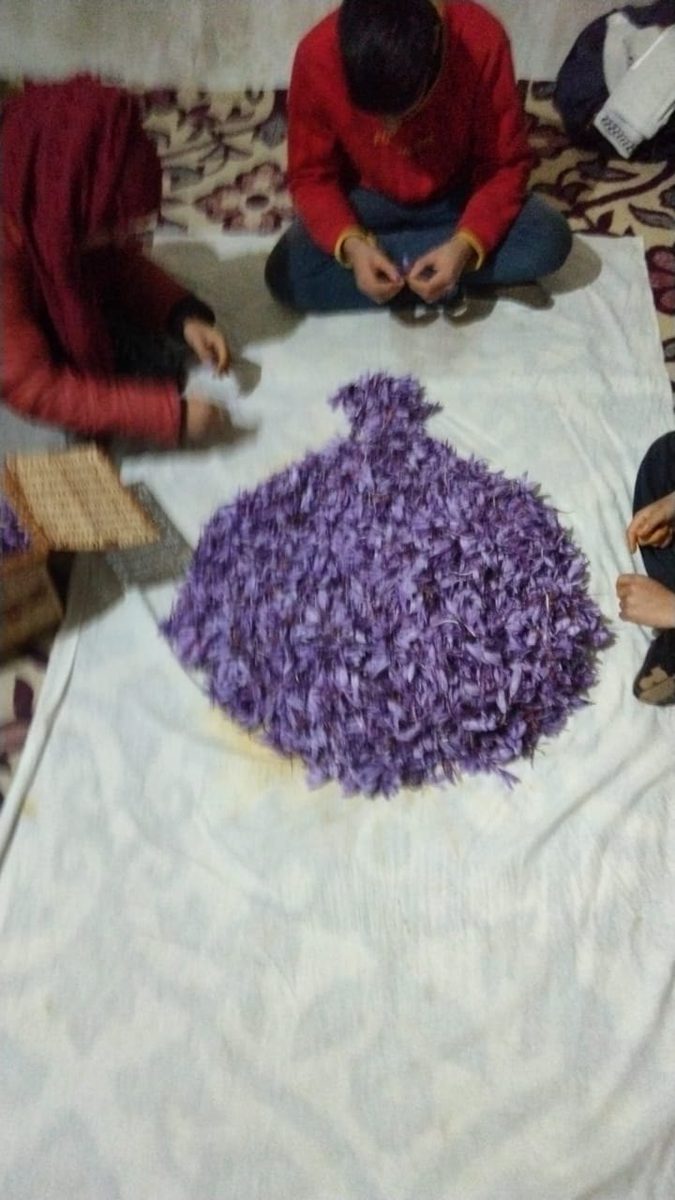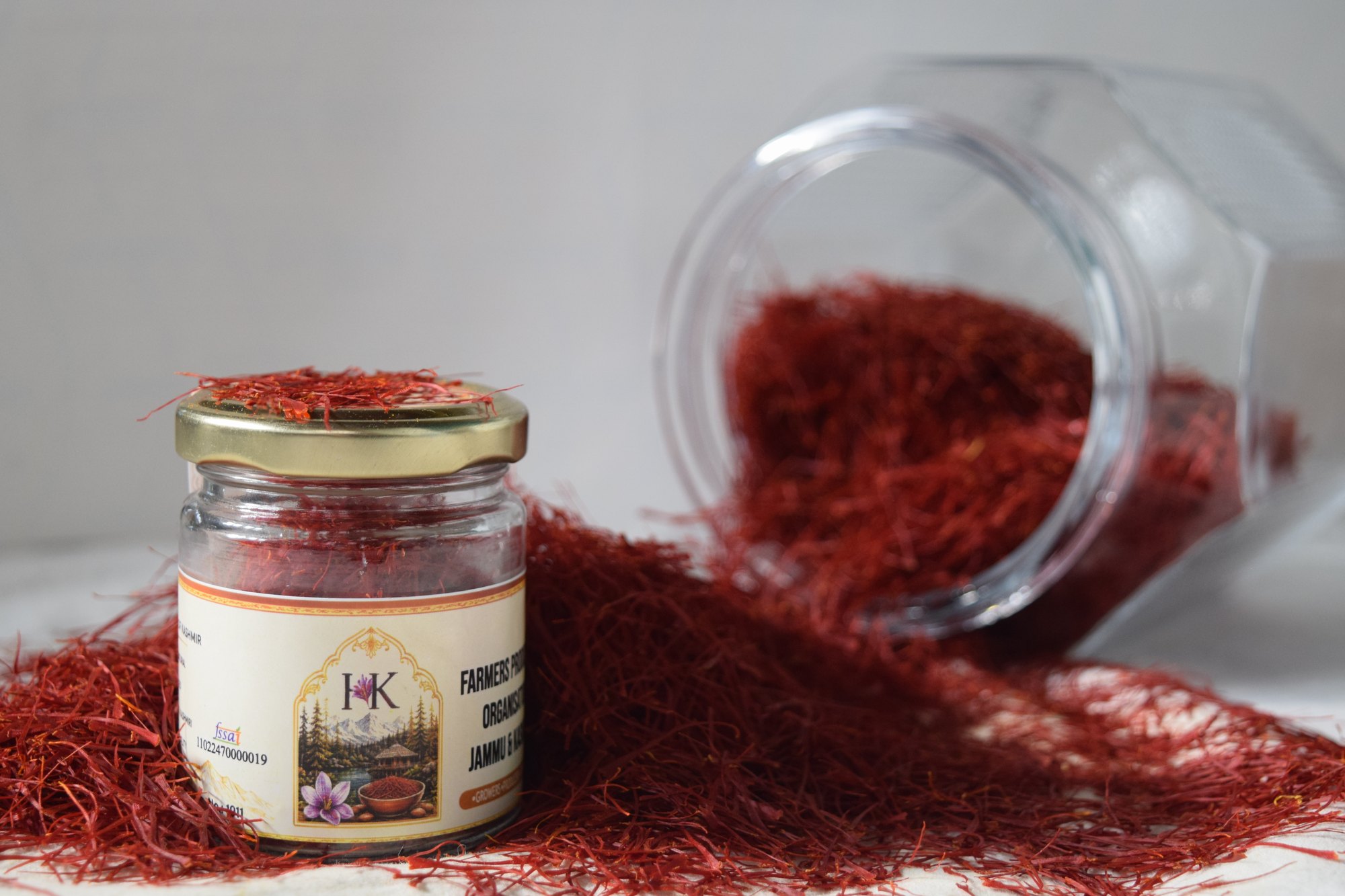
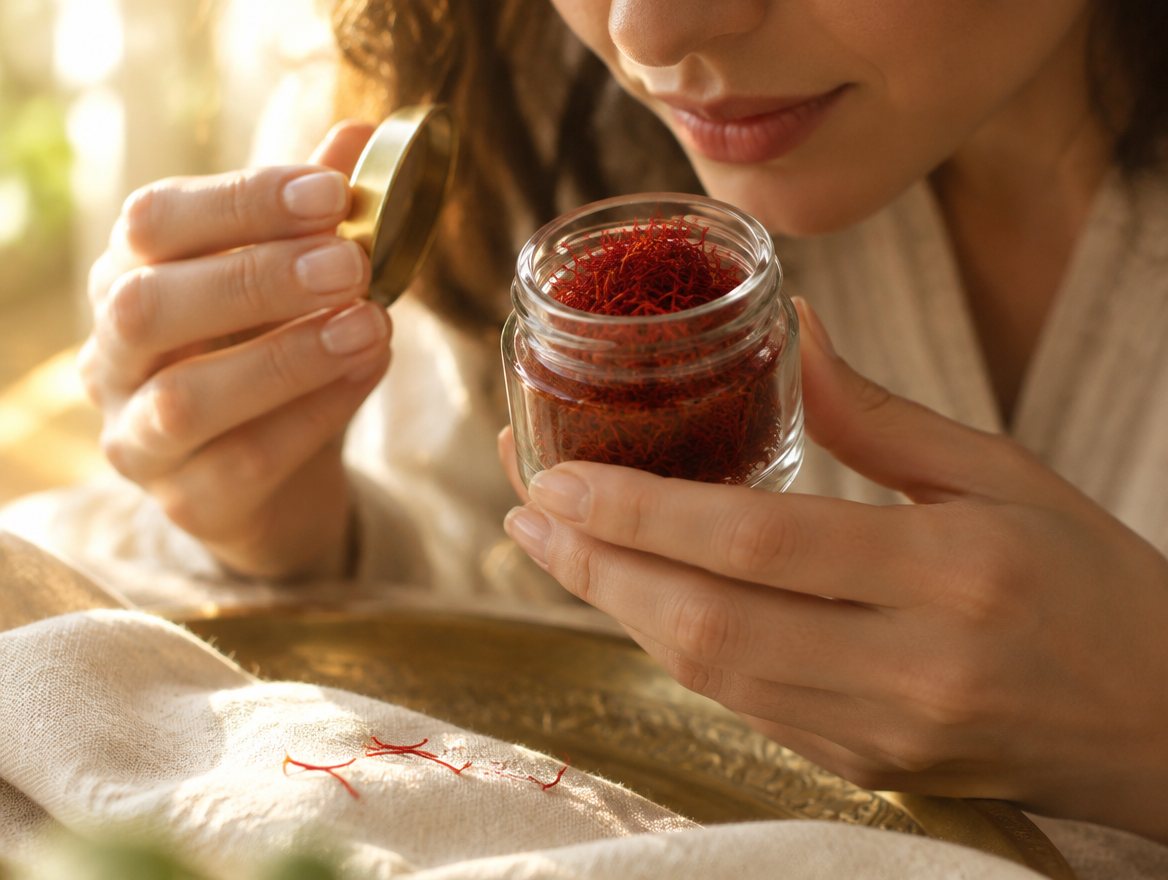
Real saffron smells sweet, like honey, with a dry, grassy edge like hay. The compound is safranal, and it forms as the threads dry after harvest. Fake saffron either smells of nothing, or of something that is not saffron: sharp, bitter, chemical, or perfumed. At drying time in Pampore we can smell the trays from the next room. Here is how to put your own jar to the same test.
What you need
- The saffron, at room temperature. Cold threads give up less smell.
- A clean nose: no coffee, no perfume, no frying pan going in the background.
- Your own palm, or a small dry bowl.
- Five or six threads. One thread is too little to judge by.
- A minute, and a cup of warm water if you want the optional last step.
The steps
- Open the jar and smell at the mouth first. Note your first impression before you think about it.
- Tip five or six threads into a dry palm and close your hand over them for half a minute. Your skin warms them.
- Open your hand and breathe in. Warm threads give more than cold ones; this is the real reading.
- Crush one thread between finger and thumb and smell again. This is the strongest the smell will get.
- Optional: drop the threads into warm water and smell the glass after five minutes. The steam carries the aroma, and the water should be turning gold, which is the saffron water test starting on its own.
What real saffron smells like
Honey first, then hay or dried grass, with a faint floral note behind it, a little like black tea. Sweet but earthy, never perfume-like. It is distinctive without being loud; you should not be able to smell it across the room, but you should know it the moment the jar opens, and it stays on your fingers for a while after you have handled the threads. Taste one if you like: the smell is sweet, the thread on the tongue is faintly bitter, and real saffron has both.
What fake saffron smells like, and why
- Nothing at all. Dyed corn silk, coconut fibre and safflower never had safranal, so they have no smell to give. Very old saffron can smell of nothing too, which is why this test is not the last word.
- Sharp, bitter or chemical. You are smelling the dye, the solvent it came in, or both. Treat it as a warning. A musty, damp smell is a different warning: real saffron that was stored badly.
- Loud, sweet, fruity perfume. An artificial fragrance sprayed on a fibre to pass this test. It gets the note wrong: too sweet, too strong, and no hay behind it.
The reason is that safranal forms from picrocrocin as a real stigma dries, so only a real dried stigma has it. A counterfeiter can paint colour onto a fibre and can spray a scent on top, but cannot make the fibre produce the honey-and-hay smell itself.
Common mistakes
- Smelling a cold jar. Let it come to room temperature. Saffron should not live in the fridge anyway; our guide to how to store saffron explains why.
- Smelling straight after cooking or perfume. Your nose is already full.
- Judging by one thread. Use five or six, and warm them.
- Confusing faint with fake. Real saffron is not loud, and older saffron fades. Faint plus a good water test is real saffron that is getting on in age.
- Smelling the packet, not the saffron. Plastic and cardboard have smells of their own. Take the threads out.
When the result is inconclusive
A faint smell can be age, or it can be your nose on a bad day. Run the saffron water test: if the water turns gold slowly over 10–15 minutes and the threads stay red and whole, the saffron is real and merely older. A good smell with a bad water test is the other way round: real, low-grade saffron that has been re-dyed to look richer, and the dye bleeding red at once is what gives it away. If the smell is fine and the water is fine but the threads look wrong, lay them on white paper for the trumpet test. And no nose can tell Kashmiri saffron from saffron grown anywhere else; origin needs paperwork, which is covered in our guide to how to identify real Kashmiri saffron.
The science in one paragraph
Three compounds do saffron’s work. Crocin is the colour: it dissolves in water and is held inside the stigma’s cells, so it spreads out slowly as gold, where a dye on a fibre bleeds fast. Picrocrocin is the taste, faintly bitter, and as the stigma dries and ages it breaks down into safranal, the aroma. Safranal is volatile, which is why warming the threads brings the smell up and why a jar left open loses it. A laboratory measures all three under ISO 3632; our saffron measured a colouring strength (crocin) of 217.51 against the Grade I minimum of 200, and the report is on our lab reports page.
Our water-test refund
Every jar of our Kashmiri Mongra saffron is dried and sealed by our family in Pampore, and the smell is the first thing you will notice when you open it. Then put three or four threads in warm water. If our saffron fails the home water-bloom test, tell us within 7 days of delivery and we refund in full.