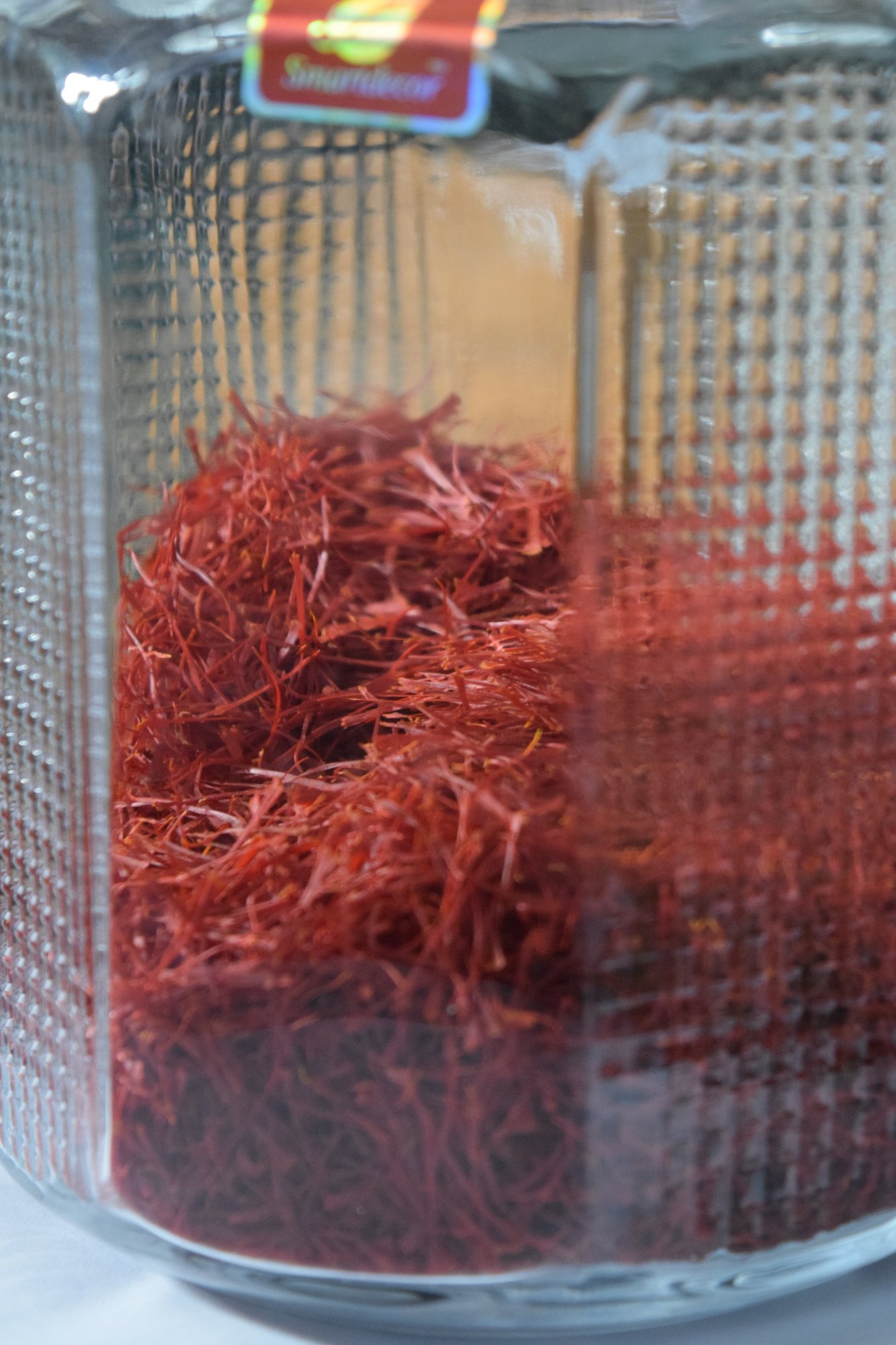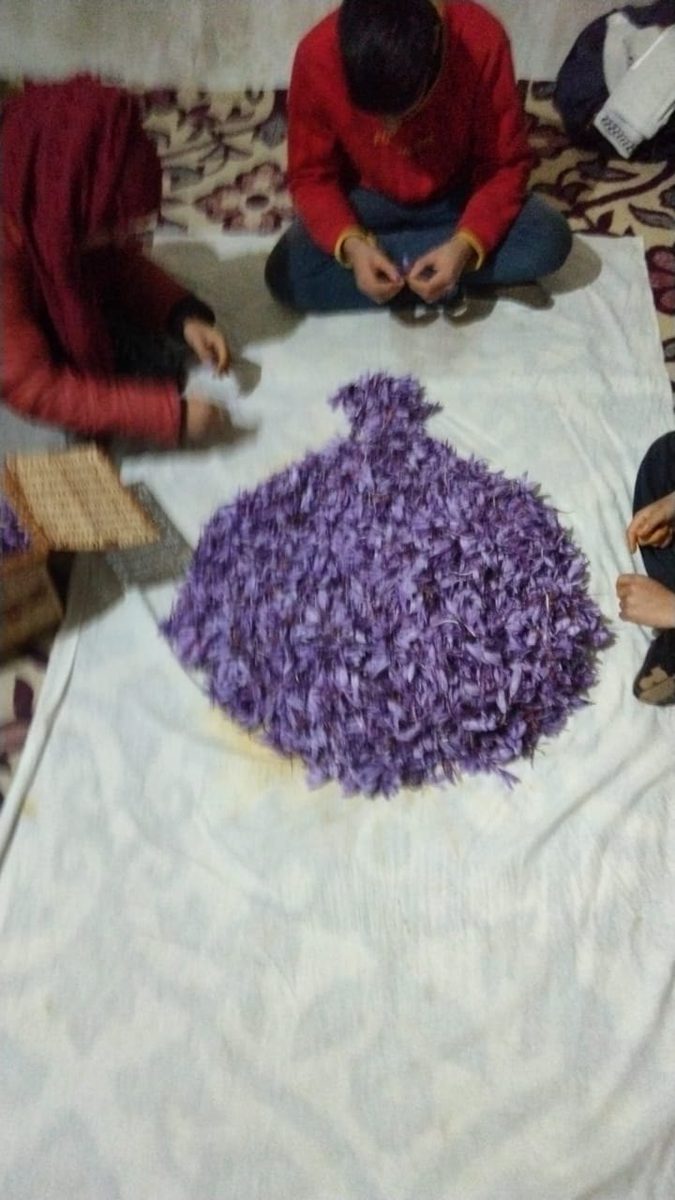
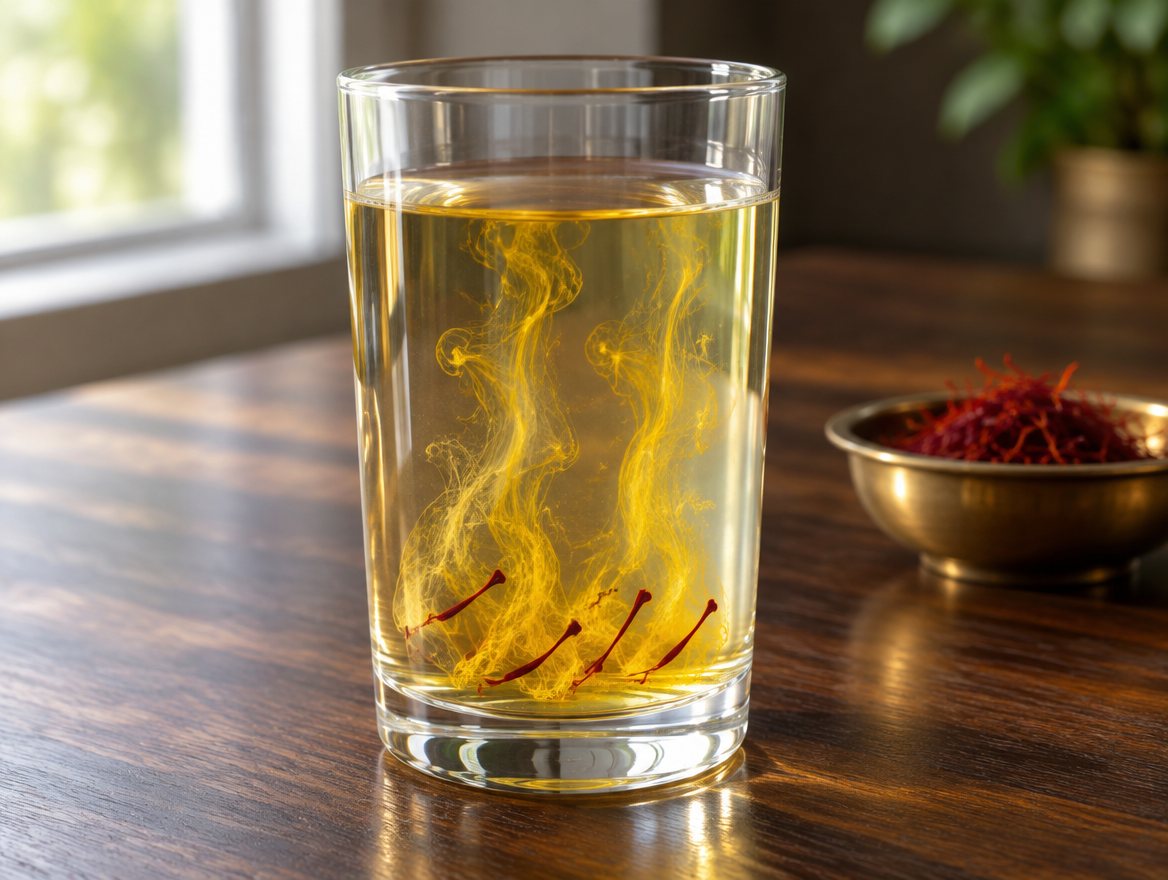
Drop three or four threads of saffron into a glass of warm water and wait a quarter of an hour. Real saffron colours the water a clear golden yellow, slowly, while the threads stay red and whole. Dyed or fake saffron bleeds red or orange almost at once, and the threads often fall apart. That is the whole test. We run it on our own harvest in Pampore every season, and we ask every customer to run it on the day their jar arrives.
What you need
- A clear glass, or a white cup or saucer, so you can see the colour against white.
- Warm water: warm to the touch, not hot. Water you could comfortably hold a finger in.
- Three or four whole threads of the saffron you want to test. Not a pinch; a pinch hides what single threads do.
- A sheet of white paper for the end.
- Fifteen minutes, and the patience not to stir.
The steps
- Pour the warm water into the glass and let it stand still.
- Drop in the threads whole. Do not crush them first; a whole thread tells you more than a crushed one.
- Watch the first minute without stirring. This minute is the dye check. Real saffron does almost nothing yet; a dyed fibre starts to bleed straight away.
- Leave it for 10–15 minutes. Then look at the water from the side, against something white.
- Lift a thread out onto the white paper and press it between finger and thumb. Look at the thread, then at the paper.
What real saffron does
In the first minute, very little. Perhaps a faint gold wisp trailing from a thread. Over the next ten to fifteen minutes a golden-yellow halo spreads out from each thread until the whole glass is a clear gold, deeper the longer you leave it. The colour is gold, never red. The threads themselves stay deep red and keep their shape; a thread lifted out after fifteen minutes is still a red thread, and pressed on white paper it leaves a yellow-gold smear while staying red itself. Put your nose to the glass and the water smells faintly of honey and hay, which is the subject of the saffron smell test.
What fake saffron does, and why
Dyed corn silk, safflower petals, coconut fibre, and tired old saffron re-dyed to look fresh all behave the same way: the colour comes off at once, and it comes off red or orange rather than gold. Within a minute or two the water is coloured and the threads are going pale, because the dye was sitting on the surface of the fibre and the water has washed it off. Many of them also soften and break apart, since the fibre underneath was never a saffron stigma. The reason is simple: a surface dye has nothing to hold it, while the colour in real saffron is locked inside the cells of the stigma and can only come out slowly.
Common mistakes
- Hot water. It pulls the colour out faster and softens the threads, so the slow-versus-fast reading stops meaning much.
- Too many threads. A pinch colours the water quickly and you lose the slow bloom that proves it is real.
- Stirring or crushing. Both speed the colour up and spoil the first-minute dye check.
- A coloured cup. You cannot tell gold from orange in a green mug.
- Judging at two minutes. Real saffron looks idle at two minutes. That is the point.
- Expecting red. Real saffron water is gold. Red water is the warning, not the proof.
When the result is inconclusive
Sometimes the water goes gold, but slowly and faintly, and the threads stay whole. That is usually real saffron that is old or lower in grade, not a fake; try again with fresh threads and give it the full time. Whether the threads float or sink proves little either way. If you cannot decide, run the two other checks: lay dry threads on white paper for the trumpet test and warm a few in your palm for the smell test. The baking-soda check and the price floor are in our full guide to how to identify real Kashmiri saffron. One thing no glass of water can tell you is origin: a real thread from anywhere passes this test, so “Kashmiri” needs paperwork, not water.
The science in one paragraph
Saffron’s colour is crocin, which dissolves in water and is held inside the stigma’s cells, so it diffuses out slowly and dissolves gold. A dye painted onto a fibre sits on the outside and bleeds fast. Safranal is the aroma, the honey-and-hay smell, and picrocrocin is the taste, faintly bitter on the tongue. A laboratory measures all three under ISO 3632; our saffron measured a colouring strength (crocin) of 217.51 against the Grade I minimum of 200, and the report is on our lab reports page.
Our water-test refund
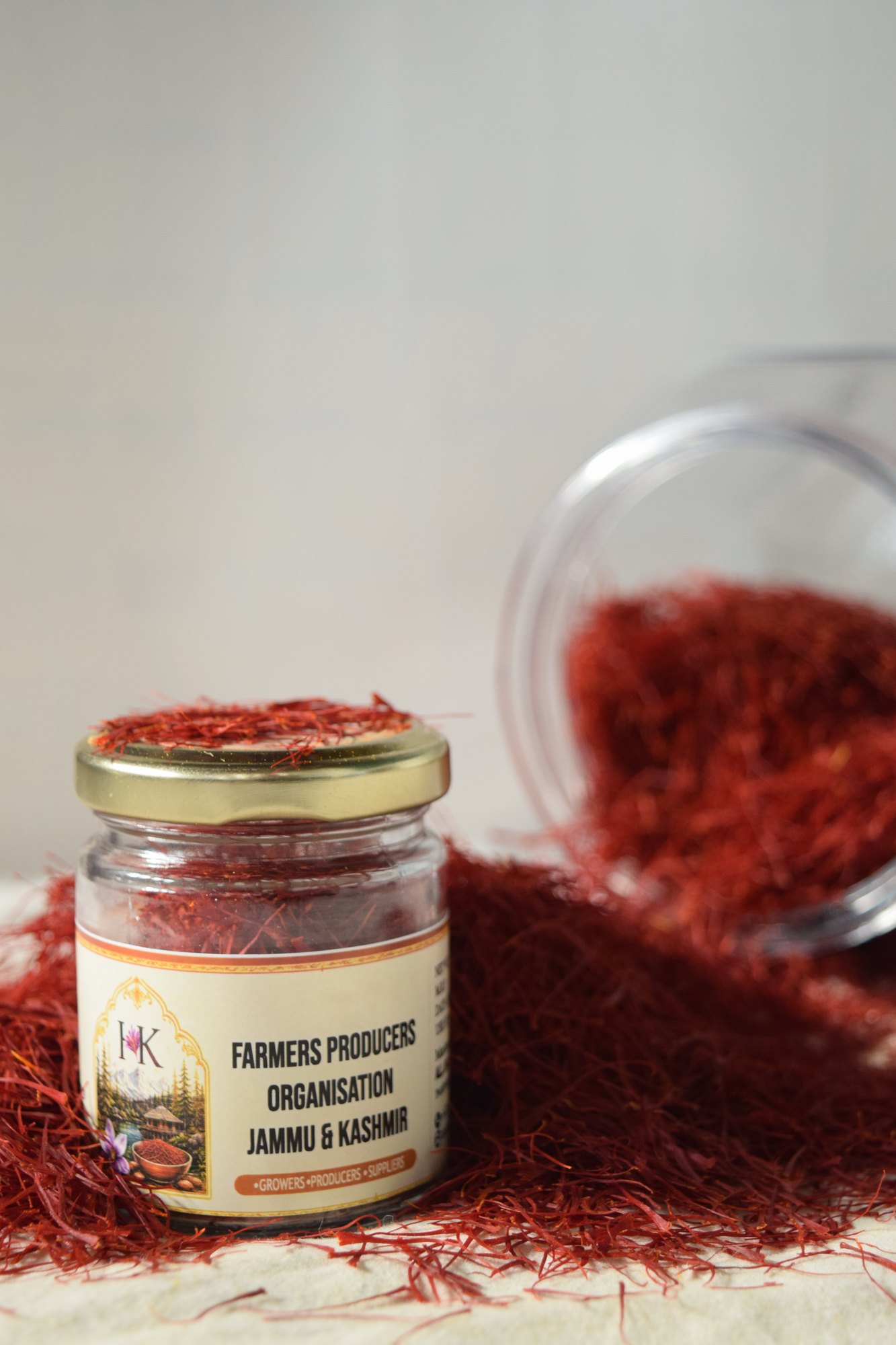
Our family grows saffron in Pampore, and every jar of our Kashmiri Mongra saffron comes from our own fields. Test it the day it arrives. If our saffron fails the home water-bloom test, tell us within 7 days of delivery and we refund in full.