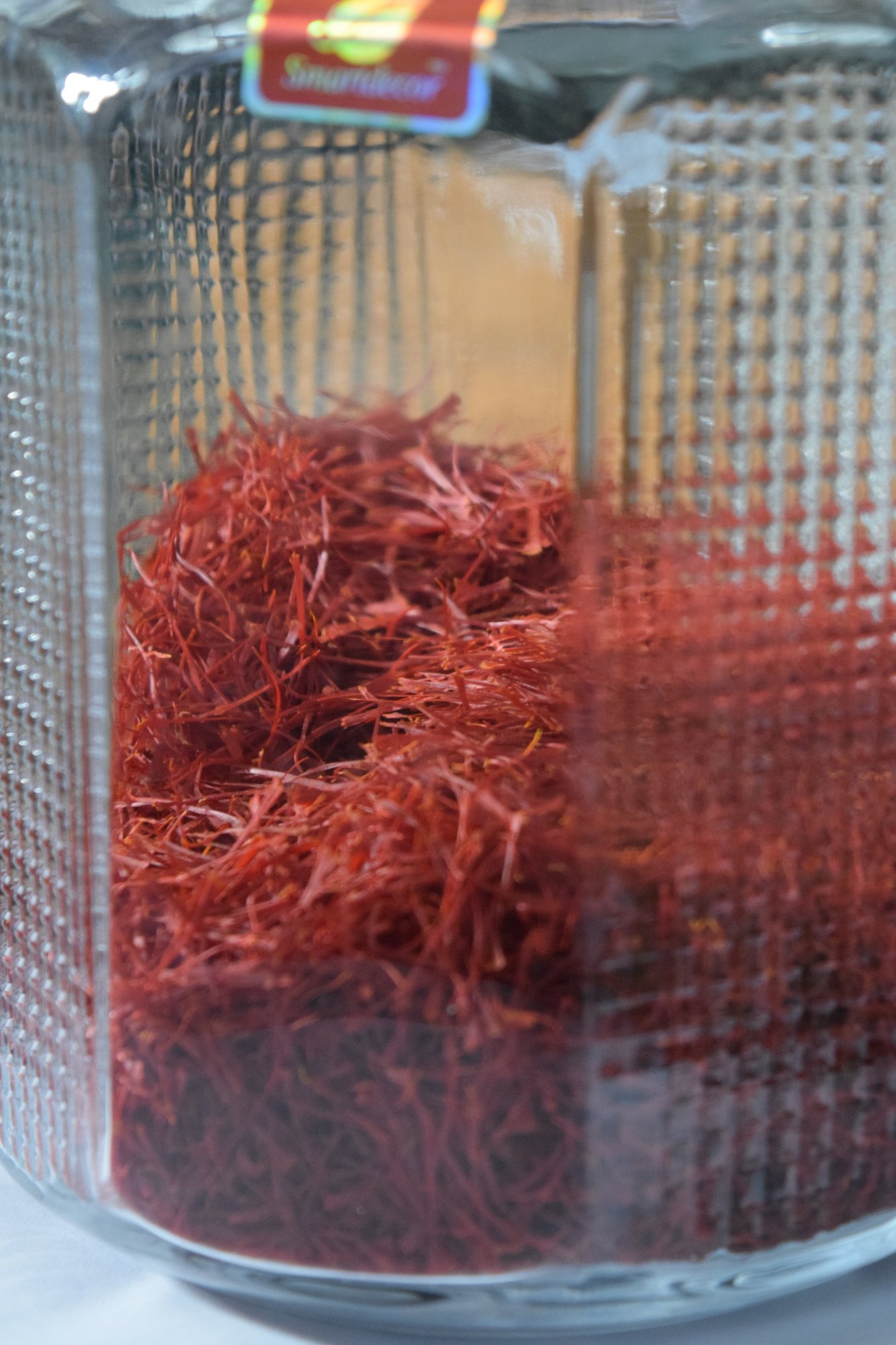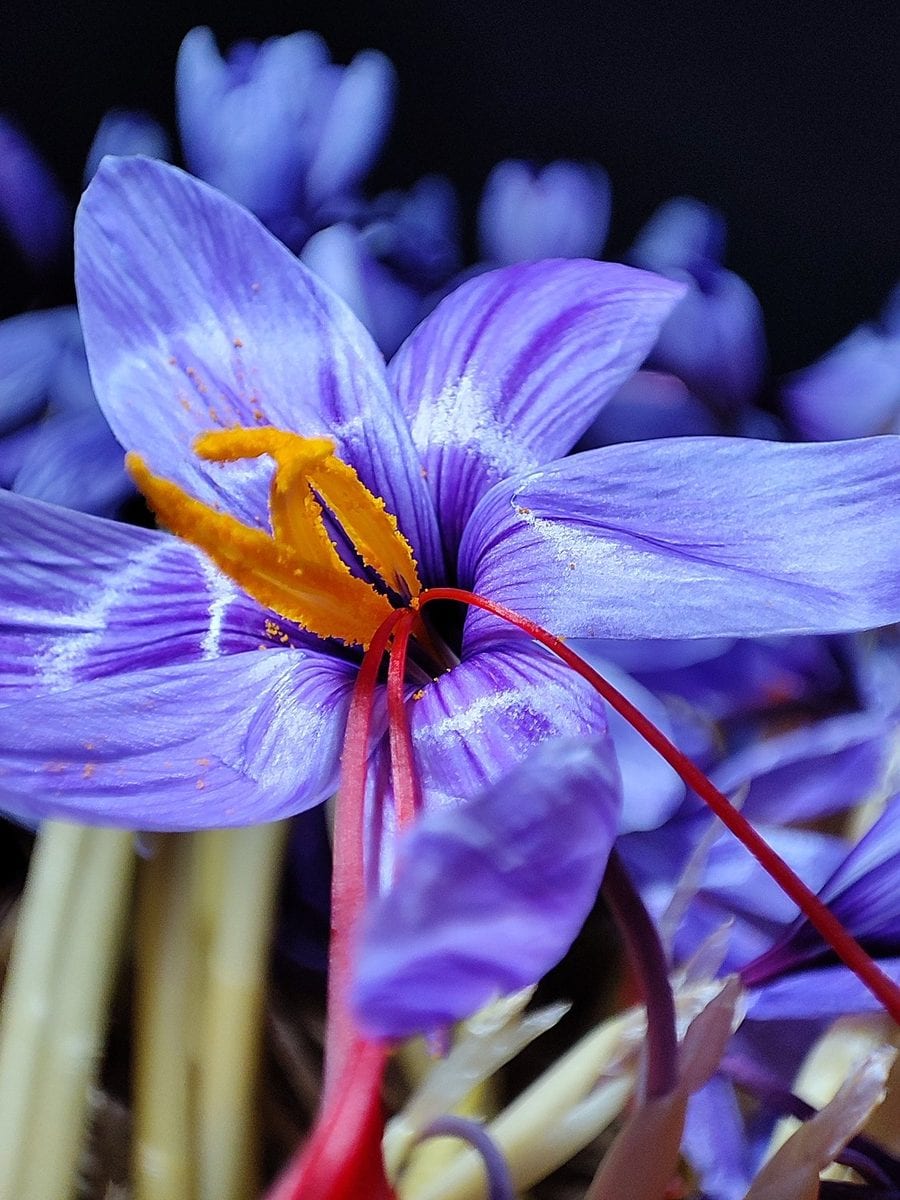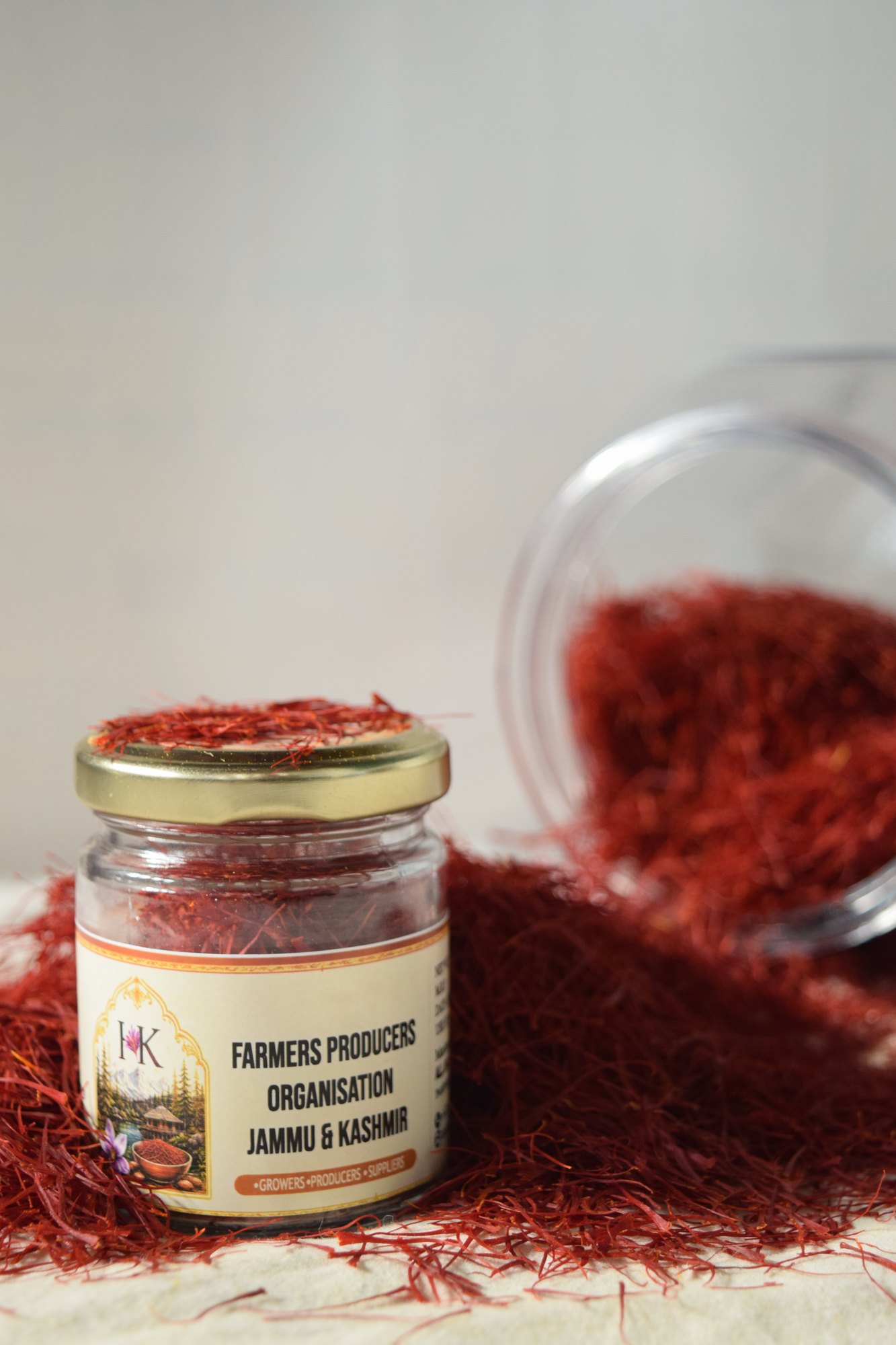
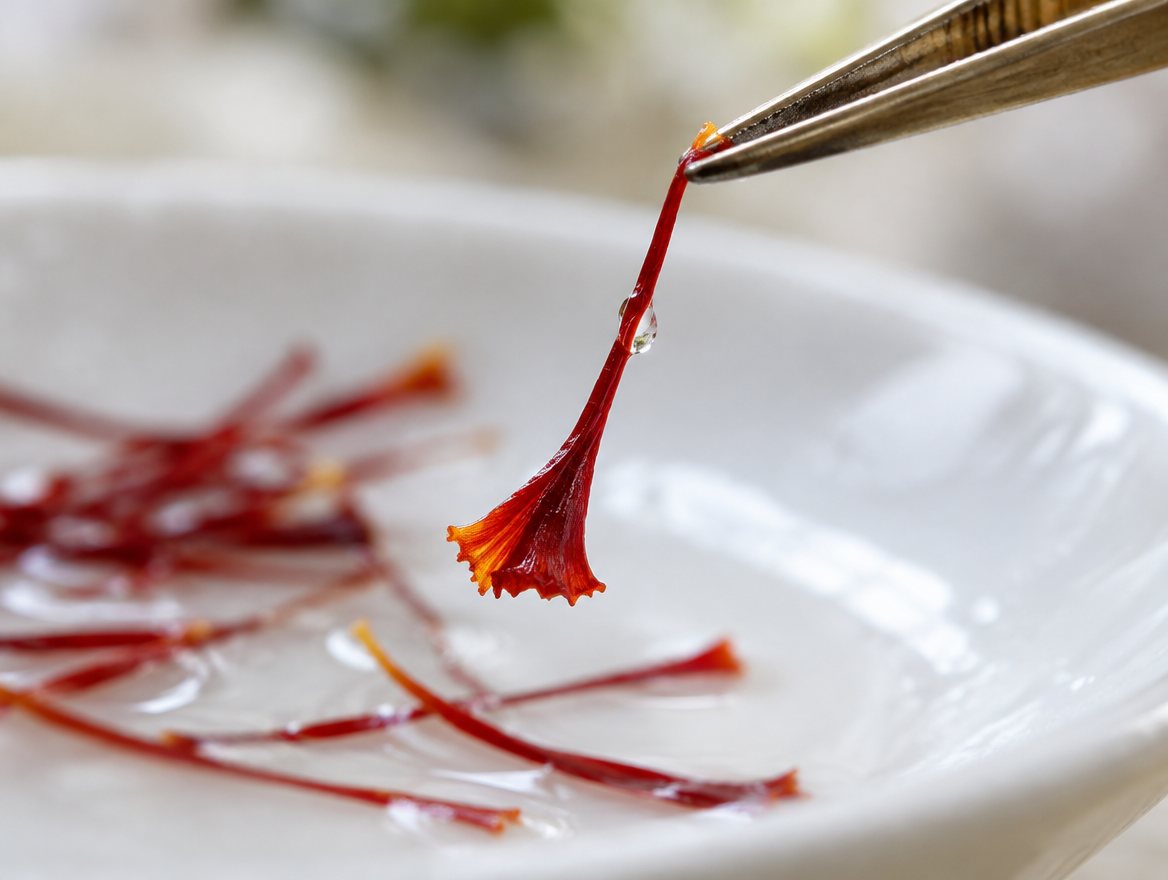
A real saffron thread is one arm of the crocus stigma, and it has the shape of its job: narrow where it joined the flower, widening at the far end into a small trumpet or flare. Safflower petals, corn silk and dyed fibres are the same thickness from end to end. Put the threads on white paper under a good light and you can see this with your own eyes in two minutes. We sort our harvest in Pampore by hand, thread by thread, and that flare is what our sorters look for.
What you need
- A sheet of plain white paper, or a white plate.
- Daylight, or a bright lamp. Shape is hard to read in a dim kitchen.
- Five or six whole threads. Any jar holds some broken pieces; pick the whole ones.
- A magnifying glass, or your phone camera on zoom. Optional, but it helps.
- Dry fingers.
The steps
- Tip the threads onto the paper and spread them so no two touch.
- Look at each thread end to end. One end should be fine and narrow; the other should broaden.
- Look closely at the wide end. You are looking for a flare like the mouth of a small trumpet, sometimes split or frilled at the rim.
- Zoom in with the phone camera. At that size the flare is unmistakable, and so is its absence.
- Compare the threads with each other. Real saffron shows the same shape on every whole thread, with the natural variation of length and curve that hand-picked stigma has.
What real saffron looks like
A trumpet at one end, tapering to a fine point at the other. The colour is a deep crimson, slightly darker at the flared tip, and in Mongra there is no yellow tail, because the yellow style has been trimmed off at the sorting table. The colour is in the thread, not on it: no pale streaks, no patches, no square cut ends. Threads vary a little in length and curl, as anything picked by hand does. Our Kashmiri Mongra saffron is sorted this way in Pampore, and the Short Thread jar is the same stigma, sorted shorter, with the same flare at one end.
What fake saffron looks like, and why
- Safflower petals are flat and ribbon-like, more orange than crimson, and the same width all along. They are petals, so they have no flare at either end.
- Dyed corn silk and coconut fibre look like fine round wires: machine-straight, uniform in thickness, often with pale streaks where the dye missed.
- Cut and dyed threads of any kind come with square ends and suspiciously equal lengths.
The reason is that only the stigma of the saffron crocus has this shape. A counterfeiter can match the colour with dye and the length with scissors, but no scissors can cut a flare. That is why the trumpet is the quickest honest sign there is, and why it belongs next to the water test in our guide to how to identify real Kashmiri saffron.
Common mistakes
- Judging broken pieces. A middle section has no flare on either end. Pick whole threads.
- Expecting every thread to be identical. Hand-picked stigma varies in length and curl. Identical is the warning sign, not the proof.
- Mistaking a style for dye. A yellow or white tail at the narrow end is part of the flower, left on in lower grades. Streaks along the red part are dye.
- A dark or patterned background. Use white paper.
- Looking in poor light. The flare is small. Give it daylight or a lamp.
When the result is inconclusive
If the threads are too short or too broken to read, go straight to the saffron water test. The shape can also pass when the saffron is real but has been re-dyed to look brighter than it is; the water test catches that, because the dye bleeds red at once while real saffron blooms gold slowly. Threads with the right shape and no smell at all are usually old rather than fake, which is where the saffron smell test comes in. And the shape cannot tell you where the saffron grew: a stigma from any country has the same trumpet, so origin needs a lab report and a named grower, not a magnifying glass.
The science in one paragraph
Each saffron crocus carries three stigma arms, and each arm is one thread. The flare is the tip that receives pollen, which is why it widens. Inside the thread’s cells sits crocin, the colour, which dissolves in water and spreads out slowly as gold; a dye on a fibre sits on the surface and bleeds fast. Safranal is the aroma and picrocrocin the faintly bitter taste. All three are measured under ISO 3632; our saffron measured a colouring strength (crocin) of 217.51 against the Grade I minimum of 200, and the report is on our lab reports page.
Our water-test refund
Look at the threads the day your jar arrives, then put three or four in a glass of warm water. If our saffron fails the home water-bloom test, tell us within 7 days of delivery and we refund in full.