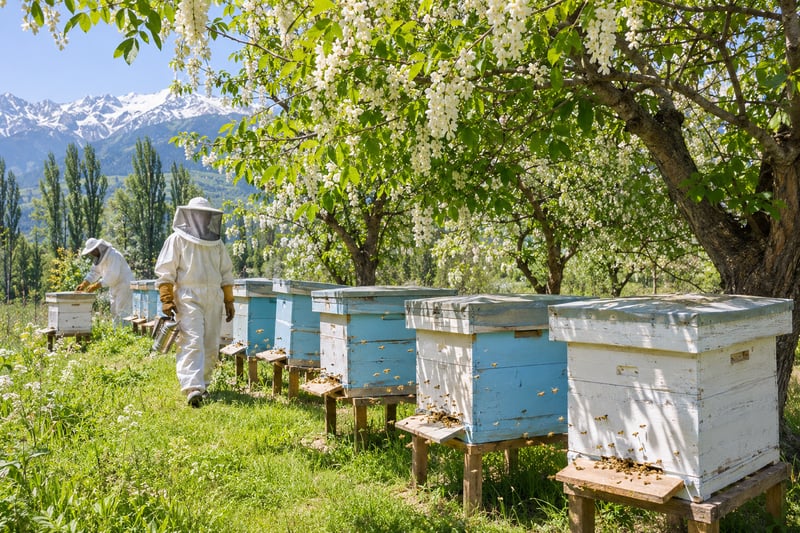
Kikar honey is Kashmir’s acacia honey: raw honey from the white kikar bloom, which in the valley is Robinia pseudoacacia (false acacia, black locust), the tree behind Europe’s acacia honey. Ours comes from our Kikar forests of Wastarwan and Ramban, never heated and coarse-sieved, at ₹450 for a 500 g jar. Pale, mild and slow to set, it is the honey often sold as Kashmiri white honey, and the honey we steep our saffron in. Here is what the tree is, why the word kikar means two trees in India, where our forests are, how the honey is made, and what to check before you buy.
Kikar: the tree behind Kashmir’s acacia honey
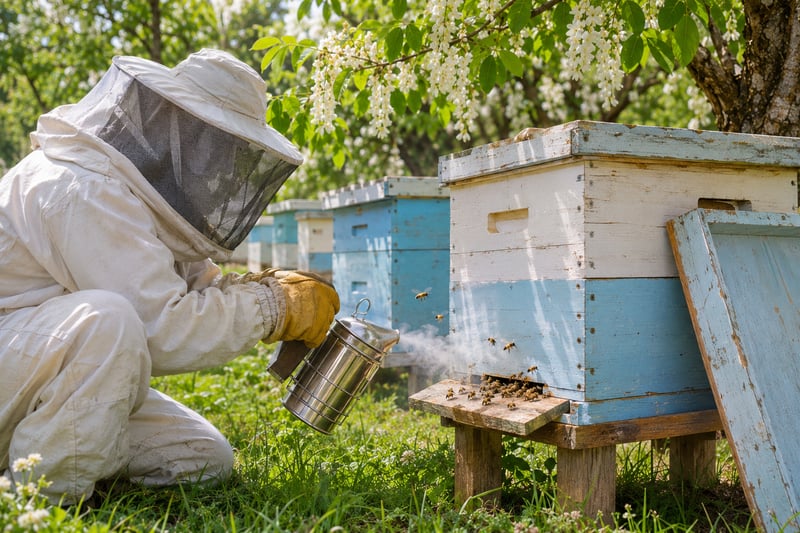
In the Kashmir valley the tree called kikar, or kikur, is Robinia pseudoacacia (false acacia, black locust). It is not a true acacia at all but a North American tree, planted along the valley’s roads and hillsides for about a century, and today its most abundant deciduous tree. It flowers in April–May, each tree for about a week to ten days, in hanging white clusters that are heavy with nectar, and Kashmir’s beekeepers say it gives most of the honey they extract. A peer-reviewed study of Kashmir’s acacia honey, sampled in Pulwama, Srinagar and Budgam, found it 54–60% kikar pollen.
The same tree is the source of the acacia honey that Hungary, Italy and France are known for, which is why “Kashmiri acacia honey” is an honest label and not a borrowed one. “White honey” describes the colour; it is not a grade. Our white honey guide covers that side of the story.
Kikar, babool, acacia: one word, two trees
Walk down to the plains of Jammu, Punjab or Rajasthan and “kikar” means a different tree: Vachellia nilotica (babool), the thorny babool with yellow pom-pom flowers and grey pods. It is a true acacia, it is a recognised bee-forage tree, and its honey is sold as kikar honey or babool honey too. But it grows from sea level to about 1,300 m, and the Kashmir valley floor sits at about 1,600 m, so a jar of kikar honey from the valley cannot be babool honey. The two names got tangled because both trees are thorny-looking legumes with a folk name in common.
What this means for a buyer: ask which tree and which place. A pale, mild, slow-setting honey from a named Kashmir forest is the false-acacia kind; a darker, stronger plains honey under the same name is the babool kind. Neither is fake; they are different honeys.
Where our kikar honey comes from
Wastarwan (also spelt Wasturwan and Wasterwan) is the forested range between Pampore, Tral and Awantipora in Pulwama district. Kikar grows on its lower slopes; above it stand kail pine, ash, maple and birch, and on top are rolling meadows where Gujjar and Bakerwal families graze their herds in summer. Maharaja Hari Singh’s old hunting ground, Shikargah, sits at its foot on the Tral side, 2,130 m up. Our saffron fields are on the Pampore karewas below the same range, so the honey and the saffron come from one corner of the valley. Tral is one of Pulwama’s beekeeping centres, and Pulwama was the third-largest honey-producing district of Jammu and Kashmir in 2023–24.
Ramban is a district of Jammu and Kashmir in the Chenab valley, on the Jammu–Srinagar national highway roughly midway between the two cities. It is lower and warmer than the Kashmir valley, nearly three-fifths of its catchment is forest, and it is a honey district in its own right: the second-largest producer in Jammu and Kashmir in 2023–24, with more than 470 beekeepers and a GI tag on its white sulai honey. The kikar on its slopes gives our second forest. Our Ramban honey is kikar honey, not the GI-tagged sulai.
How kikar honey is made
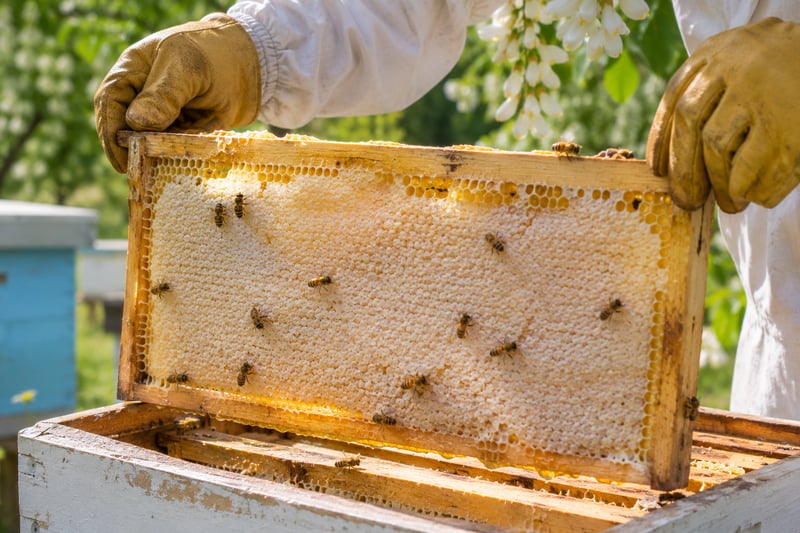
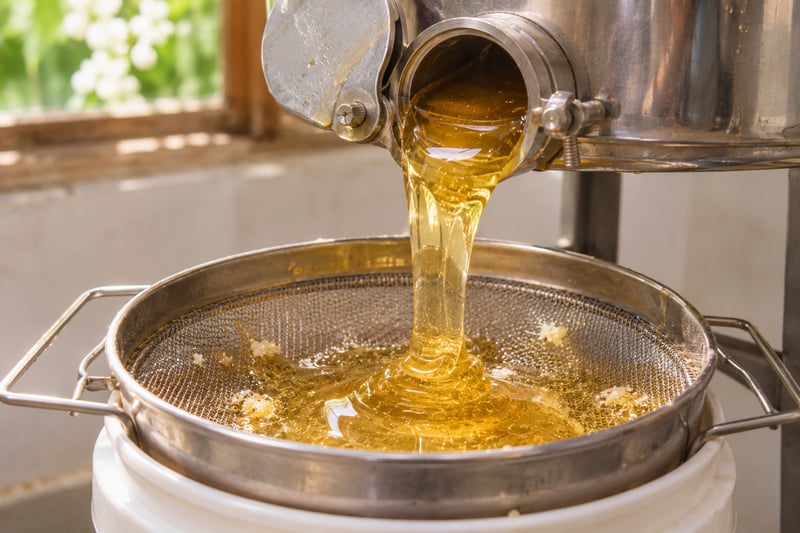
The hives stand in the bloom through April and May. Capped frames are lifted, uncapped with a knife over a tray, and spun in a hand-cranked steel extractor; the honey runs to the tap, passes through a coarse sieve that catches flecks of wax and leaves the pollen and aroma, settles for a few days so the foam rises, and is bottled from the tap. Nothing is heated above the temperature of the hive, nothing is fine-filtered, and nothing is added. The whole run, frame by frame, is on our Kashmiri acacia honey page.
What kikar honey looks and tastes like, and why it stays runny
Pale gold, almost clear in the jar; mild, clean and floral, with a weak scent of the blossom, a medium-to-strong sweetness and no bitterness. Kashmir’s acacia honey measures as extra light amber; the European reference honey from the same tree is water-white. Both are fructose-rich: the European honey averages about 42.7 g of fructose to 26.5 g of glucose per 100 g, against about 40.9 g to 35.7 g in honey generally. Honey sets when its glucose crystallises, so a honey with less glucose stays liquid longer, and acacia honey can stay liquid for three to four years. It is not a sign of heating or syrup. If a jar does set, stand it sealed in warm water for fifteen to twenty minutes; never boil or microwave it.
| Honey | Bloom and season | Colour and taste | Sets? |
|---|---|---|---|
| Kikar (acacia) — ours | Robinia pseudoacacia, Kashmir valley, April–May | Pale gold; mild, floral | Very slowly |
| Saffron honey — ours | The same kikar honey, steeped with Mongra saffron | Deep gold with threads; floral and warm | Very slowly |
| Mustard (sarson) | Brassica fields, spring in the valley and winter in the plains | Pale yellow; quick, plain sweetness | Within weeks |
| Sulai (Ramban, GI-tagged) | Plectranthus rugosus shrub, August–October | White; mild | Fairly quickly |
| Babool (plains kikar) | Vachellia nilotica, monsoon in the plains | Darker; stronger | Varies |
| Multifloral and forest | Mixed wild bloom, spring to autumn | Amber to dark; strong | Varies |
What kikar honey costs
Ours is ₹450 for a 500 g jar, which is a ₹900 a kilo rate; we sell the 500 g jar only, so two jars make a kilo, and the same honey with half a gram of our saffron steeped in it is ₹649 for 500 g. Kashmir press puts the valley’s acacia honey at roughly ₹800–1,200 a kilo, against ₹400–500 for mustard honey brought in from the plains and ₹300–500 for blended table honey on a supermarket shelf. A “Kashmiri acacia honey” at plains-mustard prices is worth a question about which bloom and which place.
How to check kikar honey
No kitchen test proves honey is genuine; the water, thumb and flame tests measure thickness, and kikar honey is naturally runny, so it fails the ones that reward a thick syrup. What you can check is the label and the source: an ingredient line that says honey and nothing else, a named bloom, place and season, an FSSAI number you can look up, and honey that behaves like raw honey in your cupboard. Only a laboratory test on the batch settles the rest; our guide to how to check original honey explains what the laboratory measures and why the home tests mislead.
Kikar honey and health, honestly
Honey is a sugar with a good flavour, not a medicine. By USDA’s typical values it is about 82.1 g of sugars per 100 g, roughly 21 kcal a teaspoon, so a spoon counts as sugar in your diet; if you are managing diabetes or blood sugar, ask your doctor. Raw honey keeps the pollen, enzymes and aroma that heating destroys, which is a difference in quality, not a treatment for anything. Never give honey of any kind to a baby under 12 months. Everything else people say about honey belongs to the seller’s imagination, and we do not say it. The spoon-by-spoon figures are in honey calories; our other honeys and the price per kilo are on the Kashmiri honey page.
Sources
- eFlora of India — Robinia pseudoacacia: Kashmiri name kikur, the valley's most abundant deciduous tree
- Down To Earth, July 2026 — Kashmir's beekeepers: kikar (Robinia) flowers April–May and gives most of the honey
- Nayik & Nanda 2015, Pol. J. Food Nutr. Sci. — Kashmir acacia honey: 54–60% Robinia pollen, extra light amber
- Ganaie et al. 2021, J. Food Sci. Technol. — Robinia honey of South Kashmir
- Persano Oddo & Piro 2004, Apidologie — Robinia (acacia) honey: fructose 42.7 g, glucose 26.5 g per 100 g, slow to crystallise
- Abrol & Sharma 2017, SKUAST-Jammu — bee flora and honey-flow calendar of Jammu and Kashmir
- ICRAF Agroforestree Database — Vachellia (Acacia) nilotica, the babool of the plains: altitude 0–1,340 m
- Rising Kashmir, 2023 — Wasturwan: the range between Pampore, Tral and Awantipora, its forest and meadows
- District Pulwama — Shikargah, at the junction of Wasturwan mountain, 2,130 m
- Wikipedia — Ramban district: the Chenab valley, midway on the Jammu–Srinagar highway
- District Ramban — One District One Product: Sulai honey, acacia and mustard as nectar sources, 477+ beekeepers
- Kashmir Life, March 2025 — honey by district 2023–24: Anantnag, Ramban, Pulwama
- DC-MSME — Brief industrial profile of Ramban district (forest cover, honey cluster)
- Greater Kashmir, April 2025 — J&K honey: 2.27 lakh colonies, 4,819 active beekeepers, top ten in India
- Flowers of India — black locust (Robinia pseudoacacia), "Kashmiri kikar", and its honey
- Mongabay India, July 2024 — Kashmir's beekeepers, honey prices and the winter migration
- USDA FoodData Central 169640 — honey (energy, sugars, water)
- FAO, Krell 1996 — honey composition and why honey crystallises
- FSSAI — Food Products Standards 2.8.3, honey: moisture, fructose/glucose, sucrose, HMF limits
- NHS — foods to avoid giving babies: no honey under 1 year
- British Heart Foundation — is honey good for you: a free sugar, about 21 kcal a teaspoon