
No home test can prove honey is original. The water, thumb, flame and paper tests all measure how thick or how wet a honey is, and the sugar syrups used to fake honey today are made to match it on exactly those points. What settles the question is a laboratory test of the batch against India’s FSSAI honey standard, and for the cleverest syrups, NMR profiling. What you can usefully check yourself is on the label and in the seller’s answers, and both are listed below. At the end we put our own honey through the same questions, including the one we can’t answer yet.
What “original”, “pure”, “natural” and “raw” mean on a label
People search “original honey” to ask one thing: is this really honey, or is it syrup? The words on the jar don’t answer that, but several of them do have legal meanings in India. The FSSAI (Advertising and Claims) Regulations, 2018 set conditions for them in Schedule V:
- “Pure” may only describe a single-ingredient food to which nothing has been added and which is free from avoidable contamination.
- “Natural” may describe a single food with nothing added that has been processed only to make it fit to eat, and the regulation’s own list of allowed processing includes pasteurisation. Heated honey can legally be sold as natural honey.
- “Original” is about a recipe or process whose origin can be traced and which hasn’t changed over time. It is not a purity grade.
- “Genuine”, “real” and “authentic” may be used only if the label also explains why the word is justified.
- “Raw” is not defined, as far as we can find, in either the claims regulations or the FSSAI honey standard.
Every one of these words is the seller’s own declaration. None of them is a test result. A jar that says “100% pure natural honey” has told you what the seller wants you to believe, and nothing you can check. By the regulation’s definition our own jar isn’t “pure honey” either: it has saffron steeped in it, on purpose, which is why we call it saffron honey.
Raw honey vs processed honey
Honey comes out of the comb thick, cloudy with pollen and specks of wax, and in most cases inclined to set. Commercial packing usually changes all three, for reasons that have more to do with the filling line than with the honey:
- Heating. Warm honey pours and filters faster, stays liquid longer on a shop shelf and won’t ferment. Heat also breaks down diastase, an enzyme the bees add, and raises HMF (hydroxymethylfurfural), which forms as honey’s sugars break down with heat and age. India’s honey standard measures both for that reason: HMF may not exceed 80 mg/kg, and diastase must be at least 3 Schade units per gram.
- Fine filtering. Pushing honey through very fine filters takes out wax and debris, and with them most of the pollen. Pollen is the honey’s fingerprint: it is how a laboratory confirms which flowers, and which region, the honey came from. The international Codex standard for honey says pollen may not be removed except where that is unavoidable in taking out foreign matter, and that honey must not be heated or processed so far that its composition changes or its quality suffers. FSSAI’s standard sets a minimum pollen count of 5,000 per gram.
- Blending. Honey from many sources pooled to one colour and one taste, which is how a supermarket brand stays identical from jar to jar.
Raw honey is honey that has skipped the first two: not heated beyond the warmth of the hive, strained only coarsely to take out wax and bits of comb, with its pollen left in.
| Aspect | Raw honey | Processed honey |
|---|---|---|
| Heat | Not above the warmth of the hive | Commonly warmed to pour, filter and delay setting |
| Filtering | Coarse strain; pollen stays in | Fine filtering can strip out most of the pollen |
| Enzymes (diastase) | Not reduced by heat | Reduced by heat |
| In the cupboard | Sets in time (acacia only slowly) | Stays glassy for much longer |
| Traceability | Pollen shows the bloom and region | Little left for a lab to read |
| Sugar and calories | About 82% sugar, 304 kcal per 100 g | The same |
The last row matters. Raw is a difference in handling, aroma and what a laboratory can verify. It is not a difference in nutrition: raw and processed honey are both about 82% sugar by weight, with the same calories spoon for spoon. The figures are in our honey calories table.
Crystallisation is normal
Honey sets because glucose, one of its two main sugars, comes out of solution. Glucose-rich honeys set fast (mustard honey can set within weeks); fructose-rich honeys stay liquid much longer, and acacia can stay pourable for a year or more, which is the one important exception to the rule. Heating and fine filtering delay setting, because they remove the tiny crystals and pollen grains that crystals grow on.
So a raw honey that sets in your cupboard is a good sign, not a fault. It is a sign about handling rather than proof of purity, and on its own it can’t tell you whether syrup went in. To soften a set jar, stand it, closed, in warm water for fifteen to twenty minutes. Never microwave honey.
The home tests, one by one
Each popular kitchen test measures one physical property of honey. Here is what that property is, and why it can’t separate honey from syrup.
| Test | What it actually measures | Why it misleads |
|---|---|---|
| Water test: a spoonful should sink as a lump | Thickness and water content | A syrup boiled down to honey’s thickness sinks the same way; a genuine honey with a little more moisture can spread sooner |
| Thumb test: a drop shouldn’t run | Viscosity, which changes with water content and temperature | Thick syrup stays put; real honey runs on a warm day, and acacia is naturally runny |
| Flame or cotton-wick test: honey should light | Whether there is enough water to stop it burning | Sugar burns whatever its source, so a dry syrup lights; a genuine honey near the 20% moisture limit can sputter |
| Paper test: no wet ring on blotting paper | Free water | Like the flame test, it reads water, not where the sugar came from |
| Ant test: ants avoid real honey | Nothing useful | Ants go for sugar of any kind, honey included |
| Fridge test: real honey sets when cold | The glucose share of the sugars, and how the honey was handled | Acacia can stay liquid for months; heated honey sets slowly; neither result says whether syrup was added |
The deeper problem is that today’s syrups are built to beat tests far stricter than these. In 2020 the Centre for Science and Environment mixed six honeys with syrups bought from suppliers, at a quarter, a half and three-quarters syrup, and every blend but one passed India’s laboratory tests for C3 and C4 sugars. The one that failed was three-quarters syrup. A spoon and a glass of water have no chance against that.
What actually proves honey is original: a lab test against the FSSAI standard
India’s honey standard sits in the Food Safety and Standards (Food Products Standards and Food Additives) Regulations. The version in force today was put into operation by an FSSAI direction of 1 July 2020, with the rice-syrup marker test reinstated in June 2020 and the method for the isotope and oligosaccharide tests approved the same month; we found no later change. A laboratory checks a sample against seventeen numbered parameters. These are the ones that do the work against adulteration:
| Parameter | FSSAI limit | What it catches |
|---|---|---|
| Moisture | 20% max | Watered or unripe honey, which ferments |
| Sucrose | 5% max (most honeys) | Added cane sugar, or bees fed on sugar |
| Total reducing sugars | 65% min (most honeys) | Honey diluted or replaced with something else |
| Fructose-to-glucose ratio | 0.95–1.50 | A sugar profile that doesn’t look like honey |
| HMF | 80 mg/kg max | Heat damage and age |
| Diastase activity | 3 Schade units/g min | Heat damage |
| C4 sugars | 7% max | Syrups from sugarcane and maize |
| Carbon-isotope differences between honey’s sugars and its protein | Set limits, per mil | C3 syrups from rice, beet or wheat, which a C4 test misses |
| Rice-syrup marker (2-AFGP) | Absent | Rice syrup |
| Foreign oligosaccharides | 0.7% max | Syrups made by breaking down starch |
| Pollen count | 5,000 per g min | Ultra-filtered honey, or a product that never saw a flower |
| Proline | 180 mg/kg min | An amino acid used as a marker of ripe, genuine honey |
Limits from the FSSAI honey parameters as tabulated by NIFTEM for the Ministry of Food Processing Industries; dates from FSSAI’s June 2020 newsletter. The “what it catches” column is our plain-English summary.
A report against these parameters, from a named laboratory, for the batch number printed on your jar, is the best evidence a buyer in India can ask for.
Where the standard has been beaten: CSE 2020 and NMR
In December 2020 the Centre for Science and Environment published an investigation of 22 honey samples from 13 brands. Almost all the leading brands passed purity tests at a laboratory in Gujarat. The same samples were then profiled by Nuclear Magnetic Resonance (NMR) at a laboratory in Germany, and 17 of the 22, or 77%, were found adulterated with sugar syrup. Only three of the thirteen brands passed. The full story, including the syrups and the C3/C4 gap, is in our saffron honey guide.
FSSAI replied the next day and disputed parts of it. Its press release said the rice-syrup marker test is mandatory and had not been run on CSE’s spiked samples, that its isotope method is as sensitive as NMR for fruit-origin sugars, and that NMR needs a reference database for Indian honey that does not yet exist. India has required NMR for honey meant for export since 1 August 2020. As far as we can find, it is still not required for honey sold within India.
For a buyer the practical reading is simple. A pass against the FSSAI parameters is good evidence. A pass against those parameters and an NMR screen is the strongest evidence there is.
Five questions to ask before you buy
- What does the ingredient line say? Honey, and nothing else. An infused honey should name what is infused.
- Which bloom, which region, which harvest? A real beekeeping operation knows where the boxes stood and when they came off. Under FSSAI’s labelling rules, a honey labelled monofloral (from one plant) should have at least 45% of its pollen from that plant.
- Raw or heated, and how is it filtered? Heating is common and rarely mentioned on the label.
- Is there a lab report for this batch? Against the FSSAI honey standard, from a named laboratory, with a date and a batch number that matches your jar.
- Has it been NMR tested? If a brand has paid for NMR, it will tell you, and it should show you the report.
The FSSAI licence number on the label is worth checking too: it tells you who is answerable for the jar, though not what is in it.
Our saffron honey, held to the same questions
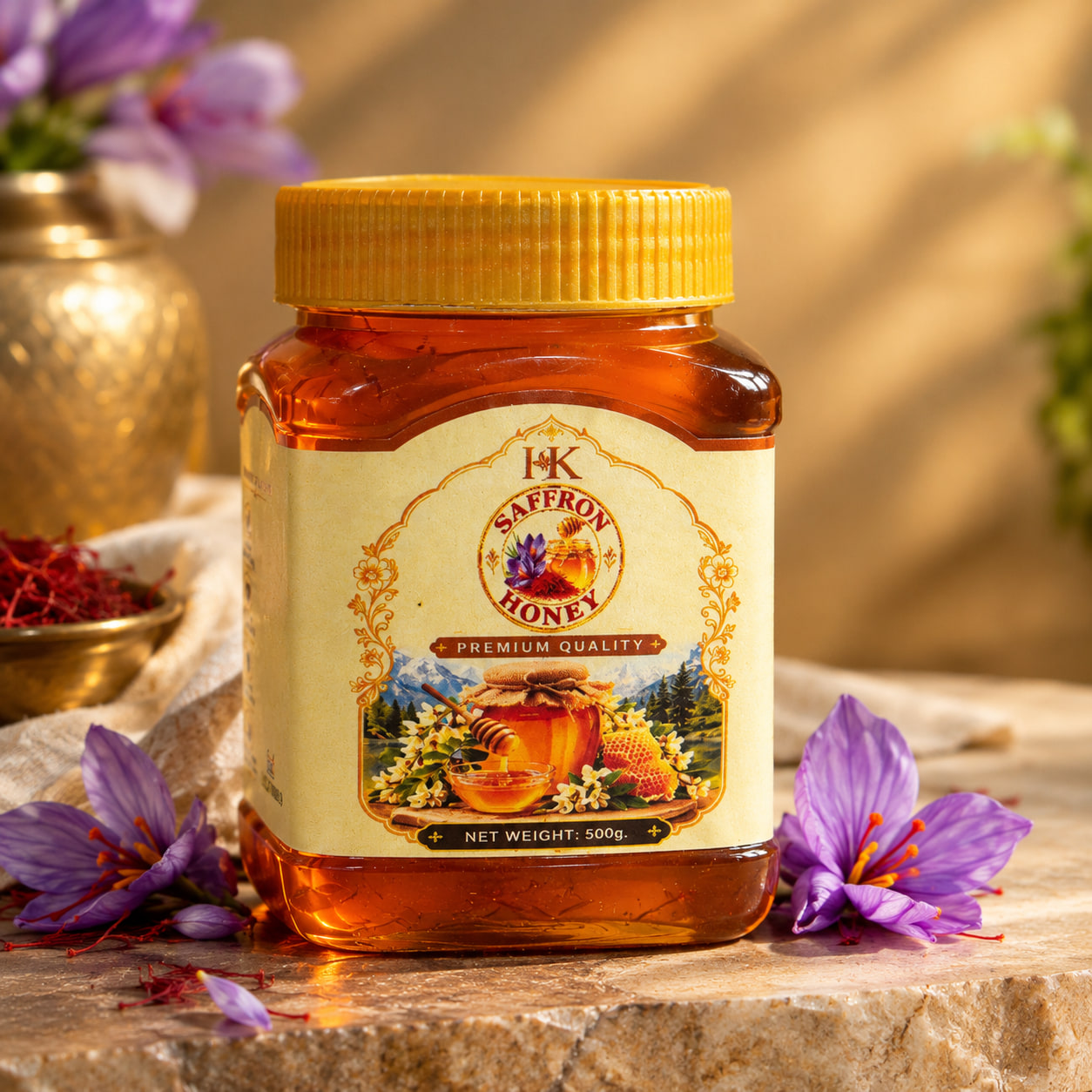
- Ingredients: raw acacia honey and Mongra saffron from our own family fields in Pampore, half a gram in every 500 g jar. Nothing else.
- Bloom and region: the Acacia and Kikar forests of the Kashmir valley, collected by traditional beekeepers. It is wild-collected, so it is acacia-led rather than a laboratory-certified monofloral honey: bees don’t read maps.
- Raw: never heated above hive temperature, and coarse-sieved only. It sets slowly, because acacia is high in fructose.
- Lab report and NMR: we have not commissioned an NMR test on this honey, and no laboratory report for it is published on this site. If we commission one, the report and its reference number will go on the product page, not a summary of it.
What we can offer until then: a named bloom, a named valley, saffron threads you can see in the jar, an FSSAI licence (11022470000019) you can look up, and honey that behaves like raw honey in your cupboard. Our Kashmiri saffron honey is ₹649 for 500 g and ₹1,249 for 1 kg; the other honeys we can supply on request are on our Kashmiri honey page, and asli shahad ki pehchan is covered in Hinglish on our kesar shahad page.
One safety point that applies to every honey: never give honey to a child under 12 months. Honey can carry the spores that cause infant botulism, and the US Centers for Disease Control and Prevention says the same.
Questions about the current batch go to our WhatsApp line at +91 95966 08297.
Sources
- FSSAI (Advertising and Claims) Regulations, 2018, Schedule V, the conditions for “natural”, “pure”, “original” and other words: gazette notification (PDF).
- FSSAI honey parameters under the Food Safety and Standards (Food Products Standards and Food Additives) Amendment Regulations, 2019, as tabulated by NIFTEM for the Ministry of Food Processing Industries: “FSSAI specification of honey” (PDF).
- FSSAI newsletter, June 2020, on the approved method for the isotope and foreign-oligosaccharide tests: newsletter (PDF).
- FSSAI press release, 3 December 2020, “FSSAI reviews the issue raised by CSE regarding adulteration in honey samples”: press release (PDF).
- Centre for Science and Environment, press release, 2 December 2020: food fraud investigation; and Down To Earth on the spiking experiment: “It’s not honey”.
- Codex Alimentarius, Standard for Honey, CXS 12-1981, Rev.2 (2001), clauses 3.1 and 3.2: text reproduced by FAO (PDF).
- US Centers for Disease Control and Prevention, foods to avoid for infants: honey before 12 months.