
A level teaspoon of honey (about 7 g) has about 21 kcal, a level tablespoon (about 21 g) about 64 kcal, and 100 g has 304 kcal. Almost all of it comes from sugar: honey is about 82% sugar by weight. Those are USDA’s figures for honey in general, multiplied out by us, and they apply to any honey, raw or processed, plain or infused, ours included.
The short answer
- 1 teaspoon (7 g): about 21 kcal and 5.7 g sugar
- 1 tablespoon (21 g): about 64 kcal and 17.2 g sugar
- 100 g: 304 kcal and 82.1 g sugar
- Against white sugar: about a fifth fewer calories gram for gram, but more spoon for spoon, because a spoon holds more honey than sugar.
USDA FoodData Central, “Honey” (FDC 169640). Typical values for honey, not a lab test of our batch.
Honey calories by the spoon
USDA FoodData Central lists honey at 304 kcal per 100 g and weighs a level tablespoon at 21 g. It gives no teaspoon for honey, so the teaspoon here is a third of the tablespoon: 7 g. The starting numbers are USDA’s; the multiplication is ours.
| Amount | Weight | Calories (kcal) | Carbohydrate (g) | Sugars (g) |
|---|---|---|---|---|
| 1 teaspoon | 7 g | 21 | 5.8 | 5.7 |
| 1 tablespoon | 21 g | 64 | 17.3 | 17.2 |
| 2 tablespoons | 42 g | 128 | 34.6 | 34.5 |
| 10 g | 10 g | 30 | 8.2 | 8.2 |
| 100 g | 100 g | 304 | 82.4 | 82.1 |
Source: USDA FoodData Central, SR Legacy FDC 169640, “Honey”, with its portion “1 tbsp = 21 g”. Calories rounded to the nearest whole number, grams to one decimal place.
If you have read “about 60 calories a tablespoon” elsewhere, including in our own saffron honey guide, it is the same number rounded down. On USDA’s 21 g level tablespoon it comes to 64.
What “1 spoon” of honey means in a real kitchen
The table assumes level measuring spoons: a 5 ml teaspoon and a 15 ml tablespoon. A steel spoon from the cutlery drawer, or a spoon heaped straight out of the jar, can hold quite a different amount, and honey is heavy for its size, so the difference adds up.
The reliable way is to weigh it once. Put a spoonful of honey on a kitchen scale, note the grams, and multiply by 3: honey has about 3 kcal per gram (3.04, to be exact). A 12 g spoonful is about 36 kcal; a 25 g one about 76.
Does honey contain sugar?
Yes, and it is mostly sugar. USDA lists 82.1 g of sugars in 100 g of honey, chiefly fructose (40.9 g) and glucose (35.8 g), with small amounts of maltose, sucrose and others. Most of the rest is water, about 17 g. Those individual sugar figures come from a small number of samples and vary with the flower the bees worked; the total is the solid number.
The balance of fructose and glucose is also what decides whether a honey sets: glucose-rich honeys crystallise fast, fructose-rich ones such as acacia stay liquid for a long time. It makes no difference to the calories.
Nutritional value of honey, per 100 g and per tablespoon
| Nutrient | Per 100 g | Per tablespoon (21 g) |
|---|---|---|
| Energy | 304 kcal | 64 kcal |
| Water | 17.1 g | 3.6 g |
| Carbohydrate | 82.4 g | 17.3 g |
| Sugars, total | 82.1 g | 17.2 g |
| of which fructose | 40.9 g | 8.6 g |
| of which glucose | 35.8 g | 7.5 g |
| Protein | 0.3 g | 0.06 g |
| Fat | 0 g | 0 g |
| Fibre | 0.2 g | 0.04 g |
| Potassium | 52 mg | 11 mg |
| Calcium | 6 mg | 1.3 mg |
| Iron | 0.42 mg | 0.09 mg |
| Vitamin C | 0.5 mg | 0.1 mg |
Source: USDA FoodData Central, SR Legacy FDC 169640. Per-tablespoon values are our arithmetic.
The minerals and vitamin C are real but they are traces: at the amounts anyone eats, honey is not a meaningful source of any of them. Nutritionally, honey is sugar and water.
Protein in honey
Almost none: 0.3 g per 100 g, or about 0.06 g in a tablespoon. The small amounts of amino acids honey does carry matter for a different reason. Proline, the main one, is one of the parameters laboratories use to check that honey is genuine, which is covered in how to check original honey.
Honey vs sugar
| Measure | Honey | White sugar |
|---|---|---|
| 100 g | 304 kcal, 82.1 g sugars | 387 kcal, 99.8 g sugars |
| Level teaspoon | 7 g: 21 kcal, 5.7 g sugars | 4.2 g: 16 kcal, 4.2 g sugars |
| Level tablespoon | 21 g: 64 kcal, 17.2 g sugars | 12.6 g: 49 kcal, 12.6 g sugars |
Sources: USDA FoodData Central FDC 169640 (honey) and FDC 169655 (“Sugars, granulated”, 1 tsp = 4.2 g). The sugar tablespoon is three of USDA’s teaspoons; the arithmetic is ours.
Two things are true at once. Gram for gram, honey has about a fifth fewer calories than sugar (304 against 387 kcal per 100 g), because 17% of it is water. Spoon for spoon, it has more, because honey is dense and a spoon holds far more of it: about 21 kcal in a teaspoon of honey against about 16 in a teaspoon of sugar.
Is honey better than sugar, then? Not in the way people usually hope. The World Health Organization counts the sugars naturally present in honey as free sugars, the same category as table sugar stirred into tea. What honey offers is flavour: a spoonful of good honey tastes of its flowers, and sugar tastes of nothing but sweet. Whether that means you use less is down to your taste, not the jar.
Is honey good for weight loss?
Honey is not a weight-loss food, and we make no weight-loss claim for it, ours included. The facts are short:
- Honey is about 82% sugar by weight and 304 kcal per 100 g. A tablespoon is about 64 kcal.
- Calories are calories. Warm water adds none and a squeeze of lemon adds very little, so honey in warm water in the morning has exactly the calories of the honey in it.
- Swapping sugar for honey spoon for spoon adds calories rather than saving them: about 5 kcal more per teaspoon.
- The WHO advises keeping free sugars, honey included, below 10% of daily energy, and ideally below 5%, which it puts at about 25 g a day. By our arithmetic, 25 g of sugars is about 30 g of honey: roughly a tablespoon and a half, with no sugar from anything else that day.
If you are managing your weight or your blood sugar, count honey as sugar, and plan around it with your doctor or a dietitian.
Calories in saffron honey
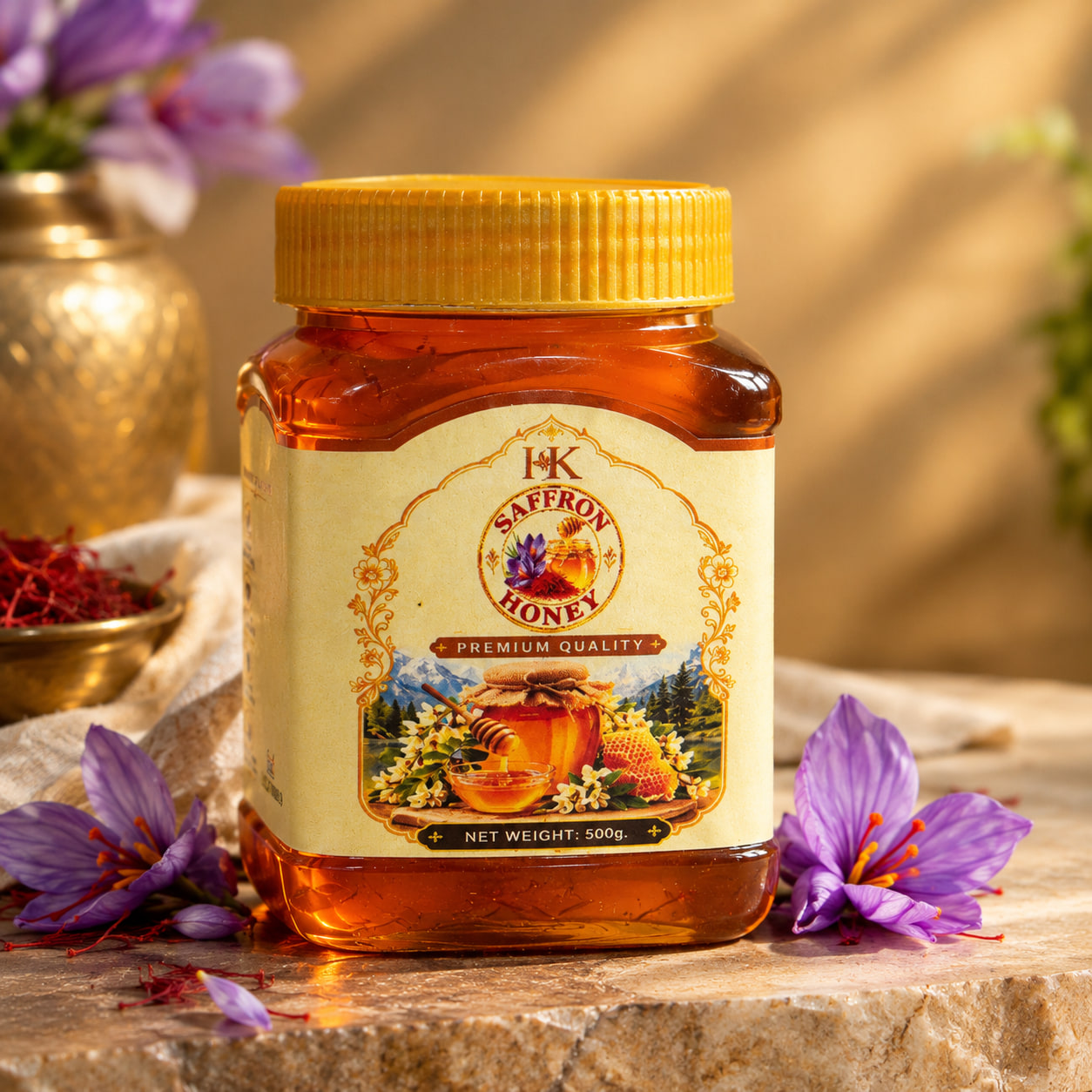
The same as plain honey, for practical purposes. Our Kashmiri saffron honey carries half a gram of Mongra saffron in every 500 g jar, which is 0.1% of its weight: about 0.02 g of saffron in a tablespoon. Even at 9 kcal a gram, the most any food can carry, that adds less than a fifth of a calorie. So a teaspoon of saffron honey is about 21 kcal and a tablespoon about 64, like any honey.
The jar is raw acacia honey from the Kashmir valley with the saffron steeped in it, nothing else added, at ₹649 for 500 g and ₹1,249 for 1 kg. The numbers on this page are USDA’s typical values for honey, not a laboratory analysis of our batch, which we have not had done. How the infusion works is in our saffron honey guide, and the other honeys we can supply are on our Kashmiri honey page.
Does warming or crystallisation change the calories?
No to both. Heat doesn’t change how much sugar is in honey, though very hot water dulls its aroma, so stir it into warm drinks, not boiling ones. Crystallised honey is the same honey with some of its glucose in solid form: the calories per gram are identical. A spoon of set honey can weigh a little differently from a spoon of runny honey, which is one more reason to weigh it if you are counting closely.
Who should be careful
- Babies under 12 months: no honey at all. Honey can carry the spores that cause infant botulism, and the US Centers for Disease Control and Prevention advises against giving it, in food, drinks or on a dummy, before 12 months. This applies to every honey, raw or processed.
- People with diabetes: honey counts as sugar. Its flower, colour or price doesn’t change that; follow your doctor’s advice on how much fits.
Questions about our honey go to our WhatsApp line at +91 95966 08297.
Sources
- USDA FoodData Central, SR Legacy FDC 169640, “Honey” (published 1 April 2019): nutrients and portions.
- USDA FoodData Central, SR Legacy FDC 169655, “Sugars, granulated” (published 1 April 2019): nutrients and portions.
- World Health Organization, guideline on sugars intake for adults and children (2015), free sugars and the 10% and 5% limits: WHO news release.
- US Centers for Disease Control and Prevention, foods to avoid for infants: honey before 12 months.