Our guide to the GI tag explains what the Geographical Indication protects. This page is about the other half of the question, the one buyers ask us on WhatsApp: how does a jar actually get the tag? The short answer is that it goes to Dussu. The long answer is below.
The centre at Dussu
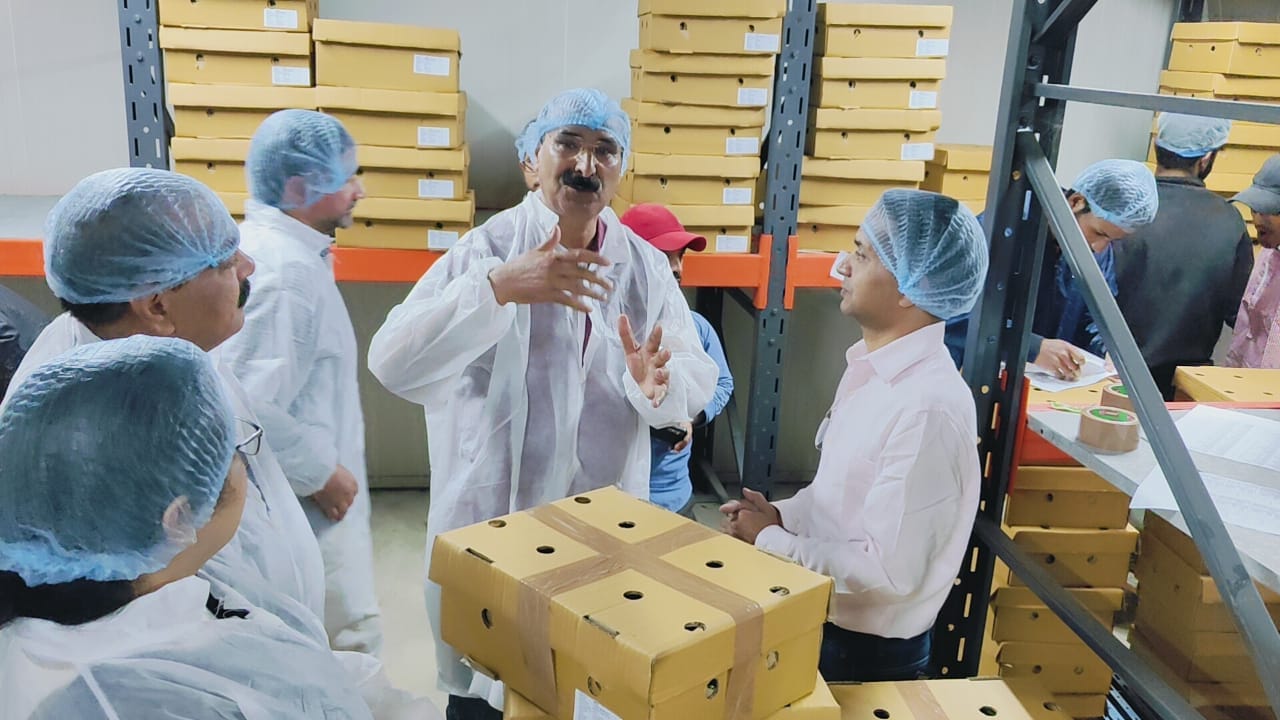
The India International Kashmir Saffron Trading Centre — IIKSTC — sits at Dussu, on the Pampore karewa, a few minutes from our fields. It was built under the National Saffron Mission and is run by the Department of Agriculture, Kashmir. The point of putting everything on one campus was to give a grower one place to take a lot and come out with something a buyer anywhere in India could trust: a lot code, a laboratory grade, a government label and, if the grower wants it, a sale through an e-auction rather than a middleman.
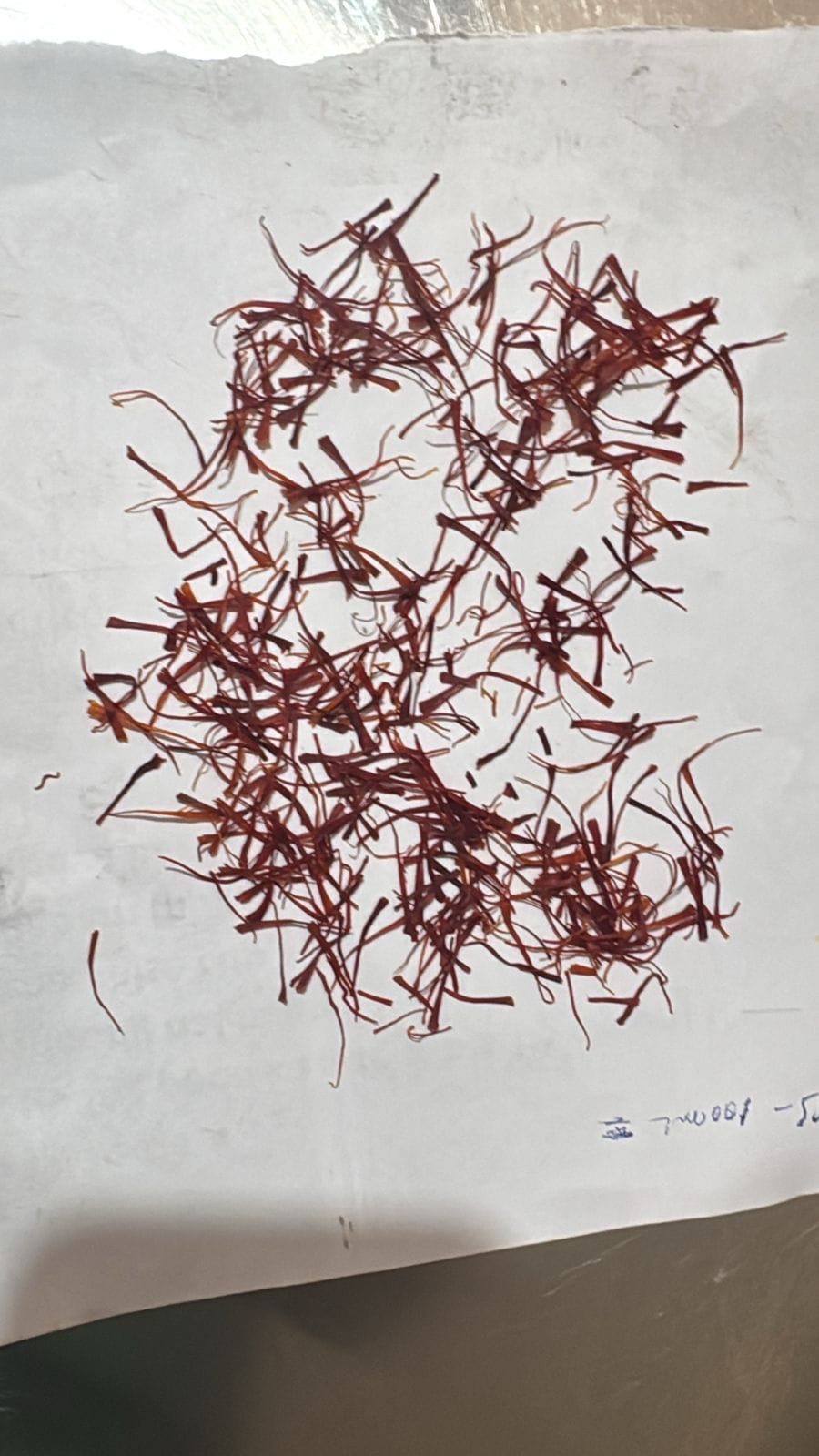
The laboratory there is the one that tests our saffron. Its report on our lot L20020644 — Grade I under ISO 3632-1:2011, test methods ISO 3632-2:2010, product type recorded as GI-Saffron — is typed out in full on our lab reports page.
The six steps
- The grower brings the dried saffron to the collection counter at IIKSTC, Dussu, where it is weighed and given a lot code.
- A coded sample goes to the Quality Evaluation Laboratory on the same campus — NABL-accredited to ISO/IEC 17025 — and is tested under ISO 3632 for colouring strength (crocin), flavour (picrocrocin), aroma (safranal), moisture and impurities.
- The laboratory assigns the grade: Category I, II or III.
- The certified lot is packed on the campus in sealed glass with the IIKSTC Kashmir Saffron GI label and its code, under the Department of Agriculture, Kashmir.
- The lot can be sold through the centre's e-auction, or taken back by the grower to sell as GI-tagged saffron.
- The code on the pack ties the jar to its lot, its grower and its laboratory grade.
What each step leaves on the jar
The lot code is the thread that runs through all six. It is written at the collection counter, printed on the laboratory report, and carried on the label of every jar packed from that lot. So a GI-tagged jar is not simply “saffron from Kashmir”: it is a specific lot, from a specific grower, with a specific grade, and the code lets anyone ask the centre to confirm all three. The label names the Department of Agriculture, Kashmir, and the centre, and the jar is sealed on the campus.
That is why we use the phrase so carefully on this site. Everything we grow is inside the GI area, and our long-thread and Short Thread jars are tested at the same laboratory. But we call a jar GI-tagged only when it has been through these steps and carries the label and the code, and we say the other jars are not. A badge a buyer cannot check is worth very little; a code they can check is worth the premium.
The e-auction, and why the Prime Minister mentioned it
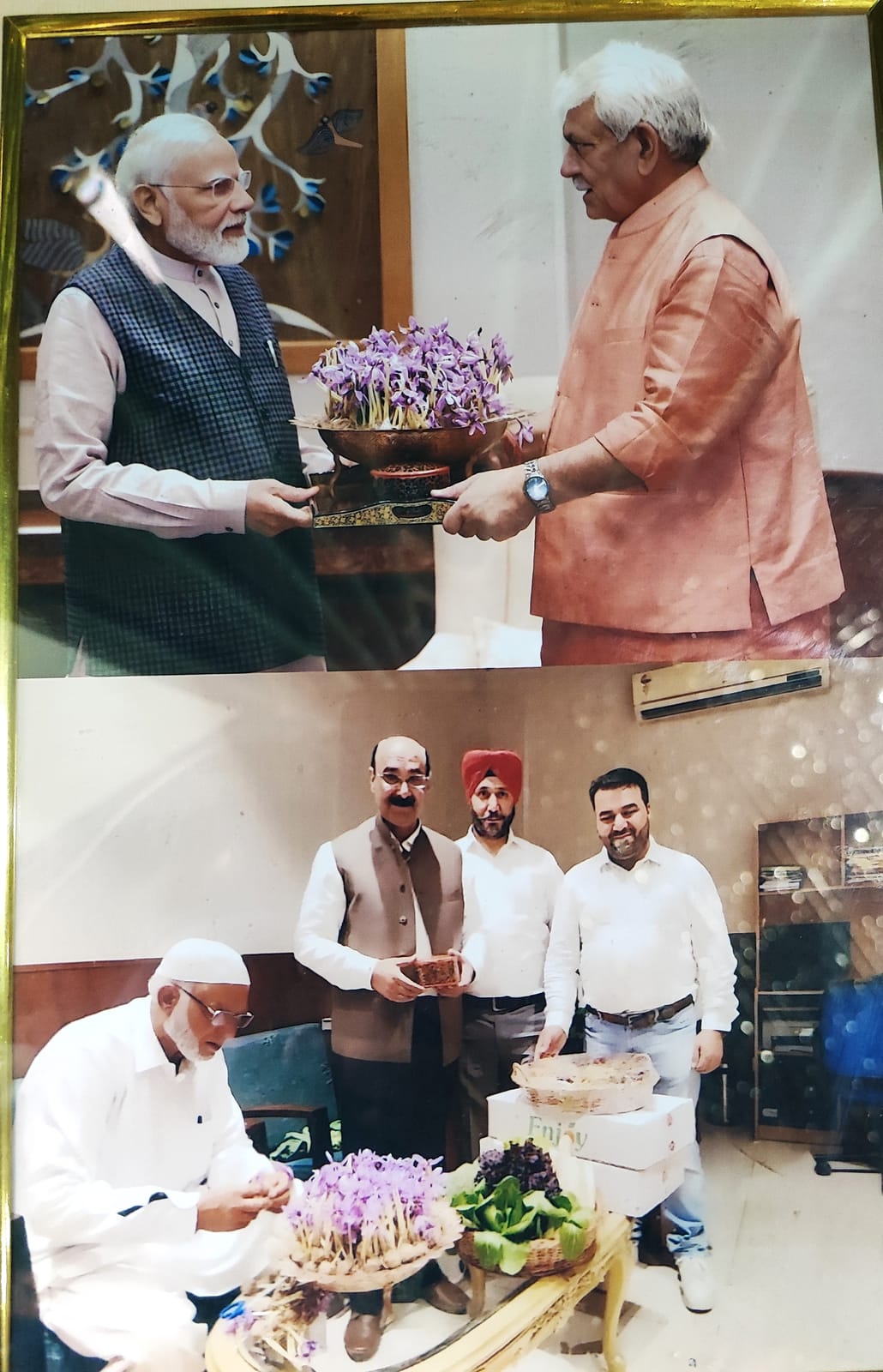
The last step is optional for the grower, and it is the one that made the news. Graded, labelled lots can be sold through the centre’s e-auction, which opened in 2020 and lets buyers across India bid on saffron that has already been tested and certified. On Mann Ki Baat on 27 December 2020 the Prime Minister named our chairman, Abdul Majeed Wani, for doing exactly that — selling GI-tagged saffron through e-trading at the Pampore trading centre. His words, and the source, are on our recognition page; the text is published by the Press Information Bureau at PRID 1683956.
The registration behind the label
| Geographical Indication | Kashmir Saffron, application 635 |
| Registered | 1 May 2020 (certificate 366); valid until 2 December 2028 |
| Proprietor | Director Agriculture, Kashmir (Lalmandi, Srinagar) |
| Types named | Lachha, Mongra, Guchhi |
| Area | Pulwama (Pampore), Budgam, Srinagar, Kishtwar districts |
| Record | GI Registry, Government of India |
How to check a GI-tagged jar
- Look for the red IIKSTC "Kashmir Saffron" label on the jar and the matching hang tag: "Certified & Packed by: India International Kashmir Saffron Trading Center, Dussu Pampore" and "Department of Agriculture Kashmir (Govt. of J&K)".
- Turn the tag over: it prints "GI No. 635", "Grade: GI" and the centre's FSSAI licence number, 11022470000024. GI No. 635 is the Kashmir Saffron registration; you can look it up on the GI Registry.
- Ask who grew it and where. A GI-tagged lot can always be traced to a grower inside the GI area, and the seller should be able to show the lot's laboratory grade.
- Run the warm-water test: real saffron releases a golden colour slowly over 10–15 minutes and the threads stay whole.
Our lot
The harvest comes in across late October and early November. Our lot goes to Dussu after that, and the GI-labelled jars are back with us to leave Pampore from 1 December 2026. Until then the jar is on pre-order at ₹800 a gram as GI Tag Saffron; you pay now, cancel any time before dispatch for a full refund, and the jar sells at its regular price once the lot is on the shelf. If you want the same saffron now, without the label, it is in our Kashmiri Mongra Saffron and Short Thread jars, from the same fields.